
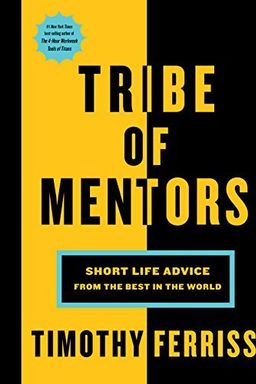
Tribe of Mentors cover

Tribe of Mentors

by Timothy Ferriss

Tribe of Mentors by Tim Ferriss is a treasure trove of life advice from the world''s leading professionals. Through insightful interviews, discover strategies, daily habits, and the books that shape their success. Whether you''re seeking inspiration or practical tips, this book offers a pathway to achieving your own potential.

Turning Wisdom into a Playbook for Growth

How do you make better decisions, perform at a high level, and stay sane in a world of overload? In Tribe of Mentors, Tim Ferriss turns forty and asks one elegant question: “What would this look like if it were easy?” That inquiry sparks a massive experiment—he asks dozens of exceptional performers eleven short questions and curates their answers into actionable wisdom. The result isn’t a collection of quotes; it’s a design for how to learn faster from others’ experience and build a life that compounds clarity, energy, and impact.

Ferriss’s project began as a method rather than a book. He refined his podcast interviewing practice, created a low-friction ask for participants, and collected vivid, tactical insights. This book demonstrates how to transform complexity into leverage—by building systems for learning, boundaries for focus, and rituals for restoration. You can read it as a manual for living intelligently under uncertainty.

The architecture of learning

Ferriss’s first insight is structural: questions determine answers. He discovered that the quality and order of a question shape the depth and usefulness of the replies. Instead of asking abstract “favorites,” he used specific triggers—“What book have you gifted most?” or “What purchase of $100 or less improved your life?” These invite story, not opinion. He sequenced easy queries before heavy ones, mirroring good teaching design. The mentors’ responses reveal that good inquiry beats good speeches as a path to understanding.

Themes that emerge from the tribe

Across hundreds of pages, patterns appear. Failure recurs as a diagnostic, not a death sentence. Almost every mentor reframes setbacks as raw data for reinvention—Samin Nosrat’s closed restaurant led to her bestselling cookbook; Steven Pressfield’s cab-driving years refined his storytelling craft. Attention appears as currency: Debbie Millman’s “Busy is a decision” captures the ethos that saying no is ultimately how you protect time for what matters. Rituals and health threads remind readers that peak output comes from recovery, not just hustle—eight hours of sleep, meditation, and movement are universal prescriptions here.

Decision and mindset models

Ferriss’s mentors don’t just tell stories; they teach cognitive frameworks. Naval Ravikant’s mention of memento mori and “want vs. desire” refocuses what you chase; Mike Maples Jr. uses the Five Whys to diagnose failure without blame; Tim Urban’s Epitaph Test compresses decision-making into one moral filter—ask whether you’d want this choice on your gravestone. These models simplify complexity under pressure, guiding you back to first principles rather than noise.

Controlling input, mastering output

When Ferriss asks what successful people do differently, the consistent answer is: they say no a lot. Jason Fried declines most commitments beyond a week. Danny Meyer politely refuses when his calendar is full. Neal Stephenson instituted a blanket “no new projects” rule when overwhelmed. These examples prove that the act of refusal isn’t selfish—it’s protection for deep work and sustained creativity. Saying no builds architecture for your best attention.

From information to wisdom

Ferriss also warns of the information–confidence trap: people assume more data equals smarter decisions, yet experiments show it often only boosts confidence, not accuracy. Mentors like Tim O’Reilly and Ray Dalio counter this with simplicity—test small, track outcomes, limit inputs. Real learning begins when you measure results, not when you justify stories. The antidote to “analysis paralysis” is practical experimentation.

Building resilience and humility

Finally, Ferriss’s tribe reminds you that endurance and compassion drive long-term excellence. Fear is treated as signal, not enemy—Kristen Ulmer teaches feeling it directly, while Stephanie McMahon reframes daily challenges as training. Give more than you capture, Tim O’Reilly insists, because value creation compounds over time. The book closes by arguing that true mastery isn’t speed or success—it’s composure, curiosity, and generosity practiced over years.

Core takeaway

Ferriss’s experiment turns mentorship into a system of questions. Ask wisely, test quickly, rest deliberately, say no often, and give value freely. Those five laws describe not just how high performers operate—but how you can build a life that scales clarity and meaning.

(Note: The book’s hidden architecture resembles Tools of Titans but focuses more on timeless thinking and midlife recalibration. It’s part philosophical field manual, part decision design lab—for anyone building a well-lived life through better questions and boundaries.)


Ask Better Questions

Tim Ferriss learned that the way you phrase a question defines the quality of the answer. Good questions are specific, grounded in memory, and sequenced intelligently. In Tribe of Mentors, he refined years of podcast interviews into eleven questions designed to elicit both tactical wisdom and philosophical insight.

Crafting questions that invite action

Abstract queries like “What’s your favorite book?” produce vague responses. Instead, Ferriss asks “Which book have you gifted most?”—forcing concrete recall and revealing values in action. The difference lies in cognitive load: recollection beats speculation. Examples shared include Samin Nosrat’s favorite under-$100 tool and Naval Ravikant’s most-gifted texts. Each reply transforms into immediate experiments readers can apply.

Sequencing for depth

Ferriss arranges questions from light to heavy—starting with tangible prompts (books, purchases) before invoking reflection (billboards, life philosophy). This sequencing builds psychological momentum. When designing your own survey or mentor outreach, apply the same method: warm up respondents before metaphysics. (In design thinking terms, this echoes IDEO’s empathy prototype approach: collect frictionless first data.)

Templates and modeling

He also provides sample answers. Showing Amelia Boone’s example of a race entry creates a behavioral model others mimic. Clarity comes from scaffolding: the easier you make it to respond, the richer the answer. You can use this principle for mentoring, research interviews, or reflection journaling.

Ferriss’s maxim

“A problem well put is half-solved.” Designing better questions is a leverage skill—you shorten the path from confusion to action without needing more data.

Next time you ask advice or run a meeting, use Ferriss’s playbook: start concrete, offer an example, and sequence toward principle. Better questions unlock faster learning and deeper relationships.


Failure as Engine of Reinvention

Failure appears constantly throughout the mentors’ stories—and always as catalyst, not condemnation. Ferriss collects hundreds of examples where what looked like collapse became leverage. The lesson: when you face a setback, mine the feedback before discarding the experience.

Patterns of productive failure

Temple Grandin’s equipment disaster taught her to diagnose root causes, not patch symptoms. Mathew Fraser’s repeated second-place CrossFit finishes pushed him into deeper preparation until victory was inevitable. Samin Nosrat’s lost restaurant birthed her signature cookbook; Susan Cain’s rejection in law illuminated her path to writing. In each case, the failure revealed missing structures or better fits.

The three-step reframe

  • Diagnose precisely—name the moment and mechanism of the failure.
  • Extract the underlying principle—what systemic truth or skill gap did it expose?
  • Iterate quickly—design the next experiment that applies that insight.

Mindset pivot

Marc Benioff articulates it best: “I stew on failures until I pick out a nugget I can take forward.” This reflective pause converts emotion into pattern-recognition. Josh Waitzkin adds the martial artist’s spin: training with setbacks primes adaptability.

A practical heuristic

When something breaks, ask: “What data did this give me that success would hide?” This transforms loss into a discovery engine.

Failure is unavoidable—but you can decide whether it’s random pain or intentional progress. The profiles here prove that treating failure as fuel is the core habit of sustained achievers.


Boundaries and Attention

You cannot outperform constant interruption. Across Ferriss’s tribe, control of attention outperforms raw effort. Saying no becomes the foundational skill for all mentors—from Neal Stephenson’s blanket refusal policy to Jason Fried’s one-week commitment rule.

Guarding time through rules

Instead of relying on momentary willpower, successful people design policies that make focus automatic. Esther Dyson uses the "Tuesday Test"—if she'd say no if it were tomorrow, she says no today. Danny Meyer scripts polite declines; Tim Urban uses the Epitaph and Deathbed Tests to confirm whether a project aligns with long-term meaning. Structure beats motivation.

  • Create a small, sacred yes-list; let everything else default to no.
  • Adopt calendar architecture—block core hours, protect recovery time, and automate refusal.
  • Delegate boundaries—assistants or systems act as gatekeepers.

A principle worth repeating

“Busy is a decision.” Every yes implies hidden nos. Protecting attention isn’t selfish—it’s alignment with your main work.

Practicing boundaries transforms chaos into clarity. Each mentor reframes “no” as design. If your calendar decides for you, excellence decays; if you decide for your calendar, progress compounds.


Rituals and Physical Foundation

High performance depends on maintenance. Ferriss’s mentors repeatedly prove that health, ritual, and recovery sustain cognition and creativity. The exceptional don’t rely on superhuman endurance; they rely on systems of restoration.

Sleep and recovery

Samin Nosrat guards nine hours of sleep; Arianna Huffington built a “phone bed” for devices to restore rest. Ed Coan’s discovery of sleep apnea altered performance dramatically. The data is consistent—sleep fuels judgment, not laziness.

Movement and ritual

Physical discipline appears universally. Jocko Willink’s garage gym, Katrín Davíðsdóttir’s coach-driven CrossFit comeback, and Tim McGraw’s bar complexes illustrate that strength routines sharpen emotional resilience. Rituals reduce friction: meditation for focus (Patton Oswalt, David Lynch), journaling for feedback (Jim Loehr), micro-anchors for composure (Jerzy Gregorek’s bracelet).

  • Sleep eight hours as base infrastructure.
  • Mix strength, aerobic, and mobility work weekly.
  • Integrate short mindfulness practices or journaling with physical routine.

Ferriss’s insight

Your nervous system drives your mind. Change physiology to change clarity. A body-first reset outperforms overthinking.

Treat health as compound interest. Sleep, movement, and ritual form durable leverage—the difference between burnout and mastery.


Decision Models and Mental Leverage

Decision quality defines life quality. Ferriss and his mentors rely on compact mental models to simplify uncertainty. These frameworks aren’t rigid formulas—they’re filters for clarity.

Tools for better judgment

  • The Five Whys (Mike Maples Jr.): uncover systemic causes rather than blaming individuals.
  • Epitaph and Deathbed Tests (Tim Urban): evaluate choices against lifelong values.
  • First principles (Elon Musk’s model via Tim Urban): strip problems to fundamentals to innovate authentically.
  • Memento Mori (Naval Ravikant): remembering death clarifies priority and dissolves vanity goals.

Practical architecture

The best mentors combine these heuristics when facing change. Run hard choices through three filters: long-term alignment (Epitaph Test), information sufficiency (Five Whys), and elemental truth (First Principles). If doubt remains, use Andrew Ross Sorkin’s rule—ask, “Would it help?” If not, move on.

Core principle

Simple mental models outperform complex data systems because they constrain bias and force clarity of cause.

Decision architecture converts chaos into discipline. With a few concise models, you build reasoning habits that protect you from information overload and emotional turbulence.


Generosity and Compound Value

Across Ferriss’s conversations, one moral appears again: create more value than you capture. This isn’t virtue signaling—it’s strategic advantage. Tim O’Reilly, Kevin Kelly, and Jason Fried show that generosity fuels ecosystems that later return multiplied benefits.

Giving as leverage

Chris Anderson gave away TED content and licenses, birthing an international movement. Fried’s anonymous coffee purchases or O’Reilly’s open-source advocacy demonstrate that micro-gifts compound into trust networks. Linda Rottenberg’s delegation of leadership at Endeavor unlocked scale by letting others lead. This is generosity in design, not charity.

Letting go to gain control

Mentors repeatedly choose release over control. Releasing rigid ownership creates social capital and influence. In business, as in creativity, the paradox is consistent: relinquish short-term capture to earn long-term alignment.

Tim O’Reilly’s warning

“Companies that extract more value than they create eventually hollow out the systems they depend on.” Generosity sustains ecosystems; extraction destroys them.

Practice giving without expectation: share ideas, mentor without demand, or pay forward time. You’ll discover that generosity isn’t loss—it’s network compounding in disguise.

Dig Deeper

Get personalized prompts to apply these lessons to your life and deepen your understanding.

Go Deeper

Get the Full Experience

Download Insight Books for AI-powered reflections, quizzes, and more.