
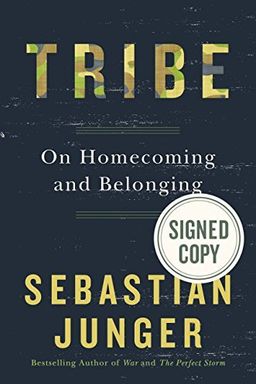
Tribe cover

Tribe

by Sebastian Junger

Sebastian Junger''s ''Tribe: On Homecoming and Belonging'' delves into the paradox of finding belonging in chaos. Through historical and psychological lenses, Junger examines why humans bond deeply in crises and how modern society can learn from tribal values to foster stronger communities.

Belonging in a Fragmented World

How do you find belonging in a society that rarely asks you to sacrifice for others? Sebastian Junger’s Tribe begins with an encounter on a Wyoming highway—a homeless man giving away his lunch to a stranger—and expands this moment into a profound argument about humanity’s hunger for connection and shared purpose. Junger contends that modern civilization, with its emphasis on individualism and comfort, has quietly stripped people of the tribal belonging that humans evolved to crave. As a result, we suffer what he calls “the pathology of disconnection.”

For Junger, the word “tribe” isn’t just about ancient societies—it’s about the bonds of mutual care that make people feel valuable and necessary. Modern life minimizes danger, hardship, and interdependence, but those very experiences are what once gave humans meaning. His core claim is that humans are wired to find fulfillment through belonging and service to others. When those instincts have no outlet—because comfort replaces cooperation—mental distress and alienation become pervasive.

The Paradox of Modern Comfort

Modern society looks like paradise from the outside: safety, technology, abundance, and leisure. Yet Junger shows how comfort has made people lonely, depressed, and psychologically fragile. In tribal societies, identity is defined by communal survival; every hunter, mother, and elder has value. But in affluent nations, people can go through entire lives without doing anything personally essential for others. This radical independence, Junger argues, breeds anxiety and meaninglessness—a paradox seen in modern rates of loneliness, suicide, and depression even as material security rises (echoing similar arguments by Viktor Frankl and Jonathan Haidt about meaning and social cohesion).

War, Disaster, and Reconnection

One of Junger’s most haunting observations is that people often miss war or disaster—not because of destruction but because these crises temporarily restore community. During the Siege of Sarajevo or the London Blitz, social distinctions vanished, and civilians cooperated selflessly to survive. Psychiatric hospital admissions dropped, suicide rates fell, and people reported feeling more alive and purposeful. Soldiers returning from combat often mourned the loss of these bonds, saying they missed the war—not the violence, but the brotherhood. This yearning reveals how profoundly people crave shared struggle and unity.

The Evolutionary Roots of Tribe

Junger draws deeply on anthropology to show that the tribal model—egalitarian, cooperative, decisive—matches our evolutionary design. Humans evolved in groups of roughly fifty individuals who shared food, protected one another, and punished selfishness. The moral instincts forged in that crucible still shape us today: fairness, empathy, reciprocity, and courage. The problem is that modern institutions reward self-interest and isolation, while our biology demands connection. Disasters and war briefly bring our ancestral wiring back to life, revealing how the human psyche thrives when belonging replaces competition.

A Call for Modern Tribalism

Ultimately, Junger’s book isn’t nostalgic—it’s prophetic. He asks what it would mean to reintroduce tribal values into modern life: mutual responsibility, equality, and shared hardship. Whether through community-centered living, genuine civic service, or rituals of collective healing (especially for veterans), the goal is the same—to restore the emotional ecology of belonging. In today’s fractured society, Junger’s message lands as both warning and invitation: our comforts are killing our connection. By recovering what it means to be part of a tribe, you can rediscover the dignity of being needed and useful.


War and the Human Condition

Junger’s chapters on war and trauma—especially “War Makes You an Animal” and “In Bitter Safety I Awake”—argue that combat strips humans down to their most primal selves and reveals truths that peace hides. War forces cooperation, loyalty, and equality in ways civilization rarely does. Soldiers who fight together experience not only fear and horror but also a deep sense of belonging, and many later admit that they miss those feelings once civilian life resumes.

Combat as a Tribal Experience

In war, individual identity dissolves into group survival. Junger recounts life with American troops in Afghanistan, where ten men slept shoulder to shoulder in a hut, often closer and more attuned to one another than family members back home. They depended absolutely on each other. This intimacy, forged under fire, mimics the communal unity of ancient tribes. Siegfried Sassoon’s poem “Sick Leave” captures it: soldiers awaken “in bitter safety,” alienated from civilian comfort yet haunted by missing their battalion in the mud.

PTSD and the Disconnection of Modern Society

Junger reframes post-traumatic stress not just as an individual disorder but as a social problem. Soldiers returning home often find themselves alienated—not merely traumatized by war, but disconnected from society. Many experience depression, rage, and longing for lost community. A veteran may recover from trauma on the battlefield but deteriorate in isolation back home. Anthropologist Brandon Kohrt’s research in Nepal supports this: soldiers reintegrating into cohesive villages recover faster than those returning to fragmented communities. In tribal societies, trauma is collective, not individual, and healing happens together.

Aggression, Grief, and the Biology of Healing

Human biology evolved to use grief, vigilance, and anger as survival tools. Short-term PTSD is adaptive—it trains the brain to avoid danger—but prolonged symptoms become maladaptive. Junger draws on Dr. Rachel Yehuda’s research at Mount Sinai Hospital showing that combat veterans’ trauma is intertwined with their most meaningful experiences: courage, freedom, and shared hardship. Paradoxically, many wish to retain aspects of war because it represents the only time they felt fully alive and embedded in something greater than themselves. Healing, therefore, isn’t merely about forgetting fear—it’s about reconnecting to community in peacetime.


Disasters and the Return to Community

One of the book’s most powerful ideas is that catastrophe—whether war, earthquake, or terror—often heals rather than harms social bonds. In these moments, class distinctions vanish, empathy surges, and people rediscover a deep sense of interdependence. Junger builds on sociologist Charles Fritz’s pioneering studies of disaster psychology to show that crisis can restore the “community of sufferers” humans evolved to inhabit.

The Blitz: Unity Through Chaos

During the London Blitz, thousands huddled in subway tunnels under nightly bombardment. Government officials had feared mass panic; instead, the opposite occurred. Civilians displayed courage, cooperation, and even humor. Psychiatric admissions plummeted, suicide rates fell, and behavior became self-regulating. Rich and poor shared food and space—an impromptu social leveling that embodied equality under duress. People were tired and terrified but also profoundly connected, rediscovering the meaning of collective life. Similar effects appeared in Dresden and Belfast: violence brought solidarity, not chaos.

The Sociology of the “Brotherhood of Pain”

Anthropologist Anthony Oliver-Smith documented how survivors of a catastrophic earthquake in Yungay, Chile, instantly organized into egalitarian communities, pooling resources and ignoring prior hierarchies. Disaster erased property and privilege, replacing them with shared identity. Once aid arrived and hierarchical normality returned, that solidarity dissolved. Junger interprets this to mean that disaster temporarily restores our ancestral social order—a state of equality, purpose, and belonging that industrial life lost.

Psychological Effects of Shared Struggle

Experiencing collective hardship relieves loneliness. According to Fritz and others, disasters create mental health improvements because they replace isolation with contribution. People feel useful again. Junger contrasts this with modern alienation, where crises are outsourced to professional responders and civilians rarely act for one another. The lesson is clear: genuine engagement in shared difficulties—even frightening ones—feeds the human need for connection far more than comfort ever will.


The Appeal of Tribal Life

Why did so many settlers in early America abandon their own civilization to live among Native tribes? Junger revisits accounts of frontier captivity to reveal a truth that unnerved colonial authorities: Indian life was simple, communal, and free—and deeply attractive to people raised in rigid hierarchies. Benjamin Franklin and Hector de Crèvecœur both observed that captives often refused repatriation and fled back to their tribes, while Indians almost never chose European civilization.

Equality and Freedom

Tribal societies were communal and egalitarian. Leadership was consensual, property limited, and social status earned through courage or skill rather than birthright. Women had autonomy, men had purpose, and life was shared. In contrast, colonial society demanded obedience, hierarchy, and repression. A captured woman said, “Here I have no master... I am the equal of all the women in the tribe.” For restless settlers, the freedom and intimacy of tribal living overwhelmed the comforts of civilization. Even adopted children and adults felt emotionally bound by loyalty stronger than any legal or religious contract.

The Cost of Civilization

Junger contrasts the violence and cruelty of both worlds—European torture and Indian warfare—but argues that psychological well-being correlated more with equality than with peace. Tribal members, despite danger, suffered almost no depression-based suicide and displayed constant community awareness. In modern societies, affluence fosters isolation: citizens work alone, sleep alone, and live apart from extended networks. Studies show that rural or poor communities—where cooperation remains necessary—report greater happiness than rich urban ones. For Junger, the attraction of the tribe isn’t romantic nostalgia; it’s evolutionary realism.

The Modern Mirror

The lesson from the colonial frontier mirrors today’s yearning for connection in times of crisis. Soldiers, volunteers, and even survivors of epidemics feel temporarily restored to an authentic form of life: one where their actions matter to the group. The question Junger poses is unsettling—why do people in safe, rich societies miss hardship? His answer: because our biology is tribal, not individual. Civilization changed our surroundings faster than evolution could adapt our souls.


The Psychology of Belonging

Beyond social history, Junger explores the psychology underpinning why humans crave community. Using neuroscience and anthropology, he argues that cooperation triggers chemical rewards—dopamine and oxytocin—that reinforce altruism and trust. These mechanisms make generosity feel good and selfishness painful. Our biology is literally wired for tribe.

Cooperation and Survival

Anthropologist Christopher Boehm’s research, which Junger cites, shows that early foragers punished greed and rewarded sharing because group cohesion meant survival. Those who grabbed extra meat risked execution or exile. Over millennia, moral behavior evolved from this social pressure. Modern cheating—fraud, corruption, exploitation—represents the same betrayal of group trust that primitive tribes treated as deadly. Junger connects this to modern economic disparity: CEOs claiming 300 times worker wages are modern versions of hunters hoarding meat, endangering the group for personal gain.

Moral Origins and Modern Collapse

Junger concludes that much of contemporary dysfunction—fraud, inequality, loneliness—stems from forgotten moral instincts. Tribal societies ensure accountability through proximity; modern anonymity allows moral decay. When neighbors no longer depend on one another, empathy withers. This isn’t a call for regression to prehistory, but for reintroducing proximity and mutual obligation into modern life—through civic engagement, shared labor, and ethical equality.

The Pleasure of Shared Purpose

Emotional wellness arises when individuals feel competent, authentic, and connected—the pillars of self-determination theory in psychology. Junger repeats this principle: happiness isn’t pleasure but purpose. When people collaborate for survival or justice, they reclaim the neurochemical rewards evolution promised for service. It’s why soldiers, activists, and disaster survivors describe hardship as joyful. They have meaning because they matter to others—a form of psychological nutrition modern society has starved us of.


Healing Veterans and Rebuilding Tribe

In the book’s closing chapters, Junger examines how modern nations fail their warriors—and what that failure reveals about alienation itself. For veterans, returning home feels like exile. In war, they were part of a tribe. At home, they enter an unknowable, divided society that praises them symbolically but rarely integrates them in meaningful ways.

The Failure of Symbolic Patriotism

“Thank you for your service,” Junger notes, does not equal belonging. Token gestures—discounts, flags, stadium tributes—are substitutes for actual participation. Israel, where military service is universal, displays minimal PTSD precisely because combat is socially understood and shared. American soldiers, by contrast, return to a country at peace with itself materially but fragmenting politically and spiritually. They never reintegrate into a shared narrative.

Ceremony and Collective Healing

Junger draws lessons from Native American rituals like the Sun Dance and Gourd Dance, where warriors publicly express grief and reintegrate through communal ceremony. This tradition affirms shared responsibility: everyone participates in the moral consequences of war. He suggests modern society needs similar public forums—town halls where veterans speak, civilians listen, and the nation heals together. It’s not therapy; it’s solidarity.

Towards a Unified Society

Junger closes with a warning about contempt—the moral toxin dividing modern democracies. When citizens revile political opponents as if they were enemies, tribal loyalty fractures. The lesson from his lifelong study of both soldiers and civilians is clear: survival depends on cooperation across difference. The tribe thrives not through uniformity but through mutual respect. Rebuilding that sense of loyalty—to neighbors, workers, soldiers, and strangers—is the moral task for any society that hopes to call itself home.

Dig Deeper

Get personalized prompts to apply these lessons to your life and deepen your understanding.

Go Deeper

Get the Full Experience

Download Insight Books for AI-powered reflections, quizzes, and more.