
Idea 1
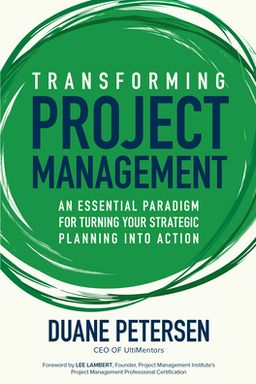
Transforming Project Management: Turning Strategy into Action
What if you could finally close the gap between your organization's bold strategic visions and the projects that are supposed to make them real? In Transforming Project Management: An Essential Paradigm for Turning Your Strategic Planning into Action, Duane Petersen challenges every assumption behind how businesses plan, budget, and execute their most important initiatives. According to Petersen, most strategic plans die not because of bad ideas, but because of poor execution — a failure rooted in how project management itself is taught, certified, and practiced.
Petersen argues that the Project Management Institute’s (PMI) revered standards, enshrined in the PMBOK (Project Management Body of Knowledge), provide consistency but not true success. They teach theory without realism, demand memorization over mastery, and ignore crucial factors such as accurate budgeting, realistic schedules, and effective monitoring. The result? Projects that spiral over budget, underdeliver, and ultimately make executives wonder where their strategy went wrong. The solution, he believes, lies in a radical rethinking—a transformation of project management itself into a discipline that truly integrates strategic planning, leadership, and rigorous execution.
The Global Problem: Projects That Fail by Design
Petersen begins with a staggering fact: project failures cost the global economy trillions each year. The issue isn’t just technical missteps—it’s systemic. Strategic planners dream up visionary goals, while project managers are left to interpret them into action using flawed tools or incomplete frameworks. The two disciplines rarely talk effectively, leading to mismatched budgets, impossible deadlines, and meaningless metrics. Without accurate means of tracking financial performance, companies often only discover the full magnitude of project disasters years after completion.
To illustrate this dysfunction, Petersen recounts a multimillion-dollar example where a company thought its $1.2 billion budget was under control—until an audit revealed actual costs exceeding $3.1 billion. Everyone’s dashboards had shown reassuring green lights, yet the project was hemorrhaging money. This, Petersen says, is not the exception—it’s the rule, caused by status reporting that measures only part of what matters. With traditional PMI metrics, organizations “monitor” only fragments of cost data while pretending to grasp the whole picture.
Redefining Success in Project Management
At the heart of Petersen’s framework is a simple but powerful definition of success: completing all work within the agreed budget and schedule without needing extra time or money. This seems obvious, but when most managers can’t create realistic budgets or schedules, it’s extraordinarily rare. True success requires a transformation of planning methods—what Petersen calls a “business process reengineering” of project management itself. Like industrial engineers analyzing a system for inefficiencies, leaders must apply rigorous, analytical methods to project management workflows.
This transformation demands three interconnected disciplines: strategic planning, which determines where the organization is going; project management, which tactically delivers those goals; and leadership, which drives teams to perform. Remove any one, Petersen warns, and the entire system collapses. Too often, planners set lofty goals without consulting project managers who understand execution, and executives assume their teams will “figure out the details later.” The result is predictable chaos.
From PMI to UltiMentors: A New Paradigm Emerges
Petersen introduces his alternative: the Pinnacle Strategist certification from his firm UltiMentors, a credential built on the principles detailed in this book. While the PMP certification allows passing grades around 60% and no real-world experience, Petersen’s exam requires 80% and deep comprehension of advanced budgeting, scheduling, and leadership techniques. His process bridges the missing link between strategy and execution, effectively turning project management from clerical coordination into organizational transformation.
To support this approach, Petersen developed a proprietary software tool, Ultimate PM, which embodies his methods with metrics that truly capture project health. Unlike generic dashboards with misleading red-yellow-green indicators, this system dynamically integrates scope, cost, risk, and performance information—rolling up data from individual projects to entire strategic portfolios. Executives, investors, even governments can see real-time progress and make informed decisions before failure becomes inevitable.
Why This Matters: The Bridge Between Vision and Reality
At its core, Petersen’s message transcends methodology—it’s about accountability and clarity. Corporate leaders, bankers, and politicians all depend on accurate foresight about what investments will deliver. Yet traditional project management obscures reality behind complex jargon, presenting the illusion of control. By building rigorous processes to determine true budgets, schedules, and risks, organizations can finally deliver on their promises rather than perpetually explaining their failures.
More than a how-to manual, Transforming Project Management is a call to leadership courage. It invites you to question entrenched systems, empower teams through data, and bring integrity back to the way organizations execute strategy. In doing so, Petersen bridges the oldest management gap in business—the space between dreaming and doing.