
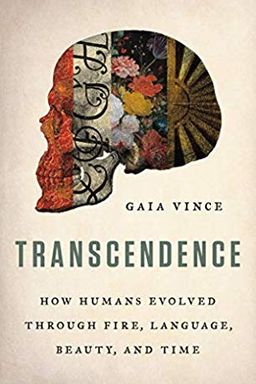
Transcendence cover

Transcendence

by Gaia Vince

Transcendence by Gaia Vince takes you on a journey through humanity''s evolution, exploring how fire, language, beauty, and time have defined our species. Delve into this multifaceted history to understand the key innovations that propelled us from the African savannas to today''s interconnected society.

Humans as a Cultural Species

You are not just the product of DNA but of culture and environment—the three forces Gaia Vince calls the human evolutionary triad. Her central argument is that genes, environment, and culture formed feedback loops that made humans unique: a species whose learned behaviors and shared knowledge now reshape the Earth itself. This book traces how those loops created cooperation, technology, art, and the global superorganism you inhabit today.

A triad instead of a thread

Evolution wasn't linear. Geological changes altered climates, forcing adaptations—genes responded, and emerging culture reshaped environments again. The savannah shift in East Africa encouraged bipedalism and tool use; fire expanded diets and freed time for social learning; storytelling encoded memory; and teaching made skill transmission more precise. Each layer of culture accelerated biological innovation, producing hominins capable of cumulative change.

Culture as the second engine of evolution

Culture became a fast adaptive system. Instead of waiting for slow genetic mutations, humans used imitation, teaching, and tools to evolve socially. This mechanism, what Vince calls cumulative culture, explains why Homo sapiens outpaced Neanderthals and why large, interconnected populations generated richer toolkits. Culture allowed energy outsourcing through fire and cooking, cooperation via norms and reputation, and connection through symbols and language. Each cultural leap altered selective pressures on genes and physiology.

Key building blocks across time

Fire made calories cheap and nights long, fueling brain growth and storytelling. Language and art created shared meaning and group identity. Teaching and imitation formed collective brains—the cognitive networks that preserve and recombine innovations. Settlements and monuments turned temporary cooperation into large-scale governance and inequality, while trade and beauty transformed symbolic value into currency. Each chapter shows how collective action pushed evolution forward.

From ancient networks to Homni

Vince’s vision climaxes in the present: our modern species acts as a planetary superorganism, Homni. Billions of humans, machines, and institutions now form one global connectome. As fire once reshaped landscapes, information networks now reshape climate, health, and the biosphere. Yet with power comes responsibility: each choice—from energy use to AI design—steers Homni’s survival.

Core insight

Humanity is a self-reflective evolutionary force. What began as small acts—sharing fire, teaching a skill, adorning a bead—scaled into networks capable of reprogramming the planet. Understanding that cultural triad is the first step to acting wisely within it.

Across its arc, the book teaches you how human cooperation, beauty, norms, and scientific reasoning grew from cultural bricolage. Vince argues that culture doesn’t just decorate biology—it drives it. Your every tradition, tool, and story is part of an active feedback system still writing humanity’s next chapter.


Fire, Energy, and the Social Spark

Fire was the first technological revolution that reshaped both biology and society. Vince portrays it as humanity’s original energy outsourcing—a tool that freed metabolic constraints and sparked culture itself. When your ancestors mastered flame, they unlocked calories, security, and social time. Fire made it possible to cook, sleep safely on the ground, and gather around warmth to communicate and imagine.

Heat and calories

Cooking transformed nutrition. By softening and predigesting food, humans extracted far more energy—up to half again as much usable protein and starch. This surplus powered larger brains while shrinking guts, an energetic trade-off visible in Homo erectus fossils. Fire extended waking hours, creating communal evenings that encouraged storytelling and teaching, the foundations of cumulative culture.

Fire and cooperation

Maintaining fire required shared effort. Someone fetched fuel, someone guarded sparks, someone taught ignition techniques. These group routines encouraged cooperation and deeper social bonds. Vince gives the Hadzabi fire drill and Neanderthal use of pyrolusite as evidence of deliberate material culture surrounding combustion—fire was both technology and ritual.

Key insight

Fire made humans ecological engineers. Controlled burning opened landscapes, shaped ecosystems, and marked the beginning of our planetary influence—a prelude to modern energy systems.

From firestick farming to electricity grids, the principle endures: culture is an energy amplifier. You leverage external sources—tools, machines, and networks—to expand what biology alone could never sustain. Fire was the first flicker of that scalable cultural power.


Brains, Birth, and Cooperative Care

Human intelligence and sociality arose because culture stretched biology’s limits. Vince’s account of brain growth and childbirth shows how shared childcare and cooking reshaped evolution. Brains are energy-hungry organs, demanding constant fuel and protection. Culture met those demands with cooperation, extending childhood and social dependency into advantages.

Energetic trade-offs

Cooking provided the caloric efficiency needed for neural expansion. A raw-food diet couldn’t sustain a human-sized brain without impossible feeding hours. Cultural innovation solved the problem, allowing smaller guts and larger heads—visible across Homo evolution. Vince notes this as a turning point: culture didn’t just adapt to biology, it powered its transformation.

The obstetric dilemma and social solution

Enlarged brains met the constraints of bipedal pelvises, making birth perilous. Humans evolved premature infants and flexible skulls, forcing assistance at childbirth. That necessity birthed alloparenting—shared childcare among mothers, fathers, and wider kin. Vince cites Efé communities with over a dozen caregivers per infant as proof of social adaptation stabilizing biological vulnerability.

Key insight

Dependency became a strength. Human cooperation around children enabled long learning periods and profound cultural transmission—the social cradle of intelligence.

Today, medical technologies continue rewriting selection: narrow pelvises and large heads coexist because culture again compensates. It’s a reminder that every human biological trait you inherit is inseparable from the social ecology that made it viable.


Language, Story, and Shared Memory

Language and story turned information into durable social memory. Vince frames tales and rituals as cognitive technologies that store data through emotion and imagery. Oral traditions like the Yolngu songlines encode survival maps in melody and dance—proof that narrative was humanity’s first library system.

Stories as data containers

Narrative binds facts to feelings, making them 20+ times more memorable than lists. When listeners visualize actions and emotions, neural coupling occurs—brains synchronize across storyteller and audience. That mechanism allowed complex knowledge, from migration routes to moral codes, to persist across generations before writing existed.

Writing as memory externalization

The later invention of writing—Sumerian tokens to alphabetic scripts—offloaded recollection into artifacts, extending cognitive horizons. Language genes like FOXP2 set the foundation; writing multiplied it. Once ideas could be stored, edited, and compared, cultural evolution accelerated exponentially.

Key insight

Storytelling and writing made human knowledge self-perpetuating. They converted memory into infrastructure—an essential step toward civilization and science.

Every conversation or text you share continues this lineage, turning fleeting experiences into culture. Story is not entertainment—it’s how your species remembers and evolves.


Symbols, Beauty, and Belonging

Vince shows that beauty and symbolism are functional forces, not luxuries. Decoration and art encode identity, coordinate trust, and make cooperation visible. From ancient beads to tattoos and architecture, aesthetic signaling evolved as a social technology.

Beauty as communication

Color, symmetry, and ornament serve to convey health or status—a principle shared with birds and fish yet vastly extended by humans. Blombos Cave beads and Ekoi nsibidi tattoos acted as early markers of group identity. By wearing shared symbols, people displayed membership and mutual trust, forming cultural tribes long before writing codified norms.

Symbolism and value creation

Vince links aesthetics to economics. Beautiful collectibles evolved into trade tokens and currency—shells, metals, coins, paper, and digital credits all rest on symbolic value. Beauty converts desire into transferable worth, enabling cooperation between strangers through shared meaning systems like wampum or modern brands.

Key insight

Symbols are social glue. They motivate belonging, shape trade, and power reputation—human art is also human infrastructure.

Beauty may seem subjective, but its social logic drives economies and identities. You live amid symbols whose meanings keep your society coherent and your actions intelligible.


Networks, Population, and Cultural Complexity

Innovation thrives in numbers and connections. Vince calls large, well-linked populations cultural accelerators. The more teachers, traders, and imitators in contact, the richer the collective toolkit. When isolation shrinks networks—as with ancient Tasmania—skills vanish; reconnection restores them.

The collective brain principle

Each person contributes ideas, but networked groups multiply combinations exponentially. Joseph Henrich’s lab simulations proved that multiple teachers preserve complexity across generations. Connectivity turns individual insight into collective reasoning.

Transport and exchange

From Yamnaya horse migrations to Roman roads and Silk Road caravans, technology expanded the cultural web and even reshaped genomes. Lactase persistence in Europe emerged alongside dairy trade routes. Dense networks reward cooperation and diplomacy—the traits of successful societies.

Practical takeaway

The diversity and connectivity of your community determine its capacity to invent. Isolation simplifies; interconnection complexifies.

In today’s world, digital networks extend this ancient logic. The internet is the latest crucible of cumulative culture—a vast, collective brain still evolving its norms and truths.


Norms, Reputation, and Cooperation

Trust among strangers depends on culture. Vince explores how gossip, moral systems, and reputation replaced kinship as the basis for cooperation in large societies. These social technologies make coordination possible beyond family lines.

Gossip and moral signaling

Studies show that most conversation is reputational analysis—who helps, who cheats. Such information guides imitation and trade. In the digital age, reputational circuits like Wikipedia’s editor scores or eBay’s feedback extend ancient social mechanisms into global commerce.

Norm enforcement

Public-goods experiments demonstrate how cooperation flourishes when defectors can be excluded and altruists rewarded. Moralizing gods historically served this role in large groups, substituting divine surveillance for direct reputation tracking. Modern norms perform similar functions through laws and platforms.

Key insight

Your moral sense is cultural software for cooperation. Reputation and norms sustain civilization as much as economics or physics.

Reputation can also misfire—mob attacks or misinformation. Vince reminds you to build systems that reward evidence and empathy, not punishment or spectacle, if Homni is to remain healthy.


Time, Reason, and Scientific Culture

Vince closes the loop between culture and cognition by showing how humans learned to reason with time. From Stonehenge’s solar alignments to Thales’s predictions and Baghdad’s House of Wisdom, the story is one of collective foresight. The same impulse that timed harvests now drives science and global coordination.

Biological and social clocks

Experiments like Michel Siffre’s cave isolation reveal the tension between biological and cultural time. Civilization depends on synchronization—clocks, calendars, and schedules—but divorcing from natural rhythm brings health costs. The book frames time as both tool and trap: a shared scaffold for cooperation that demands mindful use.

Reason and inquiry

From divination to experiment, Vince charts the rise of evidence-based thinking. Baghdad’s translation projects and Gutenberg’s press form milestones in humanity’s data network. Scientific culture prospers when communication stays open and pluralistic; repression erodes progress, as Hypatia’s murder tragically proved.

Key insight

Predictions—not prophecies—define modern humanity. Science is the cultural mechanism that makes foresight collective and sustainable.

You live in a civilization built on shared time and tested reasoning—tools that transform uncertainty into cooperation and possibility.


Homni and the Planetary Future

In her final synthesis, Vince presents Homni: humanity plus culture plus technology acting as a single organism. Data networks link billions of minds, infrastructures coordinate planetary systems, and shared challenges demand collective memory and foresight. You are a node in a global brain that is rewriting evolution in real-time.

Planetary metabolism

Homni consumes vast energy and reshapes ecosystems. Humans now appropriate most of the planet’s biomass and freshwater. The Great Acceleration compresses geological change into decades. Vince warns that coordination failures—climate collapse, polarization, inequality—could cripple Homni’s collective health.

Dilemmas of technology and governance

As tools merge minds and machines—AI, CRISPR, social credit systems—the moral choices multiply. Connectivity magnifies both creativity and harm. Vince urges planetary stewardship: design systems that uphold fairness, diversity, and transparency so Homni evolves for the common good.

Final message

You are part of a species-scale experiment in cooperation. The next evolutionary leap will be ethical: to become good ancestors rather than efficient consumers.

Vince’s closing challenge reframes evolution as choice. Cultural feedback built the superorganism; moral feedback will decide whether it endures.

Dig Deeper

Get personalized prompts to apply these lessons to your life and deepen your understanding.

Go Deeper

Get the Full Experience

Download Insight Books for AI-powered reflections, quizzes, and more.