
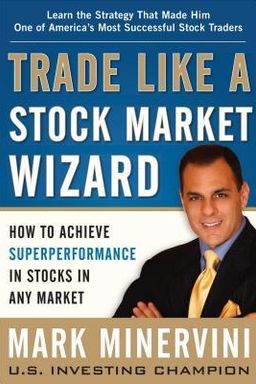
Trade Like a Stock Market Wizard cover

Trade Like a Stock Market Wizard

by Mark Minervini

Trade Like a Stock Market Wizard offers a compelling guide to achieving super performance in stocks using SEPA methodology. It empowers lay investors with strategies to manage risk, maximize profits, and leverage their unique strengths to outperform professionals in any market.

Trade Like a Stock Market Wizard: Achieving Superperformance

Have you ever wondered why some stock traders seem to achieve legendary success while most people barely beat inflation? In Trade Like a Stock Market Wizard: How to Achieve Superperformance in Stocks in Any Market, Mark Minervini reveals how he turned a few thousand dollars into millions using a precise approach rooted in discipline, timing, and mindset. This isn't a story of luck but of a replicable system built over decades of trial, error, and perseverance.

Minervini argues that achieving what he calls superperformance—returns that dramatically exceed market averages—requires two things: the right strategy and the right psychology. He insists that anyone can do it with the proper mindset and commitment, not just financial professionals. His own life, starting as an eighth-grade dropout who became a U.S. Investing Champion, serves as the ultimate proof that mindset and persistence can trump pedigree and connections.

The Philosophy of Freedom Through Trading

For Minervini, trading isn’t merely about making money—it’s about freedom. He paints the market as a level playing field where formal education, connections, or status offer no advantage. Success depends solely on preparation and discipline. This theme echoes throughout the book, and he connects trading with personal liberation: the ability to earn on one’s terms, work anywhere, and build lasting confidence through self-reliance.

He encourages readers to view trading as a business, not a hobby or gamble. Like any craft, mastery comes from treating it professionally—planning, measuring results, and refining tactics systematically. Just as athletes sharpen every detail of their performance, traders must develop the emotional control and habits that make consistency possible.

Opportunity Meets Preparedness

Minervini’s career exemplifies his motto: success happens when opportunity meets preparedness. Long before his breakthrough years, he spent nights poring over charts and financial statements, dissecting historical winners, and learning from his failures. His transformation came not through luck but from this obsessive preparation. When the market eventually offered its next bull cycle, he was ready—just as an Olympic athlete performs flawlessly under pressure after years of practice.

The takeaway for readers is clear: you can’t control when opportunity arrives, but you can control how ready you are. The market rewards those who have done the homework—those who’ve studied patterns, learned about companies, and mastered their emotional responses so that when the moment comes, execution is instantaneous, not hesitant.

The SEPA Strategy: Precision Over Prediction

The book’s foundation lies in the Specific Entry Point Analysis (SEPA) strategy, which combines fundamentals, technical analysis, and psychology. SEPA helps traders find the exact point where risk is lowest and reward potential is highest—a moment defined by probability convergence. Rather than predicting where markets will go, Minervini teaches how to recognize when multiple indicators align: strong earnings growth, institutional buying, and volume patterns confirming accumulation. This precise synchronization separates elite traders from gamblers.

In essence, SEPA builds on research from Richard Love’s Superperformance Stocks and others, refining their lessons into a modern framework. Every chapter unpacks how timing, psychology, and analysis interlock to identify stocks poised for meteoric rises while avoiding pitfalls that ruin portfolios.

Mindset Over Market

Yet technical knowledge alone isn’t enough. Minervini spends much of the book teaching readers how to master themselves. He argues that the real challenge isn’t the market—it’s you. Fear, greed, and ego destroy more traders than volatility ever does. He recounts early failures, when stubborn pride made him hold losers too long, until hard lessons forced him to prioritize humility over being right. His mantra—“Do you want to be right or make money?”—becomes a recurring theme throughout.

This mental toughness aligns Minervini with investors like Jesse Livermore and Paul Tudor Jones, who also emphasized discipline over prediction. For Minervini, trading success mirrors life mastery: persistence, preparation, and self-belief. The same principles that make a great athlete or artist apply to investors seeking consistency.

Why This Book Matters Now

In today’s era of social media stock tips and algorithm-driven trading, Trade Like a Stock Market Wizard is a refreshing call to individuality. It reminds readers that lasting success comes not from shortcuts or market predictions but from learning timeless principles of risk management and trend alignment. These are universal truths proven in every market cycle for a century.

By the end of this book, you’ll not only understand how to find great stocks—you’ll grasp how to think like a champion trader. You’ll see why knowledge must be paired with emotional strength, and how risk management transforms volatility from danger into opportunity. Above all, Minervini’s message will resonate regardless of your background: with study, persistence, and discipline, you can achieve financial freedom through the art of trading.


Mastering the Trader's Mindset

If most investors fail, it’s not because they lack information—it’s because they can’t manage themselves. In Trade Like a Stock Market Wizard, Minervini spends as much time discussing psychology as he does strategy. He declares that your greatest challenge is not the market; it’s you. Fear, greed, and indecision destroy capital faster than bad research ever could.

Discipline Over Emotion

Early in his career, Minervini clung to losing trades, too embarrassed to admit mistakes. A broker’s ridicule once made him hold a sinking stock far too long, watching it drain his account. That humiliation became a turning point: he realized trading wasn’t about ego—it was about making money. From then on, he vowed to sell losers quickly and stick strictly to his rules.

Key Idea

“Do you want to be right or do you want to make money?” becomes a mantra that separates successful traders from those ruled by pride.

Commitment vs. Interest

Most people, Minervini argues, get “interested” in trading but never committed. Commitment means treating trading not like a hobby but as a profession—with preparation, review, and lifelong learning. This distinction mirrors ideas from Napoleon Hill’s Think and Grow Rich: persistence and clarity of purpose separate success from mediocrity.

Practice Perfectly

One of the book’s striking lessons is that practice alone doesn’t make perfect—only perfect practice does. Minervini compares investors to golfers who spend years swinging incorrectly, reinforcing bad habits. Without accurate feedback and discipline, practice merely ingrains failure. Therefore, traders must continuously analyze every trade—especially losses—to refine their methods.

Risk Starts Between the Ears

In every market cycle, the biggest adversary is the trader’s emotional reaction to uncertainty. Minervini teaches that you’re never in control of the market, but you can control your response. He reframes losses not as defeats but as tuition at “the University of Wall Street.” This reframing turns discouragement into education, fostering detachment—a concept mirrored by Stoic thinkers like Epictetus and modern trading psychologists like Mark Douglas (Trading in the Zone).

Ultimately, mastering your psychology is what separates a casual investor from a professional. Your emotions will always exist, but discipline allows you to act in harmony with the market instead of against it.


The SEPA Strategy: Precision Timing

The centerpiece of Minervini’s method is his Specific Entry Point Analysis (SEPA) strategy—a scientific process for identifying when a stock is likely to explode in price with minimal downside risk. SEPA aligns fundamentals, technical patterns, and market tone to find the moment when probability is most favorable.

Five Key Elements

  • Trend: Superperformance stocks always move within a clear uptrend.
  • Fundamentals: Explosive price moves stem from improving earnings, margins, and revenue.
  • Catalyst: Behind every big winner lies a trigger—a new product, CEO, or industry change.
  • Entry: Precise timing based on volume and volatility contraction patterns (VCP).
  • Exit: Strict stop-losses to protect capital and lock in profits.

Probability Convergence

Instead of relying on predictions, Minervini looks for “convergence”—a situation where several favorable indicators arrive simultaneously, like cars meeting at a four-way intersection. When earnings acceleration matches a technical breakout and a strong market trend, your odds shift dramatically in your favor.

For example, when Apple introduced the iPod and iTunes in early 2000s, its accelerating earnings converged with momentum from the new product line, producing a 10,000% price increase over eight years. These moments are rare but identifiable.

Volatility Contraction Pattern (VCP)

Minervini’s favorite setup is the VCP—a pattern where price swings progressively tighten during a consolidation, signaling decreasing supply. When volume dries up and volatility contracts, it means weak sellers are gone and institutions are quietly accumulating shares. The breakout above the pivot point often leads to sudden surges.

This concept builds on lessons from William O’Neil’s How to Make Money in Stocks but emphasizes the physics of supply and demand rather than mere chart recognition. SEPA transforms charts from visual art into probabilistic analysis—a fusion of science and intuition.

In short, SEPA doesn’t rely on guessing; it relies on precision, positioning you where reward vastly exceeds risk.


Trading with the Trend

Mark Minervini’s mantra—the trend is your friend—guides his entire strategy. Most investors try to pick bottoms, buying cheap stocks that seem like bargains. But in reality, the market rewards those who align with prevailing trends, not those who fight them. History’s biggest winners all rose during confirmed stage 2 uptrends.

The Four Stages of Price Maturation

  • Stage 1 – Neglect: The stock moves sideways with little interest.
  • Stage 2 – Advancing: Institutional accumulation begins; this is where superperformance happens.
  • Stage 3 – Topping: Volatility increases and strong players sell to amateurs chasing headlines.
  • Stage 4 – Declining: Capitulation and steep losses occur; time to exit.

Avoiding Stage 1 and Stage 4

Minervini’s research revealed that over 99% of superperformance phases occurred when stocks traded above their 200-day moving average—a hallmark of stage 2. Buying too early in stage 1 ties up capital in “dead money.” Buying too late in stage 3 exposes you to collapse. The master’s advice: wait for confirmation before acting.

Examples in Action

Consider Amgen in the 1990s: when its price clearly transitioned to stage 2, institutions flooded in, producing a 360% rally in just 14 months. In contrast, Sun Microsystems in the early 2000s fell victim to stage 4 decline, losing more than 99% of its value. These examples show the consequences of ignoring stage analysis.

By using his Trend Template—criteria like stock price above key moving averages, strong relative strength, and recent highs—you can instantly see whether a stock is sailing with the wind or against it. The difference is the gap between a career defining gain and catastrophic loss.


The True Nature of Value

Most investors obsess over price-to-earnings ratios (P/E), hunting for cheap stocks. Minervini demolishes this traditional notion of value. He argues that “value comes at a price”—that high P/E stocks can be bargains if earnings justify their growth, while low P/E stocks often mask trouble.

The Myth of Cheap Stocks

When investors chase low valuations, they often buy broken leaders—companies like AIG or Citigroup during the 2008 crisis—which seemed cheap but fell another 90%. Minervini warns: “Buying cheap is like a trap hand in poker; it’s hard to get away.” True winners rarely come from bargain bins.

Why High Prices Can Be Cheap

Superperformers like Yahoo!, Crocs, and Apollo Group appeared expensive when they began their massive rallies, yet their earnings growth outpaced price appreciation. Apollo kept a constant 60x P/E while rising 850% because profits grew just as fast. The lesson: price follows growth, not multiples.

This paradox mirrors Warren Buffett’s belief that it’s “better to buy a wonderful company at a fair price than a fair company at a wonderful price.” Minervini agrees, adding that traders must value perception as much as statistics: “Value doesn’t move stock prices—people do.”

Sentiment as the Real Barometer

Minervini elevates sentiment to the forefront of valuation. P/E ratios are indicators of expectations, not intrinsic worth. When expectations expand amid accelerating fundamentals, the ratio itself becomes a gauge of enthusiasm. Understanding when that enthusiasm peaks is the key to selling before collapse.

In short, value isn’t something you calculate—it’s something you interpret. The market rewards growth, innovation, and excitement, not textbook cheapness.


Risk Management: The Champion's Shield

Minervini calls risk management the most important skill for achieving consistent success. Anyone can win in one good market cycle, but only disciplined risk control ensures survival through bear markets. His career—marked by eight bull markets and eight bear markets—proves that protecting capital is more critical than chasing gains.

Respect the Market's Verdict

When you lose, sell. Accept the market’s judgment without ego. This advice, simple yet rarely followed, reflects decades of wisdom from great traders like Paul Tudor Jones and Jesse Livermore. Minervini insists there’s no shame in being wrong—only in staying wrong. He compares losses to “tuition at the University of Wall Street.”

The 10 Percent Rule

His rule: never let a loss exceed 10%. Even small losses require double-digit gains to recover. A 20% drawdown needs a 25% comeback, while a 50% loss demands 100%. Cutting losses quickly keeps you agile and preserves mental clarity for the next opportunity. This logic transforms trading from gambling into risk-aware business.

Build Failure Into the Plan

Unlike most traders, Minervini designs his system assuming frequent failures. He aims for win-loss ratios of 2:1 or 3:1, meaning he can be right only half the time and still thrive. This concept—“building in failure”—creates durable profitability across unpredictable markets. By expecting losses, you prevent catastrophic ones.

Discipline as a Lifestyle

Risk management, for Minervini, isn’t a one-time tactic—it’s a habit. He urges traders to treat discipline like brushing teeth: automatic and non-negotiable. Routine contingency planning, strict stops, and incremental exposure make trading boring—but boredom is profitable. Those addicted to excitement will inevitably lose.

In the end, Minervini’s biggest lesson echoes through his story: risk management is freedom. By protecting capital, you earn not only consistent profitability but also the peace of mind that allows you to trade fearlessly and live on your own terms.

Dig Deeper

Get personalized prompts to apply these lessons to your life and deepen your understanding.

Go Deeper

Get the Full Experience

Download Insight Books for AI-powered reflections, quizzes, and more.