
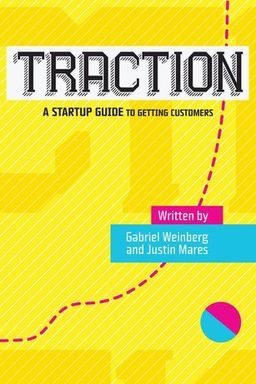
Traction cover

Traction

by Gabriel Weinberg and Justin Mares

Traction by Gabriel Weinberg and Justin Mares is your essential guide to achieving start-up success through customer acquisition. Learn effective strategies for gaining traction, balancing product development with marketing, and building a loyal customer base. Discover proven methods for each growth phase, helping you navigate the competitive start-up landscape with confidence.

Traction Trumps Everything: The Startup’s True Goal

How can you build a startup that doesn’t just launch but actually grows fast enough to survive? In Traction: A Startup Guide to Getting Customers, Gabriel Weinberg and Justin Mares argue that traction—not ideas, technology, or funding—is the single most important driver of startup success. Without traction, even brilliant products vanish. But with it, you can overcome nearly every obstacle, from fundraising to hiring.

The authors define traction as the measurable momentum that shows your business is taking off. It’s visible in facts: rising user counts, climbing revenues, or soaring engagement. Traction is the sign that people want what you offer and are finding you. It is the ultimate proof that your startup works. Their central claim is simple but radical: traction trumps everything. Investors prefer it to promises, customers respond to evidence, and your team rallies behind it.

Why Traction Matters More Than Vision

Weinberg, the founder of DuckDuckGo, and Mares, a serial entrepreneur and growth strategist, have lived through both successful and failed startups. They learned that the quality of technology or leadership didn’t determine failure—it was inability to gain traction. When startups show traction, everything else gets easier: raising funds, recruiting talent, and media attention. Conversely, without traction, even a clever idea dies in obscurity.

Paul Graham of Y Combinator captures this perfectly when he says, “A startup is a company designed to grow fast.” Traction, then, is synonymous with growth. While many founders obsess over perfecting their products, the authors warn that this is a dangerous bias—they call it the Product Trap: the false belief that if you build something amazing, customers will simply show up. In reality, distribution is harder than creation. Those startups that split their time evenly between building and getting traction end up scaling faster.

What the Book Teaches You

Across this guide, Weinberg and Mares offer a practical framework to systematically find traction—something most founders leave to intuition or luck. Through interviews with forty startup founders and analyses of dozens more, the authors identify nineteen traction channels—the distinct paths startups use to acquire customers. These range from viral marketing and search engine optimization to trade shows, content marketing, and offline ads. Their most striking finding is that successful startups almost always found traction through unexpected channels—ones other founders dismissed or ignored.

You’ll explore the Bullseye Framework, a five-step process (brainstorm, rank, prioritize, test, and focus) for identifying and validating the best traction channel for your business. You’ll learn about traction thinking—the mindset of pursuing growth in parallel with product development, guided by the “50% Rule,” which says you should spend half your time building product and half your time getting traction. Then the book walks you through traction testing, where you learn to run lean experiments on channels and measure results with hard numbers. Finally, it introduces the Critical Path, a system for staying laser-focused on the most significant traction goals for your company.

Why These Ideas Matter

For new entrepreneurs, these frameworks transform uncertainty into process. Instead of guessing where customers will come from, you’ll test channels scientifically. Instead of wasting time tweaking product features, you’ll focus on what moves the needle: real customer acquisition. For experienced founders and marketers, Traction offers a refreshing antidote to fad-driven marketing. It’s not about the newest growth hack—it’s about disciplined experimentation and sustained focus.

The authors fuse practical examples into each idea. DuckDuckGo’s billboard campaign in Google’s own backyard doubled its traffic overnight. Mint’s early blog sponsorships unlocked 20,000 users before launch. Dropbox rewired its product for viral growth after discovering paid ads didn’t work economically. Each story shows how startups that actively pursue traction can pivot intelligently and unlock exponential growth.

The Larger Context: Growth as Validation

Weinberg and Mares position traction as the ultimate form of validation—a principle echoed in The Lean Startup by Eric Ries. While Ries focuses on validating product-market fit through experimentation, Traction extends that thinking to customer acquisition: once you’ve built something people want, you must learn how to reach them systematically. Where Lean gives the science of product, Traction provides the science of distribution. Together they form a complete growth philosophy.

So, if you’ve ever built something and wondered why customers aren’t lining up, this book offers both diagnosis and cure. It gives you a repeatable playbook to find your best traction channel and scale it until it no longer works—then repeat the process to find the next one. The message is empowering: growth isn’t luck. It’s a discipline. And if traction truly trumps everything, the surest way to win isn’t just to build—it’s to grow deliberately, one tested channel at a time.


The Bullseye Framework: A System for Focused Growth

How do you choose the right marketing channel when there are so many options? Weinberg and Mares know the paralysis founders face—it’s easy to throw money at ads, social media, and PR only to watch none of them work. So they created the Bullseye Framework, a five-step process for systematically identifying, testing, and focusing on the traction channel that will deliver exponential growth.

Step 1: Brainstorm Broadly

Your first step is to brainstorm ideas for all 19 traction channels—from viral loops to business development deals to community building. The key is radical openness: don’t dismiss any channel too soon. Every startup has biases—a tendency to overvalue familiar channels (like social ads) and undervalue unfamiliar ones (like offline events or trade shows). By forcing yourself to generate at least one idea per channel, you break through mental blind spots and discover creative ways your competitors might miss.

Step 2: Rank Ideas by Promise

Next, you organize ideas into three concentric circles: your inner circle (most promising), potential circle, and long-shot circle. This visual metaphor—hence “Bullseye”—helps you compare channels based on cost, reach, and relevance. Tools like spreadsheets make this step manageable, letting you estimate customer acquisition costs, timeline to test, and total reachable customers. Your goal isn’t precision; it’s clarity on what seems most viable now.

Step 3: Prioritize Experiments

From your ranked list, select three traction channels in your inner circle to test first. As the authors emphasize, testing multiple channels in parallel is faster than testing them sequentially. It’s a balance between focus and speed. Running three small experiments simultaneously ensures you gather comparative data quickly without spreading your energy too thin.

Step 4: Test Cheaply and Quickly

Each test should answer simple questions: How much does it cost to acquire customers through this channel? How many customers are available? Are they the right kind of customers? You’re not chasing instant traction yet—just data to validate assumptions. Cheap tests prevent waste and reveal hidden potential. Noah Kagan used this process at Mint: he tested blog sponsorships, search engine marketing, and PR for $250 apiece. Blogging proved most effective, giving Mint its first 40,000 users before launch.

Step 5: Focus and Optimize

Once a channel shows promise, focus all your energy there. Optimization means mastering that channel—testing messaging, refining targeting, and scaling tactics until returns flatten. As Peter Thiel warns, most startups fail from poor distribution, not poor product. The Bullseye Framework ensures you avoid that fate by finding one channel that truly works, then relentlessly exploiting it before moving on.

Real-World Example: Mint’s Bullseye Path

Mint’s team brainstormed dozens of ideas, ranked their top three channels, tested them cheaply, and discovered blogs provided their fastest traction. Once blogging stopped scaling, they reran Bullseye and shifted focus to PR. Result: one million users within six months and a $170 million acquisition by Intuit.

You can use Bullseye not just once, but repeatedly. As channels saturate, rerun the process to uncover the next engine of growth. This disciplined cycle ensures your marketing always stays adaptive and precise. Ultimately, Bullseye transforms randomness into a repeatable science—an invaluable mindset in an unpredictable startup world.


Traction Thinking: The 50% Rule and Moving the Needle

What do you do when you have a good product but no users? Weinberg and Mares call for a shift in mindset they term traction thinking—the discipline of treating traction as equal to product development. The 50% Rule demands founders spend half their time building product and half testing traction channels. This balance ensures you’re creating something people want and figuring out how to reach them.

Breaking the Product Trap

Most founders fall into what the authors label “The Product Trap”—believing a great product automatically finds users. As Marc Andreessen warns, “Most entrepreneurs who build great products simply don’t have a good distribution strategy.” Weinberg and Mares argue that failing to pursue traction early forces founders to scramble after launch, often wasting time and capital. Dropbox discovered this when paid search cost $230 per customer—more than twice its product price. The pivot? Embedding viral marketing directly into its design, offering free storage for referrals. That shift made Dropbox one of the fastest-growing SaaS products ever.

Parallel Development Pays Off

Pursuing traction and product development together creates feedback loops that improve both. You learn which messaging resonates, which customers are easiest to reach, and what problems truly matter. Marketo, the marketing automation company, started blogging and building an email list months before launching its product—beta-testing its idea through content. By launch, they had over 14,000 interested buyers waiting. Their traction strategy validated demand and avoided a cold start.

Phases of Growth

Startup growth happens in three phases: making something people want, marketing something people want, and scaling something people want. In phase I, you do things that don’t scale—manual outreach, personal emails, speaking at meetups—to get first customers. In phase II, you refine messaging and expand through scalable traction channels. Phase III focuses on scale and profitability. What moves the needle differs at each stage; early, small wins count, while later stages demand reaching millions.

Knowing When to Pivot

If traction stalls, Weinberg advises looking for “bright spots”—small clusters of highly engaged users. These pockets can reveal target segments worth focusing on. DuckDuckGo built around a niche audience that valued privacy years before widespread demand. When privacy exploded into mainstream concern after NSA leaks, its early focus paid off. Sometimes, traction means staying patient until market timing aligns with your niche.

Investor Insight

Naval Ravikant of AngelList notes, “Traction is a moving target.” What counts differs by industry and era, but sustainable growth—like 10% monthly user increases—is irresistible to investors. Small numbers compound fast when the underlying engagement is real.

By marrying Lean Startup’s hypothesis testing with Traction’s growth focus, founders can iterate not just on product but on distribution. The 50% Rule ensures every build decision feeds real customer feedback. If you want a startup that survives first contact with the market, traction thinking isn’t optional—it’s oxygen.


Testing for Growth: Experiments and the Law of Decline

Finding traction isn’t a one-time discovery—it’s an ongoing process of experimentation. Weinberg and Mares urge founders to embrace constant testing across their chosen channels. This chapter introduces the Law of Shitty Click-Throughs, coined by growth expert Andrew Chen: every successful marketing tactic eventually stops working as competitors crowd in. The antidote? Continuous experimentation.

Stay Ahead of Saturation

Banner ads once had 75% click rates; now 0.05%. Viral tweets fade, SEO keywords get overused, and ad prices rise. The only way to stay ahead is to treat marketing strategies like perishable goods—each test has an expiration date. Startups must always look for underused platforms or new audience behaviors. Zynga dominated Facebook ads before competitors flooded in. Continuous testing let them maintain momentum until rising costs forced a shift.

Quantify Your Channels

Testing should be data-driven. Build a simple spreadsheet tracking cost per acquisition, lifetime value, and conversion rates. Use it to rank channels empirically. A channel that adds five customers monthly might be fine at launch but meaningless later. Calculations help you see which experiments actually “move the needle.” Weinberg calls this numerical discipline the backbone of the Bullseye approach—it keeps decisions rational rather than emotional.

Small, Fast Experiments

A test doesn’t require huge budgets. Spend a few hundred dollars on simple ads or pilot campaigns. The goal is speed—to replace guesses with data. Early search marketing tests at Archives.com cost little yet revealed which messages converted best, shaping both product and scaling decisions. Sean Ellis (advisor to Dropbox and Eventbrite) emphasizes fast, high-quality tests over big bets: “The faster you run experiments, the more likely you’ll find scalable growth.”

Optimize Through A/B Testing

Once a channel works, optimize it through A/B testing. Changing just one word in a headline or one color on a button can lift conversions significantly. Habitual testing compounds results: one optimization per week can double or triple channel efficiency over time. Tools like Optimizely or Unbounce make it easy to run experiments without coding headaches. For modern marketers, testing isn’t optional—it’s the rhythm of traction.

Key Principle

Treat marketing like a science lab. Each experiment tests a hypothesis. Data replaces intuition. Failure isn’t a setback—it’s a signal pointing you toward what works next.

In essence, traction testing transforms chaos into disciplined learning. Rather than chasing what’s hot, you build a repeatable habit of validation. Over time, this mindset not only keeps you ahead of saturation—it gives you mastery over uncertainty itself.


Defining Your Critical Path: Focus and Mentorship

Startups drown in opportunities—new partnerships, product ideas, and endless distractions. Weinberg and Mares propose defining your Critical Path: a single, measurable progression toward your traction goal. Every action either advances this path or diverts from it. If it’s off path, don’t do it.

Choosing a Traction Goal

Your critical path starts with one significant traction goal. It could be 1,000 paying customers, break-even revenue, or 10% market share. The milestone must be meaningful enough to change your company’s trajectory. For DuckDuckGo, aiming for 1% of the search market meant legitimacy among major players. Earlier, their goals were smaller but equally vital—getting 100 million monthly searches or achieving product-market fit.

Mapping Milestones

Once your goal is clear, map the shortest path to reach it. List only the absolutely necessary milestones—features, hires, deals, or traction activities. Then order them by dependency. Visualizing this chain helps you prioritize execution. Weinberg recommends reassessing at each milestone because markets shift, revealing new shortcuts.

Creating Sub-Goals and Accountability

Break big goals into quantifiable sub-goals—weekly or quarterly metrics like “reach 1,000 signups” or “achieve 20% month-over-month growth.” Use spreadsheets or calendars to track progress visibly. Each sub-goal guides action and creates accountability across teams. This rhythm ensures traction testing aligns with company-wide priorities rather than isolated experiments.

Overcoming Bias and Staying on Path

Founders often favor channels they understand—like SEO—or avoid ones that feel unpleasant—like cold sales or trade shows. These biases distort the critical path. Overcoming them reveals hidden opportunities. Jason Cohen of WP Engine reminds founders that competitors tend to ignore these channels, leaving untapped space: “If others refuse to try certain channels, that’s your advantage.”

The Role of Mentorship

Mentors help you maintain objective perspective. They spot distractions, refine milestones, and challenge your assumptions. Weinberg describes weekly 1-to-1s at DuckDuckGo that reinforce alignment along the critical path. Mentorship isn’t just guidance—it’s a forcing function for clarity.

Defining a critical path transforms chaos into direction. It disciplines your startup to say no 99% of the time and yes only when something triggers traction. As Weinberg puts it: everything else is noise.


Nineteen Channels for Customer Growth

Every successful startup has found at least one repeatable path to acquire and retain customers. Weinberg and Mares classify these paths into 19 traction channels. Each offers a distinct method to turn attention into adoption—but the best one for you is often the least obvious.

Main Categories

  • Online Channels: From search engine marketing (SEM) and social ads to SEO, content marketing, and email marketing.
  • Offline Channels: Billboards, TV, radio, trade shows, and offline events.
  • Strategic Channels: Business development, sales, partnerships, and affiliate programs.
  • Creative Channels: Viral marketing, unconventional PR, speaking engagements, and community building.

Unexpected Winners

The authors stress that the best traction channels often defy assumptions. Dropbox mastered viral loops instead of paid ads. HubSpot leveraged engineering as marketing, creating free grading tools that drove tens of thousands of leads. Mint grew through blog targeting while its competitors fought over paid search. These examples underscore the power of exploration.

The Advantage of Unpopular Channels

Most founders flock to social or SEO, oversaturating them. Channels like trade shows, speaking engagements, and offline ads remain less crowded and can be surprisingly effective. DuckDuckGo’s single billboard near Google’s HQ generated national press—a tiny offline effort that doubled its users. Grasshopper mailed chocolate-covered grasshoppers to influencers, sparking viral attention for pennies compared to ad campaigns.

The book’s lesson? Don’t chase trendy channels—test systematically. By keeping all nineteen options in view, you’ll guard against bias and find leverage where competitors aren’t looking. It’s not about doing everything. It’s about finding one thing that works and scaling it relentlessly.


Building Momentum: The Discipline Behind Sustainable Growth

Weinberg and Mares finish with a simple truth: traction is not a moment; it’s a motion. Sustainable growth depends on discipline—measuring, adjusting, and repeating what works until saturation occurs. This closing idea ties together all preceding frameworks into a growth philosophy companies can live by.

Measure What Matters

Each startup must identify metrics that truly reflect customer demand—what the authors call core metrics. For consumer apps, it’s daily active users; for SaaS, recurring revenue; for marketplaces, completed transactions. Focusing on vanity metrics like downloads or likes wastes effort. What counts is movement in your core metric—a visible sign your traction curve bends upward.

Iterate Relentlessly

Growth comes in spurts. Channels outperform until they saturate; then you must find the next. This cyclical process—test, focus, scale, repeat—is the heartbeat of long-term success. Evernote rode the App Store wave, then pivoted to multiple niche apps to extend growth. Zynga spearheaded Facebook games before shifting toward mobile. Smart founders don’t fear the plateau—they expect it and prepare their next attack.

Culture of Experimentation

More important than any single tactic is the mindset of experimentation. Growth doesn’t belong to marketing—it belongs to everyone. Engineers build tools, designers craft viral loops, founders test pricing. This cross-functional approach transforms traction from a department into a company-wide obsession. As Dharmesh Shah of HubSpot says, “We think of each piece of content or tool as a marketing asset that returns value indefinitely.”

Ultimately, Traction teaches that growth is a process, not magic. You brainstorm widely, test narrowly, and focus deeply. You measure everything. You overcome bias. You persist when markets change. Then, traction ceases to be a goal—it becomes the natural byproduct of a disciplined, learning-focused company.

Dig Deeper

Get personalized prompts to apply these lessons to your life and deepen your understanding.

Go Deeper

Get the Full Experience

Download Insight Books for AI-powered reflections, quizzes, and more.