
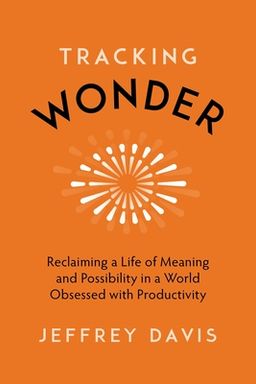
Tracking Wonder cover

Tracking Wonder

by Jeffrey Davis

Tracking Wonder is an inspiring guide to rediscovering the transformative power of wonder. Jeffrey Davis offers practical strategies to help you become happier, healthier, and more creative by embracing the childlike amazement we often lose in our busy lives.

Reclaiming Wonder in an Age of Productivity

How can you reawaken a sense of awe and curiosity in a world that never stops asking for more productivity? In Tracking Wonder, Jeffrey Davis argues that our modern obsession with efficiency and control has eclipsed our most vital human faculty—the ability to experience wonder. He contends that reclaiming wonder isn’t about retreating from reality but about learning to see the ordinary as extraordinary, transforming how you live, work, and create.

At the heart of Davis’s philosophy lies a conviction: wonder is not childish whimsy but a radical, grown-up practice. It is both an emotional experience and a skill set that can be cultivated. By tracking moments of wonder, Davis says, you can counterbalance society’s relentless call to “get things done” and instead live more creatively, resiliently, and connectedly. Drawing upon insights from psychology, mythology, neuroscience, and his own life as a writer and consultant, he offers a method for transforming daily life into a creative quest.

The Modern Crisis of Attention

Imagine your morning—emails, to-do lists, digital notifications. Davis opens by juxtaposing his own experience of “Piglet mind,” anxious and fretful, with a “summer camper” mind, open to possibility. This duality reflects the modern condition: we are conditioned to chase productivity and suppress stillness. The author argues that we live in a culture suffering from a bias against wonder. From the industrial revolution’s suspicion of daydreamers to millennial “workism” that equates endless labor with purpose, we’ve learned to undervalue curiosity in favor of measurable output.

Wonder, however, refuses productivity’s strict rules. It pauses, receives, and transforms. Davis likens it to a pebble dropped in the pond of perception—the ripples change how we see everything, from our relationships to our creative projects. When nurtured, wonder rewires the brain’s default mode network away from fret and regret toward openness and appreciation. Tracking these ripples, he suggests, can help us measure the true beauty and value of our lives.

Wonder as Counterculture and Catalyst

Davis’s central claim is revolutionary: “Wonder offers a beautiful counterbeat to our culture’s obsessive drumbeat of productivity.” Unlike happiness, which seeks stability, wonder invites uncertainty. It dissolves boundaries—between self and world, thought and emotion, artist and scientist. It cleans “the doors of perception,” to borrow William Blake’s phrase, revealing life as infinite, beautiful, and possible. It’s not escapism but engagement, making you more attuned to others, more compassionate, and more alive. He builds on thinkers like René Descartes, who called wonder the “first of all passions,” and Martha Nussbaum, who saw it as the root of empathy and love.

Wonder becomes both a spiritual and scientific practice. By cultivating it, we gain creative advantages similar to those of world-changing innovators—artists, entrepreneurs, and scientists—who stay open despite adversity. Davis’s method integrates research from positive psychology and neuroscience, showing that wonder activates dopamine pathways, enhances focus, and builds long-term resilience.

The Six Facets of Wonder

To make wonder practical, Davis introduces six facets: Openness (seeing anew), Curiosity (the rebel’s drive to explore), Bewilderment (embracing disorientation), Hope (finding possibility amid darkness), Connection (forming bonds through shared wonder), and Admiration (seeing excellence in others). Each facet represents a lens that refracts life’s light differently, offering unique ways to live more creatively and meaningfully.

Using stories from his clients and colleagues—from an Italian engineer improvising ventilator valves during the pandemic to an entrepreneur who named his company Big Ass Fans out of curiosity—Davis shows how wonder fuels real-world innovation and spiritual growth. The practice is simple yet profound: notice, pause, ask, reflect, and share. Through such acts, you train your “Wonder Eyes” to see the extraordinary right where you are.

Standing in Wonder as a Way of Life

Ultimately, Davis invites you to do more than encounter wonder—he calls you to stand in it. Standing in wonder means holding devotion to your creative calling, guided by curiosity and compassion rather than fear or rigid goals. It transforms your mindset from chasing success to cultivating meaning. You learn to see your work and relationships as parts of an interconnected “Indra’s Net,” where beauty, truth, and possibility ripple endlessly.

In an era of exhaustion and cynicism, Tracking Wonder is both antidote and invitation. Davis teaches that wonder is not fragile—it is a lifelong companion, ready to remind you that the mundane holds magic, the ordinary sparkles with mystery, and the creative quest is ongoing. By practicing wonder, you can rekindle your sense of possibility and make each day less about checking boxes and more about experiencing the fullness of this one life.


The Six Facets of Wonder

To bring wonder out of abstraction and into daily life, Jeffrey Davis defines six interlocking “facets” of wonder—distinct experiences that illuminate different parts of the human spirit. He compares them to a prismatic gem, each face catching a unique ray of light. When you learn to track these facets, you gain a fuller, more creative relationship with yourself and the world.

Openness: The Wide-Sky Facet

Openness is the ability to perceive something anew—to suspend judgment, drop cynicism, and see possibility. Davis calls it “intelligent naiveté,” the blend of grounded awareness and imaginative daring. Citing psychologist Mihaly Csikszentmihalyi, he notes that creative people are both smart and naïve. This paradoxical openness helps innovators like Carey Smith, founder of Big Ass Fans, lead with idealism rather than competition. Smith’s playful curiosity and refusal to follow orthodox business models made his brand a global success. For you, cultivating openness might mean visiting new places, engaging art, or simply choosing wonder over worry in small moments.

Curiosity: The Rebel Facet

If openness is receptive, curiosity is active. It’s the rebel’s spark that asks “What else is possible?” Davis illustrates this through the story of Cristian Fracassi, an Italian engineer who used a 3D printer to create emergency ventilator valves during Italy’s COVID crisis. Driven not by profit but compassion, Fracassi’s curiosity saved lives. Davis calls curiosity a mindset of continued learning and playful experimentation—similar to Todd Kashdan’s research showing that curious people report higher life satisfaction and meaning.

Bewilderment: The Deep Woods Facet

Bewilderment is wonder’s wild side—the disorienting feeling of getting lost and found again. Davis’s own experience of walking through the forest after his house burned became a metaphor for creative confusion as fertile soil. Clients like video game designer Tracy Fullerton, who transformed Walden into an artful interactive experience, show how confusion can lead to transformation. To “fertilize confusion” is to turn uncertainty into creativity.

Hope: The Rainbow Facet

Amid despair or darkness, hope refracts the light of possibility. Davis recalls naturalist Nikki van Schyndel witnessing bioluminescent algae while stranded at sea—a radiant reminder that wonder brings strength in adversity. Psychologist C.R. Snyder’s “hope theory,” which Davis cites, suggests that hopeful people pair optimism with intentional planning. Hope, then, is not wishful fantasy but active imagination—the power to see a way forward.

Connection: The Flock Facet

Wonder binds people together. Watching starlings murmurate with his daughter, Davis realized that true collaboration requires synchronicity and empathy. Drawing on psychologist Barbara Fredrickson’s idea of “Love 2.0,” he argues that connection is an embodied resonance—shared awe that dissolves judgment. Through listening and curiosity, we move from “Do It Yourself” individuality to “Do It Together” collectivity. This facet guides teamwork, family relationships, and leadership.

Admiration: The Mirror Facet

Admiration turns wonder outward. When Davis saw David Bowie shapeshift on stage, he felt awakened to creative courage. Admiration is different from envy or idolization—it’s “wonder mingled with reverence.” You learn by witnessing excellence that mirrors your own potential. The psychologist Jonathan Haidt calls these “other-praising emotions,” experiences that energize growth. For Davis, admiration culminates in gratitude, humility, and the realization that your own life can inspire others in turn.


Your Young Genius

What happens to the wonder you had as a child—the fearless curiosity, the joy of making things, the wild imaginative play? Davis proposes that within each of us lives our young genius, the innate force of character we displayed when we were seven years old. This genius, akin to Aristotle’s daemon or guiding spirit, still resides within, waiting to be reclaimed. Rediscovering it can be key to reigniting creativity and meaning in adulthood.

Remembering Your Seven-Year-Old Self

Psychologists Darya Zabelina and Michael Robinson discovered that adults who imagine themselves as seven-year-olds generate more original ideas. Davis uses this research to create exercises that help you write, draw, or think from a child’s mindset. When participants adopt youthful playfulness, their problem-solving becomes more imaginative.

Stories from creative leaders illustrate this. Curator Denise Markonish recalls collecting rocks as a child—a practice that foreshadowed her career organizing art exhibitions. Jonathan Fields, host of the Good Life Project podcast, tells of building “Franken-bikes” from scrap parts, embodying playful exploration. These examples show that the seeds of adult genius are often planted in childhood obsessions and improvisations.

Living with Your Daemon

Drawing from Greek philosophy, Davis explains that genius was once viewed not as a rare IQ trait but as a “guardian spirit” unique to each person. This daemon reminds you of your true calling and character. When you align with it—through activities that feel effortless and joyful—you achieve what Aristotle called eudaemonia, flourishing through purpose.

Bringing Your Young Genius to Work

Reclaiming your young genius isn’t nostalgia—it’s a strategy. Davis describes workshops where executives draw “Wild Things” inspired by Maurice Sendak’s classic children’s book. Through play, professionals loosen rigid habits and reconnect with imaginative qualities—boldness, curiosity, humor—that improve collaboration. When one participant feared seeming foolish, Davis reminded her that intelligence and creativity thrive in openness, not caution.

To live creatively, you must bring your seven-year-old self to work with you. Genius, Davis writes, is “the capacity to recapture childhood at will.” Reclaiming this inner playfulness can transform the adult drive for productivity into a joyous pursuit of possibility.


Fertilizing Confusion: Wonder Through Adversity

Life’s hardest moments—loss, illness, failure—can become portals to creative renewal. Davis introduces the facet of bewilderment as an invitation to “be wilder,” to transform uncertainty into growth. His own experience of losing his home to fire and battling Lyme disease became a crucible for rediscovering wonder. Rather than fleeing confusion, Davis learned to feel it, celebrate it, and fertilize it.

Feeling and Celebrating Confusion

Bewilderment feels disorienting, yet it opens perception. Davis likens it to Dorothy landing in Oz or Alice tumbling down the rabbit hole—the familiar dissolving into mystery. Author Tony Robbins even encourages audiences to applaud confusion, acknowledging it as a bridge between one level of understanding and the next. Neuroscientific research backs this perspective: infants learn best when surprised, and adults remember information tied to wonder more vividly.

Holding the Space Between

During turbulence, Davis teaches the practice of conscious breathing to shift physiology from fear to curiosity. Exhalation slows the heart and activates the vagus nerve, restoring openness. This technique resembles mindfulness traditions that emphasize the pause between breaths—what ancient Sanskrit texts called unmesa, the gateway to consciousness. In that pause, wonder emerges as spacious awareness.

From Confusion to Creation

Davis’s clients illustrate the power of “fertile confusion.” Game designer Tracy Fullerton turned bewilderment after the dot-com crash into creativity, creating an immersive meditation on Thoreau’s Walden. Journalist Kerra Bolton, having left politics to become an artist and filmmaker, found a new identity in the space between loss and reinvention. These stories reveal that not knowing can lead to discovery—what Davis calls “creative bewilderment.”

Rather than avoid confusion, you can harness it. Feel it fully, breathe through it, and ask, “What is this teaching me?” Confusion fertilized by wonder becomes the soil from which creative breakthroughs grow.


Hope: The Rainbow After the Storm

Hope, for Davis, is not naïve optimism but a proactive facet of wonder—the bright prism that refracts light through darkness. Using vivid real stories, he shows how wonder can restore possibility amid despair. Psychologists like C.R. Snyder and Shane Lopez confirm that hopeful thinking correlates with resilience, wellbeing, and achievement. Hope is both emotional and strategic: believing the future will be better and knowing how you’ll help make it so.

Finding Light in Adversity

Davis illustrates this through naturalist Nikki van Schyndel, who saw phosphorescent algae sparkling around her oars while stranded at sea. That beauty gave her strength to row toward safety—a literal vision of hope’s radiance. Wonder reframes suffering as connection to something larger. As philosopher Spinoza wrote, “There is no hope unmingled with fear.” Hope transforms fear into motion.

Daydreaming as a Discipline

According to psychologist Jerome Singer, daydreaming—often dismissed as unproductive—is essential to hope. But you must do it deliberately. Constructive daydreams allow you to visualize paths toward goals rather than flee reality. When you imagine your future in detail, you strengthen motivation and clarity.

Faith, Creation, and Sharing

Musician Nick Cave’s grief after his son’s death nearly extinguished his creativity. Through honest connection with fans and writing music in community, he rediscovered wonder as “the center” of his artistic life. Likewise, entrepreneur Lee Rankin’s gaze into an alpaca’s eyes led her to build a sanctuary farm—a manifestation of hope through action. Both turned loss into service, embodying hope’s lesson: beauty can return if you create and connect.

Hope invites you to daydream your way forward, to take small steps toward your vision, and to surround yourself with people who reflect possibility. Through wonder, even adversity becomes a rainbow—the mind’s prism refracting light from the storm.


Connection and Admiration: Wonder Between Us

Wonder is rarely solitary. Davis shows that our deepest awe arises in relationships—moments when minds and hearts sync like murmuring starlings. The facets of Connection and Admiration reveal how wonder flows between people, dissolving bias, building trust, and amplifying creativity. Together, they form the social dimension of a wondrous life.

The Flock Facet: Do It Together

Modern isolation erodes empathy and meaning. Drawing from psychologist Barbara Fredrickson’s Love 2.0, Davis reframes love as “resonance”—mutual presence in shared moments of awe. In these micro-moments, physiologies synchronize, oxytocin flows, and trust grows. This insight inspired Davis’s concept of “Do It Together” (DIT), replacing the myth of doing everything alone. Teams thrive when members share wonder, listening with openness instead of judgment.

His workshops feature “Wonder Talks,” pairs of participants facing each other to recall joyful places from memory. Through eye contact and deep listening—what Davis calls “listening with your feet”—participants experience connection as embodied wonder. These experiments echo Martin Buber’s idea of I-Thou communion, where human presence becomes sacred.

The Mirror Facet: Admiration Without Envy

Admiration, Davis says, is “wonder mingled with reverence.” Watching David Bowie perform sparked his realization that witnessing another’s excellence can awaken your own. Studies by psychologists Jonathan Haidt and Sara Algoe show that admiration inspires self-improvement. Unlike envy—which breeds scarcity—admiration energizes growth. Davis distinguishes “benign envy,” which motivates, from “malicious envy,” which corrodes. You can turn comparison into inspiration by identifying what specific quality you admire and cultivating it in yourself.

Poet Lucille Clifton’s encounter with Harvard’s youthful students transformed envy into creation when she wrote “what the mirror said,” celebrating her body’s power. Admiration, Davis explains, reflects our shared humanity—it helps us see beauty in others and in ourselves. When genuine, it spreads joy both ways, like mirrors reflecting infinite light.

Connection and admiration remind you that wonder is reciprocal. You open, listen, praise, and are praised. Through this mutual reflection, you and others stand in wonder together—each a jewel in Indra’s Net, shining toward the next.


Standing in Wonder: Living Devotion Every Day

In the closing chapters, Davis shows how wonder matures from fleeting moments into an embodied way of living. To stand in wonder means to move beyond the search for inspiration—to serve something larger than yourself with devotion, creativity, and care. Like love in Erich Fromm’s The Art of Loving, wonder becomes an art of attention and dedication. It is not falling for beauty but standing in it.

Devotion, Dream, and Action

Wonder requires devotion. Davis invites you to ask, “What am I devoted to?”—courage, creativity, compassion? Naming your devotion transforms goals into values-driven endeavors. He calls these dream endeavors—projects that align personal meaning with service to others, whether a business, book, or home. Devotion anchors action in soulfulness rather than ambition, echoing Gandhi’s idea that “action without devotion” becomes dry routine.

Deflecting Detractors and Embracing Naiveté

To stay devoted, you must face fears of failure and ridicule. Davis offers the “Miles Davis shrug”—a jazz-like response of confidence: “So what?” When critics or self-doubt arise, shrug and continue improvising. This attitude sustains intelligent naiveté, the courage to keep experimenting.

Creating Spaces of Wonder

Physical environments matter. Davis describes designing his studio after a fire into zones of creativity—Get-It-Done, Dream-It-Up, Reverie. Even small rituals, like displaying natural materials or taking 40-second nature breaks, nurture wonder’s presence. He encourages creating “Wonder Labs” at home or work where imagination and rest coexist.

Gifting Wonder

Standing in wonder ultimately means sharing it. Davis’s clients create “destination dinners,” spontaneous family adventures that lift spirits during hard times. Artist Amy Sherald painted Michelle Obama’s portrait as a gift of representation; a little girl’s awe before that painting became another ripple of wonder. To gift wonder is to elevate others’ experience, transforming creativity into connection.

In his final “Five Wishes,” Davis envisions a culture rooted in wonder: bringing it home to families, restoring it to education, infusing it into work, honoring the mind’s mysteries, and revering nature. To live creatively, you must stand in wonder—not briefly glance at it, but dwell in its light. When you do, all ordinary days shimmer with possibility.

Dig Deeper

Get personalized prompts to apply these lessons to your life and deepen your understanding.

Go Deeper

Get the Full Experience

Download Insight Books for AI-powered reflections, quizzes, and more.