
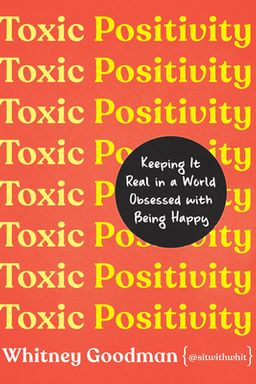
Toxic Positivity cover

Toxic Positivity

by Whitney Goodman

Toxic Positivity by Whitney Goodman unveils the hidden dangers of society''s obsession with happiness. It challenges the superficial pursuit of positivity and offers practical strategies for embracing genuine emotions and fostering authentic human connections.

Breaking Free from the Pressure to Always Be Positive

When was the last time someone told you to "look on the bright side"—and you felt worse afterward? In Toxic Positivity, therapist Whitney Goodman tackles a cultural epidemic of forced happiness and explains why our obsession with cheerfulness often leaves people feeling dismissed, shamed, and disconnected. Goodman contends that positivity is not inherently bad, but when it’s used to deny reality, silence pain, or shame people for struggling, it becomes deeply harmful.

Goodman draws on her clinical experience and personal reflections to show how we use positivity as a shield. From the workplace to religion, healthcare, and relationships, she demonstrates how cultural pressure to be upbeat—what she calls the “good vibes only” trap—has infiltrated nearly every domain of life. Rather than helping us, this compulsive optimism enables emotional avoidance, perpetuates inequality, and keeps us from genuine connection.

What Is Toxic Positivity?

You’ve probably experienced it when someone minimized your problems by saying, “It could be worse” or “Everything happens for a reason.” Goodman defines toxic positivity as the denial or invalidation of authentic emotions in favor of superficial cheerfulness. In one example, she describes losing your job and hearing a friend say, “At least you’ll have more free time!”—a phrase that shuts down real empathy and dismisses fear or grief. Far from uplifting you, this reaction isolates you and fills you with shame for not being grateful enough.

Healthy positivity, Goodman explains, acknowledges both reality and hope. It is grounded in authenticity, timing, and compassion. Toxic positivity, in contrast, forces endless happiness regardless of circumstances—creating pressure to suppress feelings and perform wellness. This distortion of emotional expression harms individuals and society by making sadness seem pathological and struggle seem like personal failure.

Why It Matters in a "Good Vibes" World

The pursuit of happiness has become both a goal and an obligation. Goodman traces this mindset back centuries, from Calvinist guilt to New Thought philosophy and the modern self-help movement. In the 20th century, books like The Power of Positive Thinking cemented the idea that our thoughts alone control our reality—a belief that still fuels social media slogans, gratitude journals, and manifestation trends. But as research shows, relentless positivity doesn’t make people happier. Instead, it contributes to isolation, burnout, and even physical stress (Goodman cites studies showing suppression worsens mood and health).

In our workplaces, healthcare systems, and interpersonal relationships, this fixation on positivity is often weaponized to ignore real problems—from discrimination to disease. A “stay strong” mantra sounds caring, yet it prevents people from expressing pain. Whether it’s telling cancer patients to “keep fighting” or marginalized individuals to “just love everyone,” this rhetoric prioritizes comfort for the speaker rather than healing for the listener.

What This Book Offers

Across nine chapters, Goodman walks readers through each dimension of toxic positivity: how it operates, where it hides, and what to do instead. She shares stories of clients like Alissa, the overworked lawyer shamed for not being grateful, and Luis, who used manifesting to suppress trauma. Through these narratives, Goodman emphasizes that emotional complexity is not a flaw—it’s a sign of being human.

The book’s second half is practical. It teaches how to process emotions, complain effectively, support others without falling into platitudes, and balance gratitude with honesty. Goodman shows readers how to practice emotional authenticity—making space for both joy and discomfort. She argues that true connection requires vulnerability, not perfection. Positivity becomes genuinely helpful only when it coexists with truth, empathy, and compassion.

The Big Picture: Why We Need Realism, Not Relentless Cheer

The heart of Goodman’s message is liberation—from the pressure to be happy all the time. She reminds readers that every human deserves to feel the full range of emotions, not condemn themselves for sadness or anger. By confronting toxic positivity, we reclaim authenticity, strengthen relationships, and create space for systemic change. After all, some things should make us uncomfortable—grief, injustice, pain. Feeling these emotions is not weakness; it’s the gateway to growth.

Key takeaway:

Stop chasing happiness at all costs. Make room for the full human experience—the beautiful, the difficult, and the messy. By honoring our emotions rather than denying them, we find a deeper kind of peace that no motivational quote can manufacture.


The Making and Mechanics of Toxic Positivity

Whitney Goodman traces the roots of our obsession with positivity back through centuries of Western thought. What began as spiritual optimism eventually morphed into psychological dogma and corporate branding. Understanding this history helps you see how deeply entrenched the demand for happiness has become—and why it feels almost dangerous to challenge it.

From Calvinists to Self-Help Gurus

Early American Calvinists viewed idleness and pleasure as sinful, teaching that salvation was predetermined. People were miserable under this heavy religious burden. In the 19th century, the New Thought Movement offered a brighter alternative: believe in Spirit, think positively, and you could cure illness or manifest wealth. It was pseudo-scientific but wildly appealing. Figures like Phineas Quimby and Mary Baker Eddy claimed all disease stemmed from wrong thinking—a concept that later shaped The Secret and modern manifestation culture.

By the early 20th century, positivity became America’s unofficial religion. Napoleon Hill’s Think and Grow Rich equated optimism with success. Norman Vincent Peale’s The Power of Positive Thinking (1952) transformed religious faith into motivational psychology. The message was clear: happiness and success were moral obligations, and negativity was failure.

Science Joins the Cheer Squad

Even psychology participated. Early researchers in the eugenics era argued that cheerful emotional control marked “higher” forms of humanity, while negative emotions indicated weakness. Darwin’s theories were misused to justify social hierarchies—those who smiled and “controlled emotions” were considered evolutionarily superior. (Note: Oksana Yakushko’s Scientific Pollyannaism explores this bias in detail.) Positivity was reframed as a sign of intelligence and moral purity, cementing the stigma against sadness, anger, and dissent.

Pop Culture’s Positivity Machine

Today, the demand for happiness has become commercialized. “Good vibes only” slogans appear on mugs, Instagram posts, and motivational seminars. A global multibillion-dollar industry now profits from selling cheerfulness—what Goodman calls “positivity capitalism.” From body positivity campaigns to corporate morale boosters, society insists that happiness is not only attainable but mandatory. Those who question it are scolded for being negative.

The Paradox of Happiness

Goodman highlights a modern paradox: the more we chase happiness, the less happy we become. Research supports this—studies show that valuing happiness too intensely leads to lower well-being (Iris Mauss, UC Berkeley). The endless pursuit traps us in guilt whenever we fall short. Like her client Tory, who plastered affirmations on her mirror yet felt empty, we confuse positivity with self-worth and end up blaming ourselves when it doesn’t work.

Key takeaway:

Positivity became toxic when it moved from hope to doctrine—from a tool for resilience to a demand for perfection. Understanding its roots reveals that our discomfort with sadness isn’t personal weakness; it’s cultural conditioning centuries in the making.


The Real Costs of Forced Cheerfulness

Goodman emphasizes that toxic positivity isn’t harmless. Its psychological and physical tolls ripple through workplaces, families, and even public health systems. What looks like optimism often conceals denial, shame, and isolation. When we suppress our emotions, we don’t become stronger—we get sicker, angrier, and more disconnected.

Emotional Suppression Hurts

Research confirms that suppressing emotions increases stress hormones and blood pressure, diminishes memory, and raises the risk of heart disease and diabetes. Goodman cites studies showing that the act of suppression itself—whether of sadness or joy—creates physical strain. Her client Dave, a smiling alcoholic, illustrates this perfectly. Obsessed with appearing “happy,” he could no longer access real feelings. His relentless cheer masked unresolved pain, making recovery nearly impossible.

Social and Workplace Fallout

In corporate culture, positivity becomes mandatory. Goodman describes law associate Alissa, whose boss demanded “higher morale” while employees burned out under impossible workloads. Every complaint was labeled negativity. The result? Groupthink, silence, and diminished creativity. Research by Peter Senge and Jacinta Jiménez supports Goodman’s claim: creative tension and healthy disagreement are essential for innovation. Without space for negativity, companies stagnate.

Positivity as Gaslighting

Toxic positivity frequently morphs into subtle emotional gaslighting—convincing someone their pain isn’t real. This can show up in relationships (“You’re too sensitive”), healthcare (“Just stay hopeful and you’ll recover”), or spirituality (“Pray the fear away”). For individuals like Alex, a young cancer patient, forced optimism robbed him and his mother of genuine intimacy in his last months. Denial prevented them from grieving or saying goodbye. Goodman makes clear that positivity used to avoid discomfort often deepens it.

A Cultural Cycle of Shame

When happiness becomes a moral virtue, sadness turns into shame. People internalize failure for feeling human emotions. Goodman calls this the “positivity shame spiral”: we feel bad, shame ourselves for feeling bad, and then feel worse for not being able to fix it with affirmations. Instead of self-improvement, we cultivate self-rejection. Escaping this loop requires radical acceptance—allowing emotions to exist without judgment or hierarchy.

Key takeaway:

Positivity becomes toxic when it denies reality. Emotions are not problems to fix; they are signals to feel and understand. When we replace shame with acceptance, discomfort becomes a doorway to connection and growth.


How to Feel Without Shame

After diagnosing the problem, Goodman teaches how to repair the damage. The antidote to toxic positivity is emotional literacy—the ability to identify, feel, and share your emotions safely. This chapter offers practical strategies for doing just that, drawing from Acceptance and Commitment Therapy, emotional neuroscience, and her clinical work.

Labeling and Processing Emotions

Emotions start in the body before they reach the mind. Goodman recommends a daily “body scan” to notice sensations—tight chest, clenched jaw, fluttering stomach—and identify what feelings they signal. Naming emotions reduces their intensity; studies show labeling activates brain areas that calm distress (Matthew Lieberman, UCLA). She suggests moving from “I am sad” to “I feel sadness,” reminding yourself that emotions are temporary experiences, not identities.

Healthy Expression

Once you’ve named a feeling, let it move through you. Goodman offers methods like breathing, crying, journaling, movement, humor, or creative activity. She notes that emotions have a physical cycle—rise, peak, and fall—and suppression keeps them stuck. Even small rituals like talking with a friend or writing down what you feel act as release valves. Sharing emotions is not weakness but biological necessity: humans are wired to connect (see research by Gareth Cook, Scientific American).

Avoiding Extremes

Goodman warns that both under- and over-expression can be harmful. Never showing feelings leads to disconnection, while broadcasting every emotion can overwhelm others and backfire. The goal is balance—contextual expression. She encourages identifying safe people and spaces for emotional sharing, using cues like trust, listening, and mutual respect.

Making Room for Gratitude Without Shame

Gratitude, often used as the weapon of toxic positivity (“Be thankful—it could be worse!”), can actually support emotional health when paired with validation. Goodman proposes a simple formula: first validate your pain (“This is hard”), then add perspective (“And I’m thankful for support”). Gratitude is healthiest when voluntary, not obligatory. She reminds readers that both grief and gratitude can coexist.

Key takeaway:

You don’t need to replace sadness with joy—you need to let sadness breathe. Emotions lose power when you give them a name, a body, and a voice. Feeling authentically is not self-indulgent; it’s psychological survival.


Complaining as a Path to Connection

One of the book’s surprising lessons is this: complaining isn’t bad. In fact, Goodman calls it a vital form of communication. You complain not because you’re negative, but because you need connection, feedback, or change. The trick is to do it effectively.

Why We Complain

Humans complain to bond, vent, or solicit help. Goodman’s client Sam came to therapy mainly to “get things off his chest,” and though it seemed repetitive, it helped him process stress. Complaints reveal values—what you care about most. They also build solidarity; people empathize through shared frustrations (“Me too!” moments).

The Wrong Way to Complain

Complaining becomes harmful when it turns cyclical or helpless—what psychologist Eric Berne calls the “help-rejecting complainer.” These people don’t want solutions, only sympathy, leaving listeners drained. Goodman suggests avoiding complaint loops by practicing radical acceptance—acknowledging reality even when it hurts. Acceptance doesn’t mean approval; it means ending the futile fight against what is.

The Right Way to Complain

Effective complaining includes clarity, purpose, and audience. Goodman outlines eight steps—from identifying your core issue to choosing who can actually help. When done right, complaints drive change, not despair. Every movement for justice, she reminds us, started as a complaint. Speaking discomfort aloud is the beginning of transformation.

Key takeaway:

Complaining isn’t negativity—it’s communication. When you speak your pain clearly and compassionately, it becomes connection, not contagion.


Supporting Others with Authentic Empathy

Learning to support someone without platitudes might be the book’s most practical lesson. Goodman explains how to replace “Just be positive” with real empathy, curiosity, and presence. Good intentions matter, but the impact of what you say matters more.

Intent vs. Impact

We often defend ourselves by saying, “I didn’t mean to hurt you.” Goodman contrasts intention (“I want to help”) with impact (“My words dismissed their pain”). True empathy triages impact first. Validate before explaining. She offers practical phrases like “It makes sense you’d feel that way” or “I appreciate you sharing this with me.” Understanding doesn’t require agreement—it requires compassion.

How to Listen

Support begins with curiosity. Ask open-ended questions, eliminate distractions, and resist fixing. Goodman’s framework—Curiosity → Understanding → Validation → Empathy—creates a chain reaction that builds trust. Avoid clichés like “Everything happens for a reason”; they end the conversation rather than deepen it. Listening itself is healing.

Boundaries in Helping

Helpers must also protect themselves. Goodman confesses she once tried to fix everyone—clients, friends, family—and burned out. Now she teaches compassionate distance: make space for pain without carrying it. You can say, “I want to support you, but I’m depleted today. Can we talk tomorrow?” Boundaries transform empathy from crisis to sustainability.

Key takeaway:

You don’t need perfect words—you need genuine presence. Empathy isn’t fixing someone’s pain; it’s standing beside them while they feel it.


Finding Fulfillment Beyond the Pursuit of Happiness

In the final chapters, Goodman redefines what happiness actually means. The goal isn’t constant pleasure—it’s fulfillment, a life aligned with your values and equipped to handle both joy and hardship. When you stop chasing happiness as an outcome, you free yourself to experience it as a byproduct.

Opting Out of the Happiness Race

Research shows that the more we value happiness, the less happy we become. Goodman encourages readers to quit trying to force bliss and instead define what truly matters to them. She contrasts a “happiness-driven life”—focused on good moods and social approval—with a “value-driven life,” which prioritizes authenticity. As she puts it: living your values will sometimes feel uncomfortable, but discomfort is not failure. It means growth.

Balancing Validation and Motivation

Goodman offers a nuanced alternative to both self-pity and toxic motivation: validate, then gently push. When faced with struggle, start by acknowledging your feelings (“This is hard”) before moving into action (“I’ll try again tomorrow”). This blend of compassion and momentum transforms setbacks into development. Shame freezes progress; validation melts it.

Escaping the Self-Help Trap

Perhaps the most refreshing idea: you don’t have to be healing all the time. Goodman cautions against turning growth into obsession—a kind of emotional perfectionism. True wellness includes rest, laughter, imperfection, and play. You can read self-help books without becoming their project. Improvement is not a race; it’s a rhythm.

Redefining Positivity

In her closing chapters, Goodman distinguishes helpful positivity from toxic positivity: the former validates emotions before finding silver linings; the latter denies them. Healthy positivity coexists with darkness and enables resilience. As Goodman’s final reminder goes, “Allow yourself to experience what it means to be human—the good and the bad.”

Key takeaway:

A fulfilling life isn’t constant happiness—it’s emotional honesty. Opt out of good-vibes-only culture and craft a life that honors your values, emotions, and capacity for both joy and struggle.

Dig Deeper

Get personalized prompts to apply these lessons to your life and deepen your understanding.

Go Deeper

Get the Full Experience

Download Insight Books for AI-powered reflections, quizzes, and more.