
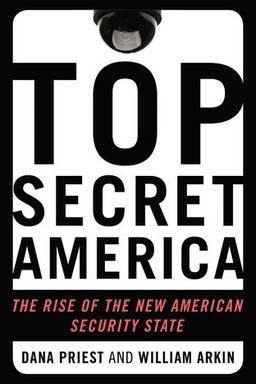
Top Secret America cover

Top Secret America

by Dana Priest and William M Arkin

Top Secret America dives into the clandestine world of U.S. security agencies post-9/11, exposing the inefficiencies and dangers of a system shrouded in secrecy. Discover the urgent need for transparency to safeguard democracy and freedom.

The Making of Top Secret America

How does a democracy respond when fear and secrecy collide? In Top Secret America, Dana Priest and William Arkin trace how the United States built an immense, parallel security world after September 11, 2001—a classified empire of agencies, contractors, and systems that now operates largely beyond public sight. The authors argue that this hidden universe was born from urgency and fear but sustained by politics, profit, and institutional inertia. It redefined not only the geography of Washington but the boundaries between war, intelligence, and ordinary life.

A Sudden Birth Under Crisis

After the 9/11 attacks, Congress and the White House flooded the national security system with emergency money and virtually unlimited authority. A $40 billion package was treated as a "down payment" on safety. On September 17, 2001, President Bush signed a broad Presidential Finding authorizing covert global operations—effectively giving the CIA the green light for paramilitary activity and broad surveillance. The new mantra became the Global War on Terror (GWOT), a framework that transcended traditional boundaries and created sprawling programs with minimal oversight.

Secrecy as Momentum

You see a system where secrecy generates its own power. Classification, initially meant to protect, became a shield against scrutiny. Politicians and bureaucrats realized that shutting down programs carried risk—if anything went wrong after a cut, careers could end. “Who wants to be the guy that says we don’t need this anymore and then something happens?” asked National Security Adviser James Jones. In that logic, the safest political move was continuation, even if utility was unclear. (Note: This is a recurring theme across Priest’s reporting on military bureaucracy—fear of blame creates institutional permanence.)

The Hidden Expansion

As programs multiplied, oversight fractured. By 2010, roughly 1,074 federal organizations and nearly 2,000 private companies worked at top secret levels in 17,000 locations. The Defense Intelligence Agency doubled in size; the NSA expanded to Pentagon-scale facilities at Fort Meade. Supplementals and classified annexes disguised billions in spending. The result was duplication—sometimes twenty-one separate federal cyber units, several redundant counter-IED groups, and multiple propaganda arms—all designed to fight terrorism yet often competing for jurisdiction and funding.

A Nation Rebuilt Around Secrecy

The authors map this new geography not metaphorically but literally. Around Washington, invisible cities of secrecy arose—Fort Meade, Crystal City, Reston, and St. Elizabeths—housing thousands of workers in fortified office parks and Sensitive Compartmented Information Facilities (SCIFs). These unmarked buildings became monuments to hidden governance, often only steps from schools and public spaces. Contractors followed, creating a dense security economy where local businesses thrived on classified work they could not openly describe.

The Cultural and Ethical Cost

Beyond budgetary excess, Priest and Arkin highlight how secrecy reshapes identity and culture. Inside Top Secret America, clearance is social status; silence is etiquette. From polygraph labs in Fort Jackson to underground archives in Boyers, Pennsylvania, the vetting system scrutinizes loyalty and trust through bureaucratic rituals. Meanwhile, the revolving door between government and contractors—figures like Michael McConnell, Michael Hayden, and Michael Chertoff—turns insider knowledge into corporate profit. These intertwined elites make accountability difficult and blur the line between public service and private gain.

The Core Argument

Priest and Arkin do not argue against intelligence or defense. They argue against opacity and inertia: a system that grows because it can, not because it should. The secret world’s motto—protect everything, reveal nothing—erodes democratic control and public trust. Whether through drone strikes in Pakistan, fusion centers at home, or secret budgets buried in annexes, Top Secret America represents a structural contradiction: the pursuit of safety that, unchecked, undermines transparency, efficiency, and constitutional balance. You are left with a pressing question—how much secrecy can freedom afford?


Compartmentalization and the Problem of Oversight

You enter a universe where knowledge is sliced into fragments. The post-9/11 state invented a new architecture of compartmented secrecy: Controlled Access Programs (CAPs) and Special Access Programs (SAPs). Each program is a locked drawer—visible in title but concealed in content. The CIA’s Greystone project, encompassing renditions and secret prisons, exemplifies this system. It reduced participation to a microscopic circle, excluding many cabinet officials and congressional overseers.

The Mechanics of Hidden Compartments

A BIGOT list determines who is 'read in.' Unless you’re on that roster, you have no lawful right to know—even if you hold a top secret clearance. The ODNI’s Controlled Access Program Coordination Office (CAPCO) tries to catalogue these compartments, but even that office only holds names and rationales, not details. James Clapper summarized the absurdity: “There’s only one entity in the universe that has visibility on all SAPs—that’s God.” Oversight disintegrates when no human can see the full system.

Greystone and Blind Accountability

Greystone’s ultra-secret nature was meant to protect sources and methods, but isolation also hid abuse. Operating through front companies and leased aircraft, the CIA ran detention centers across Europe and Africa. By the time leaks exposed the program, damage was done—alliances strained, U.S. credibility bruised. The secrecy designed to prevent scandal inadvertently amplified it.

Secrecy’s Analytical Cost

The Curveball debacle—false claims about Iraqi biological weapons—shows how compartmentalization corrupts judgment. Rafid Ahmed Alwan’s reports were sealed so tightly that cross-checking was impossible. Analysts outside his compartment could neither test credibility nor question flaws. The authors use this as emblematic: secrets meant to ensure precision instead produce blindness.

Transparency and Resilience

The authors stress a paradox: secrecy doesn't only protect success—it prevents learning. A healthy system needs transparency not just for ethics, but for accuracy. Without clear lines of vision, the risk of failure multiplies.


Duplication, Waste, and the Intelligence Overload

When you imagine an intelligence surge, you likely picture sharper responses and better performance. Priest and Arkin reveal the opposite: expansion led to redundancy, confusion, and inefficiency. Thousands of analysts, units, and missions overlap. It’s a world where everyone collects dots but no one connects them.

The Scale of Bureaucratic Growth

By 2010, the Pentagon and intelligence agencies had built 33 large top secret complexes around Washington, adding space equal to nearly three Pentagons. Within those walls, 1,074 federal organizations and nearly 2,000 contractors pursued similar missions—counterterrorism, cyber defense, intelligence analysis. DIA doubled its size; NSA’s workforce exploded. Those numbers suggest might, but they often meant overlap and competition.

Examples of Redundant Systems

  • Cyber units proliferated: over twenty separate ones before Cyber Command unified them.
  • Anti-IED programs proliferated across services with duplicated contractors worth billions.
  • Influence operations ballooned from $9 million to nearly $1 billion in overlapping propaganda budgets.

With vast resources but scattered oversight, agencies raced to grow rather than cooperate. Analysts, often inexperienced, produced 50,000 reports a year—many repetitive or ignored. Senior leaders like Michael Leiter and James Clapper lamented missed signals, such as the failed detection of Umar Farouk Abdulmutallab’s plot. In a system obsessed with gathering, the act of understanding suffered.

Efficiency vs. Expansion

The authors conclude that redundancy is not harmless—it wastes money and blurs accountability. Constant growth, justified by safety, becomes counterproductive when it overwhelms the very process needed to prevent threats.


Domestic Defense and Mapping the Homeland

Top Secret America isn’t limited to foreign battlefields—it maps the United States itself. Northern Command (NorthCom) and the National Geospatial-Intelligence Agency (NGA) built the concept of “One Nation, One Map,” a classified picture of domestic infrastructure so detailed that commanders can query any square mile for airports, hospitals, chemical plants, or bridges. It’s the domestic mirror of overseas targeting—an attempt to make the homeland fully knowable.

Data Layers and Massive Datasets

After anthrax and terror scares, planners catalogued over eleven million data points—utilities, emergency services, industrial sites, and public venues. NorthCom fused databases like MI-DB and GIANT to offer real-time situational awareness. Massive drills such as Vibrant Response tested this mapping for nuclear disaster scenarios, but auditors found plans vastly exceeded what available forces could execute.

Profiling and Ethical Risks

Mapping also means classifying citizens. Contractors compiled mosque locations while churches were listed only by size, creating concerns about bias and surveillance creep. Analysts tracked categories such as 'Muslims in America,' prompting legislative inquiries. Priest and Arkin suggest that total visibility often blurs into partial profiling—a recurring dilemma of data-driven security.

Awareness vs. Action

Information does not equal preparedness. A perfectly mapped country can still fail in response if politics, logistics, or law lag behind. Awareness without accountability is only surveillance, not defense.


Domestic Surveillance and Civil Liberties

Parallel to mapping came monitoring. Fusion centers, Suspicious Activity Reports (SARs), and the FBI's Guardian database turned everyday law enforcement into nodes of national intelligence. The goal was to detect lone actors; the result was an ocean of ambiguous data.

From Streets to Databases

Janet Napolitano promoted “See Something, Say Something,” linking local tips to federal servers. By 2010, Guardian stored over 161,000 ‘suspicious’ files. Many originated from lawful activities—people taking photos, attending rallies, or carrying backpacks. Fusion centers repeated mistakes: reports on environmentalists and clergy surfaced, turning watchlists into chronicles of civic life rather than terrorism.

Technology and Uneven Scrutiny

Police departments bought gadgets once reserved for war zones—thermal cameras, license-plate readers, mobile towers. In Memphis, real-time tracking streamlined arrests but deepened racial inequities. A single database beep could trigger a stop that subjects families to intrusive questioning. The authors warn that efficiency can mask discrimination when surveillance systems outpace oversight.

The Unresolved Dilemma

You can have broad surveillance to catch potential threats—or strict civil-liberty protections to ensure freedom. Doing both effectively remains the central unsolved challenge of the homeland-security era.


The Private Security Economy and Revolving Power

The authors expose how Top Secret America functions as both a government system and a corporate marketplace. Contractors—General Dynamics, Booz Allen Hamilton, and smaller firms like Abraxas—supply missions from analytics to interrogation, often at higher cost than federal work. Profit merges with policy, reshaping priorities and incentives.

Scale and Dependency

Contractors account for nearly half of personnel spending while forming less than one-third of the workforce. Salaries and sponsorships blur ethical lines; vendors host lavish conferences, sponsor military galas, and court agency decision-makers. Robert Gates’s warning that contractors cost 25 percent more largely went unheeded—the system adapts around them because they deliver speed and expertise.

The Revolving Door

Figures like Michael McConnell and Michael Hayden illustrate the movement from public office to private profit. The Chertoff Group and Booz Allen market their founders’ access as a product. INSA events where corporate executives dine with agency heads symbolize this elite overlap. As policy becomes a marketplace, trust and independence erode.

Profit Meets Patriotism

When contracts define national-security capacity, patriotic motives mix with revenue goals. The authors caution that a democracy must sustain real public competence—not just purchase it from shareholders.


Drones, JSOC, and the Remote Battlefield

The military side of Top Secret America reveals how technology transformed war itself. Unmanned drones and Joint Special Operations Command (JSOC) created a model of perpetual, remote engagement. Operators fire missiles from distant cubicles; commandos launch raids with real-time data streamed from satellites.

The Drone Revolution

The U.S. drone fleet grew from sixty aircraft after 9/11 to over six thousand by the next decade. Target nominations flowed through fragmented lists from the NSC, CIA, and JSOC. John Rizzo at CIA approved lethal actions with guidelines that stretched definitions of ‘current threat.’ Civilian casualties—officially thirty per 1,400 militants, but much higher by independent estimates—undermined U.S. legitimacy in Pakistan and beyond.

JSOC’s Hidden Empire

Under Stanley McChrystal, JSOC merged elite units—Delta, SEAL Team 6, 160th SOAR—into a networked, data-driven force integrated with NSA and NGA feeds. Its tools (Real Time Regional Gateway, cell-phone locators, camera-equipped dogs) blurred boundaries between military and intelligence. Accused of civilian deaths and secret detentions, JSOC epitomized the paradox of power without visibility: efficient yet largely unregulated.

The Ethical Distance

Remote killing and invisible command create moral detachment. The authors ask whether strategic convenience justifies legal ambiguity—and challenge you to consider the costs of wars that can be fought from the safety of suburbia.


Secrecy, Leaks, and the Fragility of Control

Priest and Arkin end where they began—with the paradox that secrecy breeds vulnerability. The bigger and more complex the network, the harder it becomes to keep secrets intact. The book chronicles digital leaks, ideological blind spots, and cultural drift that prove total control is an illusion.

When Secrecy Fails

Rick Wallace’s firm Tiversa found classified documents on peer-to-peer networks—some traced to Iranian IP addresses. WikiLeaks exposed hundreds of thousands of cables from a single insider’s downloads. Priest and Arkin interpret these not as anomalies but symptoms: an apparatus that collects too much to secure, classifies too broadly to manage, and relies on secrecy as a brittle shield.

Public Information Outpacing Intelligence

Meanwhile, social media movements in Tunisia and Egypt baffled analysts who focused on secret channels—missing public revolutions broadcast openly online. Over-classification blinds systems to open signals. True security requires integration of open and classified knowledge, not isolation.

Training Gaps and Civil Consequences

The authors also expose local distortions: private trainers peddling anti-Muslim fear narratives to law enforcement. When secrecy limits scrutiny, pseudoscience replaces expertise. Fear-driven instruction erodes both trust and effectiveness.

The Lesson

You cannot classify your way to security. Real resilience comes from transparency, integrity, and accountability—values that secrecy must serve, not supersede.

Dig Deeper

Get personalized prompts to apply these lessons to your life and deepen your understanding.

Go Deeper

Get the Full Experience

Download Insight Books for AI-powered reflections, quizzes, and more.