
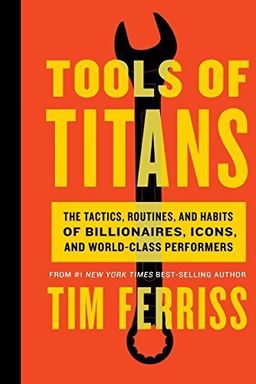
Tools of Titans cover

Tools of Titans

by Tim Ferriss

Tools of Titans offers transformative insights from billionaires, icons, and world-class performers. Delve into their stories and strategies to enhance your health, wealth, and wisdom, building a creative and successful life.

Crafting a Wealthy Life: The Real Meaning of Success

What if real wealth had little to do with the size of your bank account? In Tools of Titans, Tim Ferriss argues that being “wealthy” extends far beyond financial gain—it’s about creating freedom, impact, and meaning in your life. Drawing on lessons from hundreds of world-class performers—from investors like Marc Andreessen and Chris Sacca to creatives like Arnold Schwarzenegger and B.J. Novak—Ferriss redefines success as the ability to live on your terms and to direct your attention toward what truly matters.

Ferriss contends that mastering “wealth” involves building personal systems that allow you to earn, create, and live smarter—not harder. He shows that wealth comes through leverage: self-awareness, time management, relationships, and courage to do meaningful work. By exploring patterns among the ultra-successful, Ferriss uncovers how to think differently about money, freedom, and ambition.

Redefining the Game

Ferriss challenges the conventional notion that the goal of life is to accumulate more. Instead, he insists that real wealth is measured in discretionary time and creative autonomy. You can have millions of dollars and still be poor in spirit if you’re enslaved by email or obligations. Like Peter Thiel, who urges us to question why we create ten-year plans instead of asking how we can achieve them in six months, Ferriss insists that success starts by redefining the game entirely: you must be rich in choice, not just resources.

Throughout the book, Ferriss illuminates contrasts between those who make “a living” and those who make a life. From Kevin Kelly’s radical essay “1,000 True Fans” to Rolf Potts’s manifesto on Vagabonding, the idea surfaces that fulfillment doesn’t require millions—it requires mastery of attention and alignment of time with values. The creators, entrepreneurs, and artists Ferriss interviews demonstrate that disciplined design, not luck, drives their outcomes.

Patterns of the Wealthy Titans

Ferriss organizes the “Wealthy” section around recurring mental and behavioral patterns. For instance, Marc Andreessen—the legendary venture capitalist and co-founder of Netscape—urges creators to “raise prices” and resist the cultural obsession with the cheapest option. Chris Sacca describes how pulling himself out of the chaos of San Francisco coffee meetings allowed him to focus on long-term, intentional choices. These titans all cultivate systems rather than chasing quick wins: Scott Adams’s “systems, not goals” philosophy teaches that success compounds when daily habits guarantee some form of progress, even from a setback.

Ferriss also explores the art of investing—from the literal financial discipline of deal-making to “investing” in health, relationships, and creative confidence. Every chapter ties back to the same mantra: discipline equals freedom (as Jocko Willink puts it). The billionaire investor Peter Thiel shares the contrarian view that “competition is for losers,” encouraging readers to identify secrets others miss and build monopolies around them—ideas echoed by Arnold Schwarzenegger, who transformed his “flaws” into distinctive advantages on his path from bodybuilding to Hollywood to politics.

Freedom through Systems

Throughout Tools of Titans, Ferriss insists that wealth creation is mainly a systemic challenge, not a motivational one. Developing systems—such as Derek Sivers’s “hell yes or no” rule, Ramit Sethi’s automation strategies, and the practical 80/20 analyses that Ferriss himself uses—creates leverage that multiplies your efforts. Wealthy people minimize the number of decisions they must make daily so that they can focus on what truly matters. As Matt Mullenweg, creator of WordPress, puts it: “Clarity of writing indicates clarity of thinking.” For Ferriss, building systems is the equivalent of learning to write your life with better syntax.

Beyond Money: The Wealth of Time and Purpose

One of Ferriss’s most powerful insights comes from Rolf Potts’s philosophy of vagabonding: wealth is nothing without time and courage. Taking extended breaks, questioning the deferred-life plan, and cultivating simplicity often create more fulfillment than a lucrative career. Similarly, Peter Diamandis’s moonshot mindset challenges you to think ten times bigger, not ten percent—a transformative lens that turns ordinary businesses into movements. Meanwhile, Tony Robbins’s concept of state → story → strategy reminds you that financial richness means little without emotional richness.

Ultimately, “wealth” for Ferriss is about freedom: freedom from unexamined obligations, freedom from the noise of social comparison, and the freedom to play your own game according to rules you define. The Wealthy Titans show that fulfillment emerges from deliberate design—whether that’s Alex Blumberg crafting the perfect question, Ed Catmull admitting that all Pixar’s films “sucked” at first, or B.J. Novak finding meaning in laughter as emotional storytelling. Each person demonstrates a creative, experimental life built not on waiting for luck but on engineering serendipity. Ferriss’s message is clear: wealth is not about possessions but about possibilities.


1,000 True Fans and the Power of Niche

Kevin Kelly’s famed idea of “1,000 true fans,” which Tim Ferriss revives and expands, offers a revolutionary redefinition of success for creators. Instead of chasing mass appeal or viral fame, Kelly proves you need only a small, dedicated tribe willing to support your work directly. If 1,000 true fans each pay $100 a year, you’ve built a $100,000 livelihood. Ferriss calls this “a saner destiny”—a path of independence built through authentic connection, not celebrity scale.

Direct Relationships over Intermediaries

The key to Kelly’s model is removing the middlemen. Before the Internet, creators relied on publishers, labels, or studios, which took most of the profits. Today, platforms like Patreon or Kickstarter—both discussed extensively by Ferriss and Kelly—let fans pay artists directly. This one-to-one relationship reduces the number of fans you need while deepening loyalty. As Kelly writes, “It is always easier and better to give your existing customers more than to find new fans.” (In The Long Tail, Chris Anderson later expanded on this, showing how obscure niches collectively rival mainstream hits.)

Technology Enables the Long Tail

The Internet’s structure allows creators anywhere to reach their global audience. Ferriss notes that what once required multimillion-dollar companies can now be done from a laptop in Bend, Oregon or Kathmandu. Search engines, recommendation systems, and global payment processors mean that even an “obscure node” can be one click away from the mainstream. This flattening of distribution empowers what Kelly calls “the long tail”: countless small markets united by specific passions. Whether you’re a left-handed fisherman or a minimalist jazz collector, your people are out there—and reachable.

The Emotional Engine: Cultivating Superfans

True fans do more than buy products: they become advocates. Each deepens your financial stability and your reputation. Ferriss observes that “fans are not only income but your chief marketing force.” He demonstrates this through countless entrepreneurs and creators, from authors like Neil Strauss to musicians like Kaskade, who engage fans through transparency, participation, and story. These superfans want intimacy and consistency more than perfection. As Derek Sivers later phrases it, “If it’s not a ‘hell yes,’ it’s a ‘no’”—meaning that delighting a few deeply is far more potent than pleasing many shallowly.

Crowdfunding and Creative Independence

For Ferriss, crowdfunding is the economic proof of the 1,000 true fans theory. Mike Del Ponte’s Soma Water project raised $100,000 on Kickstarter in 10 days by targeting exactly the right early believers. Ferriss shows how these small armies not only fund projects but shape the future of entrepreneurship. From Kelly’s vision of artisanal creators to Tim’s case studies, the consistent message is empowerment: small, focused communities can sustain whole careers. “1,000 True Fans,” Ferriss concludes, is not merely a stepping-stone to a billion-dollar company—it may be the purest form of creative freedom itself.


From Ideas to Execution: The Canvas Strategy

Ryan Holiday’s “Canvas Strategy,” featured prominently in the Wealthy section, is Ferriss’s blueprint for turning ambition into apprenticeship. Holiday argues that before you can lead, you must learn to follow; before you can rise, you must first make others look good. The metaphor comes from ancient Rome, where an *anteambulo* cleared the path for his patron—removing obstacles so greatness could pass unhindered. In the modern world, that patron might be your boss, mentor, or collaborator.

Clearing the Path, Not Competing for It

Holiday’s premise is simple yet radical: your early career should not be about self-promotion but about service. By “finding canvases for others to paint on,” you build trust, skill, and networks faster than chasing credit. Benjamin Franklin famously embodied this when he wrote anonymous letters for his brother’s newspaper, learning the art of persuasion without recognition. Similarly, Bill Belichick, now a legendary NFL coach, started by volunteering to analyze film for free. His dedication to grunt work made him indispensable.

Ego as the Enemy of Growth

The biggest obstacle to mastering the canvas strategy is ego: the desire for immediate status. Many young professionals reject “serving” out of pride, but Ferriss and Holiday show that humility amplifies opportunity. Service-oriented apprenticeships allow you to absorb the habits of excellence without bearing the risk prematurely. When you help a mentor execute their vision—whether writing investor decks, managing details, or connecting people—you gain access to decision-making logic money can’t buy. As Holiday puts it, “The person who clears the path ultimately controls its direction.”

From Serving to Steering

Ferriss highlights that this mindset is not servitude—it’s strategic investment. Over time, your habit of making others better compounds into a reputation for reliability and insight. The result? Influence. You become, as Ferriss writes, “indispensable.” The canvas strategy turns networking into value creation: by improving others’ capacity to succeed, you inevitably become the conduit for future collaboration. The principle mirrors modern mentorship—from Silicon Valley teams to Hollywood sets—where the most trusted protégés earn their own canvases because they first mastered painting for someone else.

Ultimately, this philosophy dovetails with Derek Sivers’s ethos of utility (“Be useful”). Instead of chasing personal brands, you quietly accrue a portfolio of trust and results. Then, when you finally launch your own vision, the same people you once elevated now clear the path for you. Ferriss’s inclusion of Holiday’s concept turns success into a timeless exchange: you build power by amplifying those around you.


Learning from Titans: Systems, Not Goals

Across every interview and profile, Ferriss discovers one consistent theme: the most successful people operate on systems, not goals. Cartoonist Scott Adams articulates it best: goals are binary—you win or lose—while systems ensure progress regardless of outcome. When you build systems that create daily wins, success becomes inevitable. This principle appears everywhere, from Arnold Schwarzenegger’s training discipline to Ramit Sethi’s automated finances.

The Power of Compounding Habits

For Adams, “losers have goals; winners have systems.” Instead of obsessing over finishing a comic or writing a bestseller, he focuses on daily routines that increase his odds of success—skills like writing persuasively or managing time efficiently. Each action pays dividends across multiple projects. Similarly, Ferriss’s guests—from blogging pioneer Matt Mullenweg to Evernote founder Phil Libin—design repetitive, measurable actions that evolve into mastery. Systems compound learning; goals collapse once they’re achieved or missed.

Executing Under Pressure

Systems thrive through structure. Ferriss’s “morning pages” journaling ritual, adapted from Julia Cameron, embodies this. Each morning he “empties the mental debris” by writing longhand for clarity, transforming anxiety into action. Likewise, Tony Robbins begins his day with “priming”—a structured 10-minute sequence of gratitude, breathing, and focus that optimizes his physiological and emotional state for decision-making. These habits don’t depend on motivation; they generate it.

Designing Systems for Freedom

Ferriss and his mentors prove that structure breeds freedom. By proactively blocking time for creation instead of reaction, you protect the energy that generates wealth. Systems also replace willpower with predictability: Derek Sivers exercises discipline by saying no to everything except “hell yes.” Marc Andreessen warns that startups die because they don’t charge enough—his rule “raise prices” is another systemic guardrail against mediocrity. Each system limits poor choices, freeing mental bandwidth for creativity.

In Ferriss’s world, systems act as life’s autopilot for excellence. Whether running a six-hour work cycle (à la Chase Jarvis’s creative scheduling) or automating finances (per Ramit Sethi), the genius of top performers lies not in motivation but in architecture. They design environments that make the right actions automatic—and that’s how they win consistently, even when goals change.


Redefining Risk and the Real MBA

One of Ferriss’s most personal chapters, “How to Create a Real-World MBA,” turns traditional business education upside down. Instead of taking on debt to learn theory, Ferriss spent $120,000—the cost of Stanford’s MBA at the time—on a two-year experiment investing in startups. Treating money as tuition, not risk, he redefined learning through direct exposure. The results outperformed any classroom education: it produced not only profit but also the network and mindset that shaped his later success.

Learning by Doing

Ferriss’s “Tim Ferriss Fund” applied an experimental model of education: learn through investment, not instruction. His first big $50,000 mistake reinforced an essential business law—if you develop rules, follow them. Over time, he turned errors into heuristics for smarter decisions: invest only in companies where you *can* add unique value, such as marketing or design leverage. By year two, he was functioning as both investor and advisor, blending capital with service. The approach taught him tangible lessons in dealmaking, risk perception, and human psychology.

From Theoretical Risk to Controlled Learning

By redefining failure as tuition, Ferriss unlocked experimentation without paralysis. He cites Mike Maples’s principle that it’s better to break your rules with conviction than to follow the crowd mindlessly. The resulting portfolio included early stakes in Shopify, Uber, and Twitter—returns that validated experience as the true ROI. These ventures taught him what Taleb calls “skin in the game”: wisdom emerges only when outcomes matter personally. He concludes, “Everything worth doing comes from testing reality, not hypothesizing it.”

The DIY Education Framework

Ferriss expands the “real-world MBA” philosophy into a universal learning model. To master any field, replace academic debt with deliberate experiments: spend what you would pay for tuition on real experience. Want to master public speaking? Invest the same $30K into small events and critique sessions. Interested in politics or education? Work one day a week for a campaign. Ferriss argues the ultimate education currency is applied experience, not credentials. It builds both competence and confidence—the twin pillars of wealth creation.

In redefining risk, Ferriss urges you to see losses as data, not defeat. When you treat failure as iterative feedback, the world itself becomes your university. His journey from angel investor to bestselling author mirrors the freelancer’s or creator’s path today: cultivate mental flexibility, design experiments that teach real-world physics, and measure success not by the absence of risk but by the increase of freedom and learning.


Saying No and the Discipline of Focus

At the heart of Ferriss’s philosophy is the courage to say “no” to almost everything. In his essay “How to Say No When It Matters Most,” Ferriss examines how busyness kills creativity and how disciplined refusal opens space for high-return opportunities. Success, he argues, isn’t about more commitments but about better boundaries—the difference between scattering focus and directing it like a laser.

From FOMO to Freedom

Ferriss recounts his decision to step away from angel investing at the peak of his success—a move that shocked even close friends. Despite lucrative opportunities, his inbox had become an avalanche of noise. Guided by Derek Sivers’s rule “If it’s not a hell yes, it’s a no,” Ferriss realized that each partial “yes” stole energy from creative work. True wealth, he discovered, meant having the time and clarity to write, not the burden of endless deal flow. As Greg McKeown puts it in Essentialism, “If you don’t prioritize your life, someone else will.”

Decision by Subtraction

Ferriss introduces a minimalist decision process rooted in reflection and fear-setting—similar to Stoic philosophy. He lists discomforts, quantifies risks, and then examines worst-case outcomes on paper. The exercise reveals that most “catastrophes” are reversible or negligible. This clarity allows him to say no without guilt. He writes, “Being busy is a form of laziness—lazy thinking and indiscriminate action.” Saying no becomes not an act of withdrawal but one of stewardship: choosing depth over volume.

The Myth of Moderation

Perhaps the most striking insight is that moderation seldom works for high performers. Ferriss compares certain habits—like startup investing or caffeine use—to “domino foods”: things that can’t be enjoyed in moderation. Instead of partial commitment, he advocates binary choices: all or nothing. You reclaim control by designing automatic no’s for distractions while carving sacred blocks for creation (his weekly “Creation Wednesdays”). The discipline mimics triage: only the vital few activities that produce disproportionate results survive.

Ultimately, Ferriss teaches that saying no is the highest form of focus. It’s how billionaires, authors, and athletes guard their edge. As he tells readers, “To develop your edge initially, you learn to set priorities; to maintain your edge, you need to defend against the priorities of others.” In a world drowning in options, the simplest wealth lies in focus—the courage to miss out on everything that doesn’t truly matter.


The Freedom Formula: Designing a Life That Pays for Itself

Rolf Potts’s essay “How to Earn Your Freedom,” closing the Wealthy section, reflects Ferriss’s enduring thesis: money matters less than mobility. Potts’s philosophy of vagabonding—extended, deliberate travel as self-exploration—became the cornerstone of Ferriss’s first book, The 4-Hour Workweek. Here, he reframes wealth as the ability to control time and direction, not possessions. The freedom to think, create, and wander is the ultimate dividend of intelligent systems and conscious design.

Beyond the Deferred-Life Plan

Potts dismantles the Western obsession with the “deferred-life plan”—the belief that hard work now earns happiness later. He argues that long-term travel (and by extension, experimentation in life) is not rebellion but common sense. Like Thoreau at Walden Pond, he insists the goal is simplicity: “Travel isn’t just for changing what’s outside—it’s for reinventing what’s inside.” For Ferriss, this realization became the seed for lifestyle design: build systems that fund freedom in the present, not hypothetical leisure decades away.

Wealth as Time Autonomy

Both Potts and Ferriss equate wealth with control of your schedule. You earn freedom by minimizing commitments that trap you. Whether it’s Potts’s “vagabonding” year or Ferriss’s “mini-retirements,” both advocate reclaiming time as the real currency of life. This redefinition transforms risk: “quitting” a job to travel isn’t reckless—it’s constructive. You exchange money for agency. As Potts says, “Travel doesn’t require millions; it requires a deliberate outlook.”

Work as Preparation for Freedom

Potts cautions against idolizing leisure itself. Freedom requires discipline and resilience, cultivated through working life. His “constructive quitting” involves leaving with integrity, after using each phase of work to gain skills, savings, and perspective. Ferriss reflects the same ethic: sustainable freedom emerges from responsibility, not escape. You can’t buy integrity with airfare or digital nomadism—it must be earned through thoughtful design of how you spend energy each day.

Potts’s closing image—walking away from fear, not responsibility—anchors the Wealthy section as a meditation on purpose. Wealth without awareness is just consumption. By aligning Potts’s philosophy with lessons from investors like Thiel and Sacca, Ferriss completes his arc: riches mean little without the courage to live richly. True wealth is measured not in zeros but in minutes well spent.

Dig Deeper

Get personalized prompts to apply these lessons to your life and deepen your understanding.

Go Deeper

Get the Full Experience

Download Insight Books for AI-powered reflections, quizzes, and more.