
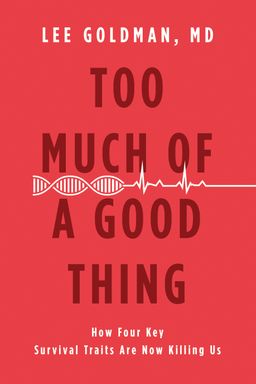
Too Much of a Good Thing cover

Too Much of a Good Thing

by Lee Goldman

Lee Goldman''s ''Too Much of a Good Thing'' explores how our evolved survival traits conflict with modern life, leading to chronic diseases. Discover why our bodies struggle with today''s abundance and learn how collective action can address these health challenges.

Genes That Saved Us Now Threaten Us

Why do bodies designed to survive scarcity and violence now succumb to obesity, hypertension, and heart attacks? In Too Much of a Good Thing, Lee Goldman offers a grand unifying argument: your evolutionary inheritance—traits that once protected and propagated life—has become dangerously mismatched with your modern environment. He calls this paradox the evolutionary mismatch. Your ancestors’ genes optimized survival amid danger, hunger, and dehydration, but the world since the Industrial Revolution changed faster than natural selection could adjust. You still carry ancient physiological settings tuned for survival, not longevity in abundance.

How evolution built your body for another world

Across roughly 10,000 generations, natural selection rewarded reproduction, not healthy aging. Four core survival systems—appetite and metabolism, water and salt balance, fear and stress response, and clotting—were honed for environments of scarcity, injury, and conflict. When food was rare, storing fat saved lives; when predators were common, hypervigilance prevented death; when bleeding risked life, strong clotting secured maternal survival. Humans evolved for low-calorie, high-activity conditions filled with acute dangers. Now, with supermarkets, central heating, cars, and medicine, these same systems overreact to modern ease and cause chronic disease. Hypertension, obesity, clot-driven heart attacks and strokes, and psychiatric stress disorders collectively account for nearly half of all American deaths—what Goldman calls the unintended consequence of evolutionary progress.

Concrete examples of mismatch

Goldman tells vivid stories to bring these mismatches alive. The Pima Indians, for instance, saw diabetes prevalence soar from near-zero in 1900 to half the population by the 1970s after rapid dietary shifts from traditional agriculture to processed commodities. Franklin Roosevelt’s fatal stroke shows how salt-conserving physiology—once protective—produces catastrophic hypertension when dietary sodium explodes. Rosie O’Donnell’s heart attack exemplifies modern clotting turned lethal. And PTSD in veterans like Jason Pemberton illustrates survival fear systems misfiring amid modern social stress. Each narrative drives home the same pattern: traits once linked to fitness now undermine wellbeing in circumstances evolution never anticipated.

Why evolution can’t catch up

Genetic adaptation operates too slowly to offset such rapid cultural change. A mutation needs centuries to spread widely—unless it confers massive reproductive advantage, which modern chronic diseases rarely affect. Most people with obesity, hypertension, or anxiety still reproduce, meaning selection pressure remains weak. Even epigenetic modifications, though real, rarely transmit across many generations. Natural selection optimizes for survival to reproduction, not comfort afterward. Hence, the very success of civilization—reducing early mortality—has frozen ancestral genes in inappropriate settings.

What evolution still teaches us

Goldman’s message reshapes how you see disease. Illness often signals not moral weakness but inherited physiology in conflict with environment. Understanding those roots allows smarter prevention and treatment: public policy shaping healthier choices, behavioral support, and biomedical tools—from statins and antihypertensives to antidepressants and bariatric surgery. A Berlin patient cured of HIV via CCR5 Delta 32 donors shows how knowledge of genetic variants can undo ancient vulnerabilities. These fixes complement—not replace—personal responsibility.

Core insight

You inherit instincts and chemistries fine-tuned for survival in danger and scarcity. Civilization removed those dangers but left intact the biology. To thrive now, your brain and medicine must look forward while your genes still look backward.

In sum, Goldman’s central argument merges anthropology, physiology, and public health. The evolutionary past explains modern disease; the path forward requires behavioral realism, biomedical innovation, and compassion for the biology that built us. Your task is no longer to survive, but to reengineer survival traits for a new era.


Appetite and Obesity

Goldman begins with food—the most tangible evolutionary mismatch. Appetite and metabolism evolved to help your ancestors survive famine; now they push you toward obesity and diabetes. From hunter-gatherer efficiency to supermarkets overflowing with sugar and fat, the story of obesity is the story of biology colliding with excess.

How your body defends calories

The body evolved to store energy aggressively. Hormones such as ghrelin drive hunger; leptin signals fullness from fat tissue but can be ignored when leptin resistance develops. Your taste system prioritizes sweetness, salt, and umami—all rare signals of nutrition in prehistory but ubiquitous now. Human ancestors feasted when food was abundant; Lewis and Clark recorded days exceeding 12,000 calories in wild abundance. That same instinct today drives surfeit in sedentary lives.

The thrifty legacy

Genetics amplify the problem. The thrifty genotype hypothesis suggests populations facing recurrent famine retained genes favoring efficient calorie use. Twin studies reveal 55–85% heritability of weight. Variants in FTO and SLC16A11 correlate with obesity and diabetes, particularly among indigenous peoples. The Pima Indians exemplify the tragedy: bodies perfected for survival under scarcity succumbed to diabetic collapse when flour, sugar, and lard replaced their ancestral diet.

Environmental sabotage

Mechanization eroded daily activity. The average American now eats about 500 more calories per day than in the 1970s. Small excesses—an extra cookie or spoon of oil—compound invisibly. Efforts to change individual behavior face biology’s pushback: after weight loss, appetite rises and metabolism slows. Goldman stresses that prevention beats cure, and structural change outweighs self-discipline alone.

Practical insight

Your appetite is ancient software running on modern hardware. To fight obesity, alter your environment—portion size, food formulation, and public policy—rather than rely solely on willpower.

Goldman’s narrative reframes obesity as predictable biology, not moral failure. The thrifty legacy explains global epidemics, and the solution lies in structural, medical, and cultural shifts that realign your environment with ancestral expectations.


Salt, Water, and Blood Pressure

Your body’s salt and water balance evolved as a survival safeguard against dehydration and heat. Today, those same mechanisms produce hypertension—the world’s top chronic killer. Goldman explores how kidneys, hormones, and vascular reflexes that once prevented fainting now overload modern arteries.

The physiology of protection

Humans evolved efficient sweat systems to cool during endurance hunts. Sweating drained sodium, so your body developed powerful salt-conservation hormones—renin, angiotensin, aldosterone—and thirst triggers. In high-heat, low-salt conditions, this saved lives. In modern abundance, it maintains chronically high pressure. The kidneys, tuned to conserve, retain sodium even when intake triples ancestral levels.

The paradox of survival physiology

Roosevelt’s fatal stroke, with blood pressure above 300/190, exemplifies overprotective systems gone rogue. African Americans, genetically predisposed to conserve sodium from tropical ancestors, display higher salt sensitivity and hypertension prevalence. Populations like the Yanomami, who eat minimal salt, show virtually no age-related rise in blood pressure—a glimpse of ancestral norm. Goldman’s lesson: physiology optimized for scarcity becomes pathological under excess.

Core message

The same control systems that sustained desert hunters now constrict arteries in office workers. You can fix the mismatch—reduce salt, remain active, and, when needed, use medication to modulate inherited thermostats.

Understanding hypertension through evolution clarifies why prevention and pharmacology work together. The body’s genius for conservation saved your ancestors; now it requires mindful correction to save you.


Fear and Modern Mental Health

Goldman expands the mismatch idea into the brain: anxiety, depression, and PTSD are extreme expressions of adaptive systems designed for survival. Fear and vigilance once saved lives amid predators and rival humans; today, those circuits persist in relatively safe societies and often turn inward.

Violence and vigilance in evolutionary context

Prehistoric studies show 15–25% of hunter-gatherer deaths resulted from violence. Fear learning, aggression, and status competition evolved under these conditions. Memories of threats became deeply encoded through the hippocampus and amygdala—circuitry proven by Eric Kandel’s neurobiological research. Rapid fear conditioning ensures avoidance but can cause PTSD when traumatic memories replay uncontrollably.

The biology of stress and breakdown

Chronic stress elevates cortisol and disrupts cellular calcium regulation (Andrew Marks) and shortens telomeres (Elizabeth Blackburn), accelerating aging. Goldman’s examples—from veterans suffering PTSD to suicides among service members—show how stress circuits calibrated for external enemies now create internal collapse. The body that once triggered fight-or-flight now loops itself into despair.

Insight

Anxiety and depression are not failures of character but ancestral alarm systems misfiring in changed surroundings. Recognizing their origins encourages humane treatment—biological and social—rather than stigma.

Goldman’s evolutionary lens merges anthropology with psychiatry: mental illness arises when ancient fear machinery overwhelms modern contexts. The cure lies in compassion, therapy, and medical innovation that respects its biological heritage.


Clotting and Cardiovascular Risk

Few mismatches kill more people than clotting. The same system that saved mothers from postpartum bleeding and hunters from wounds now causes heart attacks and strokes. Goldman treats clotting as an evolutionary masterpiece turned menace.

Why clotting protected survival

Platelets and coagulation proteins rapidly seal wounds, aided by uterine contraction after childbirth. Variants like Factor V Leiden likely spread for protection from hemorrhage. These genetic adjustments optimized early-life survival—the very definition of adaptive evolution.

When protection becomes peril

In modern arteries, clots arise not from cuts but from ruptured atherosclerotic plaques. LDL-rich deposits trigger platelet cascades that block blood flow within minutes. Rosie O’Donnell’s cardiac episode exemplifies this chain reaction. In veins, immobility—like sitting through long flights—promotes deep vein thrombosis, occasionally fatal pulmonary embolism. Chris Staniforth, a sedentary gamer, died this avoidable death.

Tradeoffs and therapy

Evolution tuned clotting for early life, not old age. The fix is medical moderation—aspirin, statins, anticoagulants, and lifestyle habits like mobility and diet. Understanding evolutionary intent explains why pharmacologic prevention is not synthetic interference but adaptive correction.

Clinical viewpoint

Your survival advantage became your vulnerability. Evolution prevented bleeding in young mothers; modern medicine must now prevent clots in aging arteries.

Goldman situates cardiovascular disease at the center of evolutionary mismatch. The ancient shield of clotting demands scientific and behavioral balance to remain lifesaving.


Genes, Adaptation, and Medicine

Goldman explores how human genetic variety illuminates evolutionary adaptation and modern medicine, using cases like skin pigmentation, lactase persistence, and CCR5 Delta 32 immunity. These examples reveal both the creativity and limits of natural selection.

Local adaptations

Skin color reflects UV tradeoffs: dark skin preserves folate under high solar radiation; light skin enables vitamin D synthesis in low-UV zones. Lactase persistence arose independently among dairy cultures, allowing milk consumption long after weaning. Each mutation responded to local ecological niches, not universal needs.

Modern crossovers

The CCR5 Delta 32 deletion, a relic possibly selected by ancient epidemics, became lifesaving against HIV. Timothy Ray Brown’s cure after bone marrow transplant illustrated medicine leveraging evolutionary accidents. Yet local gifts can become liabilities: CCR5 Delta 32 increases vulnerability to West Nile, and hemochromatosis—once helping recovery from blood loss—now causes iron overload.

The future of guided adaptation

Goldman predicts that biomedical engineering—CRISPR, gene silencing, pharmacogenomics—may someday fast-track what evolution cannot. Medicine becomes the evolutionary agent, editing mismatched genes consciously. Still, ethical caution matters: gene editing for population-wide traits carries social and biological risks.

Evolutionary lesson

Natural selection solved problems locally; medicine can now solve them globally. Understanding this lineage helps personalize care and policy instead of applying one-size-fits-all solutions.

Goldman’s genetics chapters remind you that the body’s diversity is a biological diary of survival. Modern science reads those pages to design tomorrow’s cures.


Behavior, Policy, and Science Together

Acknowledging mismatch is only useful if it drives action. Goldman concludes with pragmatic strategies—individual, societal, and scientific—for bridging evolutionary past and modern well-being.

Personal change and its limits

Behavior change is biologically uphill. Dieters face hormonal backlash; environmental cues like plate size and packaging subvert self-control. Yet strategies—specific implementation plans, social support, and environment modification—can work (as seen in Jennifer Hudson’s and Breanna Bond’s sustained success). Willpower alone rarely triumphs against physiology, but organized environments can.

Population-level levers

Public policy is more effective than advice. Trans-fat bans cut consumption by 85%; Finland reduced sodium nationally, lowering stroke rates. Taxation and reformulation outperform calorie labels and voluntary pledges. Even so, political resistance limits these changes—some reforms fail due to cultural and economic inertia.

Medicine as our new evolution

Goldman’s preferred path blends modest behavioral shifts with scientific correction—pharmacology, surgery, and gene therapy. Bariatric surgery reverses diabetes; PCSK9 inhibitors slash cholesterol; ketamine revolutionizes depression care. Evolution can’t fix mismatches quickly, but medicine can adjust them enough to preserve health and lifespan.

Final takeaway

Human progress requires coevolution of habits, policies, and science. Behavior aligns choices, policy reshapes context, and medicine rebalances biology. Together, they create a humane adaptation faster than genes can evolve.

Goldman’s roadmap dismantles moral judgment and replaces it with biological empathy and pragmatic optimism. Modern humans won’t wait ten thousand generations for genes to change—they can use insight, law, and science to make the future livable now.

Dig Deeper

Get personalized prompts to apply these lessons to your life and deepen your understanding.

Go Deeper

Get the Full Experience

Download Insight Books for AI-powered reflections, quizzes, and more.