
Idea 1
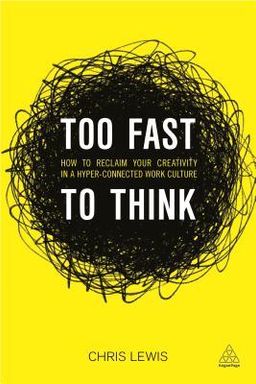
Too Fast to Think: Reclaiming Creativity in a Hyperconnected World
Have you ever felt that the harder you work, the less inspired you become? In Too Fast to Think, Chris Lewis explores a paradox of modern life: the faster we move, the less we truly think. He argues that the hyperconnected, always-on culture—fed by social media, email, and digital multitasking—has created an epidemic of busyness that erodes deep thought, empathy, and creativity. Lewis contends that while the world celebrates speed and productivity, these very habits undermine the quiet and reflection necessary for innovation and human meaning.
The book is both diagnosis and prescription. It blends insights from business leaders, artists, scientists, clergy, and educators to reveal how genuine creativity works and why it is dying under the weight of interruption. Lewis defines eight traits—Quiet, Engage, Dream, Relax, Release, Repeat, Play, and Teach—that form the foundation of creative thinking. With them, he invites you to slow down, reconnect with purpose, and rediscover the space where real ideas emerge.
The Speed Trap
Lewis begins by examining the relentless acceleration of the modern world. The rise of smartphones, social media, and instant communication has blurred boundaries between work and life. We check emails in bed, scroll through news while watching TV, and measure success by how busy we are. This digital noise creates what he calls a 'soufflé in a storm'—an environment so turbulent that creativity cannot rise. Every ping from a device fractures concentration, pushing us toward shallow thinking and reactive decision-making.
Research and anecdotes illustrate the scale of this overload. The average worker receives hundreds of emails a day and dozens of alerts per hour. Millennials, the first generation raised entirely within this ecosystem, often multitask even in bathrooms or while driving. The result: declining attention spans, rising anxiety, and decreasing capacity for reflection. As film director Tony Palmer warns, 'Social media has been a catastrophe for the young—they’ve stopped thinking deeply.' The tragedy is that the technology built to connect us now disconnects us from ourselves.
How Busyness Became a Badge
Lewis explores how busyness has replaced productivity as the measure of worth. Through the story of Carol, a high-achieving executive who organized every minute of her day into 15-minute slots, he shows how the cult of time management leads to burnout and guilt. Carol equated speed with success until Lewis challenged her to 'do less, not more.' The result was transformative—by freeing an hour a day for reflection, she became calmer, more strategic, and more inspiring to her team. Her colleagues described the shift as cultural: from frightening to fun, from manic to supportive.
This case reveals a key insight: creativity is less about constant doing and more about being. Carol’s father embodied this truth—he wasn’t good because of what he did, but because of who he was: constant, generous, loving. Lewis argues that leadership and creativity share this quality of presence. You cannot project values when you are too busy to see the big picture. To think well, we must reclaim idle time as fertile ground for ideas.
From Information to Insight
Beyond personal burnout, Lewis traces how information overload has corrupted media and culture. The chase for clicks has replaced depth with speed; journalists produce four stories a day instead of four a week. News has become dominated by celebrity gossip and negativity, feeding the illusion that the world is getting worse even as data shows global health, wealth, and safety improving. Harvard psychologist Steven Pinker’s statistics on declining violence contrast sharply with the pessimism of social feeds. The faster a story spreads, Lewis notes, the less truth it contains.
“Speed kills truth.”
Lewis visualizes this dynamic as an inverted curve: as story speed rises—from historians to Twitter updates—accuracy declines. The mind favors binary judgment over nuance. We process headlines faster than we think, and our worldviews narrow accordingly.
The Cost of Connection
Social media’s emotional toll, particularly on women, forms another thread. Surveys show that women dominate visual-based platforms like Instagram and Pinterest, using them to connect family, work, and brands—yet this engagement breeds stress and unrealistic standards. Dove’s #SpeakBeautiful campaign revealed that four of five negative beauty tweets came from women themselves, illustrating a cycle of online self-criticism. Lewis suggests that while social media amplifies female creativity, it also magnifies vulnerability, turning personal expression into a source of pressure.
Rediscovering the Quiet Mind
Ultimately, Lewis proposes a radical cure: stillness. Drawing on the experiences of artists, designers, and neuroscientists, he shows that great ideas arise not from speed but from slowness—from walking, dreaming, and sleeping. Whether it is Oxford neuroscientist Russell Foster on the power of sleep, Vanessa Brady on the discipline of separating creative and commercial time, or Admiral George Zambellas on how belief transforms leadership, every perspective converges on one truth: creativity requires space. As Lewis writes, innovation happens 'like creating a soufflé in a storm.' You must calm the air before it can rise.
If modern life makes you feel fragmented and frantic, this book offers both diagnosis and liberation. It teaches that thinking fast may make you busy—but thinking slow makes you whole. To reclaim your creativity, you must begin by reclaiming your quiet.