
Idea 1
Power, Principle, and a New Republic
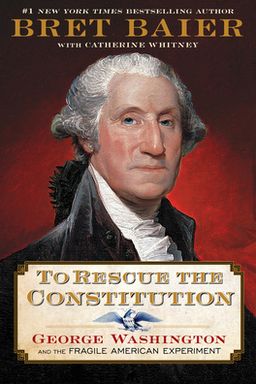
How do you build a durable republic out of protest, war, and fiscal chaos? This book argues that America emerges not from a single genius or a perfect plan, but from a sequence of crises that force reluctant leaders to accept responsibility and shrewd negotiators to hammer out compromises. George Washington’s moral authority, the army’s survival, the Articles of Confederation’s collapse, and the Philadelphia Convention’s bargaining all converge to produce a Constitution that is both high-minded and hard-nosed. The core claim: legitimacy grows where character meets institution—Washington’s restraint gives the new government its tone, while collective design gives it staying power.
You follow an arc: colonial dissent turns to revolution; Washington learns on the job and becomes the indispensable symbol; the postwar confederation fails; the Framers invent a national architecture that balances power with liberty; ratification battles demand a Bill of Rights; and Washington’s presidency sets working precedents that test the theory in practice. Along the way, you confront an open wound—the Constitution’s compromises with slavery—that expands Southern power while postponing moral reckoning. The story blends battlefield grit, committee drafting, and newspaper persuasion into a single political founding.
A reluctant leader anchors legitimacy
You meet Washington as a planter who craves retirement and repeatedly returns to public duty. His leadership at Trenton and Princeton, the agony and reform at Valley Forge under von Steuben, and the Franco-American coordination at Yorktown give him unparalleled credibility. He resigns his commission at Fraunces Tavern, proving he seeks no crown (a contrast the book invites you to make with leaders who cling to office). That posture turns his presence into political capital at the 1787 Convention and later as the first president.
From confederation breakdown to constitutional design
The decade after independence exposes the Articles’ weaknesses: no taxing power, chaotic commerce, unpaid soldiers, and state-level protectionism. Shays’ Rebellion dramatizes the danger of anarchy. Annapolis leads to Philadelphia, where delegates face a single dilemma you still recognize: empower a national government enough to solve collective problems without crushing the states. The Virginia Plan pushes national authority; the New Jersey Plan insists on state equality; Elbridge Gerry’s committee brokers the Connecticut Compromise that fuses both.
Representation, slavery, and painful bargains
Counting people becomes counting power. Southern delegates want enslaved people fully counted for representation; opponents demand consistency: persons or property? The three-fifths formula, borrowed from a 1783 proposal, becomes the uneasy middle path. It is pragmatic yet morally fraught, magnifying Southern influence in the House and Electoral College (note the long tail into antebellum politics). The lesson is sober: constitution-making can hardwire injustice even as it builds liberty-protecting structures.
Inventing the executive, testing the system
Delegates wrangle over how to choose and restrain the executive—direct vote, legislative selection, state legislatures, or something novel. The Electoral College emerges as a hybrid that mixes popular input with federalism. A limited veto and separated powers prevent monarchy fears from smothering energy in the executive. In office, Washington builds the cabinet (Jefferson, Hamilton, Knox, Randolph), stands up the judiciary (Judiciary Act of 1789; Chief Justice John Jay), and navigates the Compromise of 1790 to align finance and the capital’s location.
Ratification politics and the Bill of Rights
The Constitution’s authority depends on you—the people—through state conventions. Federalists (Hamilton, Madison, Jay as Publius) sell the design; Antifederalists (Patrick Henry, George Mason) demand protections. Narrow votes in Massachusetts, Virginia, and New York hinge on a promise: ratify now, amend swiftly. Madison keeps the promise, transforming skepticism into the Bill of Rights, which clarifies liberties and affirms the amendment mechanism as a safety valve (compare Gordon Wood’s emphasis on the shift to popular sovereignty).
A founding made of teamwork
From von Steuben’s drills and Knox’s guns to Franklin’s diplomacy and Madison’s drafting, the republic is a networked achievement—greatness coordinated, not solitary genius enthroned.
Enduring lessons for you
If you lead, this story teaches that personal restraint can create institutional trust. If you design systems, it shows you that compromise prevents collapse. And if you’re a citizen, it reminds you that consent—won in bruising public debate and secured by amendments—is the lifeblood of constitutional government. The founders built mechanisms strong enough to act and flexible enough to correct. Keeping the republic requires both.