
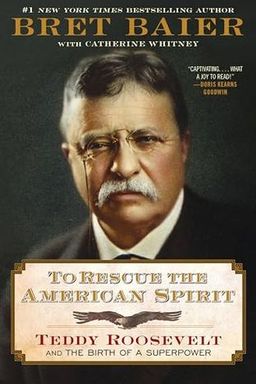
To Rescue The American Spirit cover

To Rescue The American Spirit

by Bret Baier With Catherine Whitney

The Fox News Channel’s chief political anchor chronicles the life and times of Theodore Roosevelt.

Quiet Strength, Hard Choices

How can you lead through fracture without breaking the nation? In To Rescue the Republic, Bret Baier argues that Ulysses S. Grant’s unshowy character—shaped by humble beginnings, disciplined learning, and failure—made him uniquely capable of saving the Union twice: first by defeating the Confederacy with relentless, logistics-driven warfare; then by steering the country through Reconstruction’s violence and the constitutional crisis of 1876. Baier contends that Grant’s steadiness and moral clarity, not flamboyance or ideological zeal, are the leadership virtues that carry a republic through its hardest hours—yet those same traits also expose limits when politics demands skepticism, negotiation, and institutional guardrails.

You follow Grant from a boy who loved horses and arithmetic to a general who unified armies and a president who tried to unify citizens. The book threads four themes: character forged in ordinary places; a military philosophy of pressure and logistics; a peace policy rooted in magnanimity and law; and a presidency that paired landmark civil-rights enforcement with damaging administrative naïveté. It closes by weighing the sober deal that ended the 1876 crisis—averting renewed civil conflict at the price of retreat on Black rights—and the final redemption of Grant’s voice and reputation through his Personal Memoirs.

Origins and character

Grant’s beginnings in Point Pleasant and Georgetown, Ohio, teach you to look past glamour. Raised by a humble, industrious father (Jesse) and a quiet, principled mother, he excelled at horsemanship and practical math. West Point reshaped his habits but not his modesty—and even his name was an accident: a congressman’s clerical error turned Hiram Ulysses into Ulysses S. Grant. Baier’s point is simple: ordinary routines—breaking colts, hauling, counting—become extraordinary habits in crisis. (Note: This echoes Doris Kearns Goodwin’s thesis on character in leadership, though Baier emphasizes plain duty over rhetorical genius.)

War by logistics and pressure

Grant’s art of war is austere: find the enemy, move fast, hit hard, keep moving. In Mexico, he learned supply and improvisation as a quartermaster; in the Civil War, he scaled that into campaign design. At Fort Donelson he demanded “unconditional and immediate surrender,” capturing momentum and a nickname. At Vicksburg he marched downriver, crossed below the city with Admiral David Porter’s aid, then attacked from the south—an audacious logistical deception. With Sherman, he synchronized theaters: Grant held Lee around Richmond and Petersburg while Sherman shattered the Confederacy’s logistical base from Atlanta to the sea.

Peace with dignity

Grant ends the war to save the future, not to punish the past. At Appomattox he lets Confederate officers keep sidearms and soldiers keep horses; he orders rations for starving foes. He paroled Vicksburg’s garrison because guarding tens of thousands was impossible. This moderation—aligned with Lincoln’s “malice toward none”—signals a doctrine of victory without humiliation. You watch him resist vengeful politics after the shooting stops because sustainable peace requires a bridge for the defeated to cross back into civic life.

Reconstruction and the presidency

Postwar, the battlefield shifts to law. Grant supports the Fourteenth and Fifteenth Amendments and, as president, deploys the Ku Klux Klan Act to crush organized terror—especially in northwest South Carolina, where federal arrests and suspended habeas corpus dismantle Klan networks, if only temporarily. He also tries a humane “Indian Peace Policy,” appointing Seneca leader Ely S. Parker as the first Native Commissioner of Indian Affairs. Yet his governing style imports army habits into politics: he prizes loyalty and treats the cabinet as staff, a choice that limits dissent and oversight and leaves him exposed to the Gold Ring panic, the Whiskey Ring, and the Belknap trading-post scandal. (Compare Lincoln’s “team of rivals”; Grant rejects that model and pays a price.)

The 1876 crisis and its cost

When the Hayes–Tilden election implodes with disputed Southern returns, Grant champions a 15-member Electoral Commission to avert breakdown. The Commission, swayed by Justice Joseph Bradley, awards the votes to Hayes 8–7 and, alongside the Wormley Agreement, trades acceptance of Hayes for troop withdrawal from the South. The bargain preserves peace but abandons federal enforcement that shielded Black citizens, hastening Jim Crow. Baier forces you to confront the trade-off: constitutional order today, civil-rights retreat tomorrow.

The last campaign: memory and meaning

Ruin follows fame when Grant & Ward collapses. Throat cancer closes in. He writes for his family’s survival, and with Mark Twain’s savvy publishing, the Personal Memoirs become a literary and financial triumph—muscular prose, clear judgment, and $450,000 to Julia. Historians later elevate his presidential ranking, citing civil-rights enforcement and Indian policy efforts (Ron Chernow: “He got the big issues right… even if he bungled many of the small ones”). Modern debates—like the 2020 toppling of his statue—reveal how memory, stripped of context, can misfire.

Core claim

Grant rescues the republic by pairing relentless force with restrained peace—and by choosing constitutional stability in 1876 over prolonged confrontation, a choice with tragic downstream costs.

If you lead teams or communities, Grant teaches that character is capacity: logistics outlasts theater, magnanimity ends cycles of vengeance, and loyalty must be balanced by systems that check your blind spots. The republic survives on that balance.


Making a Reluctant Master

Baier shows you a leader built in workshops, not salons. Young Grant grows up amid the smells of Jesse Grant’s tannery, the wide Ohio River, and the everyday math of barter. From age two he’s drawn to horses; by adolescence he’s the local colt-breaker. That tactile mastery—reading weight, balance, and fear—becomes a habit of mind you later recognize on battle maps: observe quietly, act decisively, conserve motion.

From Hiram Ulysses to Ulysses S. Grant

Grant’s path to West Point isn’t prophecy; it’s a nomination his father hustles for. A clerical error by Congressman Thomas Hamer recasts Hiram Ulysses as “Ulysses S.,” a bureaucratic serendipity that sticks. He’s no prodigy at the Academy—middling grades, many demerits—but he shines with horses and practical engineering. That gap between swagger and substance is a recurring motif: the boy who looks ordinary learns to do extraordinary things in ordinary ways.

Mexico: the quartermaster education

In the Mexican War, Grant learns the war that matters most: the one fought by mules, wagons, and ledgers. He studies how to keep men fed, ammo dry, and columns moving across bad roads. This apprenticeship in logistics and improvisation primes him to favor movement over maneuver theater and to see supplies as the governor of strategy. (Note: Where many Civil War generals sought Napoleonic battles of decision, Grant builds operational grindstones.)

The Humboldt breaking point

At Fort Humboldt on the Pacific Coast, drinking and an unforgiving commander corner Grant. He chooses resignation over a court-martial to spare his family. Baier doesn’t sanctify him; he humanizes him. Grant isn’t a chronic drunk by every account, but he doesn’t wear liquor well. Consequence matters more than argument: the uniform comes off, the social standing evaporates, and humiliation arrives.

Hardscrabble, humility, and a moral pivot

Grant’s farm—aptly named Hardscrabble—fails under disease, weather, and debt. He frees William Jones, a man enslaved by Julia’s family, and confronts the tangle of affection and injustice in a slaveholding kinship network. Pride is expensive; he pawns his watch to feed his family, then takes a clerk’s job at his father’s leather store in Galena. Here’s the pivot you should notice: the man who will command the largest Union armies learns to submit to routine and to do it without complaint.

Julia as ballast

Julia Dent Grant, vivacious and loyal, steadies him. Their marriage bridges North and South, free-state and slaveholding kin, with letters and tenderness that outlast poverty. Domestic scenes—children tumbling, chores done, penny-pinching—reveal a patient father. Those years compress his ego and expand his resilience, so when greatness knocks, it finds a man allergic to theater and ready for work.

Formative maxim

“Circumstances make men,” a contemporary wrote; Baier’s Grant is proof. Failure doesn’t disqualify him; it tempers him.

Leadership lessons you can use

First, cultivate practical mastery. Grant’s horse sense and quartermaster math become strategic thinking under fire. Second, let reversals teach you pace and patience. Galena’s leather shop prepares him for months-long siege logic at Vicksburg better than parade-ground flourishes could. Third, keep a moral north. Freeing William Jones and later protecting paroled Confederates reflect a conscience that makes peacemaking credible.

  • Specifics anchor the arc: clerical renaming at West Point; resignation at Humboldt; Hardscrabble’s failure and the pawned watch; Julia’s unwavering partnership.
  • Comparative note: Where Robert E. Lee starts with patrician bearing, Grant arrives with blue-collar competence—and ends the war.

By the time the telegraph summons him back to command, you’re not meeting a prodigy; you’re meeting a craftsman. That is Baier’s point: the republic’s rescuer is built deliberately—through horses, ledgers, losses, and a home that kept him human.


War by Relentless Pressure

Grant strips war of romance. He believes that speed, supply, and synchronized blows compel outcomes more than elegant maneuvers do. You see this from the West to the James: he hunts the enemy, smothers him with pressure, and denies him time to reset. The method looks simple because it is—simple like a lever that moves a boulder.

Doctrine in a sentence

Baier highlights a compact credo: find where your enemy is, get at him as soon as you can, strike as hard as you can, and keep moving. The doctrine privileges initiative, not spectacle. It assumes that the Confederacy, lacking industrial depth, will crack when hammered across multiple nodes—armies, railroads, riverways—without pause.

Fort Donelson: momentum and meaning

At Fort Donelson, after weather and confusion, Grant chooses audacity. He refuses Simon Bolivar Buckner’s request for terms and demands “unconditional and immediate surrender.” Beyond capturing a fort, he captures psychology: the Union finally has an aggressive winner. The nickname “Unconditional Surrender Grant” sticks and buys political room for Lincoln in a dark season.

Vicksburg: logistics as maneuver

Grant can brawl, but he’s not a blunt instrument. At Vicksburg, instead of frontal lunacy, he marches south of the city on the Mississippi’s west bank, coordinates with Admiral David Porter to run the river past the batteries, then crosses below and drives north to choke the fortress from inland. It’s a riverine chess move that redefines maneuver as supply geometry. The payoff is continental: the Mississippi becomes a Union river; the Confederacy splits.

The East: simultaneous pressure

Promoted to lieutenant general, Grant moves East but refuses to make the war about a single duel with Lee. He orders simultaneous offensives—Sherman toward Atlanta, others in supporting theaters—while he personally sticks to Lee through the Wilderness, Spotsylvania, Cold Harbor, and the Petersburg siege. Casualties are ghastly because entrenchments and rifles make assaults murderous. But Grant’s insight holds: attrition plus maneuver over months, not one day’s brilliance, decides industrial wars. (Note: This anticipates twentieth-century operational thought more than Napoleonic battle doctrine.)

Tenacity with a moral endgame

Grant’s hard hand serves a soft landing. He paroled Vicksburg’s garrison for practical reasons—no guards, no spare prisons—and to shrink the appetite for guerrilla war. He later carries that logic to Appomattox, where he permits sidearms and horses and orders rations for Lee’s men. He fights men fiercely but refuses to degrade them at surrender. The logic is strategic: reconciliation reduces the half-life of hatred.

  • Examples: Donelson’s terse terms; Porter’s run past Vicksburg guns; the Petersburg grind; Sherman’s March synchronized with Grant’s siege.
  • Comparative note: Where McClellan confuses preparation with action, Grant turns preparation into relentless action—and Lincoln notices.

Operational truth

Battles matter less than campaigns, and campaigns are logistics in motion. Grant makes that maxim the Union’s advantage.

If you lead projects, you can borrow this frame: choose decisive points, sustain momentum, and align parallel efforts so the problem can’t recover. Then close with dignity so tomorrow’s cooperation is possible.


Trust That Wins Wars

Baier centers the Lincoln–Grant partnership as the moral and strategic fulcrum of Union victory. Lincoln bets on results over rumor; Grant respects political authority without bending to paralysis. Their rapport—quiet, unsentimental, and focused on outcomes—becomes a national asset when other relationships in Washington crack under ego and intrigue.

Lincoln’s wager on a doer

Lincoln ignores whispers about drink and backwoods manners because Grant makes “things go.” In their first meeting at the White House, the chemistry is understated: two introverts committed to purpose. Lincoln elevates Grant to lieutenant general, a rank dormant since Washington, because the country needs a general who will fight through setbacks and not mistake caution for prudence.

Managing generals and egos

Grant keeps George Meade’s formal command of the Army of the Potomac to preserve pride, yet he issues the strategic north star: wherever Lee goes, you follow. He uses Henry Halleck as a staff coordinator rather than a field driver and unleashes Sherman’s operational audacity in the West. The secret sauce is temperament: Grant’s refusal to rise to provocation lowers the room’s temperature so plans can synchronize.

Appomattox: ending with honor

By April 1865, Sheridan’s win at Five Forks and Grant’s siege cinch the outcome. In the McLean house, Grant arrives muddy and plain while Lee is immaculate—two styles, one purpose. Grant’s terms are humane and practical: sidearms to officers, horses to men, parole papers to ease return. He orders rations from Appomattox Station for starving Confederates. You watch the soldier who pounded hardest become the peacemaker who eases hardest.

Why mercy was strategy

Magnanimity tamped down guerrilla fantasies and accelerated reconstruction of daily life; it turned victory into governable peace, echoing Lincoln’s “malice toward none.”

Guarding the surrender’s promise

After the shooting stops, Grant fights a quieter battle to protect the meaning of Appomattox. When President Andrew Johnson eyes punitive arrests, Grant warns that hauling in paroled leaders would violate surrender terms and resigns rather than abet it. You see the through-line: the general who exacts “unconditional surrender” at Donelson insists on unconditional honor at Appomattox.

  • Examples: Meade’s retained command; Sherman’s coordinated march; Lee’s sidearms and men’s horses; rations issued post-surrender.
  • Comparative note: Where some victors perform triumph, Grant performs closure—he ends the war, not the enemy.

For your leadership playbook, this chapter teaches that trust scales impact. Pick doers, set clear intent, shield them from politics, and close tough conflicts with enough dignity that tomorrow’s work can begin.


First Battles of Peace

Reconstruction opens with questions muskets can’t answer: Who protects the freed? Who defines citizenship? Who controls reunion? Baier walks you through a political minefield where President Andrew Johnson pushes leniency, Congress pushes civil rights, and Ulysses S. Grant—first as general, then as the era’s most trusted public figure—pushes for order with law.

Johnson vs. Congress

Johnson, a Southern Unionist, seeks rapid reconciliation. He vetoes the Freedmen’s Bureau extension and the Civil Rights Act of 1866; Congress overrides him. Black Codes sprout across the South, constraining labor, movement, and property. Violence erupts—from Memphis to New Orleans—proving that without federal protection, emancipation can mutate into coercion by other names.

Grant’s evolving conviction

Grant tours the South and concludes that federal presence is essential to safeguard life and law. Initially pragmatic about slavery as a war issue, he now embraces Black citizenship as a political necessity for national unity. He supports the Fourteenth Amendment and warns Johnson that removing troops too fast will invite blood and sabotage reconstruction. When Johnson tests the Tenure of Office Act by ousting Secretary of War Edwin Stanton—and briefly tapping Grant—Grant refuses to be a cat’s-paw, helping set the stage for Johnson’s impeachment trial.

Rule of law over revenge

Grant defends the integrity of Appomattox. He argues that arresting Confederate leaders who accepted parole would make the surrender a deceit. When pressure mounts to prosecute, he threatens to resign rather than break faith. It’s a through-line you should note: the same man who insisted on clear terms at Donelson insists on kept terms in peace. That consistency undergirds public trust when he later runs for president.

Toward the presidency

By 1868, voters want order that protects the Union’s gains. Grant’s message—“Let us have peace”—signals enforcement without malice. It’s a promise to sustain the Amendments, not to punish vanquished communities into permanent rebellion. (Note: Eric Foner later argues rights in the Constitution are not self-enforcing; Baier shows Grant grasping that truth in real time.)

  • Examples: Overrides of Johnson’s vetoes; Fourteenth Amendment’s citizenship clause; riots in Memphis and New Orleans; the Stanton crisis and impeachment drama.
  • Leadership takeaway: Peace requires honest terms, lawful enforcement, and enough humility to avoid stoking fresh insurgency.

Grant’s line

“A state half slave and half free cannot exist.” He comes to see equal citizenship as strategy as much as morality.

These are the first battles of peace: not about surrender, but about the terms of living together. Grant proves he can hold a line without holding a grudge.


Governing Like a General

Grant enters the White House with a general’s reflex: staff for loyalty, give clear orders, expect execution. In war, that saves lives. In politics, it breeds blind spots. Baier traces how that staffing instinct—tempered by a few excellent choices—shaped both Grant’s achievements and the scandals that scarred his reputation.

Cabinet as staff, not rivals

Grant prizes trusted lieutenants. He leans on John Rawlins (War), taps Elihu Washburne briefly at State before dispatching him to France, and brings aides like Horace Porter and Orville Babcock close—Babcock even lives in the White House. This is the army model: staff executes, not debates. The upside is cohesion; the downside is fewer internal guardrails. Hamilton Fish at State becomes the great exception—a seasoned counselor who anchors foreign policy for eight years. (Parenthetical comparison: Unlike Lincoln’s “team of rivals,” Grant avoids adversarial talent; predictably, fewer alarms ring before trouble.)

Early missteps and structural risk

An early embarrassment—nominating magnate Alexander T. Stewart to Treasury despite a legal bar on importers—signals vetting gaps. Rawlins takes War despite grave illness; Sherman serves in awkward acting roles. Patronage swirls around the War Department’s trading posts. These aren’t personal vices; they’re organizational design flaws: too much trust, too little friction.

Scandals of trust exploited

Three storms define the pattern. First, the Gold Ring/“Black Friday”: Jay Gould and James Fisk recruit Grant’s brother-in-law, Abel Corbin, to push a no-sell policy on federal gold. Grant’s offhand “all right,” meant to end the pestering, is read as assent; a sudden Treasury sale of $4 million in gold pops the bubble and triggers panic. Second, the Whiskey Ring: distillers and taxmen skim excise revenues; Treasury Secretary Benjamin Bristow prosecutes vigorously, and evidence touches Orville Babcock. Grant, loyal to a fault, testifies on Babcock’s behalf; Babcock is acquitted but forced out, and the presidency’s moral capital bleeds. Third, War Secretary William Belknap’s trading-post kickbacks prompt a resignation moments before impeachment; the Senate declines to convict on jurisdictional grounds.

Julia’s quiet statecraft

Amid turmoil, Julia Grant rehabilitates the executive mansion’s dignity. She bans smoking in public rooms, dresses ushers in gloves, and stages warm morning receptions that humanize her husband and the office. Family life—meals together, children in the house—offers a tableau of normalcy that steadies public sentiment. (Note: This domestic diplomacy matters more than it seems; it counters narratives of chaos.)

  • Specifics: Fish’s eight-year tenure; Stewart’s ineligibility; Babcock’s residence and indictment; Belknap’s resignation under fire; Julia’s house rules and receptions.
  • Leadership takeaway: Strengths don’t always transfer. In politics, you need institutionalized skepticism—people empowered to say no.

Contemporary verdict

“He treated his Cabinet as staff rather than counsellors,” James H. Wilson observed—explaining how decency coexisted with damaging naïveté.

Admire Grant’s integrity and results; learn from his design errors. Trust fuels speed, but in a republic, guardrails protect trust.


Rights, Enforcement, and Nations Within

Baier pairs two ambitious projects of the Grant presidency: using federal power to protect Black citizenship from white terror, and attempting a humane overhaul of Indian policy under Seneca leader Ely S. Parker. Both reveal Grant’s instinct to substitute law and inclusion for brute coercion—and the limits of that instinct against entrenched interests.

Beating the Klan with law and force

With the Fifteenth Amendment on paper, terror in practice spreads: churches torched, schools burned, voters whipped and murdered. Grant swaps a hesitant attorney general for Amos T. Akerman, who treats civil-rights conspiracies as federal crimes. After Grant’s 1871 appeal, Congress passes the Ku Klux Klan Act, expanding federal jurisdiction and allowing suspension of habeas corpus. Targeting northwest South Carolina, Major Lewis Merrill and General Alfred H. Terry document near-total white participation in Klan cells. Federal troops deploy; hundreds of arrests follow; organized Klan structures collapse by 1872.

The limits of victory

Courts clog, disguises foil identifications, and convictions lag. New paramilitaries and “rifle clubs” arise as successors to the Klan. You learn a sobering truth: statutes and raids can suppress terror, but without sustained political will and cultural shift, violent systems regenerate. (Note: Later Supreme Court decisions, like the Slaughterhouse Cases, will also narrow Reconstruction’s reach.)

The Indian Peace Policy’s promise

Grant brings the same humane reflex to Native policy. Early impressions from Fort Vancouver—admiring family life, recognizing white provocations—shape his belief that fairness and citizenship should replace extermination. He appoints Ely S. Parker as the first Native American Commissioner of Indian Affairs and recruits Quakers and reformers to the Board of Indian Commissioners. The goals: reduce military conflict, honor treaties, and support education and agriculture on reservations. Red Cloud dines at the White House, then tells New Yorkers he wants peace and schooling, not riches.

Politics and cultural reality collide

Two headwinds sink the policy. First, assimilationism—assuring tribes will welcome reservation agriculture—misreads the cultural centrality of nomadic hunting for Plains nations. Second, the reform coalition fractures. William Welsh, chair of the commissioners, smears Parker as “a remove from barbarism,” orchestrating accusations later disproven but effective enough to end Parker’s tenure. With Parker gone, the policy loses its moral center and gets ground down by settlers’ hunger for land and bureaucratic patronage.

  • Specifics: Akerman’s prosecutions; suspension of habeas in SC; hundreds of arrests; Red Cloud’s Cooper Union speech; Parker’s appointment and ouster; Dr. Herman Bendell’s territorial service.
  • Leadership takeaway: Representation opens doors; institutions must keep them open. Good intentions drown without structural protection and sustained resources.

Two-sided lesson

Federal resolve can save lives and ballots; it cannot, by itself, undo cultures of power or appetites for land.

Grant’s best presidency shows up here: where he treats equal protection as a national security duty and inclusion as statecraft. His worst moments are institutional—when he can’t protect reformers like Parker from the machine.


The 1876 Bargain

The Hayes–Tilden election threatens to rip the Constitution where the war had failed. Florida, Louisiana, and South Carolina send rival electoral returns; Oregon adds a technical snag. Samuel J. Tilden stands at 184 electoral votes, needing one; Rutherford B. Hayes at 166, needing all 19 disputed votes. Baier places Grant at the center as the broker of a peaceful, if painful, solution.

Designing a constitutional off-ramp

Grant backs a 15-member Electoral Commission—five House members, five senators, five Supreme Court justices—to adjudicate disputes. The design aims at bipartisanship, but politics intrudes immediately: Justice David Davis, seen as neutral, exits after election to the Senate, replaced by Justice Joseph P. Bradley. The Commission then votes 8–7, along party lines, to accept state-certified Republican returns and declines to “go behind” certifications to probe fraud. Decision by decision, Hayes collects the contested slates.

The Wormley Agreement

While the Commission grinds, Republicans and Southern Democrats meet at Washington’s Wormley Hotel. The unwritten bargain: Democrats abandon the filibuster blocking the count; Republicans promise troop withdrawals from the remaining Reconstruction governments and signal “kind consideration” for Southern home rule. Grant’s quiet assurances to negotiators like Edward Burke smooth the path. The immediate result is calm; the deeper cost is the burial of federal enforcement that had shielded Black political participation in parts of the South.

Grant’s standard: legitimacy over victory

Grant tells the press no man worthy of the presidency should want it if “counted in” by fraud. He privileges process legitimacy to avoid dueling inaugurations and armed mobilization. In his calculus, a republic survives by honoring procedure in the breach. (Note: Critics argue that this stabilized form while sacrificing substance—rights without protection.)

  • Specifics: Commission composition and Bradley’s swing; 8–7 rulings; Florida, Louisiana, South Carolina awarded to Hayes; Wormley Hotel parleys.
  • Historical echo: The Compromise ends Reconstruction’s federal muscle, opening the door to Jim Crow regimes that will last nearly a century.

Tragic arithmetic

Peace now for rights later—an exchange that preserved order while betraying Black citizens who had trusted federal protection.

For your civic lens, the crisis warns that institutions need written mechanisms before they’re needed. Ad hoc fixes save time; they can also trade away justice in the fog of urgency.


Memoirs and Memory

Grant’s final chapter reads like a third rescue—this time of his family’s future and his own reputation. He becomes a citizen of the world, a victim of fraud, and an author whose plain prose outlives the charges that dogged his presidency. Baier closes with a meditation on legacy: how reputations fall and rise as the country reconsiders what mattered most.

World tour, world verdict

From 1879 to 1881, Grant and Julia circle the globe. Crowds line streets; queens and popes receive them; Bismarck queries America’s civil war like a peer strategist. The voyage resets public feeling at home: the man who ended the rebellion earns worldwide acknowledgment as a statesman, not just a soldier. Talk of an 1880 comeback simmers, though Grant doesn’t chase it.

Grant & Ward: ruin without wrongdoing

Ferdinand Ward’s speculation, laundered through Marine Bank, implodes. Grant’s trust in his son Buck’s partner turns catastrophic: debts cascade, treasures are mortgaged, and the old soldier feels public shame he never knew in war. He repays what he can—accepting help from friends and even offering keepsakes to Cornelius Vanderbilt—because honor remains his only currency.

The last campaign: writing

A diagnosis of throat cancer concentrates the mind. Grant sells a few articles to Century but Mark Twain intervenes with a far better deal—profit-sharing, subscription sales, national buzz through Charles L. Webster & Co. In excruciating pain, voice failing, Grant writes with crystalline recall. The Personal Memoirs—two volumes of muscular, unadorned narrative—become a masterpiece and a financial lifeline. Julia receives roughly $450,000; early sales hit 60,000 sets and soar to 200,000 by year’s end.

Reckoning and reassessment

Grant finishes the last lines on July 19, 1885; he dies four days later. A nation mourns en masse—North and South, Blue and Gray—pallbearers from both sides sharing a caisson. Mid–twentieth-century historians rank him low for scandal-tarnished governance; late–twentieth and early twenty-first-century scholars revise the view, highlighting his civil-rights enforcement and humane Indian policy aims. Ron Chernow’s verdict—he got the big issues right, bungling the small—gains traction as legal historians note structural setbacks beyond his control (Panic of 1873 distractions, the Slaughterhouse narrowing of the Fourteenth Amendment).

  • Symbols in dispute: In 2020, protesters topple a Grant statue alongside Confederate memorials—an object lesson in how public memory flattens complexity unless guarded by context.
  • Literary legacy: Twain calls Grant’s recall a “wonderful machine”; critics still rank the Memoirs among America’s finest military autobiographies.

Enduring lesson

Character isn’t PR; it’s a through-line. Grant dies as he lived—stoic, dutiful, and intent on leaving the house in order.

If you seek a usable past, Baier offers this one: judge leaders by the crises that could have broken the country. Grant met them, paid visible costs, and left tools—pressure, mercy, law, and honest prose—to help the next generation try again.

Dig Deeper

Get personalized prompts to apply these lessons to your life and deepen your understanding.

Go Deeper

Get the Full Experience

Download Insight Books for AI-powered reflections, quizzes, and more.