
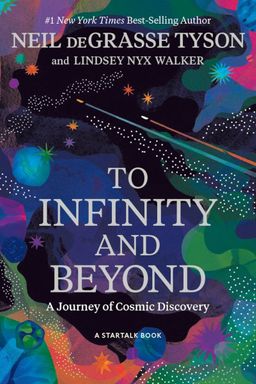
To Infinity And Beyond cover

To Infinity And Beyond

by Neil Degrasse Tyson And Lindsey Nyx Walker

Science and pop culture intertwine in this exploration of the cosmos, which includes parallel worlds and time travel.

From Sky Myths to Spacetime Reality

When you look up at the night sky, are you seeing a ceiling of lights, a map of gods, or a living laboratory? In To Infinity and Beyond, Neil deGrasse Tyson and Lindsey Nyx Walker argue that your answer isn’t just personal poetry—it’s a timeline of human progress. They contend that humanity’s most audacious achievements sprang from replacing stories with measurements, and wonder with method. But to do so, you must understand how we learned to leave the nest of Earth, how we reimagined our solar backyard, how we defined space itself, and how Einstein’s equations bent reality into new shapes—opening the door to black holes, time travel, and even multiple worlds.

The book is part history of science, part field guide, and part invitation. In brisk, vivid episodes—from Archimedes’s bath to the 2012 Red Bull stratospheric jump; from the Montgolfier balloon to the Saturn V; from Galileo’s telescope to the James Webb Space Telescope (JWST)—the authors show you how each leap demanded a prior unlearning. The result is a tour through four arcs: leaving Earth, touring the Sun’s backyard, venturing into outer space, and pressing to the limits of infinity and beyond.

Why This Journey Matters Now

The authors make a case that space isn’t a luxury pursuit—it’s a mirror that corrects our self-portrait. By grasping gravity and air pressure, you appreciate why a suction cup holds—or why you can’t hear in space. By understanding orbital mechanics, you see why the International Space Station is weightless and why reentry demands ablative heat shields. By learning how Venus became a runaway greenhouse (an insight Carl Sagan took to Congress in 1985), you glimpse climate risk on Earth. By watching the DART mission nudge an asteroid and the Cassini probe find methane rain on Titan, you realize this science changes what we protect, where we can live, and how we can defend ourselves.

What You’ll Explore in This Summary

You’ll start with the physics that finally got us off the ground—buoyancy, air pressure, lift, thrust, and the terrifying moment called max q that doomed Challenger. You’ll see how Newton’s imaginary cannonball foretold Sputnik and why the rocket equation (from Tsiolkovsky) makes fuel the tyrant of every mission. You’ll then tour planets newly revealed: Mercury isn’t “retrograde trouble” but a physics puzzle solved by Einstein; Venus isn’t goddess-green but oven-hot; our Moon is likely a child of violence (Theia); Mars isn’t a canal web but a colder cousin still holding water—and a tantalizing, contentious terraforming debate (Robert Zubrin and Chris McKay’s giant mirrors vs. the “Prime Directive” of planetary protection).

From there, you’ll meet Jupiter’s planet-size storm, watch Comet Shoemaker–Levy 9 bruise its atmosphere, skim Saturn’s cathedral-thin rings, and land—via the Huygens probe—on Titan’s methane shores. You’ll descend under Europa’s and Enceladus’s ice where black-smoker–like chemistries could feed alien microbes (echoing Nick Lane and Janna Levin’s fascination with life’s energy sources). You’ll also learn why orbits crowd (LEO, MEO, GEO, polar), how Kessler’s cascade could trap us under a shrapnel sky (a more accurate plot than Gravity’s bangs), and how DART’s “thwack” became the first planetary defense demo.

What Space Really Is (And Isn’t)

Next, you’ll redefine “space.” No, it isn’t empty: the Large Hadron Collider’s vacuums beat interplanetary space, virtual particles fizz in the void (quantum foam), and gravity never shuts off. The luminiferous aether died with Michelson–Morley, yet another kind of “nothing” emerged—Lagrange balconies where spacecraft lounge (JWST at Sun–Earth L2, SOHO at L1). You’ll distinguish sound from shock: in a vacuum, no acoustic booms; in air, shock waves sculpt everything from sonic booms to supernova shells and gamma-ray bursts.

A Universe With a Beginning—and Many Worlds to Come

The authors then solve a childhood riddle—why is the night sky dark?—by showing how Hubble’s expanding universe (nudged by Friedmann and Lemaître) plus the finite speed of light resolve Olbers’ paradox. When Penzias and Wilson stumbled on the cosmic microwave background, they found the baby photo of the cosmos—and validated the Big Bang. From there, exoplanets pour in (Kepler’s “Goldilocks” tally suggests hundreds of millions of habitable worlds in our galaxy alone), and biosignatures and technosignatures (oxygen, methane, CFC analogs) become targets for JWST-class telescopes (compare to Lisa Kaltenegger and David Grinspoon’s work).

The Warped Side: Time Travel, Black Holes, and Causality

Finally, you’ll walk the “warped side” Kip Thorne champions. Worldlines, not dates, decide meetups. Time dilates: muons reach sea level because the atmosphere “shrinks” in their frame; your phone’s GPS works only because satellite clocks are corrected for both special and general relativity. Black holes eat light; M87’s shadow proves their silhouette. Wormholes (Contact, Interstellar) are mathematically allowed but require exotic matter; Alcubierre’s warp bubble contracts space ahead and stretches it behind, yet energy demands remain cosmic. Try to outrun light with tachyons and you shred cause and effect—Hawking’s party for time travelers stays empty. Everett’s many-worlds, though, leaves a side door ajar: every quantum choice may branch reality.

The book’s promise

To Infinity and Beyond isn’t just a greatest-hits reel; it’s a user’s manual for awe. It asks you to swap superstition for physics, anecdotes for data, and isolation for a cosmic address. By the end, the sky you grew up under is larger, sharper, and—paradoxically—more intimate.


Escaping Air: Gravity, Pressure, Lift

Tyson and Walker start where all space stories must: inside the air. Before rockets, you had to understand the ocean you breathe. Air has weight. At sea level, every square inch of your skin holds up about fifteen pounds of atmosphere. You don’t feel crushed because pressure pushes from all sides; remove counter-pressure and a suction cup clings with the strength of a barbell. This isn’t trivia; it’s the physics behind why sky lanterns float, hot-air balloons rise, airplanes fly—and why rockets enter the danger zone called max q.

Buoyancy to Balloons: Ancient Tech, New Heights

Archimedes’s “Eureka” in a bath became the launchpad for flight. When the Montgolfier brothers heated air in 1783, their balloon rose because its warm, expanded air became less dense than the surrounding fluid (air is a fluid). They first sent a sheep, a duck, and a rooster aloft for eight minutes. A century later, meteorologist James Glaisher and Henry Coxwell climbed to ~35,000 feet in a coal-gas balloon, lost consciousness to low oxygen, suffered the bends, and barely lived. Their sacrifice taught us how air thins and why pressure matters (compare with Alfred Wegener’s high-altitude work on climate).

Torricelli’s Barometer: Weighing the Sky

In 1644, Evangelista Torricelli inverted a mercury tube into a basin and watched the column fall and stop. The vacuum above wasn’t sucking; the atmosphere below was pushing. Mark the height and you get inches of mercury—the world’s first barometer. Blaise Pascal then marched one up a mountain to prove pressure falls with altitude. This is why Felix Baumgartner’s 2012 “edge of space” jump at 24 miles required a pressure suit—and why he fell at 844 mph in thin air without instantly frying or freezing. Spoiler: he didn’t touch space; the Kármán line sits ~62 miles up, itself a fuzzy political-physics compromise (NASA uses ~50 miles).

Lift, Drag, Thrust: Why Wings Work

Airplanes exploit Bernoulli’s principle: air moves faster over a curved wing top than beneath it, lowering pressure above and generating lift. Add thrust (props or jets) to overcome drag and you fly. Helicopters create lift with spinning airfoils and can hover where jets can’t (on Mars, NASA’s 4-pound Ingenuity helicopter needed giant, fast-spinning blades because Martian air is ~1% Earth’s density—equivalent to flying at 16 miles on Earth). Rockets, however, don’t breathe. They carry their own oxidizer, which is why they can leave the troposphere, where weather and most air live, and punch toward space.

Max q: The Most Dangerous Minute

As a rocket accelerates through thick air, dynamic pressure peaks—max q. Too much aerodynamic stress and the vehicle can tear apart. Challenger’s O-ring, stiffened by Florida’s cold morning in 1986, leaked flame that became a blowtorch. Buffeted at max q, the stack disintegrated 73 seconds after liftoff. Tyson and Walker recount this soberly to make a point: engineering is applied physics under pressure—literally. The solution for max q is choreography: throttle down through this region, then throttle up when the air gets thin.

Why We Launch East, and Near the Water

Rockets don’t just go up; they go sideways—fast. To reach orbit, you need ~17,000 mph horizontally so you keep “missing the ground” as Earth curves away (Newton’s cannonball). Launching east adds Earth’s rotation as a free boost: ~1,000 mph at the Equator; ~915 mph at Cape Canaveral. Eastward launches over ocean also drop used boosters into uninhabited water. That’s why Europe launches from Kourou (5°N), why China favors Xichang (28°N), and why sea-based platforms like Ocean Odyssey make sense—right on the Equator.

A reality check on spectacle

Austrian daredevil stunts and billionaire suborbital hops make headlines, but the physics that truly opened space—barometers, buoyancy, Bernoulli, and max q—decide whether you survive the climb. (Note: This emphasis echoes Tom Wolfe’s The Right Stuff—glory is downstream of math.)

  • Takeaway: Before you chase the stars, master the air—its pressure, density, and turbulence decide your odds.

Orbits, Rockets, And Coming Home

Orbit is organized falling. Tyson revives Newton’s 1687 thought experiment: fire a cannon from a mountaintop faster and faster until the cannonball’s drop matches Earth’s curvature—it never hits the ground. That’s the International Space Station’s day job: free-fall at five miles per second, missing Earth for 90 minutes per lap. To speed up enough to do that, you fight the tyrant of rocketry: the rocket equation.

The Rocket Equation: Fuel’s Ruthless Math

Konstantin Tsiolkovsky used calculus to show that the delta-v (speed change) you can get depends exponentially on the ratio of total mass to dry mass. Translation: every pound of payload demands far more pounds of fuel to lift it, plus extra fuel to lift that extra fuel—a recursive tax. That’s why the Saturn V was 95% propellant and why miniaturization (born in the space race) matters to your smartphone. It’s also why Arthur C. Clarke’s 1979 space elevator is so seductive: climb a tether to geostationary orbit and bypass fuel entirely. Not yet—today’s materials can’t handle a 22,000-mile cable’s stress—but research on carbon nanotubes inches that dream forward.

Escape Velocity, Slingshots, And Gravity Assists

To leave Earth entirely, you need ~25,000 mph—escape velocity. The Voyagers did more using a once-in-two-centuries lineup of the outer planets to steal a little orbital energy from each—gravity assists. Think of it as drafting behind a semi truck, but with momentum exchange instead of air. Tyson flips the trick for missions that must slow down: MESSENGER reached Mercury via multiple flybys of Earth, Venus, and Mercury itself, bleeding energy until the speedy inner planet could capture it. Ironically, it’s easier to launch out of the solar system than to park at tiny, fast Mercury.

Coming Home: Heat Shields and Free Brakes

If launch is tyranny, reentry is negotiation. Meteors show the bargain: convert kinetic energy to heat via friction and compression. Apollo’s resin heat shields ablated—charred and peeled away—to carry the heat off with them. The space shuttle used ultralight aerogel tiles to soak and re-radiate heat, bleeding off Mach 25 to Mach 1 in thirty minutes, and then gliding to a landing. Call them what they are—“aerobrakes”—because at orbital speeds, Earth’s air is a free brake pad.

Why Satellites Fall (Slowly)

Sputnik lasted three months because even hundreds of miles up, wisps of atmosphere snag satellites. Over time they spiral down; the ISS reboosts itself every few weeks to counter its two-miles-per-month decay. In lower orbits, this self-cleaning helps curb debris; in higher ones (GEO), junk can linger for centuries—fuel for the Kessler cascade.

Voyagers: Humanity’s Longest Throw

Launched in 1977, Voyagers 1 and 2 toured the giants, then crossed the heliopause—the boundary where the solar wind yields to interstellar space. They carry the famous Golden Records: hellos, whales, Chuck Berry, and Earth’s heartbeat. Tyson treats them as emissaries and time capsules, quite possibly outlasting our species. (Carl Sagan, who chaired the record committee, told that humanist story in Cosmos.)

  • Actionable lens: When you weigh a big decision, ask the rocket-equation question: what hidden “fuel” are you underestimating to carry your current plan?

Bottom line

Orbit is a dance with gravity; reentry is a truce with air. The best space stories—Voyager’s slingshots, MESSENGER’s braking tour, Apollo’s ablative plunge—are really tales about learning to spend and recover energy wisely.


Rewriting Planets: Mercury–Mars

Once you’re above the clouds, the familiar planets become strangers. Tyson and Walker delight in turning pop-culture tropes into teachable physics. Mercury’s “retrograde” isn’t a mood, it’s an optical illusion from our faster orbit. Venus isn’t a jungle paradise; it’s an inferno. The Moon is not a tranquil twin but a scar born of impact. Mars isn’t a web of canals; it’s a dry, cold worksite that still might hide life—and inspires heated arguments about how humans should settle new worlds.

Mercury: Retrograde, Relativity, And Ice in Shadows

Ancients blamed Mercury’s “backward” motion for misfortune because they assumed a geocentric cosmos. Copernicus and Kepler demoted Earth; Einstein finished the job by explaining Mercury’s weird orbital precession with general relativity—killing the hypothesized inner planet “Vulcan.” Getting there is hard: MESSENGER used years of flybys to shed speed, then found water ice in permanently shadowed craters—minus 300°F pockets on a world that hits 800°F in daylight.

Venus: Phases, Transits, and a Runaway Greenhouse

Galileo used Venus’s phases to smash the Ptolemaic model; Jeremiah Horrocks and Captain James Cook timed transits to size the solar system. Then the Soviet Venera landers (1970s) and Mariner flybys measured surface temperatures near 900°F and a crushing pressure ~90 times Earth’s. Carl Sagan anticipated this: a thick CO₂ blanket drove a runaway greenhouse, perhaps drying out an ancient ocean. This is planetary climate science as warning label (see Elizabeth Kolbert’s work on climate risk as parallel reading).

The Moon: A Violent Birth and a Tidal Bond

Apollo didn’t just plant flags. Neil Armstrong’s first scoop of regolith was a contingency sample in case they had to abort; those rocks (and later seismometers) supported the Theia hypothesis: a Mars-sized body sideswiped early Earth, launching debris that congealed into our unusually large Moon with a small iron core. Tides from this close companion slow Earth’s spin (we add leap seconds because of it) and stabilize our tilt—no small favor for climate. Apollo’s laser reflectors still let us measure the Moon spiraling away ~1.5 inches per year.

Mars: From Canals to Rovers (and Terraformers)

Giovanni Schiaparelli’s canali inspired Percival Lowell’s canal maps and H. G. Wells’s War of the Worlds; Mariner 4’s 1965 flyby replaced fantasy with craters and a thin, cold atmosphere. Viking, Spirit, Opportunity, Curiosity, Perseverance—and the nimble Ingenuity helicopter—have since mapped ancient river deltas and found organics. Terraforming is the lightning rod: Robert Zubrin and Chris McKay proposed orbiting mirrors to thaw poles and release CO₂ and water vapor. But Mars likely lacks enough CO₂, and NASA’s Office of Planetary Protection warns: what if microbial life already lives there? Tyson raises the “Prime Directive” question—do we have the right to overwrite an alien ecosystem, however humble?

  • Quick comparisons: Mercury asks for patience (gravity assists), Venus warns about feedback loops, the Moon reminds that violence can build stability, and Mars demands humility.

A note on myth-busting

Einstein “killed” Vulcan; Mariner “killed” the canals. In this book, every death of a myth births a better story—a throughline that echoes Sagan’s Cosmos and Mary Roach’s Packing for Mars.


Giants, Rings, And Hidden Oceans

Beyond the asteroid belt lie the spectacle worlds—Jupiter’s churning bands, Saturn’s blade-thin rings, and the blue ice giants Uranus and Neptune. But the headline isn’t just beauty. Tyson and Walker use these worlds to reveal deep processes: storms that outlive nations, rings just a hundred feet thick yet 175,000 miles wide, and moons where it rains methane or where salty oceans slosh beneath ice. This is the part of the tour where “sci-fi” becomes field report.

Jupiter: A Storm the Size of Earth

Jupiter’s Great Red Spot—bigger than Earth and centuries old—is an anticyclone feeding on smaller eddies. The Juno spacecraft and earlier Galileo probe showed an atmosphere layered with belts and zones, helium rain, and likely a vast ocean of liquid metallic hydrogen that forges a titanic magnetic field. In 1994, the torn fragments of Comet Shoemaker–Levy 9 slammed into Jupiter at ~37 miles/second, leaving scars darker than the Spot—a live-action lesson in solar system dynamics and natural planetary defense.

Saturn: Jewelry With Depth

Galileo saw “ears,” Huygens saw a ring, and Cassini found a gap—now the “Cassini Division.” The Cassini–Huygens mission (2004–2017) turned ring lore into physics: the rings are astonishingly thin—tens to hundreds of feet—for all their breadth; a hexagon storm caps the north pole; and tiny embedded moons sculpt ring edges. Then Huygens parachuted onto Titan, the only moon with a thick atmosphere and stable surface liquids—not water, but methane and ethane. On Titan, methane cycles like water does on Earth: rain, rivers, seas. Deeper still may lie a global briny ocean of water and ammonia.

Ocean Worlds: Europa and Enceladus

If you search for life as we know it, follow the water. Europa’s cracked ice suggests a warm ocean below—twice the water of Earth’s seas—heated by tidal flexing from Jupiter’s gravity. Enceladus, a smaller Saturnian moon, vents jets hundreds of miles high from its south pole. When Cassini flew through the plumes, it sniffed salts and organic molecules suggestive of hydrothermal activity at the seafloor—Earth’s deep “black smokers” reborn in alien form. Life on Earth thrives there without sunlight, feeding on chemical energy; Tyson argues that this makes Europa and Enceladus the most promising places to look for life nearby (a case astrobiologists like Kevin Hand passionately share).

Ice Giants: Odd Axes and Wild Winds

Voyager 2’s flybys revealed Uranus tipped on its side, with rings hugging it vertically—likely the relic of an ancient collision. Neptune, chemically similar, surprised with deep blues and the fastest winds in the solar system (over 1,000 mph). These “most bizarre, least explored” worlds may actually be the most common kind of planet in the galaxy, based on exoplanet data—super-Earths and mini-Neptunes abound.

  • Why this matters for you: The “conditions for life” aren’t exotic—they’re everywhere fluids flow and energy gradients exist. That widens your imagination for where purpose might be found.

A humility checkpoint

A moon the size of Britain can sculpt a million-mile ring; a vent in darkness can feed an ecosystem. The giants remind you: scale and significance are not the same.


Crowded Skies & Planetary Defense

Space is getting busy. Since Sputnik’s midnight beep in 1957 (launched atop the R-7 ICBM that could just as easily have lofted a bomb), humans have filled low Earth orbit with thousands of satellites—plus tens of thousands of tracked fragments and hundreds of millions of untracked flecks. Tyson and Walker explain how this traffic works—and what happens when it doesn’t. They also follow the thread from von Braun’s V-2 to DART’s bullseye to argue that the same physics that can harm us can also protect us.

How Orbits Organize the Sky

LEO (up to ~1,200 miles) hosts ISS and Hubble; laps take ~90 minutes, yielding 16 sunrises a day. MEO (~12,500 miles) hosts GPS, whose clocks tick differently thanks to relativity (more on that later). GEO (~22,200 miles) hovers above the equator so a satellite “stands still” over one longitude—a boon for TV and weather. Polar orbits, slicing north–south, let satellites scan every longitude as Earth spins under them—ideal for reconnaissance and Earth science.

Kessler Syndrome: A Self-Feeding Cascade

At orbital speeds (ten times an AR-15 bullet), a paint chip can crater a window. Donald Kessler warned in 1978 that beyond a threshold, debris collisions create more debris in a runaway cascade, making some orbits unusable. Tyson invokes Gravity to dramatize the hazard—but corrects its physics: debris clouds don’t zip around the whole planet in minutes. Still, the trend is worrisome, especially with mega-constellations like Starlink multiplying quickly.

From V‑2 to Planetary Defense

Wernher von Braun’s 1944 V-2 was the first human-made object in space—and a terror weapon that killed thousands, plus tens of thousands enslaved in its manufacture. After the war, von Braun became NASA’s Saturn V architect. Tyson refuses to romanticize this; he frames space progress as entangled with military motives (echoing his and Avis Lang’s Accessory to War). The ethical throughline then flips with DART (2021–2022): a kinetic impactor that nudged the moonlet Dimorphos and measurably changed its orbit—our first proof we can deflect a hazardous asteroid.

Five Ways to Nudge a Rock

Tyson lists ideas both charming and serious: paint one hemisphere to exploit sunlight pressure; send impactors in a chain to slow it; whack it with a probe (DART); explode a nuke near the surface to vaporize a layer and create thrust; park a “gravity tractor” spacecraft nearby and let mutual gravity tug its path over years. The earlier you start, the smaller the nudge required.

Hidden Figures, Visible Futures

Behind the first human orbits were Katherine Johnson, Dorothy Vaughan, and Mary Jackson—the “human computers” whose pencil-and-paper trajectories John Glenn insisted on. Tyson highlights their work (popularized in Margot Lee Shetterly’s Hidden Figures) to make a broader point: diversification of who does the science widens what science gets done—and for whom its benefits accrue.

  • Your takeaway: Space safety is not a spectator sport. Regulation, debris remediation, and planetary defense are public goods that need public will.

What Space Is: Waves, Aether, Lagrange

If you grew up thinking space is “nothing,” Tyson and Walker will un-teach you. Even a perfect-seeming vacuum is alive with virtual particles (quantum foam). Gravity never runs out; it just weakens with distance. And you can park spacecraft at special balance points—Lagrange points—where gravitational and inertial forces cancel. To get there, the authors take you through a century-long detour: the rise and fall of the luminiferous aether, and the showdown over whether light is a wave or a particle.

From Aether to Emptier Vessels

Huygens (1690) argued light is a wave, like sound, and posited an all-pervading aether to carry it. Newton (1704) saw light as corpuscles (particles), which neatly explained straight-line travel and mirror-like reflection. For two centuries, physicists tried to measure Earth’s motion through the aether. Albert Michelson and Edward Morley built an exquisitely sensitive interferometer (1887) and found…nothing. The speed of light was the same in every direction. The aether died; Einstein’s relativity rose.

Wave, Particle… Both

Maxwell showed light is electromagnetic waves; Einstein won his Nobel for the photoelectric effect—treating light as quantized packets (photons). Thomas Young’s double-slit experiment nails the paradox: a single photon sent toward two slits creates an interference pattern if you don’t look—as if it went through both slits. Observe which slit it uses and the wave-like pattern collapses. The authors tee this up for later discussions of many-worlds and causality, but here the message is simple: nature isn’t obliged to fit your categories.

Lagrange Points: The Balconies of Space

In the rotating Sun–Earth system, five special points (L1–L5) offer gravitational balance. L1 sits between Sun and Earth; park SOHO there to stare at the Sun and warn of solar storms. L2 lies a million miles past Earth; it’s cold, dark, and perfect for the JWST’s infrared shields to sip ancient light (and for DSCOVR to watch Earth’s climate from the sunlit side at L1). L3—opposite Earth—makes good sci-fi but is dynamically shaky. L4 and L5 (the “Trojan points”) are stable and hoard asteroids in the Sun–Jupiter system. In real mission planning, these aren’t trivia—they’re utility shelves in the garage of space.

Shock Waves: Why Booms Boom

In fluids, pressure ripples propagate at the speed of sound. Go faster and ripples pile into a shock front. That’s the boom when a jet crosses Mach 1, the destructive ring of a nuclear blast, and the glowing rim of a supernova’s expanding shell. In space—no air—Hollywood’s thunderous explosions fall silent. But shock fronts still exist as expanding, superheated gas plows into interstellar material. Tyson uses this to bridge to giant-scale phenomena: Stephan’s Quintet’s bow shock larger than the Milky Way; gamma-ray bursts that outshine galaxies in an instant.

A practical footnote

Your GPS and satellite TV work because engineers bet on the right “nothing”: there’s no aether, but there is spacetime geometry—and sweet spots (L-points) where geometry makes life easier.


A Universe With A Birthday

Why is the night sky dark? Tyson turns that child’s question into a cosmology masterclass. If the universe were infinite, eternal, and uniformly filled with stars, every line of sight would end on a stellar surface—the sky would blaze. It doesn’t. The solution—Hubble’s expanding universe plus finite light speed—motions you back to a beginning. Lemaître called it “the primeval atom”; Penzias and Wilson heard its fading echo: the cosmic microwave background (CMB).

From Genealogies to Geology to General Relativity

Seventeenth-century clerics dated Earth by “begats” (Archbishop Ussher: 4004 BCE). Nineteenth-century physics (Lord Kelvin) lowballed the Sun’s age because nobody yet knew about nuclear fusion. Geology and Darwinian evolution demanded deeper time. The modern fix compounded multiple lenses: radiometric dating (Marie Curie’s legacy), Leavitt’s law for Cepheid variables to ladder up cosmic distances, and Hubble’s redshifts showing galaxies retreat faster the farther they are—implying expansion. When Arno Penzias and Robert Wilson found the same faint hiss from every direction, they’d tuned into the CMB—light released ~380,000 years after the Big Bang, stretched by expansion to microwave wavelengths today.

How Old, How Big

Refining the Hubble constant (with help from Walter Baade and Allan Sandage) pushed the universe’s age from a too-young ~2 billion years to today’s ~13.8 billion years. Tyson’s scaling analogies land the awe: a billion seconds is ~31.7 years; a trillion seconds is ~31,700 years—back to Neanderthals. Multiply ~100 billion galaxies by ~100 billion stars and you get ~10²² stars. Kepler then suggested hundreds of millions of habitable-zone exoplanets in our galaxy alone. It’s hard to overstate how recently this picture gelled—JWST’s first deep fields already nudge those numbers higher.

Dark Energy: Einstein’s “Blunder” That Wasn’t

Einstein inserted a cosmological constant to preserve a static universe; later he called it his “biggest blunder.” In 1998, two teams found distant supernovae dimmer than expected, implying expansion is accelerating. Dark energy—an unknown pressure-like component—dominates the cosmos (~68%). The constant lives again, now as a driver opening the universe faster. Tyson’s lesson: in science, yesterday’s fudge factor can become today’s bedrock (see also the “epicycles” that morphed into legitimate perturbations in orbital mechanics).

Life Signs and Techno-Signs

Astrobiologists now treat spectra as fingerprints. Oxygen and methane in disequilibrium hint at biology; certain pollutants (CFC analogs) could betray industry—technosignatures. JWST and its descendants will look for these in exoplanet atmospheres. Tyson offers the sly inversion: an alien looking our way in the 20th century might have read our CFC spike and concluded, “Life, yes. Intelligence—jury’s out.”

  • Living with the answer: A universe with a birthday shrinks your centrality—but expands your kinship. You live in a story still being written.

The Warped Side: Time, Black Holes, Travel

Einstein didn’t just add a page to physics; he rewrote the plot. Space and time fuse into spacetime; worldlines, not calendars, decide who meets. Speed and gravity warp time; energy and mass tell spacetime how to curve. Tyson and Walker take you into this “warped side,” with practical stops (GPS) and speculative ones (wormholes, warp drives, many-worlds).

Time Dilation You Can Use

Special relativity says the speed of light is the same for everyone; therefore distances and times must flex to keep it so. Send a single photon to a moving spaceship’s bathroom mirror and the Earthbound observer sees it travel a longer, diagonal path—meaning more time elapses. That’s why fast muons born high in the atmosphere reach the ground: in their frame, the atmosphere is “length-contracted.” General relativity adds gravity: clocks deeper in a gravitational well tick slower. Your phone’s GPS only works because satellites (in weaker gravity and moving fast) are corrected for both effects. Scott Kelly’s year in space made him ~5 milliseconds “younger” than his twin.

Black Holes: From Thought to Photo

John Michell speculated about “dark stars” in the 1700s; relativity made them rigorous. Cross the event horizon and not even light escapes. Feed one with a companion star’s gas and you get a hot, x-ray–bright accretion disk—how Cygnus X-1 outed our first galactic black hole. In 2019, the Event Horizon Telescope imaged the shadow of M87’s supermassive black hole: a lopsided donut of light bent by gravity around darkness. Tyson tips his hat to Kip Thorne’s Interstellar visuals—film-grade GR—and notes the “Tiffany problem” choice not to render Doppler-brightening asymmetry that would confuse audiences.

Wormholes, Warp Drives, Tachyons

An Einstein–Rosen bridge (wormhole) could, on paper, fold space so distant points touch; to hold one open you likely need exotic matter with negative energy density. Kip Thorne advised Carl Sagan’s Contact on a plausible version; Interstellar took it further. Miguel Alcubierre’s 1994 warp bubble contracts space ahead and expands it behind, moving you FTL relative to distant observers without you locally breaking light speed. The energy bill, however, is outrageous. Tachyons—hypothetical particles that only go faster than light—wreck causality.

Causality and Many Worlds

Send a faster-than-light message and you can receive it before it’s sent—Stephen Hawking’s party for time travelers stays empty. Tyson offers a kinder weirdness: Hugh Everett’s many-worlds interpretation. In the double-slit experiment, if all quantum possibilities are real in branching universes, then “grandfather paradoxes” dissolve—your backward-time choice simply lands you in a different branch. You haven’t changed the past; you’ve chosen a future. Whether that’s testable is another matter (Sean Carroll and David Deutsch offer friendly extensions), but as a thinking tool, it rescues cause-and-effect without killing wonder.

  • Everyday application: When you plan, remember your “worldline.” To meet someone or ship something, you don’t need “when” or “where”—you need both. Logistics is low-stakes relativity.

Final note

Tyson and Walker don’t promise you a ticket through a wormhole. They give you something better: literacy in a universe where such questions are serious, not silly.

Dig Deeper

Get personalized prompts to apply these lessons to your life and deepen your understanding.

Go Deeper

Get the Full Experience

Download Insight Books for AI-powered reflections, quizzes, and more.