
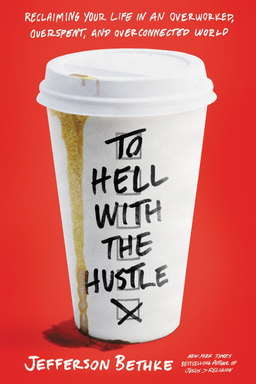
To Hell with the Hustle cover

To Hell with the Hustle

by Jefferson Bethke

To Hell with the Hustle challenges the relentless demands of modern productivity culture. Jefferson Bethke offers a transformative guide to reclaiming your life through intentional living, rest, and spiritual health. Discover practices that foster meaningful connections and personal fulfillment.

To Hell with the Hustle: Reclaiming Humanity from a Culture of Overwork

Have you ever felt that no matter how much you achieve, it never feels like enough? In To Hell with the Hustle, Jefferson Bethke argues that the modern obsession with hustle—the relentless drive to do more, earn more, and be more—is destroying our souls, relationships, and sense of purpose. He contends that the greatest danger of our time isn’t laziness or apathy but the spiritual corrosion caused by busyness, distraction, and misplaced identity.

Bethke’s central claim is that hustle culture, far from being a sign of progress, is a symptom of a deeper sickness. We’ve replaced faithfulness with productivity, character with accomplishment, and being with doing. The result is not flourishing but burnout: anxiety, loneliness, and spiritual exhaustion. Instead of aligning ourselves with the hurried tempo of modern life, he calls us to reclaim the unhurried way of Jesus—grounded, present, and human.

The Slow Death of the Soul

The book opens with Bethke’s own story of almost losing himself and his marriage to the cultural pressure to keep doing more. Through his personal struggles, he exposes how hustle disguises itself as ambition but often stems from fear—the fear of not being enough. The relentless chase for relevance and recognition produces a spiritual vacuum: we gain the world but lose our souls. He asks us, “What if hustle isn’t a badge of honor, but the very thing making us sick?”

Bethke suggests that hustle is a kind of counterfeit spirituality. We bow to it, serve it, and sacrifice for it as one would a god. Instead of resting in divine acceptance, we search for validation in likes, productivity metrics, and the illusion of progress. The tragedy, he argues, is that this worship yields emptiness. We are working harder than ever—and yet we are lonelier, more anxious, and more disconnected than any generation before us.

Formation over Achievement

Bethke redefines success through the language of formation rather than goals. Drawing from Christian tradition and thinkers such as James K.A. Smith and Henri Nouwen, he argues that you are always being formed—by your habits, routines, and the culture around you—whether you notice it or not. Unlike goal-setting, which focuses on results, formation focuses on who you are becoming. Every small act, from how you use your phone to how you rest, is shaping you into a certain kind of person. The question isn’t whether you’re being formed, but into what.

He contrasts modern life’s addiction to information with the wisdom of the ancients. Surrounded by endless data, podcasts, and self-improvement hacks, we’ve become informationally obese but spiritually malnourished. True transformation, he insists, comes not from consuming content but from repeated, embodied practices that align our loves with what is good and true.

Resistance and Return

Bethke organizes the rest of the book around practices of resistance. Each chapter explores a countercultural rhythm that undermines hustle’s power: silence to resist noise, Sabbath to resist urgency, limits to resist excess, and empathy to resist tribalism and division. Through these, he urges readers to slow down and rediscover their humanity—one rooted in presence, community, and dependence on God.

The book’s recurring metaphor is simple yet profound: we are like astronauts trying to build a home on the moon—weightless, unanchored, and untethered. What we need, Bethke argues, is not more propulsion but more gravity. The way of Jesus, with its rhythms of rest and restraint, is that gravity. Just as Christ resisted urgency, lived obscurely, and moved slowly, we too are called to lower our pace and deepen our roots.

Why It Matters Now

In a time when anxiety, burnout, and loneliness are cultural epidemics, Bethke’s call to “send the hustle to hell” resonates as both spiritual protest and personal confession. He doesn’t romanticize slowness or preach withdrawal; rather, he offers a vision for faithful presence—living deeply and meaningfully in a frantic world. His message echoes others in the same tradition, such as John Mark Comer’s The Ruthless Elimination of Hurry and Cal Newport’s Digital Minimalism: the good life is not faster, louder, or busier—it’s quieter, slower, and more human.

Ultimately, this book is an invitation to reorder your life around what truly matters. It’s a manifesto for the modern soul to trade exhaustion for rest, distraction for presence, and ambition for faithfulness. To hell with the hustle, Bethke declares. Because the kingdom of God runs on a very different clock.


We’re Being Formed, Whether We Like It or Not

Jefferson Bethke begins his argument with a bold statement: you are being shaped every day by the habits, routines, and rituals of modern life. Whether scrolling through your phone before bed or answering messages during lunch, every repeated behavior is forming you into a particular kind of person. The problem is that most of us passively let culture do the forming instead of intentionally choosing who we become.

From Goals to Formations

Bethke and his wife, Alyssa, used to begin each year with the classic practice of goal-setting—writing down objectives to accomplish and milestones to reach. But eventually, they noticed that these goals rarely produced the character or peace they longed for. So they replaced goals with what they call “formations”—small, repeatable practices that shape who they are over time. Rather than asking, “What do we want to achieve?” they began asking, “Who are we becoming through what we’re doing?”

This shift changed everything. By instituting simple rhythms—like turning off their phones for 24 hours each week, keeping digital devices out of bedrooms, and celebrating a family Sabbath—they found themselves becoming more whole and joyful, not merely more efficient. Bethke quotes James K.A. Smith’s idea that “we are what we love.” Our practices, not just our ideas, direct our love and ultimately define our identity.

Information Without Transformation

Bethke warns that in the digital age, we are drowning in information yet starving for wisdom. He likens our society to being “informationally obese”—addicted to learning, hacking, and optimizing without ever becoming different people. We are excellent at consuming ideas but terrible at embodying them. He notes that while innovation accelerates, genuine transformation stagnates. Our devices promise efficiency but rob us of focus, making us increasingly restless and disengaged.

He draws a historical comparison, likening today’s social media and smartphone addiction to the way tobacco and cocaine were once marketed as harmless miracles. In time, our culture will see the digital barrage for what it truly is: toxic to the soul. To counter it, Bethke encourages readers to consider practices of digital minimalism and sacred ritual—to replace stimulation with stillness, and speed with presence. Just as crop rotation allows soil to recover, our souls require boundaries to remain fertile.

The Power of Habits and Rituals

Every habit, Bethke argues, carries spiritual weight. Even seemingly mundane actions, like checking your phone or making coffee, form desires beneath the surface. In one example, he describes preparing coffee each morning for his wife as a ritual of love. What began as an act of courtesy became a habit of communion—a tangible way to cultivate joy in ordinary life. He encourages readers to view such rituals not as empty legalisms but as vehicles of grace. True love, he says, is not spontaneous emotion but practiced habit.

“Love isn’t just a feeling; it’s a habit. Rules before love equals legalism, but love before rules equals formation.”

Ultimately, Bethke calls us to examine the “micro-liturgies” of our lives—the small rituals we unconsciously repeat—and ask whether they align with the character of Jesus. From liturgical prayer to technological boundaries, the goal is not self-improvement but soul reformation. Because we are always being formed, the only question is who—or what—is doing the forming.

(This argument echoes similar themes from Dallas Willard’s The Spirit of the Disciplines and James Clear’s Atomic Habits: that transformation comes not from willpower but from intentional, consistent, embodied action over time.)


Freedom Within Limits

Bethke continues his cultural critique by turning to one of modernity’s favorite idols: the pursuit of unlimited freedom. Drawing on history, he argues that the Western promise of boundless independence—freedom from every restraint—has mutated into a spiritual cancer. In its healthiest form, freedom protects human dignity and creativity. But when detached from moral limits, it becomes self-destructive.

Freedom without Boundaries

Modern freedom, Bethke notes, was born from good intentions: liberation from tyranny and the right to self-govern. But over time, “freedom from tyranny” became “freedom from limits.” Society now treats every boundary—ethical, sexual, relational—as an obstacle to personal happiness. We chase an existence where no one can tell us no. Yet by removing every constraint, we’ve paradoxically enslaved ourselves to our own appetites.

He uses the metaphor of a skydiver: the experience only feels exhilarating because of the parachute, not despite it. True freedom, like skydiving, depends on restraint. Similarly, the biblical model of sexuality finds liberation not in endless choices but in covenant commitment. The irony, Bethke notes, is that the modern obsession with “freedom of choice” often leads to loneliness, addiction, and despair—the opposite of freedom.

The Industrial Roots of Hustle

Tracing the origins of hustle culture, Bethke points to 1913—the birth of the assembly line. When Henry Ford divided labor into tiny, mechanical motions to maximize productivity, he unleashed a new logic: efficiency over humanity. Over time, this mindset seeped into every corner of life. Students became products. Churches became production lines. Even relationships became disposable because convenience replaced commitment.

Corporate leaders like Paul Mazur of Lehman Brothers, Bethke reveals, intentionally shifted America from a “needs-based culture” to a “desires-based culture.” Consumers were trained to want more than they needed—to mistake convenience for joy. In the process, we turned work into an idol. The factory mentality didn’t just change the economy; it changed our souls.

Rest, Ritual, and Meaning

Bethke laments the disappearance of meaningful rituals and rhythms in modern life. Ancient cultures, even nonreligious ones, were anchored by rites of passage and communal ceremonies that affirmed identity. In contrast, today’s milestones—getting a driver’s license, acquiring an iPhone—are shallow substitutes. What humans truly crave, he argues, is meaning, not freedom. We need structure, rhythm, and belonging to flourish.

By embracing healthy limits—rest days, community commitments, and boundaries around technology—we find the liberation we’ve been chasing. “Freedom in limits,” Bethke insists, “is not restriction but design.” When we stop worshiping autonomy and learn to rest under divine order, we rediscover our humanity—and the grace to live it well.


The Music of Shalom

In one of the book’s most striking chapters, Bethke explores chaos and peace through the language of music. He begins with a lesson from history: Thomas Edison, the man who invented the lightbulb, despised sleep. He believed it was an unnecessary relic of “cave life” and sought to eradicate it. By creating artificial light, Edison helped modern society cheat night itself—and in doing so, Bethke argues, we lost rhythm.

Chaos as the Default

Bethke draws from Genesis, describing how the world began “formless and void”—tohu wa-bohu, Hebrew for chaos. God didn’t eliminate chaos through productivity but by bringing order, rhythm, and beauty: light, dark, day, and night. He points out that modern humans are repeating the fall by rejecting limits on time and rest, living in constant “daylight.” Sleep deprivation, overwork, and synthetic rhythm have made us sick, both physically and spiritually.

Music from the Mess

To explain restoration, Bethke uses the metaphor of music: disorganized sound is noise, but organized sound through rhythm becomes a song. Likewise, our lives need structure and cadence. Without a tempo to guide our days, we dance out of sync—what he calls “spiritual chaos.” The goal of Christian formation, then, isn’t to escape rhythm but to find the divine beat of shalom—peace that “destroys the authority of chaos.”

He writes about his own season of heartbreak and depression when, after losing direction and purpose, he found himself churning in internal turbulence. The breakthrough came when he realized that the antidote to chaos wasn’t more doing but more being: time with God, rest, and meaningful ritual. “When you start dancing to His song again,” Bethke says, “your feet finally hit the ground.”

Learning the Dance

True spiritual growth, Bethke suggests, is like learning to dance with God. Early attempts feel clumsy and awkward—you step on toes, count beats, and struggle to find your groove. But consistency leads to fluency. With time, rhythm becomes instinct, and the dancer looks up, no longer watching their feet but meeting their partner’s gaze. This metaphor reflects the slow, embodied transformation of spiritual maturity: grace learned step by step.

“The antidote to chaos isn’t control. It’s rhythm.”

In rediscovering rhythm—through rest, prayer, work, and silence—Bethke argues we participate in God’s ongoing symphony of peace. This harmony, or shalom, isn’t the absence of activity but its proper tempo. Like a song that finally resolves, life under divine rhythm sounds right.


Silence as Resistance

In a world addicted to noise, Bethke declares that silence is a revolutionary act. He describes writing in a coffee shop, surrounded by buzzing espresso machines and background music, realizing how unnatural constant sound has become. Our nervous systems, he notes, were never built for such continuous stimulation. Silence, once the default human environment, now feels unbearable because it forces us to face what’s inside us.

Noise as a Cultural Drug

Drawing on neuroscience, Bethke references studies showing that chronic noise fatigue physically exhausts the brain’s sensory systems. We live with migraines, anxiety, and disconnection but rarely trace their cause to noise. Even leisure spaces—restaurants, gyms, and parties—blast sound to manipulate behavior, making us eat faster, drink more, and leave sooner. In this sense, noise has become both a numbing agent and a control mechanism, keeping us too distracted to notice our exhaustion.

He contrasts this with silence’s power to reveal the truth. When distractions are stripped away, our buried pain, guilt, and unmet desires surface. That’s why silence feels terrifying—it exposes what noise concealed. Yet that exposure is the birthplace of healing. Bethke quotes Henri Nouwen: “Silence is the place where the old self dies, and the new self is born.”

Mister Rogers’s Quiet Revolution

To illustrate silence’s countercultural impact, Bethke spotlights Fred Rogers—“Mister Rogers”—as an unlikely revolutionary. When television was obsessed with noise, speed, and spectacle, Rogers used pauses, slow speech, and calm presence as his protest. Every meeting he led began with sixty seconds of silence. Even at the Emmys, before millions, he invited the audience into a minute of reflection. He believed stillness restores the human soul’s capacity for empathy.

Seeking and Defending the Quiet

Bethke introduces Gordon Hempton, an ecologist who mapped the quietest places in America—a forest where even the wind sounds sacred. Like Hempton, Bethke urges readers not only to seek silence but also to defend it. He describes turning off his phone once a week and practicing short daily moments of stillness as acts of spiritual rebellion. For him, silence is not absence but presence: “When we stop shouting, we finally hear God whisper.”

In the end, Bethke reframes silence as not the opposite of sound but the echo of grace. In the quiet, we meet God again. And through this practice, we slowly relearn what it means to be human.


The Power of No

Few words are more spiritual than no. Bethke argues that every “no” we say creates the space for a better “yes.” In a culture that equates worth with busyness, saying no becomes an act of worship—an acknowledgment that we are not God. To illustrate, he explores how our modern concept of time, once fluid and communal, has become mechanized and oppressive.

Time as a Tyrant

The invention of standardized time, Bethke explains, transformed how humans relate to work and each other. Before railroads, each village set its clock by the sun. But industrialization demanded precision, and soon time became a slave master. We stopped living by natural rhythms and began living by the clock, measuring our worth in productivity units. As Seneca once warned, we hoard money but give away our time freely—our most precious asset.

This shift birthed “time stress,” the anxious sense that we never have enough. For Christians, Bethke notes, this is theological rebellion: to live without rest is to deny God’s provision. True freedom requires margin—the sacred gap between our load and our limits. Without it, burnout becomes inevitable.

The Sacred Default

Bethke proposes a radical discipline: make your default answer “no.” Our calendars should reflect finite humanity, not divine omnipresence. He and his wife began filtering every opportunity—social invites, travel, work—through ruthless prioritization: family, community, craft, then others. “If you want more time for what matters,” he writes, “you have to starve your schedule.” This discipline allowed them to love their neighbors and children well, not from leftover scraps of energy but from true presence.

Bethke also connects this idea to ancient Jewish wisdom. Every seventh year, the Israelites practiced Shmita—a sabbatical for the land and the poor. Fields were left fallow, debts forgiven. This system of restraint wasn’t impractical; it was holy justice. It reminded them that the earth—and their lives—belonged to God.

Margin as Compassion

For Bethke, rest is not selfishness but service. Creating emptiness in your calendar allows interruptions—those ordinary miracles where love happens. Jesus performed many of His greatest acts not because He was efficient, but because He was interruptible. Modern discipleship, Bethke argues, requires the same posture. “If you don’t have time to be interrupted,” he writes, “you don’t have time to love.”

To say “no” is to embrace our creaturely limitations and trust in divine timing. Saying no to hurry opens the door to grace—and to the slow, steady rhythm that makes life worth living.


The Desert Gift and the Beauty of Obscurity

After examining silence and rest, Bethke explores an even deeper practice of resistance: embracing obscurity. He tells of losing his unborn daughter, Ellie Grace—an experience that shattered him. In grief’s wilderness, he learned that God works most intimately in hidden places. Our culture worships visibility and applause, but Jesus calls us into the quiet desert where our worth is proven in love, not likes.

The Blessing of the Desert

Bethke connects his story to Jesus’ own pattern: baptism, desert, ministry. Before performing a miracle or preaching a sermon, Jesus heard the Father say, “You are my beloved.” Then He withdrew to the wilderness to anchor that identity before returning to public life. Bethke calls this the neglected order of discipleship: identity → obscurity → calling. Skip the desert, and your ministry collapses under the weight of your ego. The desert isn’t punishment—it’s preparation.

Choosing “Boring” Faithfulness

In a culture obsessed with platform, Bethke champions what he calls “boring holiness”: a life of quiet faithfulness that refuses to equate impact with visibility. He quotes Fred Rogers again: “You don’t have to do anything sensational to be loved.” Biblical heroes, he notes, often lived most of their lives in anonymity—Moses tending sheep for forty years, Abraham dying without seeing fulfilled promises, Paul waiting in Arabia. Their greatness was faithfulness, not fame.

For Bethke, obscurity brings freedom. After his first viral YouTube video made him famous overnight, he realized how unbearable visibility could be. Success without formation is suffocating. By stepping back into hidden work—writing slowly, living quietly—he rediscovered joy in process, not performance.

Faithfulness over Fame

The desert life, Bethke concludes, releases us from the tyranny of outcomes. God is less concerned with what we achieve than with who we become. Obscurity trains us to love unseen, to serve unnoticed, and to rest in the truth that “well done, my good and faithful servant” is far greater than “you went viral.”

(In many ways, this chapter stands in conversation with Henri Nouwen’s The Way of the Heart and Eugene Peterson’s A Long Obedience in the Same Direction: both call us back to fidelity and formation in an age that prizes fame over faith.)


Empathy: The Way Back to Being Human

Bethke closes his manifesto with empathy—the practice that glues humanity back together. In an age of outrage, empathy feels radical. He introduces Daryl Davis, a Black musician who befriended hundreds of Ku Klux Klan members and, through simple friendship, convinced many to renounce racism. When asked his method, Davis replied, “I simply ask them, ‘How can you hate me when you don’t even know me?’” Empathy, not argument, opened their hearts.

Tribe and Disconnection

Bethke warns that technology has distorted our sense of community. Referencing Sebastian Junger’s Tribe, he notes that early settlers often left Western cities to join Native tribes because communal life was more fulfilling than individualism. Today, our digital “tribes”—political bubbles, online fandoms, ideological enclaves—are poor imitations of real belonging. They give us identity without intimacy, affirmation without accountability.

Fear as the Enemy of Love

The driving force behind division, Bethke asserts, is fear. Modern media profits from stoking fear because fear fuels engagement. But love requires presence and slowness. Drawing from the teachings of John, he notes that “perfect love casts out fear”—not hate. Fear is faster than love; it rushes to judgment. Love, however, moves at “three miles per hour,” the average speed of walking. It listens, stops, and waits. Jesus changed the world by walking, not running.

To cultivate empathy, Bethke recommends a simple but profound practice: before reacting in conversation, ask, “What do you mean by that?” This question creates the pause love needs to breathe. Online outrage dehumanizes; empathy rehumanizes.

The Slow Revolution

Bethke envisions a community of believers who embody slowness, listening, and compassion in a world of speed and shouting. Jesus’ way, he concludes, is not hustle but hospitality. By walking at God’s pace—steady, grounded, compassionate—we resist the empire of noise and fear. “To love,” he writes, “is to walk three miles an hour.”

In the end, empathy is not merely an emotion but a discipline—a choice to see and stay with others, even when it costs us. It is the final antidote to hustle, the posture of a heart unhurried by fear, awake to grace, and deeply human once again.

Dig Deeper

Get personalized prompts to apply these lessons to your life and deepen your understanding.

Go Deeper

Get the Full Experience

Download Insight Books for AI-powered reflections, quizzes, and more.