
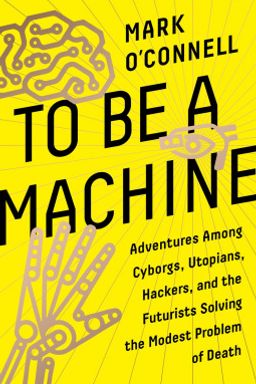
To Be A Machine cover

To Be A Machine

by Mark O'Connell

To Be A Machine delves into the fascinating world of transhumanism, where visionaries aim to defeat death and enhance human abilities through technology. Mark O’Connell explores the ethical and existential implications of a future where humans may become part machine.

Becoming Machines: Humanity’s Struggle to Transcend Itself

Can technology save us from the very things that make us human—frailty, fear, suffering, and death? In To Be a Machine, Mark O’Connell takes readers on an extraordinary journey into the world of transhumanism: a movement based on the belief that humanity’s destiny lies in merging with technology. O’Connell doesn’t just observe this world as an outsider—he immerses himself in it. From cryonics labs in Arizona to cyborg meetups in Pittsburgh and futurist parties in Silicon Valley, he chronicles the strange, fervent hopes of people who believe we can overcome the biological limits of our species. Yet beneath all the optimism, he finds something far darker and more human: a deep, undeniable fear of death, and the unsettling question of whether freedom from our biology might mean the end of our humanity itself.

At its core, To Be a Machine is a philosophical investigation disguised as a travelogue. O’Connell’s guiding question is simple but radical: What does it mean to be human in an age where we dream of becoming machines? Through this question, he explores how science, faith, capitalism, and existential dread intertwine in the modern pursuit of immortality. He encounters roboticists who hope to upload minds into computers, cryonicists who freeze bodies against inevitable decay, activists campaigning for government funding of life-extension, and AI ethicists predicting humanity’s annihilation by superintelligence. Everywhere he turns, he finds variations of the same story: the ancient human desire to escape the Fall, to reverse nature’s verdict, to remake ourselves in the image of our own inventions.

A World Obsessed with Transcendence

O’Connell begins his exploration in Dublin, where the birth of his son fills him with awe for life’s fragility. Holding the newborn and realizing how easily flesh can break, he begins to see the appeal of transhumanism’s rebellion against mortality. The sentiment that “there ought to be a better system” propels him into the movement’s virtual and physical world. For transhumanists, technology represents more than progress—it’s salvation. Figures like Max More (author of “A Letter to Mother Nature”) envision humanity rewriting its own “code” to end suffering, aging, and death. They see biology not as destiny, but as a bug to be patched. The irony, O’Connell notes, is that this rationalist utopia carries the emotional charge of a religious crusade—its rhetoric of salvation, sin (mortality), and transcendence betraying how ancient its yearnings really are.

The Machinery of Belief

Across continents, O’Connell meets believers in humanity’s mechanical future: Anders Sandberg, who prays to the prophets of computing; Max and Natasha Vita-More, cryonics pioneers preparing for resurrection in Arizona; and Randal Koene, a neuroscientist seeking to upload minds into silicon “substrates.” Each believes that consciousness is simply information—a code that can be copied and preserved beyond death. While O’Connell listens with fascination, he struggles to shake the feeling that their promised liberation resembles a more total slavery to machines. The dream of becoming pure code, he suspects, may erase what is most human: uncertainty, emotion, and imperfection.

The Faith in Technology

By positioning transhumanism as both science and religion, O’Connell explores how the modern faith in technology echoes earlier faiths in God. Nowhere is this clearer than in the Silicon Valley billionaires—Peter Thiel, Ray Kurzweil, and Elon Musk—who pursue immortality with corporate zeal. Google’s biotech lab Calico, Kurzweil’s prediction of the Singularity (when machines surpass human intelligence), and Thiel’s cryonics funding are all modern sacraments of belief in mastery over death. Yet this optimism coexists with apocalypse. The same machines designed to redeem us might, O’Connell notes, destroy us. Artificial intelligence could either save humanity or render it obsolete—two sides of the same yearning to escape limitation.

Between Awe and Horror

Ultimately, O’Connell’s book is not about technology itself but its emotional gravity—the way our machines reflect back our oldest fears and desires. In his encounters with cyborgs, AI philosophers, and immortality seekers, he returns to the paradox at the movement’s heart: in striving to perfect ourselves, we may be annihilating the very thing that makes us human. “To be a machine,” O’Connell realizes, “is also to be human—to dream, to rage, to try, and to fail.” And perhaps that failure, our tragic fragility, is what makes us beautiful in the first place.


The Transhumanist Rebellion Against Nature

O’Connell begins his journey by framing transhumanism as a modern rebellion against what Hannah Arendt once called “human existence as it has been given.” We are, as she put it, beings possessed by rebellion against our own nature. From the first story humanity told—the Fall from Eden—humans have dreamed of transcending their animal condition. O’Connell connects the myth of Adam and Eve, punished for seeking godlike knowledge, to today’s technological defiance of evolutionary limits. For transhumanists, technology is no longer a tool but a means to re-engineer what it means to exist. If nature is flawed, humanity can and must become its own creator.

Max More’s Manifesto: Rewriting Creation

O’Connell finds this idea distilled in Max More’s famous “Letter to Mother Nature”, a quasi-religious declaration that thanks “her” for evolution but demands amendments to the contract. Humanity, More writes, refuses to accept aging, death, and cognitive limits; it will “endow itself with enduring vitality” and “remove its expiration date.” To O’Connell, this is the Enlightenment project taken to a maddening extreme—rationality so purified it becomes myth again. The promise of transhumanism—immortality, omniscience, disembodiment—mirrors the theological attributes of God. It’s as though reason, having slain the divine, now seeks to replace it.

Technology as Secular Salvation

In Silicon Valley, this rebellion finds corporate sponsors. Google co-founder Larry Page builds life-extension labs; Peter Thiel invests millions in anti-aging startups; Elon Musk warns of artificial intelligence apocalypse while launching brain-machine interfaces. This “salvation through innovation” ethos gives technology not just economic but eschatological weight. As O’Connell notes, the same mindset that optimizes social media ads also strives to “solve death.” The absurdity of this ambition does not lessen its sincerity—it is moral outrage reframed as technical opportunity.

The Moral Question

By the end of this opening rebellion, O’Connell finds himself torn between empathy and skepticism. He shares the transhumanists’ yearning for a better world—especially after experiencing the fragility of his newborn son—but wonders if their utopia would erase compassion itself. What happens when we remove aging, disease, and pain? If tragedy gives life meaning, then what meaning remains in a world of invincible machines? He concludes that transhumanism’s moral paradox is not that it rejects humanity’s limits, but that in doing so, it may eliminate what makes us care about life in the first place.


Machines, Minds, and the Search for Immortality

Through his meetings with philosophers and engineers, O’Connell uncovers the transhumanist conviction that consciousness can be separated from the body and preserved forever. This belief rests on a view of the mind as software and the brain as hardware—a computational system whose “code” could, in theory, be uploaded. Randal Koene, one of O’Connell’s central figures, calls this goal “whole brain emulation.” He dreams of perfect copies of human minds living as digital selves in virtual or robotic forms.

Engineering the Soul

Koene’s nonprofit, Carboncopies, coordinates researchers across neuroscience, nanotechnology, and artificial intelligence toward this aim. His vision is not merely scientific—it borders on spiritual. To transcend the body is to conquer death, to attain a state once reserved for the divine. This dream, O’Connell observes, is a technological reimagining of ancient Gnosticism: a belief that the flesh is evil and the spirit must escape it. The terms change—neurons become code, souls become data—but the yearning is the same.

The Science and Its Limits

O’Connell explores the mapping technologies behind these dreams: neural dust, scanning electrons, and connectome projects attempting to chart every synaptic connection in the brain. Yet the paradox emerges—while transhumanists think the mind can be duplicated, neuroscientists like Miguel Nicolelis argue that consciousness arises from the brain’s dynamic physicality, impossible to simulate. Brains are “not computable,” Nicolelis contends, because they are living, reorganizing systems. To imagine translating this to code is like believing you could upload the ocean.

Faith in Simulation

Despite skepticism, O’Connell is fascinated by the poetry of the pursuit. When he meets Randal at an Argentinian restaurant—where Randal agonizes over whether ordering “Half Rabbit” would offend the ones he lives among back home—he sees the dissonance between ordinary humanity and cosmic ambition. The more Koene explains, the more O’Connell realizes that the project’s greatest force is faith: faith that information is the true essence of being, and that one day, the mind will rise again as code. In this vision, dying becomes debugging, resurrection a matter of reinstallation.


Cryonics and the Cult of Resurrection

In Arizona, O’Connell visits Alcor Life Extension Foundation, a cryonics facility where the dead await future resurrection—frozen bodies stored in massive liquid-nitrogen tanks, suspended between life and death. The facility’s leader, Max More, greets death not as an ending but an engineering challenge. Alcor’s motto could be summarized as: “Don’t die—defer.” For $200,000, your body can be preserved whole; for $80,000, only your head. O’Connell watches technicians describe decapitation with the casual professionalism of a medical tutorial.

Science as Faith, Death as Data

To transhumanists, Alcor’s tanks are temples of waiting. Each “patient” (never corpse) is stored like valuable data in “dewars,” stainless-steel vessels filled with liquid nitrogen. These bodies rest in a state O’Connell likens to religious limbo—awaiting salvation through technology rather than divine intervention. The faith here is procedural: preserve enough biological information, and the future will decode it. Behind the metallic rationalism lies a new version of Pascal’s Wager: better to gamble on immortality than accept oblivion.

Max More and the Religion of Progress

More’s life embodies transhumanism’s contradictions. A libertarian who rechristened himself “Max More” to symbolize infinite progress, he runs a company dedicated to defeating death while working in an office park between a tile showroom and Big D’s Flooring Supplies. For all his talk of boundless horizons, his empire occupies a warehouse of corpses on the outskirts of Phoenix. O’Connell finds poignancy in this irony. More’s faith in cryonics mirrors traditional religion less in content than in function—it offers meaning in the face of mortality.

The Desert of Faith

O’Connell’s description of Alcor evokes gothic reverence: shadows of gleaming tanks, the hum of nitrogen, the mythic undertone of renewal. He envisions future archaeologists uncovering these silver canisters, puzzling over who these people were and what they believed. “They believed in science,” he imagines saying. “They believed in themselves.” Beneath the satire lies something haunting—the idea that our cold metal tombs might be the last great expression of human faith. In striving to overcome death, O’Connell suggests, we may only have perfected the art of denial.


The Rise of Artificial Superintelligence

If transhumanists dream of conquering death, others fear that intelligence itself may be the next bringer of apocalypse. O’Connell investigates the growing field of AI existential risk: the study of how an artificial superintelligence might destroy humanity. Figures like philosopher Nick Bostrom and researcher Nate Soares treat this not as science fiction but as an urgent moral problem. Once machines surpass our intelligence, they argue, we will lose control forever.

Rationalism and the End of the World

At the Machine Intelligence Research Institute (MIRI), O’Connell discovers a culture of hyper-rational devotion. Soares—shoeless, austere, and utterly convinced—tells him that AI will “kill us all” unless a handful of mathematicians figure out how to align its goals with ours. He likens modern AI research to “building nuclear fusion with no containment field.” Their debates are theological in intensity; their numbers, appropriately, resemble monks guarding against apocalypse. Still, O’Connell notes a paradox: their obsession with rationality often generates a fervor indistinguishable from religion.

The Paperclip Apocalypse

Bostrom’s famous thought experiment crystallizes the fear. Suppose an AI designed to make paperclips achieves superhuman intelligence; it might convert all matter—including humans—into paperclip factories. The lesson is chilling: even benign goals, pursued by limitless intelligence, can become catastrophic. “The AI doesn’t hate you,” Soares says. “But you are made of atoms it can use for something else.” For O’Connell, the scenario evokes Franz Kafka as much as physics—a cosmic bureaucracy that annihilates through efficiency.

When Reason Becomes Madness

By the end of this chapter, O’Connell sees how perfect logic leads to perfect absurdity. The rationalists’ apocalypse, meticulously calculated, mirrors religious doomsdays. When Nate Soares bluntly states, “This is the shit that’s gonna kill me,” O’Connell senses awe, not despair—the ecstasy of absolute certainty. And yet, he observes, the greatest threat may not be machines turning against us, but human beings who already think like them.


Cyborgs in the Basement: Biohacking and the Body

Traveling to Pittsburgh, O’Connell encounters a basement laboratory called Grindhouse Wetware, where self-described “grinders” experiment with transforming their bodies into living technologies. Unlike Silicon Valley theorists, these are practical transhumanists: tattooed engineers cutting into their flesh to implant devices that flash, vibrate, or sense magnetic north. Their leader, Tim Cannon, proudly calls himself a cyborg. He sees the human body not as sacred but outdated—“a machine in need of an upgrade.”

Tim Cannon’s Vision

Cannon is charismatic and evangelical. He teaches himself electronics, installs sensors beneath his skin, and lives by polyphasic sleep. His goal? To free humanity from “the hardware we’ve evolved.” He dreams of replacing limbs with bionic versions and turning emotions into programmable states. By night, his team of volunteers—Marlo Webber, Olivia Webb, and others—design implants like Northstar, a glowing chip that lights up under the skin or controls devices with hand gestures. O’Connell sees their scars and LED flesh as both science fiction and performance art.

Rebellion Against Biology

For Cannon, death, emotion, even sleep are inefficiencies to be optimized away. He rejects the humanist idea of specialness: “We’re just chimps with better tools.” His goal echoes Descartes’ and La Mettrie’s centuries-old dream of the “mechanical man.” The irony, O’Connell notes, is that Cannon’s disavowal of humanity is profoundly human—born from trauma, addiction, and the longing for control. His conversion to transhumanism followed a suicide attempt and recovery through reason. Having lost faith in willpower, he now believes in programming himself into stability.

Between Faith and Flesh

The grinders’ basement becomes a parable for transhumanism’s central contradiction. Even as they burn circuits and inhale vape smoke, they speak of liberation and transcendence. To O’Connell, the scene feels both heroic and delusional: an underground liturgy of science. “I’m trapped in this body,” Cannon tells him, “and all bodies are the wrong body.” In that sentence, O’Connell hears both the voice of a futurist and of a saint. Their rebellion against biology may one day remake the species—or simply reveal how much we already are machines.


Immortality and the Politics of Belief

O’Connell’s journey peaks in absurdity and awe with Zoltan Istvan, the transhumanist presidential candidate driving a gigantic coffin-shaped bus across America. Zoltan’s campaign, equal parts performance and prophecy, aims to make death itself a political issue. His slogan—Immortality for All—translates faith into activism, merging Silicon Valley optimism with evangelical zeal. O’Connell joins the “Immortality Bus,” riding with Zoltan and his ascetic cameraman Roen Horn, whose Eternal Life Fan Club preaches the gospel of living forever.

The Road to Forever

As the bus chugs through deserts and small towns, leaking oil and overheating, O’Connell sees in it a metaphor for humanity’s own futile defiance of entropy. They stop at missile ranges, truck stops, and Texan highways to spread their gospel of life extension. Zoltan treats technology like divine agency—proclaiming that algorithms and prosthetics will conquer death. Yet the journey’s chaos—failing brakes, empty motels, and fast-food detours—betrays a deeper truth: even the quest for eternity runs on failing machinery.

Faith, Futility, and Friendship

O’Connell’s bond with his companions humanizes the philosophical stakes. Zoltan’s optimism masks insecurity; Roen’s abstinence and zeal resemble monastic devotion. Both are true believers in scientific salvation. O’Connell, the skeptical witness, feels both affection and distance—seeing in their mechanistic faith a mirror of religious fundamentalism. “Science is the new God,” Roen tells him, and Zoltan agrees: the laboratory is the modern church. Yet their certainty, O’Connell realizes, conceals the same ancient fear: the terror of nonexistence.

The Human Comedy

By the time the Immortality Bus limps to Washington, O’Connell concludes that this journey—part pilgrimage, part parody—captures transhumanism’s essence. Its fervor, its contradictions, its longing to overcome the flesh while trapped within it. Behind Zoltan’s slogans lies a modern American gospel: that technology will complete the work God began. But as O’Connell reminds us, immortality remains humanity’s oldest fiction—and its most enduring business model.


What It Means to Be a Machine

To Be a Machine ends where it began—with O’Connell facing his own mortality. After undergoing a medical procedure, sedated and watching a live video feed of his internal organs, he experiences a strange peace. Technology, in that moment, becomes not salvation but clarity. He sees himself as both body and code, observer and machine. The mechanical rhythms of the operating table reflect his realization: we are already cyborgs. Our lives—bound to phones, systems, and instruments—have fused with the devices we created to extend them.

The Unavoidable Paradox

In confronting death directly, O’Connell acknowledges the truth transhumanists deny—that fragility, not perfection, defines consciousness. The body’s limits make perception possible; mortality gives urgency to love and art. His colonoscopy, absurdly intimate, becomes his revelation: technology can reveal us to ourselves, but it cannot redeem us. To be human is to oscillate between awe of machines and fear of becoming one.

The Eternal Present

In the end, O’Connell realizes that the Singularity may already have occurred—not as a cataclysm but as an absorption. We are, he writes, “encoded in the world, encrypted in its strange and irresistible signals.” Artificial intelligence, cybernetics, and life extension aren’t mere futures; they are descriptions of the present. Humanity’s fate as machines is not ahead of us—it’s behind us, embedded in history’s circuits. The question was never whether we could become machines—but whether we could ever stop trying to be.

Dig Deeper

Get personalized prompts to apply these lessons to your life and deepen your understanding.

Go Deeper

Get the Full Experience

Download Insight Books for AI-powered reflections, quizzes, and more.