
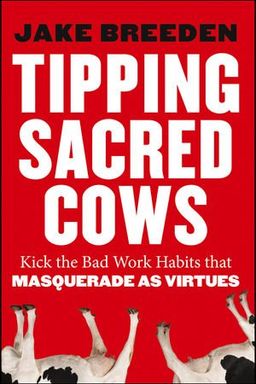
Tipping Sacred Cows cover

Tipping Sacred Cows

by Jake Breeden

Tipping Sacred Cows challenges workplace norms by revealing how virtues like balance, passion, and fairness might hinder performance. Jake Breeden provides alternative strategies to enhance happiness and productivity, encouraging a focus on meaningful innovation and excellence.

Tipping Sacred Cows: The Virtues That Hold You Back

Have you ever tried to do the right thing at work—only to find that your good intentions backfired? In Tipping Sacred Cows, Jake Breeden asks why leaders with solid values and virtuous habits still make mistakes that limit their success. The answer lies in one uncomfortable truth: the very traits we cherish most—fairness, passion, balance, collaboration, creativity, excellence, and preparation—can silently undermine us when followed without reflection. Breeden argues that when a virtue becomes unquestioned, it turns into a sacred cow: a belief so revered we forget to examine its hidden costs.

The Hidden Hazard of Virtue

Breeden opens with a disarming premise: leaders fail not because they’re lazy, selfish, or unethical, but because they’re too virtuous. He tells stories of executives who ruin results by clinging too tightly to noble ideas. A COO obsessed with efficiency cuts costs so well that his company “shrinks efficiently.” A father trying to teach fairness to his daughter ends up trapped in a cycle of equal misery. These anecdotes invite you to question your own revered values—because even virtues have side effects. The more you rely on them automatically, the blinder you become to the damage they may be doing. The author’s mission isn’t to slaughter sacred cows, but to tip them over gently so you can see what’s hiding underneath.

Seven Virtues, Seven Backfires

At the heart of the book are seven universally admired workplace virtues that, when taken to extremes, become obstacles. Balance devolves into bland compromise. Collaboration turns into codependence, where no one is accountable. Creativity mutates into narcissistic invention that adds novelty but not value. Excellence paralyzes progress with perfectionism. Fairness becomes an obsession with scorekeeping that stifles merit and encourages resentment. Passion can drive you to obsessive burnout instead of sustained performance. And Preparation—the Boy Scout virtue—can morph into overplanning that kills spontaneity and learning in real time. Breeden names these dynamics “virtues turned sacred cows,” the unseen habits that leaders praise but seldom question.

The Central Leadership Choice

Breeden’s argument rests on perception. From birth, you learn how to make sense of your world. Those meaning-making habits become the “glasses” through which you see everything. Leadership, he insists, begins with those glasses: how you construct meaning determines every decision and interaction. If you wear the “new ideas are always better than old” glasses, you might undervalue proven wisdom. If you wear the “teamwork above all” glasses, you might fail to stand alone when necessary. The challenge is to know which lenses you’re wearing—and when they distort your view. Awareness, not action, becomes your first act of leadership.

Stories That Humanize Theory

To make these ideas concrete, Breeden narrates vivid stories from real workplaces and from his own life. Hikers lost in the Australian bush discover that their devotion to “following through” nearly kills them before one of them dares to say, “We could just go back.” A beloved Air Force colonel’s humble habit of greeting every new airman personally undermines his sergeants’ authority—it’s virtue gone awry. These narratives, like David Foster Wallace’s famous “This is water” parable, dramatize how unconscious habits shape what we see as normal. The water we swim in is our culture of unquestioned virtues, and leadership begins the moment we notice it.

A Blend of Psychology, Business, and Common Sense

Drawing on research from economics, neuroscience, and social psychology, Breeden shows that our drive for fairness or excellence isn’t just moral—it’s biological. Mirror neurons make us empathize too easily; dopamine rewards novelty more than practicality; anxiety tricks us into overpreparing. These forces shape moral behavior, but they also distort judgment. The book’s hybrid of science and storytelling recalls thinkers such as Dan Ariely (The Upside of Irrationality) and Barry Schwartz (The Paradox of Choice), who uncover how “good” motives yield bad decisions.

Why These Ideas Matter

You’re surrounded by advice urging you to be more balanced, more passionate, more collaborative, more excellent. Breeden invites you to pause and ask, “More than what?” His book matters because it liberates leadership from autopilot. Instead of being ruled by cultural slogans—“Teamwork!” “Perfection!”—you learn to act mindfully, mixing virtues like ingredients rather than swallowing them whole. Real effectiveness, he shows, isn’t born from purity but from proportion. The task isn’t to change who you are, but to examine how your best qualities might backfire when taken too far. Awareness transforms virtues from sacred cows into useful tools again.

By the end of Tipping Sacred Cows, you’ll see leadership not as a checklist of traits but as a living process of meaning-making. Every day, you choose which glasses to wear. Sometimes you’ll need fairness; sometimes ruthlessness. Sometimes passion; sometimes detachment. Breeden teaches you to hold virtues in balance, knowing when to tip them over and when to stand them upright again. That’s how good intentions stop backfiring—and how leaders grow wiser without losing heart.


Bold Balance: Choosing Without Compromising

Balance sounds noble, but Jake Breeden warns it can be a trap. When leaders aim for balance by constantly compromising, they end up lukewarm—doing many things poorly instead of a few things well. True balance isn’t about moderation; it’s about bold choices. Breeden contrasts bland balance, which avoids risk, with bold balance, which embraces deliberate extremes over time. He illustrates this through Ann, a banker who evenly divides time between prospects and clients, and her colleague Darren, who focuses entirely on new clients during a crucial event—and wins big. Darren’s imbalance, in context, was the key to success.

The Myth of the Middle

Breeden cites psychologist Barry Schwartz’s research on the “maximizer,” the person who can’t choose for fear of missing out. Leaders become maximizers when they say “yes” to everything at once, trying to please everyone. This produces paralysis, or as Breeden jokes, “serving lukewarm tea”—too tepid to satisfy anyone. Whether it’s splitting attention between short-term results and long-term vision or between work and life, bland balance leads to mediocrity. Choosing courageously, even temporarily, is better than hiding behind compromise.

Balance as Dynamic Courage

The remedy, Breeden says, is to treat balance as a sequence of bold moves. Bill Gates, for instance, focused obsessively on Microsoft for decades, then shifted completely to philanthropy. Over time, those imbalances formed a balanced life. Bold balance means sprinting hard in one direction, knowing you’ll run another later. Leaders must measure twice and cut once—commit to a direction, but stay humble enough to pivot when data changes. This dynamism contrasts with the frozen moderation celebrated by bland balance.

Seven Practices of Bold Balance

Breeden outlines pragmatic habits for cultivating bold balance: audit unnecessary compromises, sprint in intervals, throw out leftover plans, hold strong opinions weakly, build a portfolio of options, start a “stop doing” list, and embrace paradoxes instead of neutralizing them. Jennifer Chatman’s Berkeley research on flexibility underscores this approach—effective leaders hold opposing qualities simultaneously: diagnostic acuity, behavioral flexibility, and comfort with paradox. These findings bridge academic rigor with personal application.

Bold balance, then, isn’t about harmony through sameness—it’s harmony through movement. You maintain the courage to be fully present in one extreme, then switch as needed. Like sprinting intervals, intense focus followed by rest yields strength. At work, that means sometimes choosing decisively over diplomacy, depth over breadth, and excellence over efficiency—but always with awareness. In Breeden’s words, bland balance is cowardice; bold balance is maturity.


Accountable Collaboration: Beyond Teamwork by Default

Collaboration is usually praised as an unconditional good. But Breeden argues that when teamwork becomes automatic, productivity collapses. He introduces the idea of accountable collaboration: working together only when necessary, with clear ownership and an end date. Through examples like Research In Motion’s co-CEOs and daily office rituals, he shows how constant meetings and consensus-seeking create “codependent paralysis.” Real collaboration should be intentional, not habitual.

The Problem with Always Working Together

Modern workplaces glorify collectivism—open offices, endless meetings, online chat rooms. Yet, as Morten Hansen's research shows (Collaboration, HBS Press), excessive coordination slows decisions and kills innovation. Breeden’s fictional HR manager, Nichole, spends weeks trying to improve exit interviews but is trapped by her team’s consensus culture. Collaboration without purpose dilutes accountability. When everyone is responsible, no one is.

Purposeful Teams

To restore clarity, leaders must create teams that are temporary and mission-bound—like the Avengers, who unite only to fight threats no hero could tackle alone. Breeden urges leaders to form teams with expiry dates and visible deliverables, disbanding them once goals are met. This agile mindset, similar to General Stanley McChrystal’s “plywood leadership,” fosters flexibility and prevents zombie committees that waste time.

Making Collaboration Accountable

Accountable collaboration requires courage to let underperformers sink or swim. When managers constantly rescue weak performers, they reinforce laziness. Breeden adds that owning results—both successes and failures—is the ultimate measure of responsibility. Unplugging occasionally, working alone, and “hunkering down” for focused effort aren’t antisocial; they’re productive. Collaboration should amplify results, not replace individual thought.

In short, Breeden redefines teamwork. Instead of perpetual togetherness, he advocates cycles of autonomy punctuated by purposeful, short-lived alliances. By default, work alone; by design, collaborate. Only then does teamwork create accountability instead of addiction—and achievement instead of meetings.


Useful Creativity: Ego-Free Innovation

We worship creativity, but at work it often becomes narcissistic—a way to prove our originality rather than solve problems. Breeden distinguishes useful creativity, which adds value, from narcissistic creativity, which adds ego. His own youthful campaign for a tech client, constructing a ridiculous “Vivo Man” mascot, fell flat because it served pride, not strategy. The same pattern doomed Sony’s engineers when they built overcomplicated MP3 players to showcase brilliance instead of serving consumers.

The Dopamine Trap of Novelty

Cognitive scientist Scott Barry Kaufman explains our attraction to “newness” as a dopamine rush. We overestimate how much variety satisfies us—a bias psychologists call “diversification bias.” Like children choosing mixed Halloween candies they don’t enjoy, leaders chase novelty and discard reliable ideas. Breeden’s advice: reuse and remix. Innovation doesn’t mean invention from scratch; it means combining and repurposing old solutions for new problems.

The Joy of Repurposing

Useful creativity draws on analogies and remixing. Picasso fused African masks with European portraiture to birth cubism; Ben Silbermann’s Pinterest reinvented the pinboard digitally. Leaders, Breeden suggests, should emulate “curators” more than “creators”—selecting, adapting, and combining existing ideas. Kirby Ferguson’s “Everything Is a Remix” perfectly captures this ethos: creativity equals copy, transform, combine.

From Ego to Empathy

To counter narcissism, Breeden offers practical steps: understand what drives your creative energy (pride, pressure, or boredom), rechannel it toward solving real problems, and curate others’ ideas generously. Master teachers, like sushi chef Jiro Ono or novelist Sara Gruen, achieve brilliance through disciplined practice and collaboration, not ego. Leaders, too, can apprentice one another in creativity rather than compete.

In the end, useful creativity is humility in action. It’s not “Look how clever I am!” but “Look what works.” Creativity becomes productive when it serves a purpose larger than prestige, transforming innovation into empathy—and narcissism into contribution.


Outcome Excellence: Progress Over Perfection

When does the pursuit of excellence cross the line into obsession? Breeden urges leaders to separate process excellence (doing everything perfectly) from outcome excellence (achieving meaningful results). Perfectionism, he argues, kills innovation and drains joy. He illustrates this through Ella, a pharmaceutical executive whose relentless standards produced tension instead of quality. Her virtue of excellence turned toxic when she confused meticulous processes with real impact.

Progress, Not Perfection

Drawing on research by Clay Christensen and Tim Harford, Breeden shows that excellence thrives on imperfection. Pixar’s Ed Catmull exemplifies the balance: his studio demands high-quality films but normalizes messy drafts. Every animator must share incomplete work daily, making imperfection routine and safe. This “culture of roughness” converts mistakes into momentum. Striving for excellence in outcome, not in every detail, liberates creativity and productivity.

Practical Shifts in Mindset

Breeden recommends seven adjustments: lower the stakes by detaching self-worth from results, ask dumb questions to avoid expert blindness, embrace the hacker mentality (launch before it’s perfect, embarrass yourself early), accept the mess of progress, start journeys even with a wrong map, embrace “OK” as good enough, and play around to learn by doing. Each technique transforms excellence from a pressure into a privilege.

When leaders choose outcome excellence, they replace anxiety with learning. Excellence becomes a destination, not a demand. Just as the musicians of Venezuela’s El Sistema learn instruments collaboratively rather than alone, leaders striving together imperfectly often achieve the most perfect results later. Excellence, Breeden concludes, isn’t mastery of detail—it’s mastery of momentum.


Process Fairness: Justice Without Sameness

Fairness feels noble, but in leadership it can backfire. Breeden warns that leaders who chase “equal outcomes” instead of “fair processes” sabotage merit and morale. The impulse is ancient and even biological—our brains light up with dopamine when we perceive fairness. But fairness, he argues, often morphs into sameness or spite.

The Perils of Fair Outcomes

In one story, a head nurse denies her best performer a second training trip “so others don’t feel left out,” and loses her star employee. Neuroscience confirms why fairness seduces us: mirror neurons make us empathize reflexively, and reward centers reinforce the behavior. But what feels fair emotionally may prove unjust strategically. Leaders confuse caring with copying—giving employees what they themselves would want instead of what others truly need.

Seven Practices for Real Fairness

Breeden prescribes seven cures: detect your projection biases, break the Golden Rule when necessary, celebrate differences, discriminate courageously by rewarding merit openly, play a bigger game instead of keeping score with colleagues, check others for toxicity (some people enjoy harming for fun, as research shows), and check yourself when resentment tempts unethical behavior. Fairness, in his model, means equitable opportunity—not identical reward.

By focusing on process rather than results, fairness strengthens integrity. Leaders win loyalty not by treating everyone the same, but by treating everyone justly. That requires courage to give different people different things—and wisdom to know which differences matter. True fairness resembles jazz more than math: structured, improvisational, and deeply human.


Harmonious Passion: Caring Without Burning Out

Passion fuels great leadership—but uncontrolled passion burns it down. Breeden distinguishes harmonious passion (self-sustaining and healthy) from obsessive passion (ego-driven and exhausting). Drawing on psychologist Robert Vallerand’s research, he explains how leaders addicted to proving themselves—like his own MBA-era self—suffer burnout and blindness. Passion becomes a prison when it’s used to validate worth instead of express joy.

Two Sources of Passion

Vallerand’s studies show that harmonious passion stems from autonomy (“I choose because I love it”) while obsessive passion stems from control (“I must because I fear failure”). Dancers with obsessive passion suffer more injuries because pride keeps them performing through pain. Leaders who can’t rest or seek help risk similar damage to their teams and health. Harmony, by contrast, aligns passion with other life pursuits—like cellist Yo-Yo Ma, who integrates philosophy and collaboration into his artistry.

Turning Passion Into Harmony

Breeden’s roadmap includes seven steps: find your shard of glass (the deep insecurity driving obsession), lead from behind instead of constantly cheerleading, stop proving yourself right, start proving yourself wrong, stay healthy through honest friends, stay out of ethical trouble through accountability partners, and look beyond yourself by serving others. These actions transform intensity into sustainability.

Harmonious passion fuels longevity—Serena Williams exemplifies it with balance between tennis and fashion. Obsessive passion wins short sprints; harmonious passion wins life marathons. For leaders, the shift means chasing purpose, not approval. When care coexists with calm, passion becomes power that lasts.


Onstage Preparation: Learning in Real Time

Most people prepare by hiding backstage until the “real show” starts. Jake Breeden proposes a radical alternative: onstage preparation—getting better while doing the work instead of before it. Preparation, he says, becomes a sacred cow when it delays action. The story of Ajay, a banker who overprepared for a client pitch only to freeze when asked unexpected questions, captures the danger. When preparation replaces presence, leaders miss real learning opportunities.

Life Is Already Onstage

Drawing from sociologist Erving Goffman’s metaphor, Breeden reminds readers that “all the world’s a stage.” There is no backstage—every moment counts. Preparation must happen in public and in motion. Schools train us for tests, breeding backstage habits that cripple adaptability. In a fast-paced world, waiting to be ready ensures you’ll always be late.

Practices for Onstage Growth

Breeden outlines seven methods to make preparation dynamic: troubleshoot your style, learn by doing (as research on doctors shows hands-on training beats lectures), hold “moot courts” or practice conversations, pretotype rough ideas to gain feedback early, practice with intensity like Olympic shot putter Adam Nelson, focus on emotions rather than mechanics to be more human, and apprentice each other through shared learning communities. Each technique shifts preparation from isolation to engagement.

In Breeden’s model, leaders learn best while performing. Every meeting, pitch, or failure becomes a rehearsal for the next act. When you stop waiting for the perfect moment, work itself becomes your teacher. That’s onstage preparation: leading as you learn, and learning as you lead.

Dig Deeper

Get personalized prompts to apply these lessons to your life and deepen your understanding.

Go Deeper

Get the Full Experience

Download Insight Books for AI-powered reflections, quizzes, and more.