
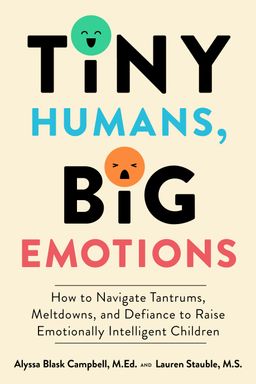
Tiny Humans, Big Emotions cover

Tiny Humans, Big Emotions

by Alyssa Gloria Campbell & Lauren Stauble

Tiny Humans, Big Emotions offers caregivers a transformative guide to managing children''s emotional outbursts with proven strategies. By cultivating emotional intelligence through Collaborative Emotion Processing, this book empowers parents to raise resilient, empathetic children, ready to face life''s challenges.

Growing Emotional Intelligence Together

How can you turn a child's meltdown into a moment of learning and connection? In Collaborative Emotion Processing (CEP), Alyssa Gloria Campbell and Lauren Stauble argue that emotional intelligence develops in relationship, not isolation. Their core idea is simple yet radical: emotions are not problems to fix but processes to experience together. When you respond with calm curiosity instead of control, you teach children that feelings are safe, manageable, and meaningful.

Drawing from classroom observations, parenting journeys, and therapeutic practice, the authors designed CEP as both a method and a mindset. It blends attachment theory, nervous system science, and mindfulness to help adults model emotional awareness while supporting children through big feelings. The approach has five learnable phases that move from allowing emotion to collaborative problem-solving—each one reinforcing the idea that connection precedes correction.

The Philosophy behind CEP

CEP emerged in classrooms where teachers realized that no script could capture the nuance of emotion. It’s collaborative because people co-regulate: one nervous system teaches another how to calm, name, and integrate feelings. Emotional intelligence grows in relationship, through mirroring and shared awareness. The method’s emphasis on adult reflection—seeing your own triggers, history, and cultural filters—sets it apart from behavioral or discipline-based models.

In essence, CEP reframes discipline as emotional teaching. A child's behavior isn’t defiance; it’s a communication signal. Instead of asking, “How do I stop this?” you learn to ask, “What is this telling me?” The shift aligns CEP with models like Gottman’s Emotion Coaching and Ross Greene’s Collaborative Problem Solving but integrates sensory science and mindfulness in unique, practical ways.

Adult Growth as the Foundation

Alyssa and Lauren make a compelling argument: the adult’s self-awareness determines the emotional climate of the child’s learning. Your attachment history, self-care, and implicit biases shape how safe a child feels expressing emotion. Children don’t need perfect caregivers—they need regulated ones. When you notice your own reactivity, name your feelings, and repair ruptures, you model resilience.

The book introduces terms like legacy blessings (positive emotional patterns you pass on) and legacy burdens (defensive habits inherited from past generations). Recognizing both allows you to break intergenerational cycles of emotional suppression. The authors urge adults to seek therapy, build support systems, and practice vulnerability. Each act of repair teaches children that mistakes are part of growing, not grounds for shame.

Brain Science and the Nervous System

CEP’s practicality lies in neuroscience translations. You and the child each have a “battery” of emotional energy that depletes throughout the day. Sensory input, hunger, fatigue, and overstimulation all drain it. The authors use metaphors like funnels and phone batteries to help adults track nervous system limits. Understanding proprioceptive, vestibular, and interoceptive senses lets you design proactive regulation: play that strengthens body awareness, movement that releases tension, and check-ins that teach self-attunement.

In CEP, you soothe before you teach. Trying to reason with a child in distress is neurologically futile. When both of your nervous systems are calm, teaching becomes possible. The insight mirrors polyvagal theory (Stephen Porges): safety cues activate the social engagement system, opening the brain to connection and learning.

Mindfulness and the Pause to Respond

Mindfulness is the adult’s first step. It creates the pause that turns reaction into response. Instead of faking calm (surface acting), mindfulness asks for real self-regulation. A breath, a lowered voice, or noticing your clenched jaw are micro-practices that anchor you in awareness. These moments protect against what the authors call “emotional hijacking”—acting out old scripts rather than conscious support. You can’t guide a child where you haven’t gone yourself.

Lauren and Alyssa describe mindfulness as a compassionate curiosity about your inner state. It’s noticing embarrassment, anger, or helplessness without judgment. That inner stance—part Goleman’s emotional intelligence, part Tara Brach’s radical acceptance—transforms the moment from power struggle to shared humanity.

Collaborative Emotion Processing in Action

The CEP Wheel translates philosophy into steps: allow emotion, name it, create safety, offer coping, and move toward problem-solving. Each phase corresponds to a developmental goal. For instance, when Amaya throws blocks, you first ensure safety (“I won't let you hit me”) while recognizing her frustration. Only later, after she’s calmer, can you explore what went wrong or plan a fix. The process trains her brain to link emotional awareness with self-control, not repression.

CEP differs from reward or punishment systems by prioritizing intrinsic motivation. External control (stickers, time-outs) may produce quick compliance but not self-understanding. CEP teaches the skill behind the behavior—how to identify needs, choose strategies, and repair errors. Over time, this builds durable emotional literacy and trust.

The Broader Promise of CEP

At its heart, CEP is a relational revolution. It invites adults and children to grow emotional intelligence together, transforming discipline from domination to dialogue. Its framework can apply to classrooms, families, and even organizations—anywhere people must navigate feelings, power, and connection.

Core message

Collaborative Emotion Processing teaches that emotions, when processed together, build intelligence, empathy, and resilience. Emotional growth is not an event but a practice—one that starts with your ability to be present, curious, and connected.


The Five Phases of Processing

Emotions can feel chaotic in the moment, but CEP breaks them into five clear phases so you can respond rather than react. These phases form a sequential loop from raw experience to resolution. They guide you through the question: what does emotional processing look like in practice?

Phase 1: Allow

Begin by giving the emotion space to exist. This phase is often the hardest because your instinct may be to distract or minimize. Alyssa recalls stepping into preschool chaos where teachers first ensured safety (“I won’t let you throw blocks”) before doing anything else. Allowing is not permissiveness—it’s containment plus acknowledgment. The child learns that feelings are safe even when behavior must stop.

Phase 2: Recognize and Label

Once the storm settles a little, name what you see. Labeling feelings shifts the brain from the amygdala to the prefrontal cortex, creating order. “I see your fists are tight—are you frustrated?” Recognition connects bodily cues to emotional language and starts emotional literacy. Even if the guess is wrong, the attempt communicates presence and curiosity. (Lisa Feldman Barrett’s concept of constructed emotion underpins this step: naming builds emotional meaning.)

Phase 3: Build Security in Emotional Range

Security means helping the child experience feelings without fear. Understanding that sadness, anger, and disappointment pass over time builds tolerance for discomfort. Parents can use cultural tools—stories, cards, role-play—to normalize the full spectrum. One family created an emotion book in their heritage language to capture nuanced feelings, a model of emotional inclusivity and belonging.

Phase 4: Support with Coping Strategies

After validation comes regulation. Offer physical or sensory strategies: heavy work, deep breaths, rhythmic movement. Mara’s case shows a classic sequence—validation, jumping break, hug, then calm conversation. These tools are not distractions but methods for integrating body and mind. Over time, the child internalizes a personalized coping toolbox.

Phase 5: Move On—Problem Solve or Let Go

Only when calm returns do you engage the rational brain. Here, you collaborate: rebuild the tower, make a new plan, or decide together to release the issue. “Solve or let go” honors agency. The point is not perfection but resilience—learning that feelings can lead to constructive outcomes.

The Five Phases repeat across moments big and small. By cycling through them consistently, you create a predictable map for yourself and the child. Over time, these steps wire the brain for reflection rather than reactivity.


The Adult Inner Work

In CEP, emotional coaching begins with your inner landscape. The authors emphasize that your nervous system, attachment style, and self-awareness are the curriculum your child absorbs. You can’t teach calm if you don’t practice it; you can’t model empathy if you’re locked in old defensive patterns.

Understanding Your Emotional Legacy

Attachment theory explains how early relational patterns become internal templates. CEP reframes this as legacy blessings and burdens. Maybe you inherited avoidance (“we don’t cry”) or chaos (“we yell to feel heard”). Naming these patterns gives you agency to rewrite them. Alyssa describes realizing how her “power-over” upbringing minimized emotions and how therapy helped her unlearn that reflex.

Shifting from Control to Connection

As a caregiver, your nervous system is the child’s emotional barometer. When you can stay grounded, you create co-regulation—the state where two bodies sync toward calm. Practicing awareness (“I feel my heart race”) allows you to respond intentionally. Mistakes aren’t failures; they’re teaching moments. Children need to see you repair just as much as they need consistency.

Building Support and Self-Care

Every adult needs recharge moments. Self-care is not indulgent—it’s preparation for co-regulation. Sleep, nutrition, and body movement regulate your battery, while community (“the village”) provides the resilience you can’t summon alone. Asking for help models humility. When your capacity grows, so does your ability to stay curious in conflict.

Key reminder

Your self-work is your child’s pathway to safety. Every moment you choose awareness over autopilot teaches emotional literacy more effectively than any lecture could.


Mindfulness and Nervous System Science

CEP integrates brain science so that emotional support feels less mystic and more mechanical. You and your child share a physiological foundation: a nervous system that cycles through activation and calm. Recognizing these cycles allows you to intervene early and compassionately.

The Battery and the Funnel

Think of each person’s regulation capacity as a rechargeable battery. Overstimulation, hunger, or transitions drain it. The funnel metaphor shows individual differences: some people filter sensory input easily, others are overwhelmed by noise or clutter. This insight shifts blame to biology—your partner’s irritation at messes or your child’s meltdown before bedtime reflect bandwidth, not willpower.

Hidden Senses and Movement

Three hidden senses—proprioception (body awareness), vestibular (balance), and interoception (internal cues)—anchor emotional regulation. Frog jumps, swinging, and gentle squeezes activate these systems. Feeding the sensory system proactively (every 90–120 minutes for many kids) prevents crises later. Movement becomes medicine.

Mindfulness: The Pause that Changes Everything

When dysregulation appears, mindfulness is the first tool. It’s as simple as noticing your breath or silently saying, “I can handle this.” These micro-pauses lower cortisol, open empathy, and reduce misattunement. Avoid performative calm—children read authenticity through micro-expressions. Real calm invites co-regulation; fake calm breeds mistrust.

By combining brain science with mindfulness, CEP operationalizes compassion. It’s not airy self-help; it’s neuroscience applied to empathy.


Boundaries, Consequences, and Repair

Boundaries in CEP are not punishments but frameworks for safety. They help children know where freedom begins and ends. The book contrasts boundaries with threats and punishment, teaching you to connect discipline to learning rather than fear.

Setting Boundaries with Compassion

A clear boundary might sound like, “I won’t let you hit my body.” It communicates limits calmly and enforces them predictably. Threats (“No doughnut if you hit”) rely on fear and punish identity rather than behavior. Over time, consistent boundaries create safety, proving to the child that your word matters more than your anger.

Consequences that Teach

Natural and logical consequences replace arbitrary punishments. If a child draws on the wall, you move the markers out of reach and help clean—the outcome connects to the behavior. Teaching consistency (“I keep my promises about time”) shapes moral reasoning better than threat-based obedience.

Apologies and Authentic Repair

CEP distinguishes between forced apologies and authentic repair. Saying “I’m sorry” doesn’t teach empathy unless the emotion beneath it is processed. Instead, validate both children’s feelings, offer coping, and guide reflection once calm returns. Real accountability happens in Phase 5—when the brain is ready to integrate, not defend.

Boundaries and repair work together: one defines safety, the other rebuilds trust. When you enforce with clarity and heart, children internalize respect instead of resentment.


Culture, Bias, and Emotional Equity

Emotional intelligence looks different across cultures, and CEP insists on honoring that diversity. The way people label, express, and evaluate emotions is culturally taught. To teach emotional literacy well, you must examine your cultural lens and biases.

Emotion Concepts as Cultural Constructs

Drawing from Lisa Feldman Barrett, emotions are learned concepts—your brain builds them from experience and language. When Lu’s mother helped her create an emotion book in their home language, she expanded not only vocabulary but identity. This recognizes that emotional meaning cannot be separated from culture.

Implicit Bias in Emotional Response

Adults unconsciously respond differently based on race, gender, or perceived compliance. Research shows Black boys are disciplined more harshly and Black girls comforted less. CEP encourages reflection: Who do you comfort first? Whose anger feels safe? Awareness paired with mindfulness interrupts these habits and promotes equity in emotion coaching.

Practicing Inclusive Emotion Work

Teach children to navigate multiple emotional “dialects,” especially if they live in bicultural or bilingual homes. Create shared emotional language agreements between co-parents or teachers. Use objective criteria for discipline to remove discretionary bias. Emotional literacy becomes not just personal growth but social justice work.

CEP reminds us that processing emotions collaboratively also means processing culture collaboratively—openness, humility, and reflection are essential.


Repairing Conflict and Building Empathy

Empathy is CEP’s ultimate fruit—the capacity to feel with rather than for someone. The authors stress that empathy emerges not from lectures but from modeling: when you validate emotions, children internalize how to do the same.

From Sympathy to Empathy

The book distinguishes sympathy (“I pity you”) from empathy (“I’m with you”). Teaching empathy means helping children take another’s perspective, stay out of judgment, recognize emotions, and communicate that recognition. Stories, role-play, and narration (“How do you think that character felt?”) train empathy muscles daily.

Avoiding Shame

Shame attacks identity: “You are bad.” CEP advocates separating child from behavior: “You are kind and you hit. Let’s figure out why.” High shame correlates with hiding behaviors rather than changing them. Repairing after missteps—both yours and theirs—normalizes imperfection.

Empathy without Codependence

True empathy respects boundaries. You can comfort without fixing. When kids learn to witness another’s pain without absorbing it, they develop emotional resilience. That balance—connected yet grounded—is the lifelong goal of collaborative emotion processing.

Practiced consistently, empathy becomes a household norm: curiosity before judgment and repair before retaliation.


Practicing CEP in Daily Life

CEP moves from theory to practice through repetition in everyday life—morning routines, conflict, transitions, and even mealtime chaos. The book outlines flexible steps to anchor the method without scripting your responses.

In-the-Moment Sequence

When conflict erupts, your algorithm is simple: pause, become aware, choose calm or teach, and take one of four roles—witness, mirror, facilitator, or toolbox-provider. Each role engages empathy and boundaries differently. Practiced repeatedly, these steps build “emotional muscle memory.”

Preventing and Ending Meltdowns

Preparation is half the work. Pre-teach routines, rehearse social stories, and use visual aids like emotion cards and timers. Predictability reduces fear and sets the stage for learning even when feelings run high. Be proactive: recharge sensory systems and plan transitions slowly.

Navigating Groups and Siblings

With multiple children, use triage: regulate one child at a time, keep others safe, and invite witnesses to learn (“Come watch how we calm”). Prioritize safety and rapport over identical treatment. CEP turns sibling rivalry into empathy laboratories where children learn perspective taking firsthand.

Through Transitions and Change

Big changes—new schools, moves, grief—magnify feelings. Normalize those emotions, plan visually, and build your village of support. Predictable rituals like handshakes at drop-off or bedtime reflections build consistency that buffers stress. Emotional processing, at its most practical, is a lifestyle, not a lesson plan.

The promise of CEP unfolds through daily repetition. Every sigh you breathe before reacting, every validation offered in chaos, reshapes the emotional wiring of your family.

Dig Deeper

Get personalized prompts to apply these lessons to your life and deepen your understanding.

Go Deeper

Get the Full Experience

Download Insight Books for AI-powered reflections, quizzes, and more.