
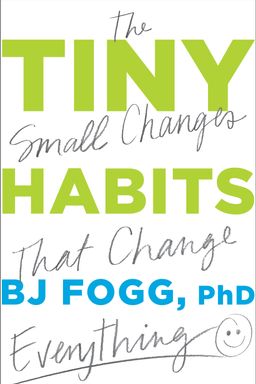
Tiny Habits cover

Tiny Habits

by BJ Fogg

Tiny Habits by BJ Fogg reveals the powerful impact of small, consistent actions on personal transformation. Fogg''s approach simplifies habit formation, making it achievable by focusing on tiny, manageable changes. By integrating these into existing routines, readers can effortlessly rewire their brains for success.

The Power of Tiny Changes

Have you ever promised yourself you’d start exercising, save more money, or finally get organized—only to watch those ambitious plans fade before February? In Tiny Habits: The Small Changes That Change Everything, Stanford behavior scientist BJ Fogg tackles this universal dilemma head‑on. He argues that the reason our big goals fail isn’t that we lack willpower or discipline—it’s that we’re working with a flawed design for change.

Fogg’s core claim is simple but revolutionary: lasting transformation comes not from huge, intimidating efforts but from tiny, easy, feel‑good actions that take root naturally. If you redesign behavior at a small scale—anchoring it to routines you already do and celebrating every win—you can rewire your life one micro‑action at a time. His mission is to show that personal growth, family wellbeing, and even workplace transformation begin with little tweaks.

The Behavioral Design Framework

At the heart of Fogg’s model is the formula B = MAP: a Behavior happens when Motivation, Ability, and a Prompt converge. You need the desire to act, the capacity to do it easily, and a signal to trigger the behavior. If any component is missing, the action won’t occur. The genius here is that you can flex these levers strategically. When motivation is low, make the task easier or improve the prompting structure. When ability is limited, simplify the task so you can actually begin.

Imagine a graph where motivation runs vertically and ability horizontally. A gentle curve marks the threshold of action. Anything above that curve, when prompted, happens smoothly; anything below stalls. Fogg shows that you can design your environment and routines so small behaviors naturally sit above the line—practically guaranteeing success.

Why Size Matters (Smaller Is Better)

Modern culture tells us to “go big or go home,” but Fogg calls this mindset a trap. Sweeping goals trigger frustration, guilt, and eventual abandonment. Micro‑behaviors, by contrast, let you build momentum through consistency—even on rough days. A starter step, like merely putting on joggers instead of running three miles, keeps you showing up. From there, the habit will grow naturally without conscious force.

Behavior scientist Stephen Guise and author James Clear (both champions of similar approaches) echo this philosophy. Guise began his fitness journey with one push‑up a day and ended up fitter than ever. Clear’s Atomic Habits highlights how 1% daily improvements compound over time. Fogg distinguishes himself by combining simplicity with emotional reinforcement—celebration—as the engine of habit formation, making change not just doable but delightful.

Emotion as Glue

In Fogg’s world, positive emotions are the superglue of habit creation. Each celebratory fist bump or whispered “Awesome!” triggers dopamine in your brain, encoding that new behavior as rewarding. You begin to crave this pleasant feeling, which propels repetition. In contrast, guilt and shame—common reactions to failing big goals—poison motivation. The more you feel successful, however small the action, the faster transformation compounds.

From Personal to Global

Fogg’s approach isn’t just about self‑improvement. He envisions a ripple effect: individuals mastering change become catalysts for families, teams, and communities. In one story, a mother of six used micro‑habits to rebuild confidence and balance her household. Entrepreneurs have used these methods to overcome procrastination and launch companies. Even Instagram’s co‑founders drew from Fogg’s Stanford classes, designing user experiences around simplicity and early feelings of success—a testament to how tiny cues and positive feedback can drive massive outcomes.

Why It Matters Today

In a world obsessed with hustle culture and constant optimization, Fogg restores sanity. His science shows that sustainable change doesn’t come from grinding harder but from designing smarter. Whether you want to eat healthier, save money, or foster kindness, the same behavioral mechanics apply. Change becomes less about heroic effort and more about practical design. You don’t need to overhaul your life; you just need a reliable recipe and a bit of celebration.

Throughout the rest of this summary, you’ll learn how motivation, ability, and prompts operate, why emotions anchor habits, how to reverse bad behaviors using the same model, and why the tiny method ultimately transforms not just what you do—but who you believe yourself to be. Fogg’s takeaway is empowering: big change is possible when it starts small, feels good, and fits seamlessly into the life you already lead.


Behavior Happens When B = MAP

BJ Fogg’s Behavioral Model states that every human action occurs through the intersection of Motivation, Ability, and a Prompt. If one of these three ingredients is missing, the behavior won’t happen. This deceptively simple formula, B = MAP, explains everything from why you skip morning runs to why you check your phone compulsively.

The Three Ingredients of Action

Motivation refers to your desire to act. It’s what pushes you to take a step—it may be joy, guilt, fear, or aspiration. Ability defines how easy the action is: time, money, physical effort, and mental capacity all play a role. Finally, Prompts are triggers—those cues, reminders, or environmental signals that start a behavior. Without a prompt, even high ability and motivation won’t result in execution.

For instance, if your goal is to exercise but your alarm goes off at 5 a.m. (low motivation and low ability at that hour), you’ll likely hit snooze. Move the alarm across the room, forcing yourself to get up; suddenly, the snooze behavior becomes harder, shifting your motivation–ability balance.

Visualizing the Action Curve

Fogg invites you to imagine a graph with motivation running vertically and ability horizontally. A curved line divides success from failure. Behaviors happen when your motivation and ability meet above that line. Below it, they stall. To create successful habits, you either raise motivation or make behaviors easier until they cross that threshold.

“If your motivation is low, you can make it up by increasing your ability. If your ability is low, increase your motivation—or adjust the prompt.”

Designing for Success

This model helps you hack your own habits. If motivation dips (and it always does), shrink your goal to something easier. Replace jogging 10 miles with a brisk walk to the mailbox. If you struggle with a bad habit like snacking, remove prompts—keep junk food out of sight or redesign your environment so the cue disappears (as James Clear recommends in Atomic Habits).

Once you grasp that motivation and ability can compensate for each other, you stop beating yourself up for inconsistency. Instead, you become a designer of your own behavioral map—one that makes good actions automatic and bad ones inconvenient.


Work Around Motivation, Not Through It

Fogg calls motivation “fickle and unreliable.” It fluctuates wildly depending on mood, context, and energy levels. You can’t depend on it to power lasting change. Instead, you should design your environment and habits to require as little motivation as possible.

The Myth of Motivation Surges

Motivation spikes—like signing up for a marathon after watching an inspiring video—are fleeting. They fade the moment real effort kicks in. Fogg compares this to facing off with a bear to protect a child: it’s intense, but unsustainable. Relying on motivational bursts to fuel daily behaviors is like trying to run on lightning—it flashes, then it’s gone.

Former Navy SEAL Jocko Willink makes a similar point in Discipline Equals Freedom. He emphasizes that self‑discipline—showing up regardless of mood—is more dependable than motivation. Fogg reframes this concept with design thinking: if you make desired actions “frictionless,” you no longer need surges of willpower.

Designing Around Motivation

Suppose you want to write daily but rarely feel inspired. Rather than forcing motivation, design an easy routine. Keep your notebook on your pillow so that touching it after making your bed prompts you to jot one sentence. The act becomes simple, automatic, and almost foolproof. Then celebrate—you’ll crave the good feeling associated with completion.

“When you stop relying on motivation and instead redesign your surroundings, consistency becomes effortless.”

Fogg’s insight reshapes our approach to goals. You don’t conquer resistance through grit; you sidestep it through smart design. Making tasks smaller, easier, and anchored to existing routines turns discipline into instinct. The less you rely on fleeting motivation, the more you rely on momentum—and that’s what carries you to lasting change.


Shrink Behaviors Until They’re Easy

Fogg insists that lasting habits start with simplicity. The easier the task, the less motivation you need—and the more consistent you’ll be. This principle overturns our cultural obsession with grand goals and big leaps.

The Trouble with Big Goals

Executive coach Sabina Nawaz calls corporate culture’s obsession with huge ambitions—“Big Hairy Audacious Goals”—a performance trap. Big goals demand enormous energy, so failure becomes inevitable, sparking guilt and demotivation. Tiny habits, by contrast, create effortless wins that restore confidence.

Example: From Pushups to Progress

Imagine wanting to do 20 pushups daily. You examine what makes it hard—physical effort. Begin with just two pushups. It’s so small you can’t fail. Soon, doing two becomes natural; soon after, five feels effortless. Consistency then replaces perfection. On even lazier days, do a starter step: put on your workout clothes or get down on the floor. Some days that’s enough—the act of showing up still fuels identity shift.

Start Small, Stay Consistent

The mantra is: make it easy to win. Start so tiny you can succeed even when tired, busy, or unmotivated. Doing so builds reliability and confidence—the actual engines of growth. The habit will expand naturally when ability increases and when your brain starts rewarding consistency with dopamine.

Eventually, these micro‑actions trigger a self‑reinforcing cycle. Two pushups become ten; walking to the mailbox turns into jogging a mile. You stop worrying about how far you’ve gone and start trusting the process itself. That’s what makes the tiny‑habits design sustainable—it grows with you, quietly and effortlessly.


Tie New Habits to Existing Routines

One of Fogg’s most practical ideas is using action prompts—attaching new behaviors to routines you already perform reliably. This method transforms habitual actions (like brushing your teeth or brewing coffee) into anchors for new habits.

How Prompts Work

A prompt can be time‑based (“every morning at 7 a.m.”), context‑based (sticky notes or alarms), or action‑based (an existing habit). Fogg argues that action prompts are strongest because they build on what you already do. For example, if you always make your bed, you could decide that after this action, you’ll put on jogging shoes and walk to the mailbox.

Designing a Recipe for Change

Fogg recommends using the formula: “After I [existing behavior], I will [new tiny habit].” Make a list of all behaviors you do daily—from waking to sleeping—and link each potential new behavior to one routine that’s in the same location and frequency. If you want to start flossing, connect it to brushing your teeth; if you want to practice gratitude, attach it to pouring morning coffee.

Consistency depends more on strong prompts than on strong will. Anchor habits to existing routines for automatic execution.

This approach prevents reliance on memory or motivation—your everyday life itself becomes a web of triggers guiding you toward positive behaviors. It turns change from conscious discipline into unconscious rhythm.


Emotions Make Habits Stick

While most self‑help systems focus on self‑control, Fogg emphasizes emotion as the key ingredient for lasting habits. Every time you celebrate a win—no matter how small—you teach your brain that the behavior brings pleasure. Dopamine binds that memory, making you crave repetition.

Celebrate Immediately

Timing matters. You must celebrate right after the behavior, not minutes later, for your brain to link the act to the good feeling. Options include smiling, doing a fist bump, saying “I got this,” striking a power pose, or any joyful ritual that feels genuine. The key isn’t the form—it’s the emotion.

Why Feeling Successful Beats Willpower

These micro‑celebrations reprogram identity. You begin to see yourself as someone who succeeds, not someone who struggles. Each smile or dance amplifies self‑belief, which fuels motivation effortlessly. The result? Habits stick because they feel good—not because you forced them through pressure.

Positive emotion isn’t a reward—it’s the catalyst. It turns routine behavior into a self‑reinforcing loop of success.

In contrast to guilt‑based motivation models, Fogg’s celebration method turns personal development into play. The more your brain connects joy with positive behaviors, the more your new habits become instinctive—and delightful.


Redesigning Bad Habits

Bad habits operate through the same Behavioral Model—motivation, ability, and prompts—but in reverse. To change unwanted behaviors, you must redesign the system that sustains them: remove triggers, make them harder to do, or lower your motivation to engage in them.

Three Methods of Change

  • Remove prompts: Identify triggers that start the bad habit and eliminate them. Hide junk food, avoid tempting websites, or declutter spaces that cue unhealthy behaviors.
  • Reduce ability: Introduce friction. Make the bad habit inconvenient—keep snacks out of your house, set app locks on your phone, or place the TV remote in another room.
  • Lower motivation: Reframe or replace emotional incentives. Eat before parties to curb cravings; reflect on long‑term costs rather than short‑term pleasure.

Substitute with Golden Behaviors

If elimination fails, replace the bad habit with a Golden Behavior—a small, positive action linked to the same prompt. If tension leads you to eat junk, commit to taking three mindful breaths instead. By tying the new habit to the same cue, you overwrite the pattern with a healthier alternative.

Breaking bad habits isn’t about deprivation; it’s about redesign. When prompts vanish and friction rises, the old behavior simply loses its power.

As James Clear writes, people who break bad habits successfully aren’t more disciplined—they’re better designers. Fogg’s method aligns this truth with emotional reinforcement, proving that ease, design, and celebration can dismantle even lifelong patterns.


When Tiny Becomes Transformative

Tiny habits don’t stay tiny forever—they naturally expand and multiply. Fogg explains that every consistent micro‑win generates momentum, propelling you toward gradual but unstoppable growth.

The Growth Principle

Just as walking to the mailbox evolves into jogging down the block, small habits build capability and confidence. Your motivation increases because success feels good. You start reaching for new challenges, nudging your comfort zone forward. Each little success plants seeds for larger change—fitness leads to better nutrition, which leads to renewed energy and creativity.

Multiplying Habits

Positive behaviors ripple outward. A tiny step in one area triggers new habits in others: eating fruit in the morning sparks interest in afternoon workouts, which cultivates stronger relationships through confidence and energy. Fogg calls these expansions the “natural growth of success.”

Reaching for the Edge

Once behaviors stabilize, you can gently stretch them toward discomfort. If you work out daily, push until you feel mild tension—then celebrate extra hard to balance the pain. This method turns challenge into reinforcement. You condition your mind to link progress with joy, not exhaustion.

Ultimately, Fogg’s philosophy reframes personal growth as an ecological process: habits evolve like organisms, feeding off success and emotional nourishment. You don’t force transformation—you cultivate it. It’s slow, steady, and sustainable, but it changes everything.

Dig Deeper

Get personalized prompts to apply these lessons to your life and deepen your understanding.

Go Deeper

Get the Full Experience

Download Insight Books for AI-powered reflections, quizzes, and more.