
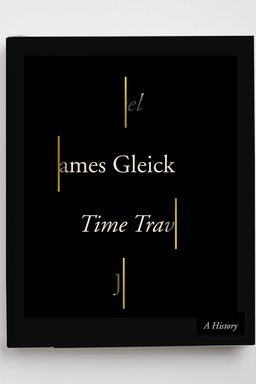
Time Travel cover

Time Travel

by James Gleick

Time Travel by James Gleick delves into the intriguing evolution of a concept that has fascinated humanity for over a century. Through historical narratives, scientific insights, and philosophical debates, it explores how time travel is woven into the fabric of our consciousness and everyday experiences.

Time Travel and the Human Imagination

Have you ever wished you could undo a mistake, relive a perfect day, or glimpse what’s waiting beyond the horizon of time? In Time Travel: A History, James Gleick explores the modern obsession with that wish — a longing that only became possible when humans first imagined time as something they could move through. Gleick argues that time travel isn’t just a science-fiction trope; it’s a profound shift in how people understand existence, memory, and progress. He traces how an impossible fantasy came to dominate philosophy, physics, and storytelling, changing our mental map of reality itself.

Before H.G. Wells’s The Time Machine, no one even thought of traveling through time. Gleick shows that this wasn’t because the ancients lacked imagination — it was because they inhabited a different concept of time. Time was a river that flowed one way; eternity lay beyond. Space could be crossed, but the past and future were unreachable realms. When Wells merged time and space with a single machine, he expressed something brand new: the modern sense of time as a dimension. From that moment, time became a frontier to be explored, not merely endured.

From Wells to Einstein: The Birth of Modern Time

In the late nineteenth century, science and technology were already unsettling humanity’s sense of permanence. Railways annihilated distance; telegraphs made instant communication possible. At the same time, Charles Lyell’s geology and Darwin’s evolution had expanded the scale of history to billions of years. Alongside these revelations came philosophical thinkers such as Henri Bergson, who described time as a lived experience (“la durée”) rather than a sequence of mechanical ticks. Into this ferment stepped H. G. Wells — a student of science, an avid cyclist, and an imaginative provocateur. His time traveler was less a scientist than a symbol, championing a new way of seeing: past, present, and future as simultaneous planes.

Gleick emphasizes how quickly this idea spread across cultures. Einstein’s theory of relativity (1905) would confirm that time and space are inseparable—spacetime. Minkowski’s four-dimensional continuum, introduced just a few years later, sealed the union. As a scientific concept, this meant that events could be plotted as coordinates. But as a psychological revelation, it implied something far stranger: perhaps the past and future already coexist, frozen within an unchanging universe. This idea — sometimes called the “block universe” — still haunts modern physics and philosophy alike.

Time Travel as Humanity’s Mirror

For Gleick, every era’s time-travel stories reveal its preoccupations. In Wells’s day, progress and evolution drove both excitement and dread; his future was filled with decadent Eloi and brutal Morlocks — reflections of class anxiety. In the twentieth century, time travel became a metaphor for modern confusion, regret, and nostalgia. Physicists debated paradoxes of causality (like the famous “kill your grandfather” dilemma), while philosophers asked whether free will could survive if time were already written. Writers — from Borges and Nabokov to Ursula K. Le Guin — used the paradoxes of time to explore the nature of consciousness and the illusion of identity. Meanwhile, technology kept catching up with imagination: film, photography, and later digital media gave humans new ways to freeze, rewind, and replay their own lives.

You begin to see what Gleick means when he calls time travel “a thinking tool.” Imagining it lets you grasp the weirdness of reality itself — that everything you know is already vanishing as you experience it. “We are immersed in time more deeply than fish are in water,” he writes, and time travel is our way of noticing that immersion. Whether we long for the past (nostalgia), regret missed chances (“if only”), or hope to shape tomorrow (utopia), what we’re really doing is rebelling against mortality and change.

Why It Matters Now

In an era when every second of life can be recorded, streamed, or replayed, Gleick’s historical lens feels prophetic. He shows that each new medium — from the printing press to social media — reshapes our sense of time. The internet collapses the past and future into one endless now; you scroll the present like a time traveler lost among ghosts. Our machines don’t whisk us away to distant centuries, but they do something equally uncanny: they let us live in multiple moments at once. The very phrase “timeline” owes its meaning to time travel.

Gleick’s book, ultimately, is about how our mental universe expanded once we imagined time as something we could step outside of. It’s about the storytellers, physicists, philosophers, and dreamers who helped humanity discover that its most powerful inventions are also mirrors. We built the time machine not to control history, but to see ourselves from the outside — to ask what it means to be bound by time at all. By the end of the book, you realize that time travel isn’t a fantasy we escape to; it’s the metaphor that defines our modern mind.


H. G. Wells and the Machine of Imagination

Gleick begins his exploration with the literary spark that ignited a global obsession: H. G. Wells’s The Time Machine. Written in 1895 by a young science teacher turned novelist, it created the language and images we now take for granted — the machine, the lever, the trip through flashing centuries. Before Wells, there were no time travelers; afterward, they were everywhere.

Why Wells Changed Everything

Wells didn’t just tell a strange story — he proposed a new way of thinking. His time traveler insisted that “there is no difference between time and any of the dimensions of space except that our consciousness moves along it.” That sentence, as Gleick shows, contained an entire revolution. It blurred the boundaries between literature, science, and philosophy. It explained why you could look backward, forward, and sideways through existence. For Victorian readers accustomed to fixed hierarchies (past behind, future ahead), this was destabilizing and thrilling. Wells turned temporal order into territory ripe for exploration — and set the stage for modern relativity.

The Context That Made His Idea Possible

Why did this concept appear when it did? Gleick connects Wells’s insight to technological acceleration. Railways standardized time across Britain; telegraphs shattered geographic distance. Scientists like William Thomson and mathematicians like Riemann were already playing with abstract spaces of many dimensions. Most importantly, the future had become imaginable. Industrial innovation and empire-building convinced Europeans that the world might change completely within a lifetime. Against that backdrop, The Time Machine offered both awe and warning: evolutionary decay, class stratification, and cosmic loneliness.

From Scientific Curiosity to Cultural Myth

Even Wells didn’t anticipate how quickly his metaphor would evolve. Within a few decades, “time travel” became a stock phrase of storytelling. Pulp magazines like Amazing Stories and films like George Pal’s adaptation gave it mass appeal, while Einstein’s theories provided new scientific legitimacy. Gleick underscores how this feedback loop between science and fiction operated: art showed what mathematics might mean emotionally. Einstein drew on thought experiments about moving trains and flashing lights; Wells had already used similar imagery to dramatize velocity and perception.

Wells’s success, Gleick argues, came not from explaining how the machine worked but from managing the illusion that it could. He applied what science-fiction writers later called “handwavium”—the appearance of logic without the burden of detail. That’s what makes the book timeless. It’s less about gears and levers than about human curiosity — the urge to peek behind the curtain of time.

Legacy of the Original Time Traveler

By dissecting Wells’s storytelling choices, Gleick shows how one novel permanently reoriented human imagination. The very concept that you or I could jump into yesterday or tomorrow reshaped philosophy and physics alike. It legitimized fantasy as a form of inquiry: What if we could rewrite history? Could we change who we are by changing when we are? Wells’s traveler became the prototype for physicists, from Robert Heinlein’s paradoxical heroes to the feed-forward loops of quantum theory. As Gleick notes, “Once you invent time travel, you invent loops, paradoxes, and infinite versions of yourself.” Wells’s machine, in short, was the blueprint for modern thought.


From Einstein to the Arrow of Time

After literature unveiled time’s possibilities, physics gave it substance. Gleick follows Albert Einstein and the physicists who discovered that time is not a universal stream but a relative dimension intertwined with space. It varies with gravity, velocity, and perspective. Einstein’s revelations — and Minkowski’s “world lines” — confirmed what Wells had imagined: each observer occupies their own slice of spacetime.

The Revolution of Relativity

Before 1905, Isaac Newton’s universe was governed by absolute time, “flowing equably without regard to anything external.” Einstein demolished that notion. A clock on a fast-moving train runs slower than one at rest. To those inside the train, reality feels normal, but to outside observers, seconds stretch. Gleick suggests this subtly transformed culture: humans began doubting not only mechanical certainties but existential ones. Every experience became relative.

Hermann Minkowski, Einstein’s former teacher, formalized the insight: “Space by itself, and time by itself, are doomed to fade into mere shadows.” Together they form a continuum where each event can be plotted by four coordinates. This “block universe” appears static; everything that ever happens already exists along the axis. To imagine time’s flow, we humans supply motion ourselves — with consciousness moving through the fixed terrain.

The Arrow Emerges

But if physics could make time symmetrical, life could not. Gleick traces how Arthur Eddington coined the phrase “the arrow of time” in 1927 to capture the one-way direction we feel. Thermodynamics — specifically, entropy — gives time its irreversible character. Eggs don’t unscramble, smoke doesn’t reassemble in chimneys, and we grow older, not younger. The second law insists that disorder increases, meaning the universe evolves from order to chaos. As Gleick puts it, “You cannot stir things apart.”

This insight introduced deep tension between physics and human experience. If Einstein’s equations work backward as easily as forward, why don’t we remember the future? Scientists like Feynman, Wheeler, and later Hawking wrestled with this, proposing multiple universes, time loops, or black-hole thermodynamics. For Gleick, these paradoxes highlight how science mirrors our psychological need for narrative resolution. We insist on before-after, cause-effect — the grammar of time — even if the cosmos does not.

What the Physicists Teach Us

Gleick isn’t writing equations; he’s dramatizing how they change our inner lives. Knowing that simultaneity is relative makes you reconsider every phrase — “the present,” “my lifetime.” It challenges morality, fate, and free will. If everything exists at once, are we free? Yet we cannot live as eternal beings; human consciousness insists on becoming. “Free will is an illusion we cannot give up,” he notes, echoing Einstein’s melancholy joke that even determinists order from the menu instead of saying, “Bring whatever the universe prescribes.”

By weaving science and story, Gleick reveals that the physics of time is inseparable from the metaphysics of living. We experience time’s arrow — however illusory — because we must. Without it, memory, meaning, and morality dissolve.


Philosophers, Paradoxes, and Free Will

Time travel may seem like fiction, but for philosophers it exposes the deepest problems of logic and identity. Gleick explores how thinkers from Aristotle to David Lewis use time loops to test our understanding of causality, free will, and the self.

The Grandfather Paradox and Beyond

The most famous riddle — the “grandfather paradox” — asks what happens if you go back in time and kill your own ancestor. Gleick tracks its variations from pulp stories to academic papers. Aristotle first pondered similar contradictions about future propositions (“Will there be a sea battle tomorrow?”). Centuries later, philosophers like Richard Taylor and Donald C. Williams revived the debate, arguing that logic itself implies determinism: every event is already fact, whether past or future.

Robert Heinlein made that idea visceral in stories like “By His Bootstraps,” where one man loops through time meeting versions of himself. What begins as science fiction becomes metaphysics: can multiple instances of “I” coexist? Gleick shows how such stories literalize philosophical puzzles about selfhood that thinkers like Descartes and Bergson could only pose abstractly. “The self is the story he tells,” writes Gleick. Each iteration of Bob Wilson or Heinlein’s later hero in “All You Zombies” wrestles with continuity of identity — and discovers that memory alone binds the selves together.

Fatalism vs. Freedom

If time is fixed — a “block” already written — then free will seems impossible. Yet Gleick suggests we live in a constant doublethink. Philosophers like Schopenhauer and Einstein both said humans can act only as they must, yet we feel ourselves choosing. David Foster Wallace, as an undergraduate obsessed with this issue, attacked Richard Taylor’s fatalism by distinguishing semantic logic from metaphysical reality: language might create determinism on paper, but life defies that grammar. “Fatalism is a philosophy built out of words,” Wallace said, “and ultimately its conclusions apply to words—not necessarily to reality.”

These debates matter because they influence how you think about responsibility. Are your future actions already etched in spacetime, or do they emerge as you live them? For Gleick, the fascination with time travel dramatizes this dilemma vividly: every traveler wants to change the past, but every story discovers they cannot. As he quips, “Free will cannot be easily dismissed, because we experience it directly.”

Why Paradoxes Persist

Gleick concludes that paradox is not a flaw in these stories but their point. Time travel makes us face the contradictions built into human consciousness — we are both actors and observers, causes and effects. Our memories create the illusion of continuity, yet every moment remakes who we are. Philosophy calls that non-identity; fiction calls it a plot twist. By moving freely between recurving thought experiments and pulp adventures, Gleick turns paradox into poetry.


The Invention of the Future

We take the future for granted. But Gleick insists that before the nineteenth century, people barely imagined it as a distinct place. Time travel begins with futurism — the discovery that the future could be different from the past.

When the Future Was Born

Ancient myths envisioned cyclical ages — golden then iron, eternally repeating. But with industrialization came the idea of progress. Jules Verne imagined submarines and moon voyages; Edward Bellamy’s Looking Backward dreamt of socialist utopia; John Jacob Astor’s clumsy forecasts blended faith in electricity and arrogance about empire. For the first time, people saw invention accelerating. “We began to feel that there might be something new under the sun,” Gleick writes, borrowing from Asimov, who called this awareness the birth of futurism.

Wells’s contemporaries rode bicycles through landscapes of steam trains and telegraph poles — literal collisions of past and future. The shift was not just technological but psychological: time became historical, directional, open-ended. That’s why a machine that moves through time felt believable in 1895 but absurd in 1595.

Futurists and Their Shadows

Gleick connects modern futurism to the artists and ideologues who glorified speed. In Italy, Marinetti’s Futurist Manifesto declared “the beauty of speed” and worshiped machines, even war. Yet Wells and later writers turned progress on its head. Isaac Asimov’s The End of Eternity imagined technocrats sterilizing creativity in the name of safety. The future became a mirror of fear: nuclear annihilation, entropy, ecological collapse. The same imagination that invented rockets invented dystopia.

Today’s “futurists,” Gleick notes, are Silicon Valley engineers replacing novels with press releases, yet they inherit the old dream — and blindness. Each era’s future is just its present projected forward. To picture tomorrow, we must first step outside time, the signature move of the time traveler. That act of mental dislocation, born with Wells and Verne, remains the essential human innovation.


Memory, Nostalgia, and the Time Capsule Illusion

Time travel isn’t always forward. Sometimes it’s a wistful backward gaze. Gleick delights in humanity’s attempts to preserve itself for the future: buried time capsules, sealed letters, the hopeful illusion that our moment can survive eternity.

Reverse Archaeology

In the 1930s, Americans buried civilization in the earth for descendants to rediscover: Thornwell Jacobs’s Oglethorpe Crypt promised “to 8113 A.D.,” while Westinghouse’s 1939 “Time Capsule of Cupaloy” contained cigarettes, microfilm, and a woman’s hat. These were monuments not to knowledge but to self-consciousness. “Builders of time capsules,” Gleick quips, “are projecting their imaginations forward, not their information.”

The irony is striking: we’ve always hoarded relics, but calling them “messages to the future” was a twentieth-century invention. Archeology once dug up the past; now we bury evidence for archeologists yet unborn. What we crave isn’t communication but reassurance — that we won’t vanish entirely.

Memory as Time Machine

Gleick connects time capsules to our brains’ own storage projects. Memory, too, is a kind of preservation — though neuroscience reveals it as reconstruction, not recording. Quoting Proust, he notes that the past can’t be summoned by force; it arrives “involuntarily,” triggered by sensation. When that happens, you are time traveling without a machine. Each recollection rewrites the self; each attempt to retrieve the past changes the memory itself. “The past appears fixed,” Gleick writes, “but memory is always in motion.”

In that sense, museums, libraries, and digital archives are externalized memory — what he calls “the species memory.” They are more reliable than neurons but equally mortal. Libraries burn; websites decay. The time capsule, paradoxically, simulates immortality by surrendering control — a slow-motion message to no one in particular.


Storytelling as Temporal Experiment

All novels, Gleick reminds you, are time machines. When you read, you move forward through someone else’s chronology, shaping anticipation and memory. As storytellers from Laurence Sterne to Proust discovered, narrative itself is a laboratory for experiencing time.

The Rise of Temporal Art

Linear plots once mirrored the arrow of time — beginnings, middles, and ends. Modernism shattered that order. Writers wove flashbacks, loops, and simultaneity into form. Proust relived moments through memory; Virginia Woolf captured consciousness as overlapping waves; Joyce’s Ulysses compressed eternity into a single day. E. M. Forster claimed that every novel “contains a clock,” but as Gleick notes, postmodern literature cheerfully broke it. Tom Stoppard’s Arcadia and Kate Atkinson’s Life After Life let characters coexist in multiple timelines.

Reading as Time Travel

When you read, you manipulate time deliberately — skipping ahead, rereading, or holding your breath at a cliffhanger. Nabokov insisted that a “major reader is a rereader” because only then can you hold a book whole, seeing past and future together. But as Gleick points out, even rereading is bounded by forgetting. Memory decays; language unfolds in order. This tension mirrors life: you can never truly reenter the same moment twice.

Why Stories Endure

For Gleick, storytelling offers what physics and philosophy cannot: a lived sense of time’s beauty. Stories show that sequence creates meaning. By arranging events, we create coherence where none exists in the raw data of experience. “Story,” he quotes Ursula K. Le Guin, “is our only boat for sailing on the river of time.” If time travel represents rebellion against mortality, storytelling is its reconciliation.


Living in the Eternal Present

In his final chapters, Gleick brings time travel home—to the way we live now. In the internet age, everyone is a time traveler, dwelling in overlapping presents. Notifications arrive from future appointments and past conversations; memories resurface as suggested posts. The timeline has replaced the clock.

The Digital Collapse of Time

Cyberspace, Gleick argues, is our real time machine. Email, social media, and streaming have merged the immediate and the archived into an endless now. Each ping or refresh blurs cause and sequence: the future has “already happened” in algorithmic predictions, while the past is continually re-presented. “We are time lords,” he writes wryly, “scrolling through our own eternities.” Yet this abundance creates disorientation. The internet promises omnipresence but robs us of duration. The result is what J. G. Ballard called “the all-voracious present.”

Why We Still Dream of Escaping

Even in this hyperconnected now, the fantasy endures. Films like Doctor Who: Blink or Midnight in Paris dramatize humanity’s craving to correspond across centuries. Social networks turn memory into performance, while technology companies offer digital immortality — virtual selves posting beyond death. Gleick calls this “the newest version of eternity: automated remembrance.”

The Only Way Forward

Still, his conclusion is neither nostalgic nor dystopian. Time travel, he suggests, was always about confronting mortality. “Time is a killer,” he writes. “Time will bury us.” The machine was only ever metaphor. What endures is the insight that to know time is to inhabit it fully—to embrace its flow rather than flee it. In a line borrowed from Virginia Woolf, Gleick ends on hope: we survive the shock of the present because the past shelters us on one side, and the future on another. Time travel, in the end, is how we learn to live in time rather than outside it.

Dig Deeper

Get personalized prompts to apply these lessons to your life and deepen your understanding.

Go Deeper

Get the Full Experience

Download Insight Books for AI-powered reflections, quizzes, and more.