
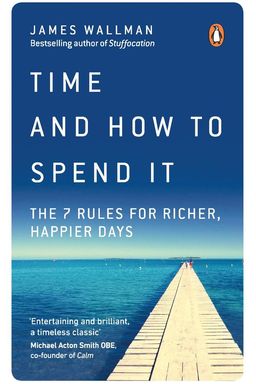
Time and How to Spend It cover

Time and How to Spend It

by James Wallman

In ''Time and How to Spend It,'' James Wallman offers a science-backed checklist for maximizing your free time. Learn to prioritize transformative experiences and outdoor adventures that enhance happiness and personal growth, ensuring every moment counts.

Experience Intelligence: The Art of Choosing What Matters

How do you make the most of your limited time? James Wallman argues that the problem isn’t that you’re time-poor—it’s that you’re experience-illiterate. In his book on Experience Intelligence (ExQ), he reframes modern busyness as a symptom of poor experiential choice. We fill our lives with junk experiences—scrolling, binging, superficial thrills—when we could instead curate high-quality experiences that enrich identity, connection, and meaning. ExQ, then, is the skill of selecting, designing, and balancing experiences to produce lasting happiness and fulfillment.

From checklists to choice architecture

Wallman borrows the model of aviation and medicine’s reliance on checklists—from Boeing’s Flying Fortress to Atul Gawande’s hospital reforms—to propose that life itself needs a similar tool. When complexity overwhelms intuition, a checklist cuts through noise. His STORIES framework serves as a decision-making lens for your time: every worthwhile experience tends to include elements of Story, Transformation, Outside & Offline, Relationships, Intensity, Extraordinary, and Status & Significance. Treat this as a heuristic to rank your options and detect “super” versus “junk” experiences.

The STORIES framework unpacked

Each STORIES element encodes decades of behavioral science. Story reminds us that we’re storytelling animals: humans make sense of life through narrative arcs and emotional challenge (echoing Kurt Vonnegut’s story shapes and Joseph Campbell’s hero’s journey). Transformation emphasizes personal growth as happiness’s deepest substrate—what psychologists call eudaimonia. Outside & Offline restores attention and calm that tech-saturated life erodes. Relationships underscore that shared experiences build longevity and joy. Intensity and Extraordinary moments provide self-transcendence and memory anchors. Finally, Status & Significance points toward meaningful recognition, not superficial signalling.

Why experience is the new wealth

Wallman aligns research strands from positive psychology (Seligman’s PERMA), social epidemiology (Marmot), and behavioral science (Gilovich) to show that experiences—not possessions—deliver the greatest happiness return. Experiences compound: they improve memory, deepen bonds, and mark transformation. Material goods depreciate, but experiences appreciate in memory. Moreover, they build resilience: adversity in the context of a narrative or challenge becomes a story of growth rather than failure.

From happiness to health and cultural renewal

ExQ is not simply self-help—it is cultural critique. Wallman envisions a shift from a twentieth-century culture of personality and consumption toward a twenty-first-century culture of character and experience. His hope is that by privileging shared experience over competitive ownership, we can counter loneliness, consumer addiction, and environmental stress. If enough early adopters embody this experiential mindset, the ripple effects could redefine status itself around contribution, creativity, and connection.

"Treat experience like an asset"

Your time is your truest currency. By applying ExQ, you build a portfolio of life-sovereign choices that deliver meaning, story, and vitality rather than regret.

In short: Wallman’s project is practical philosophy for the age of overwhelm. Using the STORIES checklist, you can upgrade not just your leisure but the architecture of your life. The book is both a map and a manifesto—a call to spend your limited time on experiences that genuinely change, connect, and fulfill you.


Stories and Narrative Meaning

You understand your life through story. Wallman shows that experiences gain meaning and stickiness when they form coherent narratives—a challenge faced, effort made, and resolution achieved. Drawing on Kurt Vonnegut’s story arcs and Joseph Campbell’s hero’s journey, he demonstrates that this ancient structure mirrors our emotional processing of life events.

Why story is your brain’s operating system

When you hear a story, mirror neurons activate; you feel the teller’s emotions. That biological empathy transforms narrative into connection. Yuval Noah Harari calls our shared myths humanity’s “collective fictions”—they enable cooperation. Similarly, Wallman suggests personal stories do the same on a micro level: they connect you to others by showing vulnerability, struggle, and redemption.

From contamination to redemption

Narrative psychologists find that people who frame their lives as redemption stories—setbacks turned to growth—report higher resilience and life satisfaction. Reinterpreting hardship as part of your hero’s arc helps you derive meaning. Clive Williams’s “mud map” makes this tangible: locate yourself on your journey and see current struggles as tests on the path to mastery.

How to live a good story

  • Say yes more: treat opportunities as calls to adventure.
  • Head for the holes: growth requires trials and discomfort.
  • Find allies and mentors: every hero needs companionship.
  • Tell redemptive tales: frame experiences in terms of lessons, not losses.

The moral is simple: experiences become richer when they produce stories worth telling. Design your days so each adventure—large or small—creates arcs of meaning that continue to nourish you long after the moment has passed.


Transformation and Growth

Transformation is the soul of meaningful experience. Wallman argues that happiness endures only when it’s tied to growth, purpose, and alignment with your truest self. Drawing on positive-psychology models (Keyes’s flourishing, Seligman’s PERMA, Deci and Ryan’s Self-Determination Theory), he identifies autonomy, mastery, and relatedness as the roots of lasting wellbeing.

Degrees of change

Not all transformation needs to be radical. Wallman categorizes experiences as Fly & Flop (restorative), Find & Seek (exploratory), and Go & Become (deeply developmental). Each plays a role in keeping life balanced—rest helps recovery, exploration fuels curiosity, and becoming drives purpose. The trick is knowing when you need rest versus reinvention.

The myth of stasis

Psychologist Dan Gilbert’s “end-of-history illusion” shows we underestimate future personal change. Wallman uses it to challenge complacency: you’re still becoming. Whether it’s learning a language, changing careers, or shifting identity (as Caitlyn Jenner did), transformation reflects your ongoing authorship of self.

Practical path to becoming

To cultivate transformation, begin with small bets—sign up for a class, accept a challenge, blend rest with growth during holidays. Over time, curate a “transformation portfolio”: projects that develop skills, test courage, and increase self-knowledge. Transformation, in Wallman’s view, is not about constant reinvention but about consistent progress toward the person you aspire to be.


Outside and Offline

Modern life bombards you with data and dopamine, but your body still craves nature and undivided attention. Wallman brings together two antidotes: going Outside and being Offline. Both restore your “bio-psycho-social equilibrium.” Outside replenishes cognitive and emotional reserves; offline restores agency over your time.

Nature as medicine

Japanese forest-bathing studies (Miyazaki, Li) show that immersing yourself in trees lowers cortisol, reduces blood pressure, and strengthens immunity. The Mappiness project found that coastal environments produce the largest immediate happiness spikes—bigger than attending concerts or winning money. Jerry Morris’s twentieth‑century exercise studies confirm that movement itself is preventive healthcare. The message: green + movement = reliable happiness returns.

Reclaiming attention from technology

On the digital side, Wallman explains how apps use behavioral conditioning to hijack your focus. BJ Fogg’s persuasive design, variable reward loops, and Tristan Harris’s “weapons of mass distraction” expose why you compulsively check notifications. He offers countermeasures: go cold turkey temporarily, ban phones from bedrooms, or create “offline Sabbaths.” Each deliberate disconnection restores depth and awareness.

Design your environment, not just your goals

Schedule green and blue time, move daily, and guard your attention boundaries as fiercely as you guard finances. You don’t wait to trip into health; you design for it.

Combining nature and tech fasting recalibrates your nervous system for genuine experience—calm focus over scattered fragments. It’s the simplest, lowest-cost intervention with disproportionate payoff.


Relationships and Connection

Wallman places human connection at the center of ExQ. Experiences matter most because they forge relationships. Citing Julianne Holt-Lunstad’s meta-analysis of 3.4 million people, he notes that loneliness increases mortality by up to 32%. Social connection, by contrast, is protective—every friendship or community tie acts as psychological armor.

Loneliness as signal

John Cacioppo reframed loneliness as a biological cue—like hunger—that motivates reconnection rather than self-judgment. When you use experiences to build community, you respond to that signal productively. Shared activities—climbing, music, meals—create identity (“I’m one of them”) and strengthen empathy through shared stories.

How to design for connection

  • Pick activities that inherently involve others (group workouts, volunteering, team travel).
  • Host recurring rituals: weekly dinners, walks, book clubs.
  • Talk to strangers—Epley and Schroeder’s experiments prove we underestimate how good it feels.

If you treat relationships as investments—time deposits that grow interest—you’ll find that experiences’ richest payoff is shared remembrance. Happiness, health, and meaning all cascade from connection.


Intensity, Flow, and Real Engagement

Wallman draws heavily on Mihaly Csikszentmihalyi’s concept of flow—the absorbed state when challenge meets skill, time bends, and self‑consciousness fades. Flow, he says, distinguishes high-quality experiences from cheap thrills. It’s the psychological sweet spot of meaningful intensity.

Anatomy of flow

Csikszentmihalyi identified conditions like clear goals, feedback, and balance between challenge and ability. Herbert Benson later mapped it into four stages: struggle, release, peak, and recovery—mirroring the hero’s journey. Wallman uses these to help readers engineer experiences that contain effort, payoff, and rest.

Real vs fake flow

Not every immersive activity counts as flow. Natasha Dow Schüll’s research on casino gambling reveals “machine zones”—states of absorption without growth. Similar pseudo-flow appears in doomscrolling or gaming loops: they feel deep but leave you hollow. Real flow expands your capabilities; fake flow drains you. The test: do you emerge enlarged or depleted?

Designing for authentic intensity

Use Wallman’s DARG FUNC checklist to construct flow-rich activities: Delete distractions, be Active, add Risk, set clear Goals, ensure Feedback, keep it Unpredictable, and introduce Novelty/Complexity. It’s a formula to move from passive consumption to engaged living. Whether learning guitar, training for a race, or painting, structure intensity deliberately. Flow isn’t luck—it’s designed struggle paired with recovery.


Extraordinary and Ordinary Balance

Wallman uses the metaphor of chiaroscuro—light and shadow—to explain how extraordinary peaks need the contrast of ordinary calm. Extraordinary experiences (awe, novelty, adventure) heighten memory and meaning, but without ordinary anchors, life becomes exhausting. Ordinary joys, when noticed, provide sustainable happiness.

Crafting the right mix

Research by Bhattacharjee and Mogilner shows younger people chase “excited happiness,” while older adults prefer calmer satisfaction. Wallman urges you to blend both: plan peaks (a major trip, a challenge event) but also spotlight rituals—morning coffee, shared meals—that you treat as sacred. A string of micro‑breaks often outperforms one long vacation for remembered wellbeing.

Design memorable arcs

Building on Daniel Kahneman’s peak‑end rule and Simon Kemp’s updates, Wallman advises to plan the beginning, multiple peaks, and end of experiences intentionally. Seed moments of awe early and design smooth endings to maximize recall. In short, vary your life’s contrast—your memories will form a masterpiece of peaks and pauses.


Status, Significance, and Experiential Legacy

Wallman confronts an uncomfortable truth: status fundamentally affects wellbeing. Michael Marmot’s Whitehall studies revealed a gradient linking social rank to health. Yet chasing material symbols delivers diminishing returns. Wallman reframes the pursuit as one of significance—using your position to contribute meaningfully, not simply win hierarchies.

Healthy forms of status

Status that stems from learning, contribution, or mastery—like Oprah Winfrey’s philanthropy or C. J. Walker’s empowerment work—enhances both self-worth and societal progress. Empty status, by contrast, isolates (the “Notch” example of wealth without relatedness). True status provides control, participation, and purpose.

Building significance

  • Invest continuously in education and skill.
  • Engage in civic or collaborative roles.
  • Undertake journeys that enrich stories and networks.
  • Stay physically fit—confidence compounds significance.

In the STORIES lens, S stands for Status—but better understood as Significance: status used well. Legacy replaces vanity; impact outlives applause.


Tiny Habits and Cultural Shift

Big change depends on small triggers. Wallman merges BJ Fogg’s behavior model (B = MAP: Behavior = Motivation × Ability × Prompt) with Haidt’s metaphor of the elephant and rider. Your conscious intentions (“rider”) must train your subconscious habits (“elephant”) to naturally choose enriching experiences.

Tiny implementation

Use tiny prompts to apply STORIES daily: “After I start planning my weekend, I’ll ask: Will this lead to STORIES?” Small repetitions train automatic preference toward meaningful time use. Just as two push‑ups evolve into a fitness routine, micro‑habits of selection evolve into lifestyle transformation.

From self-help to social movement

In conclusion, Wallman extends ExQ from personal practice to cultural revolution. Building on Warren Susman’s shift from a culture of character to one of personality, he calls for a new experientialism that values what you do over what you own. As early adopters model richer experiential lives, they normalize depth, contribution, and sustainability. The legacy of applying ExQ isn’t only your improved days—it’s the collective evolution of a culture that cherishes experiences as the truest wealth.

Design small habits, live storied days, and model experiential intelligence; when you do, you strengthen not just your life but society’s capacity for genuine living.

Dig Deeper

Get personalized prompts to apply these lessons to your life and deepen your understanding.

Go Deeper

Get the Full Experience

Download Insight Books for AI-powered reflections, quizzes, and more.