
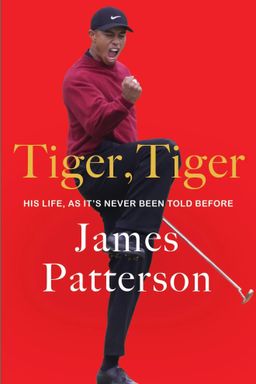
Tiger, Tiger cover

Tiger, Tiger

by James Patterson

The ups and downs in the life and career of the golf champion Tiger Woods.

Engineered Greatness, Public Burdens

How do you turn staggering potential into historic dominance—and carry the cultural weight that comes with it? This book argues that Tiger Woods is not only a transcendent athlete but a deliberately engineered project of family, method, and mindset, later tested by fame, scandal, injury, and the politics of a sport with a segregated past. When you track Tiger’s arc—from a garage high chair facing a practice net to the 1997 Masters, from spinal fusion to a fifth Green Jacket in 2019—you see a system at work: rules and rituals, calculated exposure to pressure, technical reinvention, and an evolving role as brand founder and steward of the game.

The system that built a champion

Earl and Kultida (Tida) Woods create the scaffolding: five household rules (“education before golf” chief among them), relentless practice, cultural identity, and mental training. Earl’s Green Beret background imports interrogation-style focus drills—taunts in the backswing, jingling change on the takeaway—while Tida’s Buddhist steadiness adds ritual, humility, and moral grounding. Early coaches (Rudy Duran, John Anselmo) and sports psychologist Dr. Jay Brunza add techniques like visualization, hypnosis, and breathing. Tiger’s childhood is a lab of controlled pressure and daily repetition (he plays up to 33 junior events in a year), reinforced by media exposure (Mike Douglas Show, That’s Incredible!) designed to normalize spotlight stress.

From prodigy to force of nature

The junior and amateur record—multiple Junior Worlds, three straight U.S. Amateurs (1994–1996), and Stanford team membership—reveals a pattern: Tiger learns from misses, iterates with mentors (Butch Harmon on swing architecture, Hughes Norton and IMG on early business), and treats match play as a mental crucible. He turns pro in 1996 with a staged reveal at Milwaukee, a $40 million Nike deal, and the “Hello world” campaign that fuses marketing with social commentary about golf’s exclusionary past. Early wins (Las Vegas, Disney) accelerate momentum; early missteps (a GQ interview, a Callaway Gardens withdrawal) reveal how swiftly celebrity can punish naiveté.

Race, symbolism, and the Masters threshold

Tiger’s story unfolds in a sport shaped by exclusion. The book draws a direct line from pioneers Charlie Sifford and Lee Elder to Tiger’s 1997 Masters—a victory that transforms Augusta from symbol to stage of change. Along the way, you see the backlash (death threats after a Riviera exemption; Shoal Creek furor) and hear Earl’s blunt framing (“two colors: white and nonwhite”). Tiger’s multi-ethnic identity (Thai, Chinese, Black, Native American, European) meets America’s binary racial gaze, making his breakthrough both personal and public. When he wins in 1997, crowds chant “Ti-ger,” Sifford and Elder watch with tears, and the sport’s institutions must respond.

Reinvention under pressure

At the peak, Tiger tears down his own swing with Butch Harmon—weakening the grip, cleaning the takeaway, reducing hand action—to build a more repeatable, pressure-proof motion. He accepts a 1998 lull to reach the 2000–2002 summit (Pebble Beach demolition, St Andrews command). This engineering mindset returns after injuries: microdiscectomies lead to an L5/S1 spinal fusion in 2017 (a “medical Hail Mary” that quiets nerve pain) and a retooled game that produces the 2018 TOUR Championship and the 2019 Masters, one of sport’s great comebacks.

Core thesis

Tiger’s greatness fuses designed discipline, technical reinvention, and cultural resonance; his durability comes from a willingness to rebuild everything—mechanics, brand, and identity—when circumstances demand it.

Costs, consequences, and stewardship

The personal story is as unflinching as the professional. Marriage to Elin Nordegren in 2004 builds a family; the 2009 scandal detonates endorsements (Accenture, AT&T, Gatorade, Gillette) and trust (Harvard Business Review notes a ~$12B hit to sponsor market value). Rehab—of body and reputation—becomes central: therapy, public apology, and years-long brand repair. The medical saga is grueling (knee surgeries, back fusions, leg reconstruction after the 2021 crash). Yet the arc bends toward stewardship: Tiger becomes a PGA Tour policy-board player director and, in 2024, vice chairman of PGA Tour Enterprises, while launching Sun Day Red with TaylorMade to shift from endorser to owner.

For you, the lesson is layered: success is a system you can build; reinvention is a choice you must make; and legacy is the work you do for others—your family, your sport, your community—when the wins slow and the spotlight changes angles.


Parents, Rules, Mental Forge

Tiger Woods’s foundation is parental design. Earl and Tida don’t merely support a talented child—they build a regimen around five rules (education before golf; homework before practice; no back talk; respect your parents and elders) and live those rules daily. You watch Earl take second mortgages, juggle logistics, and craft training environments that mimic battlefield stress; you see Tida introduce temple rituals, offerings, and a sense of gratitude. Together, they ensure school stays primary (a reason Tiger chooses Stanford) and golf remains a privilege earned by discipline.

Military pressure, Buddhist steadiness

Earl’s Green Beret methods aim at one outcome: composure under fire. He heckles during the swing, rattles coins at address, and builds coded cues (“Sam”) so Tiger can reset attention. Dr. Jay Brunza adds mental skill: hypnosis, breathing, and visualization sessions that Tiger treats as serious practice, not soft add-ons. Tida balances the edge with calm: meditation, rituals, and cultural pride that counteract outsider treatment in golf. The combination creates a competitor who is ruthless between the ropes and respectful at home.

Deliberate exposure to pressure

Earl engineers early TV appearances (Mike Douglas Show, That’s Incredible!) not as novelty, but as pressure inoculation. In the garage, a high chair faces a practice net so “watching golf” is as common as nap time; by ten months Tiger swings into a net. At Heartwell, “Tiger par” reframes scoring so a child learns to beat the course, not just chase conventional par. These are micro-designs that make excellence inevitable. Coaches Rudy Duran and John Anselmo provide mechanics; frequent junior events create competitive mileage. By his teens, Tiger compiles Junior World titles and a U.S. Junior Amateur, signaling method over myth.

Stanford’s choice and team dynamics

When recruiting heats up, Stanford wins. The decision aligns with the family creed: education first, surrounded by top peers and media exposure. College life teaches trade-offs—rigorous classes (he drops calculus), team accountability, and public scrutiny in an academic cauldron. Coach Wally Goodwin and campus icons (Bill Walsh) provide mentorship and systems thinking that mirror Earl’s structure but broaden it. The environment helps Tiger test leadership, manage time, and build friendships (Notah Begay III) that will accompany him through tour life.

Iteration as identity

Tiger’s youth is not about quick wins; it’s about feedback loops. Missed putts become drills (100 consecutive six-footers), visualization becomes pre-shot ritual, and each junior/college tournament is a lab for stress-testing routines. He develops “second place is first loser” ferocity without discarding respect, a paradox that makes him both feared and admired. When the 1996 U.S. Amateur final against Steve Scott pushes him 5 down, he pulls from this mental bank to claw back in extra holes—proof that the system works under maximum stress.

Transfer to your life

Codify a few non-negotiable rules, practice mental skills as seriously as mechanics, and engineer controlled pressure. Consistency plus composure beats sporadic talent.

If you’re a parent, coach, or team lead, this chapter’s blueprint is clear: define the creed; balance edge with empathy; and invest time, money, and energy in deliberate practice. (Note: The design echoes other high-control upbringings in sports—compare Earl’s military psychology with Andre Agassi’s father’s intensity in Open—but Tiger’s mix includes spiritual equilibrium and a rare commitment to education.)


Race, Identity, Masters Moment

Golf’s history with race runs through Tiger’s story, shaping how you interpret his wins and the reactions they provoke. The book ties Tiger directly to Charlie Sifford (“Grandpa Charlie”) and Lee Elder—men who confronted segregation to open doors that Tiger later bursts through. Sifford’s 1969 L.A. Open and relentless advocacy eroded the PGA’s Caucasian-only clause; Elder’s 1975 Masters appearance revealed Augusta’s late arrival to integration. Tiger inherits not only opportunity, but a burden of representation—complicated by his multi-ethnic identity (Thai, Chinese, Black, Native American, European) and the American tendency to see him primarily as Black.

Incidents that expose the sport

In 1992, after a sponsor’s exemption into Riviera, death threats arrive. In 1994, the Shoal Creek controversy (sparked by Hall Thompson’s “all-white club” remarks) forces the PGA to confront club policies. Earl speaks plainly: “two colors: white and nonwhite,” framing Tiger’s ascent as both personal ambition and social challenge. These are not footnotes; they’re context that explains why the 1997 Masters lands like a cultural earthquake.

Augusta 1997 as a cultural hinge

When Tiger wins the Masters by 12 shots, the scoreboard is only half the story. Under the Big Oak, Black caddies and staff step forward to witness a boundary broken. Crowds chant “Ti-ger,” Sifford and Elder watch with tears, and corporate America recalibrates marketing narratives in real time. Tiger credits his predecessors, refusing to be framed as “the best Black golfer” (echoing Sifford’s line) and insisting on being the best golfer, period. This moment alters public imagination of who belongs in golf—spectators, members, and champions.

Identity complexity vs. public categorization

Tida resists reductive labels. Tiger’s self-understanding blends Thai customs (colored days—red on Sundays), Buddhist-influenced rituals, and the African American struggle he’s drafted into by the audience. The book doesn’t offer easy resolution; it invites you to see identity as layered, while acknowledging that institutions and media often force binaries. This tension both amplifies Tiger’s visibility and intensifies scrutiny when he errs.

Why this matters

Major wins can be social pivot points when they occur in historically exclusionary spaces. Tiger’s 1997 Masters becomes shorthand for access—and a mirror for golf’s institutions.

For you, the lesson is to read achievements in context: performance is one axis; symbolism is another. When you break a barrier in your field, you inherit obligations you didn’t choose. The book suggests a practical stance—acknowledge the pioneers, embrace complexity, and keep the bar on being the best, not the best representative of a category (compare with Serena Williams’s and Arthur Ashe’s parallel burdens in tennis).


Hello World: Pro and Brand

Turning pro, Tiger treats business as part of performance. The 1996 Milwaukee launch is meticulously staged: Earl controls timing; Nike outfits the reveal; Titleist balls sit on the bag; IMG’s Hughes Norton orchestrates media. “Hello world” becomes a Nike tagline and manifesto, melding debut bravado with commentary about golf’s gates. Early results—wins at the Las Vegas Invitational and Walt Disney World—validate the hype and send endorsement values soaring.

The IMG playbook and agent dynamics

IMG has courted Tiger for years, building a long fuse for a big detonation. Nike’s $40 million deal anchors the portfolio; Titleist supplies clubs and balls; soon EA Sports taps his likeness for a franchise video game. The book also shows brand governance in conflict: the GQ limo interview sparks a PR fire; NCAA questions arise from Masters diaries; a Callaway Gardens withdrawal (fatigue) triggers backlash. Rapid apologies, letters (e.g., to the Haskins Commission), and process fixes become tools. Eventually, agent alignment shifts from Norton to Mark Steinberg—proof that representation must match values and strategy.

Product development as performance edge

Tiger isn’t a passive endorser; he joins Nike R&D to shape balls and clubs. He detects half-gram differences in drivers and iterates prototypes until feel meets data. Nike’s Tour Accuracy ball becomes a co-developed weapon (later echoed by his transition to a Nike ball during the brand’s deeper equipment push). These gear relationships matter on course and in culture: sneakers, Sunday red, and commercials turn Tiger into a global icon whose kit signals a mindset.

Brand brilliance and backlash

“Hello world” is both masterstroke and magnet for criticism. Some call it opportunistic social commentary; others see overdue truth-telling. The campaign widens his audience and hardens detractors—an early lesson in polarizing fame. When you add unfiltered remarks to sensitive sponsorship landscapes, you get swift consequences. Tiger’s team learns the rhythm: anticipate blowback, respond fast, refine guardrails.

Playbook takeaway

Launch with narrative control, pick partners who align with long-term goals, and build crisis muscle early. Great performance without brand strategy leaves value on the table—and invites chaos.

If you’re crafting your own debut in any field, the lesson is to fuse story with substance: time your reveal, define your message, and ensure your inner team (agents, coaches, mentors) shares your priorities. (Note: This arc parallels LeBron James’s shift from agency client to co-owner/producer; eventually, Tiger mirrors that move by launching Sun Day Red in 2024 with TaylorMade, stepping from endorser to brand owner.)


Rebuilding the Swing, Training the Mind

Perhaps the book’s most instructive theme is Tiger’s willingness to dismantle a winning engine. After early pro success, he and Butch Harmon choose to weaken the grip, simplify the takeaway, and reduce hand action—sacrificing short-term results for long-term repeatability. Video sessions in Orlando freeze top positions; Tiger reconciles feel with fact and drills until the new motion becomes second nature. A 1998 dry spell follows; then comes the 2000–2002 supernova—Pebble Beach’s historic U.S. Open rout, St Andrews mastery, and layered dominance at Augusta and Bethpage.

Process over panic

Tiger frames reinvention like a software refactor: tear it down, harden the core, reduce moving parts. He tests in lower-stakes events, accepts missed cuts or middling finishes as tuition, and keeps detailed notes. The payoff is mechanical clarity under psychological chaos—the ability to reproduce elite shots under Sunday heat. Later, after injuries and new body constraints, he repeats the approach, adapting to a fused spine and altered leg mechanics with the same humility toward fundamentals.

Rituals, routines, and caddie chemistry

Mental training is as precise as swing work. Red on Sundays (Thai tradition) becomes a personal battle flag. Putting drills (100 straight six-footers) callus the mind against doubt. The pre-shot routine—settled since age six—serves as a metronome for attention. Caddie transitions—from Mike “Fluff” Cowan to Bryon Bell to Steve Williams—mirror changes in Tiger’s needs: emotional calibration, tactical reads, and physical pacing. Williams, notably, becomes a field general in tense moments; their sync supports peak major runs. Dr. Jay Brunza’s breathing and visualization keep him anchored to the present tense of a single shot.

Compartmentalization under fire

Personal crises (Earl’s health scares, public criticism) don’t disappear; Tiger learns to bracket them. A simple mantra—“You can’t think and swing at the same time”—culls mental clutter. On course, emotion compresses to process steps; off course, it expands in private spheres (video games, Discovery Channel binges, fly-fishing with Mark O’Meara). This compartmentalization is a skill, not a quirk, and it makes sustained excellence possible.

Practice principle

Rebuild core mechanics before you need them, ritualize your resets, and choose teammates who complement your evolution.

Apply this to your craft: document what’s repeatable, not just what feels good; slot in mental drills as non-negotiable; and be willing to swap tools and teammates as your constraints change. (Note: This reinvention ethic parallels Michael Jordan’s mid-career tweaks and Tom Brady’s late-career biomechanics/pliability shifts.)


Discipline, Turmoil, and Reputation Costs

The private life is not an epilogue; it’s a force multiplier or drag on the public engine. Tiger marries Elin Nordegren in 2004 (Sandy Lane, Barbados, with high-wattage guests like Michael Jordan and Charles Barkley). He becomes a father to Sam and Charlie, reframing purpose beyond trophies. Then Thanksgiving 2009 detonates the image: after tabloid exposes and a confrontation over incriminating texts, a late-night SUV crash becomes the symbol of a sprawling infidelity scandal. On December 11, Tiger issues a public apology and steps away from golf indefinitely.

Immediate and lasting fallout

Endorsements crumble—Accenture, AT&T, Gatorade, Gillette cut ties. Harvard Business Review estimates roughly $12 billion of sponsor market value evaporates, a brutal lesson in how personal conduct is priced by markets. The Tiger Woods Foundation and Learning Center continue their work, but the halo dims. In 2017, a DUI arrest (later tied to prescribed medications) renews public concern and legal consequences (probation, community service). The crises are not neatly contained; they reverberate across years.

Repair as a long campaign

Reputation repair blends apology with action. Tiger completes inpatient therapy in 2010 (and seeks help again after 2017), increases presence with family, and lets time and transparency do quiet work. Competitive resilience helps: the 2018 TOUR Championship and 2019 Masters reframe him as a comeback artist, not only a fallen idol. Yet the book resists fairy tales; consequences remain, trust is rebuilt but not reset, and vigilance replaces assumption.

Habits that hold and heal

Rituals—sleep discipline during events, diet guardrails, red on Sundays, putting gauntlets—become scaffolding when reputation wobbles. Close circles (Bryon Bell, Notah Begay III, Mark O’Meara) provide ordinary moments that fame would otherwise erase. You glimpse the Isleworth home in nearly college-like disarray—a reminder that even global icons knit normalcy from small, private habits.

Accountability lesson

Quick denial compounds harm; owned mistakes, therapy, and consistent changed behavior are the only credible route back.

For you, the case study is practical: calibrate ambition with guardrails; separate brand from self-worth; and treat personal ethics as enterprise risk management. (In business parallels, see how CEOs recover from crises—transparent communication, independent remediation, long-term cultural changes—rather than performative fixes.)


Pain, Comebacks, and Stewardship

Tiger’s body becomes the battlefield where excellence extracts its tax. Early-2000s knee pain leads to a December 12, 2002 surgery; by 2008 he wins the U.S. Open at Torrey Pines in a playoff with a torn ACL and stress fractures—an act of will that also extends recovery costs. The back saga deepens the toll: multiple microdiscectomies fail to end nerve pain, culminating in an April 2017 L5/S1 spinal fusion that stabilizes the spine with a cage and fuses vertebrae. He wakes with instant nerve relief—but less mobility, demanding new mechanics and footwear adjustments (a switch to FootJoy for stability).

Architecture of a comeback

Comebacks arrive in phases: medical intervention; painstaking rehab and neuromuscular re-education; then competitive re-entry through limited fields (Hero World Challenge), followed by full-field stress tests. Partial revivals appear (2013 wins), but fragility persists until the fused spine allows sustained training. The payoff: the 2018 TOUR Championship (crowds surging up the fairway in a cathartic march) and the 2019 Masters—the latter a parental full circle, with Tiger hugging Sam and Charlie where he once embraced Earl.

Shock and recovery after 2021

The February 23, 2021 crash shatters the right leg (tibia and fibula), requiring rods, screws, and pins. Early speculation questions whether he will keep the limb; surgeons stabilize the fractures and begin a long rehab. Additional back procedures follow (e.g., December 2023 microdiscectomy), underscoring the cascade effect of elite wear and tear. Yet Tiger returns for limited events, calibrating pain management with competitive desire, and accepting that “tournament golf” now means strategic, sparse scheduling.

From champion to custodian

As the body sets limits, Tiger’s locus of control shifts. He mentors younger players at Ryder and Presidents Cups, serves as vice captain and captain (2019 Melbourne win), and steps into governance during golf’s civil war with LIV. By 2022 he joins the PGA Tour policy board as a player-director and, in 2024, becomes vice chairman of PGA Tour Enterprises—leveraging credibility to negotiate player rights, new revenue models, and the sport’s strategic direction.

Brand control and renewal

Financially, Tiger evolves from corporate centerpiece to owner-operator. After the 2009 sponsor exodus, he rebuilds slowly, then pivots boldly in 2024: he ends his Nike era and launches Sun Day Red with TaylorMade, shifting from licensee to principal. Philanthropy (Tiger Woods Learning Center, Tiger Jam) remains a throughline. Honors—2019 Presidential Medal of Freedom, 2022 World Golf Hall of Fame induction (with Sam as presenter)—mark an influence that extends beyond scorecards.

Enduring insight

Greatness is not only domination; it is the capacity to rebuild what time and choices break—and then use that hard-won authority to serve the game.

If you’re navigating setbacks, model Tiger’s three-part pattern: seek decisive fixes, obsess over rehab and adaptation, and redefine success by adding stewardship to achievement. Rivalries (Phil Mickelson), team play grit (Ernie Els duel in 2003 Presidents Cup darkness), and family legacy (caddying for Charlie at the PNC) round out a life now measured as much by what he gives as by what he wins.

Dig Deeper

Get personalized prompts to apply these lessons to your life and deepen your understanding.

Go Deeper

Get the Full Experience

Download Insight Books for AI-powered reflections, quizzes, and more.