
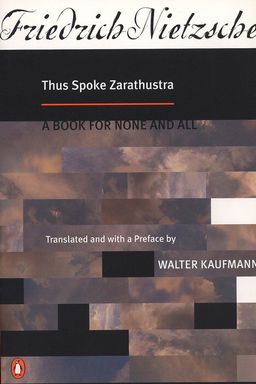
Thus Spoke Zarathustra cover

Thus Spoke Zarathustra

by Friedrich Nietzsche

Dive into Friedrich Nietzsche''s ''Thus Spoke Zarathustra,'' a philosophical journey that challenges conventional beliefs and inspires readers to forge their own path. Through Zarathustra''s teachings, explore themes of self-overcoming, the will to power, and the pursuit of the ''Übermensch.''

Zarathustra and the Task of Overcoming Man

What happens when the old gods die and the world loses its metaphysical anchor? In Thus Spoke Zarathustra, Friedrich Nietzsche imagines a prophet who descends from solitude to answer precisely that void. After ten years of isolation, Zarathustra announces his mission: not to comfort, but to awaken humanity from spiritual sleep. His proclamation — “Man is something that must be overcome” — introduces the central theme of self-transcendence and the creation of new values on the earth.

Nietzsche’s narrative stages the death of God as the crisis of meaning underpinning modern culture. The collapse of divine authority leaves people disoriented and nihilistic — a vacuum where morality, truth, and purpose lose their grounding. Through Zarathustra, Nietzsche asks: who will now create the meaning of life? His answer is radical: you must replace lost faith not with despair but with creative power, embodied in the figure of the Superman — one who gives meaning to the earth through self-mastery and affirmation.

From Solitude to Creation: A Prophetic Journey

Zarathustra begins in solitude, refining his insight away from the herd. His first descent to the marketplace dramatizes the tension between a prophetic voice and the misunderstanding of the crowd. While he teaches the Superman, the people laugh and ask for ease — they prefer the "Ultimate Man," content, safe, and trivial. This rejection becomes the book’s pedagogical turning point: the masses cannot bear the truth that life demands overcoming. Zarathustra withdraws again, seeking not followers but companions — creators who will share his labor of revaluing life.

The Drama of Nihilism and the Birth of Values

In the aftermath of divine death (“We have killed him — you and I”), Nietzsche does not offer lament but challenge. The absence of metaphysical comfort demands new tables of values written by human creators. This is more than cultural critique; it is a practical and existential call to arms. Without transcendence, you can either shrink into safety — the Ultimate Man — or rise as one who shapes meaning through strength and freedom. Zarathustra’s teaching insists that nihilism is not the end but the beginning of responsibility.

Will to Power: The Engine of Renewal

The force behind this transformation is Nietzsche’s concept of the will to power: the inner drive toward growth, mastery, and creative intensity. Life itself, he argues, seeks expansion and form-giving. Through images of metamorphosis — camel, lion, child — Zarathustra maps the stages of self-overcoming. First you accept burdens and discipline (camel), then revolt against imposed duty (lion), and finally create new beginnings in innocence (child). This progression reveals how destruction and creation intertwine: you must unlearn before you can invent.

Eternal Recurrence: The Test of Affirmation

The doctrine of eternal recurrence crowns the book’s challenge: would you embrace your life — every joy and pain — if you had to live it eternally? The vision of the laughing shepherd who bites off the snake’s head embodies this radical yes. It is not fatalism but affirmation: loving fate (amor fati) so completely that you will it again and again. Only a soul that transforms suffering into joy can endure this highest test of the will.

Revaluation of Values and the Call to Creation

Zarathustra’s ethical program seeks to overturn inherited morality. He ridicules priests, the state, pity, and equality not out of cruelty but to expose their life-denying roots. Instead, he prizes courage, strength, and creative selfishness — virtues that enhance rather than restrict vitality. The true creator revalues “evil” qualities such as sensual pleasure and ambition, discovering that health and greatness require energies condemned by conventional virtue.

Prophecy as Style: Laughter and Song

Nietzsche’s form mirrors his message. Zarathustra speaks in aphorisms, poems, and songs — prophetic language meant to move the reader emotionally and spiritually. Laughter and dance become sacred acts: tools to defeat the “Spirit of Gravity” and lighten existence. Affirmation emerges not through theory alone, but through artful celebration, where joy and courage replace heaviness and pity.

Ultimately, Thus Spoke Zarathustra is less a doctrine than an invitation. You are asked to become a creator: to face nihilism without retreat, to turn the death of God into a birth of new meaning, and to live so joyfully that you would will your life eternally. Zarathustra’s mountain is your own solitude; his laughter, your potential transformation. By revaluing values, embracing the will to power, and affirming recurrence, Nietzsche sketches the path from despair to creative freedom — the path toward the Superman.


The Death of God and the New Ground of Meaning

Nietzsche begins from a crisis: the declaration that “God is dead.” The statement is not a boast but a diagnosis — the metaphysical framework sustaining Western morality has collapsed. Without divine command, every value and truth loses its eternal guarantee. In The Gay Science, the madman announces the death of God as collective tragedy and responsibility. Zarathustra inherits this emptiness, yet turns it into possibility: an invitation to remake values from the earth.

Facing the Void

You must first confront what Nietzsche calls nihilism — the sense that life lacks purpose. The danger is twofold: despair, which freezes creation, and trivial comfort, embodied in the Ultimate Man who seeks only ease. Zarathustra refuses both. Instead, he transforms chaos into soil for rebirth, saying: “Let your will say: The Superman shall be the meaning of the earth.” This is Nietzsche’s crucial turn from transcendence to immanence: meaning is no longer above but beneath you, in the living world.

Creators of New Tables

Each people, Nietzsche says, lives under a “table of values.” When the old table cracks, the question becomes: who will write the new one? Zarathustra’s answer is not priest, politician, or philosopher in the old mould. It is the creator, driven by the will to power — the energy that writes, shapes, and affirms life. Your task is not obedience but creation: to invent virtues that enlarge existence rather than restrict it.

Practical Consequence: Meaning as Work

Nietzsche’s challenge is practical. Without transcendental authority, meaning must be made by living action. You can no longer defer significance to heaven or ideal worlds. The death of God is thus both liberation and burden: you inherit the godlike power to create values, but also the responsibility to justify them through living strength. In this way, the book teaches you how cultural collapse becomes creative renewal — a theology transformed into anthropology.

(Contextually, this is Nietzsche’s response to European moral exhaustion after Enlightenment rationalism: he intends Zarathustra as a new form of prophet without metaphysical leash. The death of God clears space for human artistry, moral courage, and spiritual self-authorship.)


Will to Power and the Metamorphoses of Self

At the heart of Zarathustra’s teaching lies the concept of the will to power — the drive within all life to expand, overcome, and create. Nietzsche replaces older moral and psychological models (soul, duty, and divine will) with this principle of dynamic growth. To exist is to express power creatively, not merely to survive or obey. Zarathustra turns this insight into a pedagogy of transformation, mapping how the self evolves through stages.

The Three Metamorphoses

Zarathustra’s image of the camel, lion, and child describes the rhythm of self-overcoming. As a camel, you accept burdens — discipline and learning — to prove strength. As a lion, you revolt against imposed duties, slaying the dragon of “Thou shalt.” Then, as a child, you create anew, embracing innocence and play. This last metamorphosis is crucial: only by symbolic rebirth can you replace destruction with creation.

Self-Mastery and Creation

Zarathustra links self-control with cultural creativity. True power is not domination but form-giving — shaping values, art, and character. When he seeks companions rather than herds, he models will to power as communal creation: shared strength, not tyranny. Your task is to cultivate inner clarity and external artistry, fusing discipline with invention.

Destruction and Affirmation

This doctrine redefines strength. Courage and attack — the willingness to destroy obsolete values — are its instruments. Yet every act of “No” must open a channel for “Yes.” Will to power therefore integrates rebellion and joy, asserting that the highest vitality is not mere conquest but creative generosity. Power used to affirm life becomes the engine of the Superman.

(In other works, Nietzsche contrasts this with Christian humility and utilitarian social ethics; here he turns psychological striving into aesthetic creation. To will power is to will meaning — an act of continuous transformation.)


Eternal Recurrence and the Art of Affirmation

Imagine a demon whispering that you must live your life — every wound, joy, and failure — over and over eternally. Would you curse or bless him? Nietzsche’s eternal recurrence tests your capacity to affirm existence in full. It is both metaphysical idea and moral experiment: the highest souls will say yes to endless repetition because their love of life includes tragedy, not despite it.

The Vision and the Laughter

Zarathustra’s vision of the shepherd choking on a snake culminates in ecstatic laughter — “Never yet on earth had any man laughed as he laughed!” When he bites off the snake’s head, he symbolically kills the spirit of gravity, freeing the joy that loves fate. This laughter becomes the emblem of recurrence: transformation of suffering into radiant affirmation.

The Doctrine of the Ring

Later songs and chapters describe the Ring of Recurrence, the “wedding ring of rings.” Zarathustra’s animals proclaim him teacher of eternal recurrence after he survives its sickness — the nausea of realizing that everything returns. Only through acceptance of inevitability does joy mature into eternity. “All joy wants eternity,” he sings; joy without end is the measure of affirmation.

Amor Fati and Creative Endurance

To accept recurrence is to practice amor fati — love of fate. You cease to accuse existence and begin to embrace it wholly. Every failure becomes material for creation. Applied personally, this doctrine becomes psychological training: before you act, ask whether you can love the act forever. If not, you are still ruled by resentment. The Superman, by contrast, wills eternal recurrence as celebration.

(Nietzsche’s eternal recurrence parallels Stoic ideas of fate but reverses their resignation: it is affirmative, not passive. You win eternity not by escaping time, but by willing its repetition.)


Revaluation and the Critique of Life-Denying Morals

Zarathustra’s revolt extends beyond metaphysics into ethics. He aims to revalue all values — to overturn moral codes that weaken life. Priests, moralists, and egalitarians become his foils. Nietzsche exposes pity, guilt, and equality as disguised forms of revenge and stagnation. Instead of measuring virtue by obedience, he measures it by vitality — the capacity to enhance existence.

Targets of Critique

In chapters like “Of the Afterworldsmen” and “Of the Despisers of the Body,” Zarathustra attacks moral systems that glorify weakness and despise the flesh. He condemns pity when it turns creative souls into servants of misery, declaring that “God died of his pity for man.” Likewise, he assaults the “tarantulas” — egalitarian preachers whose calls for justice conceal envy and vengeance.

Beyond the State and Herd

Zarathustra warns against the state, “the new idol,” claiming it devours individuality for collective safety. The herd’s comfort values give birth to small virtues — modesty, pity, and moral conformity. These make people tame but not great. True virtue grows from strength, independence, and courage to create law for the future.

Revaluing Evil

To complete his reversal, Zarathustra praises three “evil things” — sensual pleasure, lust for power, and selfishness. Each can be destructive when weak but creative when strong. Pleasure restores vitality; power purges hypocrisy; selfishness guards creative work. The revaluation turns moral vice into aesthetic strength: an artist’s ethics of creation rather than prohibition.

The practical lesson: examine whether moral claims serve life or smother it. Zarathustra’s ethics demand discrimination — kindness must not become pity, equality must not become mediocrity, and goodness must not become law against greatness.


Prophetic Style, Solitude, and Laughter as Method

Nietzsche designs Zarathustra not only to teach but to perform philosophy. The book’s language — aphorisms, songs, and parables — forms a prophetic rhetoric that stirs the reader’s own creation. To understand the doctrine, you must experience its tone: ecstatic, musical, and paradoxical. Hollingdale calls it “an eruption of style,” where form embodies freedom from academic constraint.

Song, Aphorism, and Dance

Zarathustra often teaches through song — the Night Song, the Dance Song, the Midnight Song — each transforming pain into melody. He writes “with blood,” meaning from lived experience rather than abstraction. Dance symbolizes lightness against the “Spirit of Gravity”; laughter crowns creation as its lightest gesture. The prophetic voice persuades not by logic but by rhythm and revelation.

Solitude and Companions

Zarathustra alternates between solitude and communion. Alone he refines; among companions he gives. His ideal community is selective: creators and harvesters, not followers. “The creator seeks companions, not corpses or herds.” This rhythm teaches that creativity demands withdrawal and return — inner testing followed by outward generosity.

Laughter as Philosophy

The laughter motif runs throughout — from the shepherd’s laugh to Zarathustra’s own crown of laughter. Laughter becomes metaphysical affirmation, replacing solemnity with joy. It dissolves resentment and recognizes tragedy as part of life’s play. To laugh, for Nietzsche, is to enact the overcoming of man: a creative, courageous Yes that confronts abyss with dance.

(Note: Nietzsche’s style anticipates existential and modernist literature where voice itself becomes philosophy — a method of awakening affect and authenticity. Read Zarathustra not only for argument but for contagion, as its rhythm trains your spirit toward lightness.)


Courage, Selection, and the Community of Creators

In the later chapters, Zarathustra develops a pedagogy of courage and selection. He warns that the Spirit of Gravity — embodied by the dwarf whispering “every stone must fall” — weighs down creators with fear and pity. Against this heaviness, courage acts as “the best destroyer,” freeing life from paralysis. Courage allows solitude without despair and community without conformity.

The Rejection of Pity

Zarathustra’s dialogue with the ugliest man explores pity’s danger: when compassion becomes invasive, it corrodes dignity. He teaches you to respect distance and strength; excessive pity kills creative souls. The moral is not cruelty but respect for self-reliance — to protect greatness from sentimental erosion.

Honey Offering and Tests

Zarathustra’s teaching is selective. He casts his happiness as “golden bait” into the human sea to draw only those strong enough to respond. He waits for companions who can transform, not comfort themselves. The honey offering illustrates an artful pedagogy: temptation becomes a test, and only creators take the hook. Even kings must cook in his cave — symbolic equality through effort, not status.

Community of Creators

Zarathustra’s ideal fellowship consists of those who have survived solitude and self-overcoming. They gather not to worship but to work and laugh. His cave becomes a stage where diverse types — prophet, king, sorcerer, beggar — reveal virtues and weaknesses in dramatic mirrors. Through these dialogues, Nietzsche transforms philosophy into theatre, testing what human types can evolve toward higher affirmation.

In sum, courage, solitude, and selective companionship form Zarathustra’s final teaching. They prepare the earth for creators who will say the joyous Yes of eternal recurrence. This is Nietzsche’s vision of humanity reborn through daring spirit rather than doctrine — the living community that overcomes man.

Dig Deeper

Get personalized prompts to apply these lessons to your life and deepen your understanding.

Go Deeper

Get the Full Experience

Download Insight Books for AI-powered reflections, quizzes, and more.