
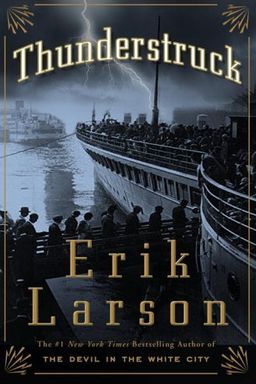
Thunderstruck cover

Thunderstruck

by Erik Larson

Thunderstruck by Erik Larson intricately weaves the stories of Guglielmo Marconi, the inventor of wireless telegraphy, and Dr. Hawley Crippen, a notorious murderer. Set against the backdrop of Edwardian England, this captivating tale explores how Marconi''s technological breakthrough played a crucial role in one of history''s most suspenseful criminal chases.

Invention, Rivalry, and the Birth of Wireless

How does obsession with practical tinkering create revolutions? In this book, you witness a detailed chronicle of Guglielmo Marconi’s rise from attic experiments to global domination of wireless, intertwined with scientific rivalries, corporate secrecy, and sensational criminal intrigue that reshaped modern communication. The author shows that technology’s breakthroughs are not products of pure theory but of trial, persistence, and conflict—scientific, legal, and human.

From Attic Sparks to Industrial Stations

Your journey begins in the attic of Villa Griffone. Marconi, driven more by intuition than equations, painstakingly builds, tests and adjusts his improvised coherer some four hundred times. Each change—nickel filings here, mercury traces there—exemplifies how empirical curiosity beats theoretical restraint. The Celestine Hill experiment, where a gunshot confirms successful long-range wireless signaling, marks the moment scientific curiosity turns into public spectacle.

Soon, practice scales into enterprise. Marconi demonstrates wireless telegraphy for William Preece at the Post Office and astonishes audiences at Toynbee Hall and the Royal Institution. His sealed boxes and showmanship fuel public fascination. The narrative celebrates invention as performance: a technology must prove itself in theaters and fields, not just in equations.

Science vs. Commerce and the Clash of Personalities

You encounter the deep tension between scientific openness and commercial secrecy. Oliver Lodge’s 1894 coherer demonstration prefigures Marconi, yet Lodge’s inclination toward abstract theory and side interests in psychical research stall his progress. Meanwhile, Ambrose Fleming and Preece push for demonstration and patents. Rivalry among these figures represents the collision of academic transparency with entrepreneurial protection—a pattern still visible in today’s tech startups.

Patent battles, public letters to The Times, and accusations of appropriation illuminate how early wireless innovation was bound up in ego and law. Marconi becomes the prototypical tech founder: secretive, impatient, and business-driven, while Lodge and his allies defend scientific virtue. This duality—pure theory versus commercial iteration—frames the story’s moral complexity.

Scaling the Dream: Towers, Power, and Atmospheric Mystery

Marconi’s wireless leaps from yards to miles to continents. The book vividly depicts industrial-scale stations at Poldhu, Glace Bay and South Wellfleet—each a forest of timber, copper and steam engines. When storms topple masts, when ice severs lines, the failures expose engineering truths: nature itself is part of every design equation. The so-called “daylight effect” emerges as wireless signals decay under sunlit skies, forcing a rethinking of transmission wavelengths and antennas. (Later scientists identify the ionosphere and Heaviside layer, solving Marconi’s mystery.)

The author shows Marconi’s brilliance not in perfection but persistence. Every storm, collapse, and missed signal adds data—teaching engineers that tall verticals may fail where long horizontal arrays succeed, introducing lessons that steer radio’s evolution for decades.

Secrecy, Espionage, and International Politics

As wireless grows, its secrecy provokes espionage and rivalry. You learn how Adolf Slaby carries Marconi’s secrets to the Kaiser’s Germany, birthing Telefunken; how the Deutschland incident pushes Kaiser Wilhelm to demand interoperability across systems; and how Marconi’s refusal to open his network inflames international press and policy. Wireless thus becomes geopolitical—a corporate system entangled with naval ambition and national pride.

These tensions reveal that innovation doesn't unfold in isolation. Patents, government power, and secrecy are technical and moral levers. Marconi’s success depends as much on strategic monopoly as on tuning spark gaps. In this way, the book mirrors modern debates about open-source versus proprietary technology.

The Human Drama: Murder, Evidence, and Wireless Justice

Threaded against the engineering saga runs the chilling tale of Hawley Harvey Crippen, his vanished wife Belle Elmore, and lover Ethel Le Neve. The author masterfully intertwines both narratives—showing how wireless technology, once a stage trick, becomes a detective instrument. When Captain Kendall sends the first radio telegram capturing fugitives at sea (“Have strong suspicions that Crippen London Cellar Murderer...”), the line between innovation and justice blurs. Wireless communication itself becomes proof of civilization’s reach.

Crippen’s story parallels Marconi’s in unexpected ways: secrecy, evidence and human motive all echo scientific verification. Forensic chemists like Willcox apply deduction as methodically as Marconi—the cat test for hyoscine matches wireless experiments in its precision and risk. Bernard Spilsbury’s courtroom triumph makes forensic science a public performance just as Marconi turned physics into theater.

Legacy and Meaning

By the end, you grasp a unified portrait of invention and truth-seeking. Wireless turns from curiosity into infrastructure; Crippen’s case transforms forensic credibility. Both stories converge around a theme: technology reshapes how reality is proven and pursued. The world learns that waves invisible to sight can expose lies, connect continents, and broadcast justice.

Core Insight

Innovation isn’t just science—it’s drama, persistence, and human collision. Wireless and forensic discovery share the same lesson: progress arrives when evidence meets imagination, and when persistence outlasts opposition.


Hands-On Genius and Practical Innovation

Marconi’s early chapters remind you that great inventions grow from dirty hands, not polished theories. As a young tinkerer, his obsession with adjusting coherer tubes and filing nickel-silver mixes demonstrates relentless trial and error. Through hundreds of iterations, Marconi learns what pure equations could not predict: materials behave unique under spark stress.

His improvements—raising aerial heights, adding earth plates and clapper mechanisms to reset the coherer—convert Hertz’s invisible waves into tangible signals. In field tests from the Villa Griffone attic to Celestine Hill, empirical observation becomes discovery. (Note: Marconi’s emphasis on empirical adjustment anticipates later engineering philosophies of iterative design used by Edison and Bell Labs.)

From Hobby to Demonstration

Where scientists publish, Marconi performs. His Royal Institution demonstrations captivate audiences and investors alike. Showmanship becomes a technical strategy—the wireless works not because it’s fully understood but because audiences see unconnected bells ring. You realize how public spectacle legitimizes technology faster than theory ever could.

Marconi’s transition from amateur experimenter to entrepreneur bridges another gap: between curiosity and capital. With Henry Jameson Davis’s syndicate, he transforms hobbyist insight into an organized industrial company. The Wireless Telegraph & Signal Co. stands as one of the first global tech startups grounded in empirical innovation.

Lesson for Innovators

If you want progress, don’t start with elegance—start with grit. Persistent testing, observation and incremental improvement often outrun abstract prediction.


Science, Prestige and the Patent Wars

The book vividly portrays the rivalry among Lodge, Fleming, Preece and Marconi. You see theory clash with commerce: Lodge’s coherer lectures establish the physics; Marconi’s patents and secrecy capitalize on them. Fleming mediates between both worlds, seeking scientific credit and fair pay. Preece’s institutional loyalties shift from advocate to adversary as money replaces curiosity.

Academic Virtue vs. Commercial Secrecy

Academic scientists value publication; Marconi values protection. This cultural divide spawns lawsuits and bitter letters in The Times. The result is a portrait of what happens when discovery becomes property. Lodge’s complaints mirror future disputes—university labs versus private inventors.

Through this tension, you learn that innovation operates within social systems. Credit, reputation and ownership define who changes the world. Preece’s support demonstrates how government infrastructure can incubate invention, yet turn quickly suspicious when power and profit emerge.

Key Understanding

The friction between theory and practice isn't just emotional—it's structural. Scientific norms of openness collide with market norms of exclusivity, and progress lives in the conflict between them.


Engineering at Scale and the Daylight Mystery

Engineering ambition drives the story’s middle act. At Poldhu, hundreds of wires hang from 200-foot towers; powerhouses roar at kilowatt levels; spark gaps can't be constrained. The narrative immerses you in scale’s chaotic realities: guy wires emit blue sparks, workers nickname stations 'thunder factories,' and mechanical stress topples towers. Each failure teaches an engineering lesson about the difference between concept and implementation.

The Daylight Effect

Then comes discovery by accident. During transatlantic tests and voyages on the S.S. Philadelphia, Marconi notices that daylight extinguishes signals received at night. His exasperated cry—'Damn the sun!'—captures the frontier between ignorance and insight. This apparent impossibility births new science: though unknown then, the ionosphere later explains wave reflection and absorption. What begins as frustration becomes a foundation for atmospheric radio science.

Design evolves through adversity

Marconi shifts from vertical towers to horizontal long wires, discovering that orientation and wavelength matter more than sheer height. This is engineering’s evolution through error: the world teaches what the lab cannot. (Compare to the Apollo program’s test failures leading to design reformation.)

Broader Message

Scale never guarantees success; feedback does. Systems that fail in storms or daylight often reveal deeper truths—the physical laws waiting beneath human ambition.


Secrecy, Spies and International Rivalries

As wireless networks expand, they provoke espionage and national anxiety. Adolf Slaby’s visit to Marconi sites seeds Germany’s Telefunken, and soon Kaiser Wilhelm treats radio as naval weaponry. When the Deutschland fails to communicate with Poldhu, international uproar follows—accusations of deliberate silence spread through press and court. Behind every mast now stand diplomats, not just engineers.

Wireless Monopoly vs. Global Standards

Marconi insists that only Marconi gear talk to Marconi stations, defending patent exclusivity as reward for innovation. Critics like Oliver Lodge and Sylvanus Thompson condemn the practice as dangerous to maritime safety. The Kaiser demands conference-imposed interoperability; Britain fears losing advantage. You see communication technology emerging as geopolitical currency.

The author’s insight: secrecy breeds standardization. National conflict ultimately forces the industry toward open protocols and mutual patents, paving radio’s path toward collective safety rather than monopolistic control.

Deep Insight

Every private innovation, once scaled, becomes public infrastructure. Wireless had to evolve from secret corporate system into open global standard under pressure from diplomacy and disaster.


Forensics, Murder and the Wireless Manhunt

The narrative pivots from invention to investigation. Hawley Harvey Crippen’s domestic deception, Belle Elmore’s disappearance, and Ethel Le Neve’s loyalty open a second lens through which technology and truth intersect. Police persistently probe Hilldrop Crescent until Dew finds human remains hidden beneath brick flooring—organs intact but bones absent.

Chemical and Anatomical Breakthroughs

Home Office chemist William Willcox’s 'cat test' identifies hyoscine—an alkaloid capable of fatal sedation—linking the act of poison to concrete evidence. Bernard Spilsbury’s match of a scar confirms victim identity. Scientific procedure enters the courtroom as spectacle, transforming crime-solving into empirical demonstration much like Marconi’s stage experiments had legitimized physics.

Wireless Turns Detective

Captain Henry George Kendall’s Marconigram from the SS Montrose instantaneously alerts Scotland Yard: Crippen and Le Neve are aboard disguised as father and son. Dew’s pursuit across the Atlantic aboard the Laurentic produces the first wireless-assisted arrest. Technology performs justice; communication reshapes time itself. Newspapers worldwide celebrate wireless as civilization’s new sentinel.

Symbolic Convergence

Marconi’s invisible waves that once carried Morse dots now carry moral weight—proof that information can pursue truth faster than distance.


Trial, Media and the Making of Modern Evidence

The Crippen trial at the Old Bailey crowns the narrative. Bernard Spilsbury’s forensic charisma, Willcox’s chemical rigor, and Dew’s steady testimony embody science’s public triumph. Scar tissue, hair, pajamas and chemical residue form a chain of proof convincing jury and press. The verdict—guilty—marks forensic science’s arrival as central legal authority.

Wireless and Mass Perception

Captain Kendall’s wireless message becomes a cultural turning point: technical novelty transforms into symbol of safety and omnipresence. The press converts signal into drama, proving how communication technology shapes belief. Maritime demand for wireless explodes; the industry gains legitimacy through crime’s publicity.

Technology’s Moral Legacy

In aftermath, wireless transitions from experiment to necessity. Governments institutionalize radio; scientists pursue atmospheric theory; forensic method formalizes evidence collection. The Crippen saga serves as case study in how media, science and technology fuse to define truth.

Closing Lesson

From Marconi’s experimentation to Spilsbury’s testimony, you see one continuum: evidence must be made visible—whether through waves or scars—before it can change the world.

Dig Deeper

Get personalized prompts to apply these lessons to your life and deepen your understanding.

Go Deeper

Get the Full Experience

Download Insight Books for AI-powered reflections, quizzes, and more.