
Idea 1
Reprogramming the Growth Logic of Digital Capitalism
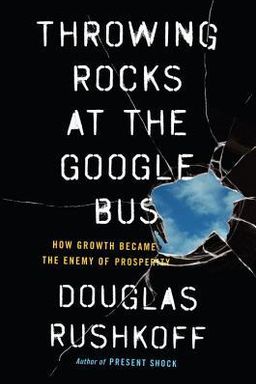
Why does every successful digital company seem fated to metastasize—from a friendly startup to a monopolistic empire? Douglas Rushkoff argues that it isn’t because founders lose their moral compass, but because they are caught in the growth trap: a systemic imperative built into our economic operating system. In this worldview, growth is not a choice but a mandate. Companies must expand valuations to satisfy investors, wages depend on perpetual productivity gains, and even your 401(k) assumes stock prices will rise indefinitely.
Rushkoff frames digital capitalism as a set of coded instructions. Every system, from corporate charters to stock markets and monetary policy, runs on a software layer whose prime directive is extraction and expansion. The result is an economy that grows faster than it circulates value—an architecture tilted toward accumulation rather than human well-being.
The Growth Imperative and Its Cultural Consequences
The "grow or die" command is visible everywhere: Twitter’s modest profits condemned as failure because investors wanted exponential returns, Uber’s endless push for market dominance despite losses, and startups optimizing products not to serve people but to capture engagement. Digitization accelerates this dynamic. A single viral moment can reach global scale overnight, amplifying winner-take-all effects and freezing capital in inflated valuations. Deloitte data show profit ratios falling while accumulated assets stagnate in stock markets—capital without productive use.
For cities such as San Francisco, the social effects are tangible: housing inflation, displaced residents, and protests against tech buses are symptoms of a digital economy that mines local value for distant shareholders. You see jobless recoveries where automation and data metrics outpace employment, reshaping entire labor markets into precarious gig roles and clickwork economies.
Human Erosion in the Machine Logic
This obsession with efficiency has a dehumanizing side. From industrialism to algorithms, the system has treated people as inefficiencies to eliminate. Receptionists become phone trees, drivers become autonomous vehicles, and meaningful service is replaced by frictionless transactions. Rushkoff calls it the "dumbwaiter effect": technologies that make human labor invisible also make human suffering invisible. The convenience you experience hides the webs of low-wage labor, pollution, and data exploitation beneath the surface.
Yet the digital medium also contains its cure. The word digital comes from digits—fingers, touch, human interaction. Peer-to-peer models such as Bandcamp or eBay show how technology can reconnect buyers and creators, amplifying local, relational economies rather than erasing them. The design choice—what a system optimizes for—decides whether digital tools empower people or extract from them.
Platforms, Data, and the New Extraction Frontier
Digital platforms promise democratization but often deliver centralization. Instead of restoring the vibrant bazaar, algorithmic systems create steep power-law economies where a handful of winners capture nearly all attention and profit. iTunes, Spotify, or Amazon rank content globally, making most creators invisible while rewarding a microscopic elite. The supposed long tail collapses into a short head.
Meanwhile, a new asset class emerges: data and attention. Every like, click, or scroll becomes monetizable behavioral capital. Instagram and Snapchat once reached massive valuations with zero revenue precisely because of this data potential. You become the product—your engagement mined, analyzed, and sold—while platforms use surveillance to manipulate your habits. (Facebook’s emotional-contagion experiment exposed this dynamic starkly.)
Rushkoff contrasts this with direct-connect models such as Amanda Palmer’s Kickstarter, where fans fund artists directly, or data-dividend proposals from Jaron Lanier that seek fairer participation in the data economy. The broader principle: value should return to participants, not vanish upward into capital.
Recoding the System
Rushkoff’s key message is pragmatic: you can reprogram the economy. Systems are not natural laws but designs written by humans. He urges you to think like a coder—question default assumptions, examine incentives, and rewrite architectures. Distributed cooperatives, benefit corporations, community currencies, and decentralized protocols offer paths toward circulation instead of extraction. The same code that powers a blockchain or social network can be rewritten to privilege sharing, participation, and stability.
Core Insight
Digital capitalism is not a fate—it is a program. You have the agency to debug it, redesign money and corporations for longevity, and bring human values back into the code.
Across the book’s arc—from startup culture and financial algorithms to blockchain experiments and local currencies—Rushkoff recasts the economy as an editable script. When you learn to see its code, you can choose circulation over hoarding, relationships over extraction, and sustainability over infinite growth.