
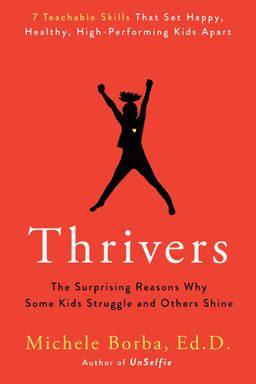
Thrivers cover

Thrivers

by Michele Borba

Michele Borba''s ''Thrivers'' explores why some children excel while others struggle in today''s competitive world. It emphasizes the importance of empathy, curiosity, and talent nurturing over mere academic achievement to foster true happiness and success.

Turning Strivers into Thrivers

What if success, as we define it today, is actually harming our children? In Thrivers, psychologist Michele Borba challenges the cultural fixation on achievement, grades, and résumé-building that leaves young people anxious, lonely, and burned out. Drawing from groundbreaking research on resilience and child development, she argues that real success—the kind that allows kids not just to strive but to thrive—comes from nurturing seven essential Character Strengths: self-confidence, empathy, self-control, integrity, curiosity, perseverance, and optimism.

Borba’s mission began after hearing teenage Eva, a 16-year-old honors student waking up at four each morning to train for swim meets and study until midnight, describe her exhaustion and fear of failure. When Eva landed in the hospital for severe depression, Borba realized this wasn’t an isolated story but part of a generational crisis. Across interviews with hundreds of students, she found the same refrain: “We’re stressed, empty, and never good enough.” And so she launched this book to help parents and educators reimagine how to raise resilient, whole children.

Raising Whole Humans, Not Perfect Test-Takers

At its heart, Thrivers calls for a radical shift from academic overachievement to character-based flourishing. Borba warns that our obsession with scores and competition has created a generation of students who are “beautifully wrapped packages missing the gifts inside.” She points to the epidemic of anxiety, depression, and loneliness among young people—even affluent, high-performing ones—as evidence that cognitive ability alone cannot predict life success. What truly matters are mental and moral traits: compassion, self-awareness, grit, optimism, and integrity.

Through stories and science, Borba reminds readers that while intelligence may open doors, it’s character that sustains lifelong fulfillment. The seven Character Strengths she outlines are not innate—they can and must be intentionally taught and modeled. They are protective factors, helping children weather adversity and maintain a sense of joy and purpose.

The Science of Thriving

Borba’s approach mirrors decades of psychological research on resilience, beginning with Emmy Werner’s landmark longitudinal study in Kauai. Werner found that one-third of children raised in poverty or trauma grew into competent, caring adults because they developed key social-emotional traits and had at least one caring adult champion in their lives. That foundation—heart, mind, and will—creates what Borba calls the Character Advantage, a set of inner resources that help kids grow stronger through challenges rather than crumble.

Character, according to Borba, is dynamic and teachable. It’s not about perfection or moral lecturing but everyday modeling—what parents and teachers do far more than what they say. Integrity, empathy, and optimism are like muscles: they grow through repetition, guidance, and positive reinforcement. When schools and families emphasize these strengths alongside academics, students perform better academically and emotionally—because thriving amplifies capacity for achievement, not the other way around.

The Seven Strengths That Build Thrivers

Each chapter explores one of the seven Character Strengths. Self-confidence helps children understand who they are and find authenticity beyond grades or social validation. Empathy teaches them to connect and care, countering the rise of narcissism and loneliness. Self-control builds focus and emotional regulation, the foundation for lifelong discipline. Integrity gives kids a moral compass to do what’s right, even when no one is watching. Curiosity fosters creativity and resilience in an uncertain world. Perseverance helps them face failure with courage and endurance. And optimism sustains hope—the antidote to the pervasive fear and cynicism of our times.

Each strength interlocks with the others, amplifying their impact in what Borba calls the Multiplier Effect. For instance, Self-Confidence plus Empathy builds compassionate leadership, while Perseverance plus Optimism fuels passion-driven success. Through the right parenting and teaching habits, every child can cultivate this resilient mosaic of traits—forming what Borba calls the “complete package of heart, mind, and will.”

Why It Matters Now

Borba argues that the urgency couldn’t be higher. Generation Z, she writes, is growing up in an era of social isolation, information overload, fear-based media, and runaway perfectionism. In affluent communities, this translates into a subtle emotional poverty—kids have everything except the tools to enjoy it. Across socioeconomic lines, young people struggle to connect, cope, and find meaning. Parents, she insists, must shift from being managers to mentors: reducing the pressure to perform and increasing the space to grow character.

More than a parenting manual, Thrivers is a cultural wake-up call. It challenges adults to reconsider what “success” really means and to prioritize raising happier, ethical, and emotionally healthy human beings—not just achievers. It invites readers to build homes and schools where confidence, compassion, and courage flourish, replacing burnout with balance and emptiness with purpose. “Character is destiny,” Borba reminds us, quoting Heraclitus. “And now is our chance to help our children find theirs.”


Self-Confidence: Knowing the Real You

Borba begins her journey toward thriving by redefining self-confidence—not as inflated self-esteem, but as a quiet, authentic awareness of your strengths, weaknesses, and purpose. Rather than telling children they’re special for simply existing, she encourages parents to help kids discover who they actually are, what they care about, and what they can do well. “Thrivers focus on who, not what,” she writes, highlighting the danger of confusing self-assurance with external validation.

Character Over Appearance

In a culture obsessed with image—social media likes, résumés, and brands—Borba warns that kids are losing touch with their intrinsic identity. A twelve-year-old named Sky lamented that her peers “strive to be someone else and aren’t comfortable being ourselves.” Many children, she found, define themselves by their grades or sports performance rather than their values or talents. The antidote is helping kids identify Core Assets, a term Borba uses for signature strengths that make each child unique.

These assets can include qualities like kindness, creativity, humor, or perseverance. Parents can spot them by observing when their child displays tenacity (sticking with a task), attention (intense focus), learning speed, eagerness, need, or positive tone. She shares stories of parents who discovered hidden strengths—a boy’s fascination with wolves leading to scientific ambition, or a mother realizing her son’s gift for storytelling when his grandfather encouraged him to “open the story box.” These examples show that confidence grows when adults acknowledge genuine aptitudes instead of forcing achievements.

Purpose Over Perfection

Self-confidence, Borba explains, thrives on purpose. Kids must learn not only what they’re good at but why it matters. She cites psychologist William Damon’s research at Stanford: only 20% of teens have a strong sense of purpose. Without meaning, many “drift from who they are,” trapped in the pursuit of prestige. Reconnecting children to their interests—through mentors, hobbies, and self-directed projects—restores the joy of authentic effort. Whether it’s a violin lesson, volunteering, or a hobby discovered in childhood, these experiences help young people align talent with passion.

Confidence Through Effort

Borba stresses that children build real confidence through mastery, not praise. Participation trophies and constant “You’re so smart!” compliments backfire, creating fragile self-esteem and fear of failure. Supporting Carol Dweck’s “growth mindset” research, she advises parents to praise effort (“You worked hard on that project”) and improvement (“You’re getting better at organizing your ideas”), helping kids see competence as earned. Confidence is like a staircase—they climb it through challenges, not shortcuts.

Perhaps her most touching story is that of Jim Abbott, the baseball pitcher born without a right hand. His father refused to rescue him, choosing instead to teach self-reliance: “Never do for your child what he can do for himself.” With patience and belief, Jim learned to throw with his prosthetic arm, developing mastery and pride. He later said, “Believe in who you can be. Believe in becoming more.” True confidence, Borba concludes, is built on effort, resilience, and self-knowledge—not perfection or praise.


Empathy: The Power of ‘We, Not Me’

Empathy, according to Borba, is the antidote to the rising self-centeredness and loneliness among young people. Where cultural competition fosters isolation, empathy connects hearts and communities. “Thrivers think: We, not Me,” she writes. This isn’t just an emotional skill—it’s a biological, behavioral, and cognitive capacity that can and must be taught.

The Empathy ABCs

Borba divides empathy into three dimensions: Affective Empathy (feeling others’ emotions), Cognitive Empathy (understanding their perspective), and Behavioral Empathy (acting with compassion). When these combine, empathy becomes “empathy in action.” She showcases Barbie Monty’s fifth-grade students, who spent a year researching empathy, reading stories about child changemakers like Trevor Ferrell and Christian Bucks, and creating lessons for younger peers. These children didn’t just talk about empathy—they practiced it by helping homeless people and organizing inclusivity projects.

Teaching Empathy Through Action

Empathy flourishes through face-to-face connection. Borba cites a decline in emotional literacy because of digital distraction—kids who can text emojis but can’t read facial expressions. She recommends simple daily practices: naming emotions (“You look frustrated”), modeling compassionate listening, and encouraging gratitude rituals like family “thankfulness circles.” Another proven method is having children volunteer directly with those they’re helping, such as donating blankets to shelters or reading to seniors. Direct human interaction activates empathy far more deeply than abstract charity.

The Ripple Effect of Care

Empathy creates courage. Borba’s examples are moving—like the true story of Keanon Lowe, a football coach who disarmed an active school shooter by hugging him instead of attacking. “Obviously, he broke down,” Lowe said. “I just wanted him to know I was there for him.” Empathy doesn’t just prevent cruelty; it transforms fear into connection. Children who learn to care experience less burnout, more purpose, and greater happiness.

Empathy, Borba insists, can be taught at any age, and it’s the cornerstone of thriving relationships. It moves kids from “Me” to “We”—reminding them that success without humanity is just emptiness in disguise.


Self-Control: Thinking Straight Under Pressure

Every successful life depends on learning to manage emotions, impulses, and focus. Borba reveals that self-control, not IQ, predicts success better than any measure of intelligence. It’s the strength that helps children put the brakes on temptation, regulate stress, and stay grounded when things get tough.

The Tools of the Mind

Through the example of Tools of the Mind, an innovative preschool curriculum, Borba shows how teaching planning and self-regulation early builds lifelong discipline. In these classrooms, four-year-olds create “Play Plans” before building or reading, helping them set goals and focus attention. Instead of rewards or punishments, teachers train children to self-monitor with mental reminders like “My three things: stand in line, count to ten, sit down.” These lessons, she explains, cultivate inner motivation rather than dependency on adult control.

Why Self-Control Is Declining

Technology, overscheduling, and lack of sleep have eroded children’s ability to pay attention. Digital multitasking—switching between apps and screens—reduces focus and creativity. “Our kids are suffering from information overload,” Borba warns. Play deprivation and the push for early academics have stripped away crucial developmental time for self-regulation. True growth, she argues, happens in free play and rest, not endless supervision.

Practicing Calm and Focus

Borba teaches the ACT method: Assess stress triggers, Calm down using deep breathing, and Talk positively to yourself. These steps give children practical ways to reduce anxiety and regain composure. She draws from Navy SEALs who use affirmations like “I got this” to stay calm under pressure. Teaching kids to breathe slowly and self-talk helps them manage their reactions instead of being ruled by them.

Letting Kids Steer

Finally, Borba urges parents to hand kids the wheel. Overparenting, she argues, prevents self-control. Children must learn to make decisions, mistakes, and recover independently. A father’s motto captures the essence: “Never do for your child what he can do for himself.” Learning autonomy builds confidence. Like Olympian Michael Phelps—who transformed his hyperactivity into discipline through swimming—kids thrive when given tools to direct their energy, not when adults micromanage every move.


Integrity: Doing What’s Right When No One’s Watching

In a world saturated with scandals and shortcuts, Borba reminds us that integrity—the art of acting ethically even under pressure—is the backbone of resilience and respect. “Thrivers have a moral code and stick to it,” she writes. Integrity gives children direction when adults aren’t there to guide them, helping them choose honesty, responsibility, and courage over convenience or fear.

Stories That Shape Character

Borba illustrates integrity through history and everyday heroes. In Kansas, teacher Norm Conard’s students uncovered the hidden story of Irena Sendler, who smuggled 2,500 Jewish children out of the Warsaw Ghetto. When asked why she risked her life, Sendler replied, “I was just being decent.” This humility and decency, Borba says, are the essence of integrity: doing right because it’s right, not for applause.

She also celebrates Malala Yousafzai’s moral courage against Taliban oppression, Hugh Thompson Jr.’s refusal to obey immoral orders at My Lai, and families who create “honesty mottoes.” These stories, she notes, show that integrity flourishes when modeled. Children learn ethics from observing parents and mentors—not lectures or punishment.

Teaching Integrity at Home

Parents can cultivate integrity through the TEACH method: Target moral touchstones, Exemplify good behavior, Accentuate with a family motto, Catch and name virtue in action, and Highlight it daily. For instance, the “Honest Dunns” family repeatedly reinforced their motto until their daughter said, “My parents said it so much, we became it.” Repetition builds identity; integrity becomes who the child is, not just what they do.

Finding Your Moral Voice

Integrity also means finding courage to speak up. Using Socratic questioning, Borba encourages families to discuss difficult topics—fairness, responsibility, moral decisions—so kids learn to articulate values and defend their views respectfully. When children understand why kindness matters or why honesty builds trust, they internalize ethics instead of obeying from fear. “You can’t raise ethical kids by accident,” Borba insists. “Integrity must be intentional.”


Curiosity: Thinking Beyond the Box

Curiosity fuels innovation, adaptability, and joy—the very qualities kids need in a fast-changing world. Borba’s chapter bursts with examples of young inventors: a 13-year-old designing a car seat safety sensor, another developing a vibrating cane for the visually impaired. These are not prodigies but children who were allowed to question and tinker.

The Four P’s of Curiosity

Drawing lessons from MIT’s Media Lab, Borba outlines four pillars to spark curiosity: Peers (collaboration across disciplines), Passion (finding joy in projects), Projects (hands-on creation), and Play (learning through exploration). These principles turn classrooms and homes into creative studios where failure is part of discovery. “Great ideas don’t come from playing safe,” she quotes MIT’s Frank Moss. Real learning happens when adults step back and let kids struggle, imagine, and invent.

Overparenting Kills Wonder

Borba warns that modern parenting often replaces curiosity with control. Rigid schedules, excessive rules, and constant rewards suffocate exploration. She urges families to reclaim downtime—unplugging technology, encouraging tinkering spaces, and accepting moments of boredom. Her acronym C-U-R-I-O-U-S highlights the qualities of child-driven, unstructured, open-ended learning that sparks genuine interest.

Teaching Problem-Solving

Curiosity thrives on problem-solving. Borba’s SPARK method—Say the problem, Positives only, Add on ideas, Rapid-fire, Keep storming—helps children brainstorm creative solutions. She recounts her experience coaching “Odyssey of the Mind” teams, teaching kids to build plays, sing songs, and fix tree extinction through collaboration. Years later, one student returned to thank her: “Odyssey helped us discover our creativity. It taught us to work together to solve problems we cared about.” Curiosity, Borba concludes, is not about IQ—it’s about imagination married to purpose.


Perseverance: Grit with Heart

Every dream requires endurance. Borba defines perseverance as the steadfast resolve to keep going when giving up seems easier. This strength, powered by resilience and grit, is what separates Thrivers from Strivers. She introduces teens from Outdoor Odyssey Leadership Academy who discover courage by rock-climbing, rafting, and problem-solving without adult rescue. “You learn you’re stronger than you think,” one teen said.

Growth Through Adversity

General Tom Jones, the camp founder, teaches that progress happens when youth step outside comfort zones. Facing real risk under supervision builds confidence, not fear. Like Angela Duckworth’s research on grit, Borba emphasizes that perseverance predicts long-term success better than IQ or talent. “The grittier—not the smarter—succeed,” Duckworth found. Perseverance can be strengthened through what Borba calls a growth mindset, goal-setting, and learning from mistakes.

Learning from Failure

To teach perseverance, parents must stop rescuing kids from failure. Each struggle is a chance to stretch determination. Children learn that mistakes aren’t fatal when adults model recovery—“I burned dinner, but learned to check the oven.” Borba suggests “turnaround plans,” “bounce-back statements,” and praising effort instead of perfection. “Never do for your child what your child can do for himself,” she reminds. Without adversity, resilience cannot bloom.

The Hard Thing Rule

To cement perseverance, Borba cites Angela Duckworth’s family principle: everyone chooses one hard thing to practice daily. Quitting is allowed only at natural stopping points. This develops self-discipline and accountability for parents and children alike. Stories like Michael Jordan’s family upbringing—equal parts demanding and supportive—show how perseverance becomes a “superpower.” In his mother’s words: “If you haven’t failed, you’re not trying hard enough.” Perseverance, Borba concludes, is the will to finish what you start and the courage to begin again.


Optimism: Choosing Hope Over Fear

In anxious, fear-driven times, optimism is both shield and superpower. Borba explores how constant exposure to frightening news—from school shootings to pandemics—breeds hopelessness in children. One out of three, she notes, believes Earth might not exist when they grow up. The antidote is teaching kids that hope is learnable.

Reframing Fear

Borba begins with a simple but powerful exercise: “Shrinking worries.” In a second-grade classroom, she watches teacher Mrs. Sandler guide nervous students to put their fears into progressively smaller boxes until they become manageable. “You can shrink a worry,” Sandler tells them. This cognitive reframing, aligned with Aaron Beck’s and Martin Seligman’s research, helps kids see setbacks as temporary, not permanent—a cornerstone of optimism.

The CALM Method

Optimism grows through self-advocacy and calm confidence. Borba teaches the CALM framework: Chill (manage emotion), Assert (speak up), Look strong (show confidence), Mean it (use a firm tone). These steps empower children to face adversity and stand their ground in friendship, school, or crisis. Confidence breeds control, and control feeds hope.

Modeling Hope

Parents are the first “hope models.” Borba recalls British families during the Blitz who sang “Life is good; we’ll get through anything” even as bombs fell. Optimistic adults, she writes, transmit stability through their reactions. Fred Rogers’s advice—“Look for the helpers”—captures this perfectly: show children examples of kindness and courage amid darkness so they believe the world is still good.

Renewing Faith in the Future

Through stories like Ruby Bridges walking into a segregated school protected only by her optimism and prayer, Borba reminds us that hope is an active strength. It transforms fear into resilience and despair into purpose. “You can’t give up on kids,” a young boy tells her at the end of the book. Optimism, Borba concludes, is the flame that helps every Thriver see possibility in chaos—and light the way for others.

Dig Deeper

Get personalized prompts to apply these lessons to your life and deepen your understanding.

Go Deeper

Get the Full Experience

Download Insight Books for AI-powered reflections, quizzes, and more.