
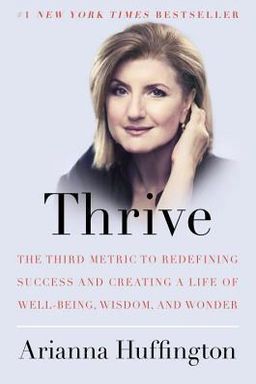
Thrive cover

Thrive

by Arianna Huffington

In ''Thrive,'' Arianna Huffington argues for a new definition of success, one that values well-being, wisdom, wonder, and giving. By moving beyond the traditional metrics of money and power, readers can achieve true fulfillment and enhanced productivity. Discover actionable insights to transform stress into strength and cultivate a life of joy and purpose.

Redefining Success Through the Third Metric

What does it mean to live a successful life? Arianna Huffington’s Thrive begins with a collapse—her own—in 2007, which made her question the conventional equation of success with money and power. This crisis becomes a universal mirror: how many of us are running on empty, sustained only by caffeine, stress, and external validation? Huffington argues that the culture of workaholism, digital distraction, and sleeplessness has led us to mistake achievement for thriving.

Her answer is the Third Metric, a framework that expands life’s scorecard beyond wealth and status. The Third Metric rests on four pillars—well-being, wisdom, wonder, and giving—each reinforcing the other. Together they propose a three-legged stool of success, stable where money and power alone would topple.

Why We Need a Third Metric

Huffington points out that burnout has become a global epidemic—“civilization’s disease.” Across nations, stress and mental health costs are soaring. In the U.S., sleep deprivation alone undercuts creativity, decision making, and empathy. Chronic stress shortens life spans and drains the very human capital on which all success depends. Huffington’s metaphor—a banker overdrawn on his health account—captures this imbalance.

By redefining success, the Third Metric invites you to balance ambition with emotional and physical sustainability. When well-being becomes nonnegotiable, you protect not only yourself but also the organizations and relationships that rely on your clarity and compassion.

The Four Pillars in Practice

Well-being restores the physical bedrock of health—sleep, rest, and recovery—as a foundation for performance. Wisdom is not intelligence but discernment: the ability to step back, listen inwardly, and choose your priorities. Wonder reconnects you to awe, beauty, and meaning, whether through nature, art, or everyday presence. And Giving roots flourishing in compassion rather than competition. When these pillars work together, you move from surviving to thriving.

Each pillar is illustrated through stories: from executives who reinvented life after burnout to astronauts describing the “overview effect.” In Huffington’s interviews and examples—from Aetna’s wellness programs to mindfulness in Silicon Valley—success looks less like exhaustion and more like equilibrium.

A Cultural Shift, Led by Women but for All

The author also situates the Third Metric within a larger social transformation. The current model of success emerged from workplaces designed for men unburdened by caregiving roles. As more women ascend to leadership, they are driving a cultural correction—toward flexibility, empathy, and health as strategic imperatives. Yet, Huffington insists this is not a “women’s issue”: both sexes suffer under unsustainable norms and both gain from redefining success.

Practical Pathways to Thrive

Huffington treats transformation as incremental. She argues for “micro-adjustments”: turning off devices at night, creating ritualized sleep boundaries, taking pauses for silence, meditating, practicing gratitude, and performing small acts of giving. These daily disciplines form a scaffolding of presence that recalibrates your life one decision at a time. The question she invites you to ask often is simple yet radical: “What will my eulogy emphasize?”

Core insight

Success without well-being is failure by a slower name. Thriving means achieving while sustaining yourself—and others—in the process.

By embracing the Third Metric, you replace external metrics of value with inner measures of fulfillment. You stop living as if exhaustion proves worth and begin to measure success by vitality, connection, and contribution. In doing so, you recover the balance that modern life forgot but your body, mind, and spirit still crave.


Well-Being and the End of Burnout

Burnout is the invisible tax of modern achievement. Huffington exposes it as not just a personal issue but a systemic one—rooted in workplaces that glorify overwork and treat rest as optional. She calls it civilization’s disease, citing research from Carnegie Mellon, the Benson-Henry Institute, and the CDC showing dramatic global rises in stress-related illness.

The Hidden Costs of Success

The health toll is enormous: sleep-starved employees make poorer decisions, empathize less, and consume more healthcare. For women, the burden is disproportionately high—stress in high-responsibility roles correlates with a 40% higher risk of heart disease and 60% higher diabetes risk. Collective burnout drains economies as much as individuals. Huffington uses these numbers to dismantle the myth that long hours equal loyalty or productivity.

Rethinking Health as Human Capital

You are your organization’s most valuable capital, she argues. When you compromise sleep and well-being, you’re effectively withdrawing from your own “health bank account.” Companies like Safeway and Aetna prove the payoff of reversing this mindset: wellness incentives, yoga, and meditation reduced costs and improved output. Leaders like Aetna’s CEO Mark Bertolini became advocates after personal awakenings to well-being’s business value.

From Time Famine to Restoration

Research by Leslie Perlow on “time famine” shows how ceaseless hurry erodes creativity and judgment. Huffington connects this to our “badge of busyness” culture where exhaustion earns admiration. The antidote lies in replacing scarcity with sufficiency—ensuring recovery time, flexible schedules, nap spaces, and digital boundaries. Ordinary employees and CEOs alike find that when rest is respected, performance improves.

Huffington reminds you that taking care of your health is not self-indulgence; it’s self-respect—and organizational intelligence in action. The more rested and balanced you are, the more you can give, decide, and lead effectively.


The Science of Sleep and Restoration

Sleep, Huffington writes, is the simplest high-return investment you can make. Long mocked as laziness, it is now recognized by science as the engine of cognitive clarity, emotional balance, and physical repair. Her argument is as strategic as it is physiological: you cannot thrive when you’re half-awake.

How Sleep Fuels Success

Neuroscience validates its importance. Harvard’s sleep labs show that rest consolidates memory and learning while the brain’s glymphatic system clears toxins during deep sleep. Chronic deprivation, by contrast, damages metabolism and heart health, reduces empathy, and undermines decision-making. One study she cites found that an extra hour of sleep raises happiness more than a large income increase—a data-backed challenge to typical career logic.

Athletes and Evidence

Sports research makes the point tangible: Stanford studies by Cheri Mah show that when athletes extend sleep, performance metrics—from shooting accuracy to reaction time—rise measurably. Elite competitors from Kobe Bryant to entire NFL teams adopt sleep as a training variable. If sleep determines physical precision, why wouldn’t it shape executive decisions or creative output?

Building a Sleep-Positive Culture

Huffington translated the science into action through her “Sleep Challenge,” encouraging readers and companies to design sleep rituals: set bedtime appointments, remove screens from bedrooms, replace late-night emails with rest rituals, and treat naps as refueling rather than weakness. Such behavioral architecture reframes rest as performance strategy, not indulgence.

Key takeaway

Sleep is not the enemy of success; it is its engine. Protecting it protects your wisdom and your work.

(Note: Huffington frames sleep as a feminist act because women often shoulder domestic labor after professional hours. Making rest a right rather than a luxury is a quiet revolution—one that restores both health and humanity.)


Managing Digital Life and Finding Stillness

We live in what Huffington calls the digital Garden of Eden—where the serpent is constant connectivity. Technology promises convenience but often steals presence. Studies by McKinsey show that knowledge workers spend 28% of their time on email, and neuroscientists now identify “email apnea,” the unconscious breath-holding when reading messages. This perpetual alarm shortens attention spans and amplifies stress.

Reclaiming Attention

Linda Stone’s term “continuous partial attention” captures how devices fracture focus. Huffington reframes digital boundaries as moral hygiene: turning off notifications is an act of self-mastery. Companies model this change—Volkswagen disables emails after hours; FullContact pays bonuses for unplugged vacations; Sheryl Sandberg leaves work at 5:30. The message is consistent: if you want a life, you have to protect it from your phone.

Cultivating Silence as Inner Space

Silence, Huffington says, is not absence but presence restored. During her retreats on Rhodes with monks, she discovered that quiet attention nourishes insight. Quoting Hermann Hesse—“Ask your soul!”—she links modern mindfulness to ancient contemplative traditions, all teaching the same lesson: when you stop broadcasting, you hear guidance. In a noisy world, stillness becomes leadership’s underrated superpower.

Simple rituals—a nightly phone curfew, morning breaths before notifications, five minutes of meditation—become anchors against fragmentation. Silence is not withdrawal; it’s renewal.


Wonder, Art, and the Power of Perspective

If well-being restores energy and silence restores clarity, wonder restores meaning. Huffington calls it the stance of astonishment at existence itself—the antidote to numbness. Ancient and modern voices, from Aristotle to astronauts, agree that wonder is the seed of wisdom. The Apollo astronaut Edgar Mitchell called his space view of Earth an “overview effect”—a sudden, humbling awareness of connection.

Everyday Awe

Wonder doesn’t require exotic experiences. It hides in the ordinary—a rainy Munich morning, a child reaching for a star. The difference lies in attention. When you slow down, the mundane becomes luminous. Research cited in the book aligns: awe decreases self-focus and boosts well-being. The Harvard Grant Study’s decades-long data distilled to “Happiness is love. Full stop.”—demonstrates that awe and connection are bound together.

Art and Museums as Portals

Museums, Huffington suggests, are sanctuaries for wonder. Her daughter Isabella once spent two hours absorbed in Turner’s The Fighting Temeraire, feeling “runner’s high” through focused attention—proof that art can change consciousness. Yet technology risks flattening such encounters into content. Sherry Turkle warns: photographing before seeing turns experience into souvenir. The book urges mindful technology design—LACMA’s digital tools, MoMA’s courses, and Rijksmuseum’s remix studio show tech can deepen, not dilute, engagement.

Learning to look deeply—without multitasking—builds the same muscle that allows you to see beauty in ordinary life. Wonder, therefore, is practical: it reconnects you with gratitude and the sacredness of time.


Giving and the Science of Compassion

Huffington’s final pillar, giving, completes the circle of thriving. Generosity, she argues, is not only moral but biological: it changes your chemistry and extends your life. Paul Zak’s studies on oxytocin show that acts of giving increase empathy and resilience. Harvard research quantifies it literally—the happiness boost from donating or helping rivals a substantial income raise.

Why Giving Enriches You

Volunteers report lower stress, stronger immunity, and even longer lifespans. Seniors who serve experience reduced depression and sharper cognition. These benefits ripple into workplaces, where employees who give become more engaged and loyal. Giving connects you to abundance rather than scarcity, shifting your mindset from competition to contribution.

Stories of Connection

The book illustrates giving through lived stories. Isabella Huffington’s act of sharing gifts with a disadvantaged child shows empathy learned by example. Ray Chambers redirected his business acumen to philanthropy, founding Malaria No More. Jacqueline Novogratz’s “blue sweater” story—a donation found years later in Rwanda—embodies how generosity loops across lives and continents.

How to Give Sustainably

  • Start small and consistent—weekend volunteering or daily kindness builds identity.
  • Match strengths to service—use professional skills via platforms like Catchafire.
  • Leverage digital giving—GlobalGiving and DonorsChoose connect you to direct impact.

Giving is the paradox of thriving: in extending life to others, you enlarge your own. As neuroscience and narrative converge, generosity emerges not as extra credit but as the essential rhythm of a flourishing life.


Facing Mortality and Living Fully

In one of the book’s most intimate sections, Huffington insists that thriving requires remembering death. The Latin memento mori—“remember you will die”—is not morbid but clarifying. When you accept mortality, priorities reorder naturally: love, forgiveness, and presence rise above status and speed.

Death as Teacher

Philosophers from Socrates to Marcus Aurelius saw death-awareness as life’s true discipline. Modern voices like Joan Halifax and Elisabeth Kübler-Ross echo them, framing proximity to death as a creative force that intensifies living. Huffington’s account of her mother’s final day—dying at home amid music, food, and family—embodies how facing death restores meaning. The bench engraved with her mother’s words, “Don’t Miss the Moment,” crystallizes the ethos of the entire book.

A Social Movement for Awareness

Modern initiatives—Death Cafes, The Conversation Project, threshold choirs—invite communities to speak openly about mortality. Talking about death early brings people closer, not darker. The act of planning your final wishes becomes a way of designing your life with intention.

Huffington concludes that remembering we’re all terminal frees you from trivia. When you live with that awareness, you don’t postpone joy or generosity—you practice them now.

Dig Deeper

Get personalized prompts to apply these lessons to your life and deepen your understanding.

Go Deeper

Get the Full Experience

Download Insight Books for AI-powered reflections, quizzes, and more.