
Idea 1
Awakening the Mind: Buddhism Meets Psychotherapy
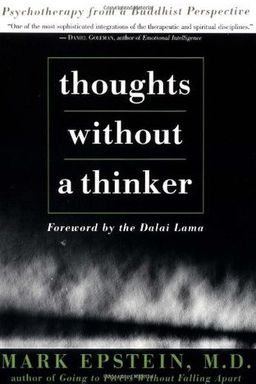
Have you ever wondered why, even when life looks good on paper, there’s still that faint whisper of unease—that sense that something is missing or incomplete? In Thoughts Without a Thinker, psychiatrist and Buddhist practitioner Mark Epstein explores this pervasive human tension. He argues that the source of our suffering lies in a fundamental misperception of self: we take our inner world of thoughts, cravings, fears, and identities to be solid and permanent when, in fact, they are fluid and insubstantial. The path to healing, he suggests, isn’t about fixing or improving this self, but about seeing through it.
Epstein contends that Buddhism and modern psychotherapy, when woven together, offer a powerful way to understand and transform the mind. Where Freud reached deep into the unconscious to reveal hidden desires and conflicts, the Buddha delved into consciousness itself and discovered that there was no permanent self to crave, defend, or define. Both, in their own ways, help us confront our illusions. Together, they create a framework for true liberation—one that brings emotional honesty, compassion, and mindful awareness to the heart of our psychological struggles.
Two Systems, One Goal
Epstein invites you into the ancient mirror of Buddhist psychology as it meets the clinical clarity of psychoanalysis. Buddhism offers the Four Noble Truths, which diagnose the cause of human dissatisfaction (dukkha) and reveal how liberation arises from insight into craving and selflessness. Freud, meanwhile, unearthed the mechanisms of repression, transference, and desire that drive the human psyche. Both disciplines, Epstein argues, describe how we hide from ourselves—and both point toward the same awakening: self-knowledge so deep that the self itself dissolves.
In this synthesis, Epstein suggests that psychotherapy provides the safety and language to explore personal wounds, while meditation trains the quality of awareness that sees beyond the self's drama. Therapy helps you remember; meditation helps you release. The combined practice allows you not only to understand your pain but to work through it without clinging or avoidance. The ultimate goal is the Buddha’s version of healing: not happiness through perfection, but freedom through insight.
From Suffering to Awareness
Epstein’s model begins with an honest acknowledgment of suffering. Borrowing from the Buddha’s First Noble Truth, he reframes dukkha—not just as physical or emotional pain, but as an existential insecurity embedded in our attempts to be someone. Whether it’s humiliation, longing, or alienation, our discomfort arises from how tightly we cling to an idea of who we are supposed to be. The task is not to eliminate these experiences, but to recognize their nature. Like the Buddha sitting beneath the Bodhi tree, we must face the truth of our craving and discover that release lies not in fulfillment but in insight.
Where therapy historically focused on reconstructing a stable self (what Winnicott called the “True Self”), Epstein suggests a deeper evolution: seeing that even the True Self is a concept. What matters isn’t finding a better identity, but cultivating the courage to rest in the groundlessness beneath all identities. You stop asking, “Who am I, really?” and begin observing, with mindfulness, how that question itself keeps the illusion in motion.
A Path of Integration
Throughout Thoughts Without a Thinker, Epstein illustrates this integration through vivid frameworks and stories—from the Buddha’s Wheel of Life, describing six psychological realms of existence, to Freud’s three-part therapeutic process: remembering, repeating, and working through. Meditation and therapy, he writes, both require courage to sit still and confront what we habitually avoid. Both uncover patterns of craving and defense. And both culminate not in transcendence outside life, but in fuller participation within it.
In the end, Epstein’s synthesis invites you to a new kind of spiritual psychology—one that neither idolizes the self nor erases it, but learns to hold it lightly. Through mindfulness (bare attention) and compassionate awareness, you discover that even the most painful thoughts and emotions are empty of solidity yet full of vitality. When the “thinker” releases its grip on “thoughts,” what remains is a vivid, liberated mind—a mind awake.