
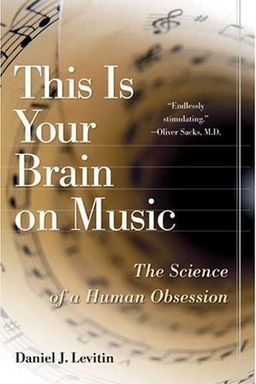
This Is Your Brain on Music cover

This Is Your Brain on Music

by Daniel Levitin

In ''This Is Your Brain on Music,'' Daniel J. Levitin, a musician and neuroscientist, explores the profound impact of music on the human brain. Discover the evolutionary roots of our musical instincts, how music evokes memories, and why certain tunes move us emotionally. Levitin''s insights reveal music''s intricate relationship with cognition and emotion, enhancing our appreciation for this universal human experience.

How Your Brain Makes Music

What makes music feel so familiar, so instantly meaningful, and so deeply tied to emotion? In This Is Your Brain on Music, Daniel Levitin argues that music isn’t a mysterious cultural luxury—it’s a fundamental cognitive function built into how your brain perceives, predicts, and remembers patterns. From the raw vibrations of air to the chills you feel at a key change, music recruits almost every part of your brain, blending perception, memory, emotion, and motor control into a single, unified experience.

Levitin, a former record producer turned neuroscientist, uses examples that range from Stevie Wonder’s high-hat groove to Ravel’s Bolero to show that the pleasure you get from music rests on the brain’s machinery for pattern recognition and expectation. Your brain dissects music into separate elements—pitch, rhythm, timbre, loudness, spatial position—and then recombines them, forming perceptual objects like melody and harmony. These objects are stored and recognized through complex memory systems that intertwine emotion, prediction, and learned schemas.

From Sound to Structure

Sound begins as vibration but becomes percept when your brain converts frequency into pitch, timing into rhythm, and overtone structure into timbre. The auditory cortex maps frequencies tonotopically like a piano keyboard, while subcortical structures like the inferior colliculus help track timing and pattern. This transformation lets you group sounds intuitively: you hear a melody rather than disjointed notes, a drummer’s groove rather than isolated hits, a singer’s tone rather than pure frequency content.

The Predictive Brain

Levitin shows that musical pleasure arises from the same predictive circuitry that guides everyday thought and movement. As you listen, your brain constantly forecasts what’s coming next—when a beat will drop, when a harmony will resolve—and you feel reward when those predictions are met or artfully violated. This moment-by-moment dance between expectation and prediction recruitment activates your dopamine system: the nucleus accumbens lights up during pleasurable moments, while the cerebellum and basal ganglia synchronize timing and anticipation.

Memory, Schema, and Surprise

You don’t store individual notes like pixels; you store relations, prototypes, and multi-trace memories of thousands of listening episodes. When you hear something new, your brain compares it to these past traces—recognizing style, chord patterns, or timbres that feel familiar. Composers play on this memory by balancing familiarity with novelty. The pleasure you take from a deceptive cadence, an unexpected syncopation, or a new timbre comes from this tightrope between expectation and surprise.

Emotion, Movement, and Reward

Rhythm and beat tap ancient brain systems. The cerebellum—once thought purely motor—supports timing, emotion, and body synchronization. That’s why you nod your head or tap your foot: your motor circuits join the experience. Through dopaminergic reward systems, music merges motion, timing, and emotional processing, creating the chills, tears, and joy that transcend analysis. These mechanisms, once vital for survival and social bonding, now drive the deep pleasure of listening and performing.

The Cognitive Symphony

Levitin ultimately portrays music as a bridge between art and neuroscience, emotion and computation. Every part of your brain—from brainstem startle pathways to prefrontal prediction networks—plays a part. Music evolved with you: it shaped social groups, aided communication, and trained the neural circuits that handle language, timing, and emotion. Understanding this orchestra of processes doesn’t make music less magical; it deepens your wonder by showing how deeply musicality is written into what it means to be human.


Building Blocks of Sound

Music begins with raw perception. When you hear a note, your brain parses it into component elements: pitch, rhythm, timbre, loudness, and spatial cues. Levitin calls these the elemental ‘atoms’ of musical experience—each one separable and independently processed in the brain.

Pitch and Harmony

Pitch is how you perceive frequency. The basilar membrane in your cochlea breaks sound into bands, and your auditory cortex maps these like keys on a piano. Doubling frequency produces an octave, giving rise to the universal sense of tonal ‘home.’ Western music divides the octave into twelve semitones (equal temperament), allowing transposition and harmonic freedom. The overtone series—integer multiples of a fundamental—determines consonance: simple ratios like 2:1 or 3:2 feel stable, while more complex ones feel tense. This sensory physics underlies why a major chord sounds ‘open’ and a tritone ‘unsettled.’

Rhythm and Tempo

Temporal organization is the other axis of music. Rhythm arranges durations, and meter structures them into patterns (2/4 marches, 3/4 waltzes, or 5/4 progressions like in “Take Five”). Tempo gives absolute pace—the rate of pulse your cerebellum tracks with striking accuracy. Levitin and Cook showed that even nonmusicians recall song tempos within about 4 percent of the recorded value, revealing memory’s surprising precision for timing.

Timbre and the Sound Palette

Timbre distinguishes a saxophone from a violin on the same note. It’s defined by overtone structure, attack, and flux—the way a tone begins, sustains, and changes. Pierre Schaeffer’s experiments revealed that when you remove the attack, instrument identity collapses—confirming how crucial transient cues are to recognition. Producers, from George Martin to Prince, manipulate timbre the way painters use color—changing microphone placement or EQ to shift emotional character.

From Atoms to Musical Objects

Your brain integrates these low-level features into structured objects: chords, melodies, rhythms. Even without theory, you intuit tonal resolution and recognize patterns you’ve absorbed through exposure. Timbre, rhythm, and pitch aren’t independent facts—they weave into one perceptual tapestry. When you recognize a song in seconds, or sense a key change’s emotional pull, you’re feeling your brain’s orchestration of these elemental perceptions into meaning.


Rhythm, Beat, and the Cerebellum

Rhythm isn’t background to music—it’s how your nervous system dances. The brain’s timing network, centered in the cerebellum and basal ganglia, locks onto periodic pulses and predicts when events will occur. This synchronization provides the foundation for groove, emotion, and coordinated movement.

Pulse, Meter, and Groove

A pulse (or tactus) anchors the listener. Composers play with it: Beethoven starts his Fifth with silence before the famous motif; Stevie Wonder’s “Superstition” uses a subtly shifting high-hat to tease your expectations. A good groove balances steadiness and surprise—slight microtiming variations that keep music alive and physically irresistible. Human drummers introduce microdelays and accent shifts computers struggle to replicate, reflecting expressive timing rather than mechanical accuracy.

Neural Timing and Emotion

The cerebellum, once thought purely motor, contains dense connections to limbic and frontal systems, linking rhythm perception with emotion. Damage here can disrupt timing and flatten affect, while stimulation can alter mood and arousal. Lesions reveal hemispheric specialization: left for simple rhythms, right for meter and contour. Evolutionarily, this timing system helped coordinate group movement and signal safety; in music, it produces empathy and shared entrainment.

Startle, Synchrony, and Survival

Early mammals developed direct ear–cerebellum pathways for rapid orienting—the reflex that makes you jump at a sudden cymbal crash. Repeated benign sounds normally evoke habituation; when that mechanism fails, anxiety and hyperarousal follow. Williams syndrome, with enlarged cerebellar volume and high musical affinity, suggests this brain region supports emotional timing as well as rhythmic coordination.

Core idea

Groove is the pleasurable synchrony between your cerebellum’s predictive timing and small expressive deviations—a neural dance where physical movement and emotional response become one.

When you feel compelled to move with music, it’s not coincidence—it’s neural entrainment. The cerebellum’s timing engine synchronizes predictions about pulse and dynamics with incoming sound, generating that irresistible sense of flow known as groove.


Memory, Categories, and Expectation

The way you remember and anticipate music defines your listening experience. Levitin dives into how memory systems store both the literal details of songs and their abstract patterns. He disputes the idea that memory is either a tape recorder or a gist-based summary; instead, it’s both specific and constructive.

Multiple-Trace Memory

Every hearing of a song leaves a trace. When a new one arrives, you compare it to thousands of stored exemplars—a process described in Douglas Hintzman’s MINERVA model. This multi-trace design explains why familiar songs trigger vivid emotion: their sensory fingerprint overlaps with many stored contexts. You may even sing your favorite tune in the correct key years later because absolute pitch, tempo, and timbre information coexist with abstract relational codes.

Schemas and Prediction

Exposure builds schemas—templates of common chord patterns, phrase lengths, and rhythmic expectations. Composers manipulate them through controlled surprise: Haydn’s sudden stops or jazz’s deceptive cadences reveal that emotional power lies in prediction error. The reward system interprets fulfilled or violated expectations as pleasure or tension release, feeding dopamine into the nucleus accumbens when patterns resolve artfully.

Categorization and Chunking

You compress complexity through chunking. Instead of storing each note in a C major chord, you encode the concept of “C major.” Instead of twelve bars, you recall a single blues form. Expert musicians like Richard Parncutt improvise by drawing on these schematic chunks, while experienced listeners identify genres from a few seconds of timbre and rhythm. Through this lens, memory efficiency becomes the foundation for musical fluency.

Music cognition, therefore, depends less on passive recall and more on active reconstruction. What you expect next in a melody or chord change reflects the statistical patterns your brain has internalized through countless exposures—and the joy of music comes from how artists play with, confirm, or subvert those patterns.


Emotion and Reward in Music

Why does a melody give you chills? Levitin and Vinod Menon’s research reveals that music hijacks ancient reward circuits originally evolved for survival behaviors. Pleasure in music is biochemical: it engages dopamine, opioids, and predictive loops between auditory, emotional, and motor regions.

The Reward Circuit

Positron emission tomography and fMRI studies by Anne Blood and Robert Zatorre show activation in the nucleus accumbens, ventral tegmental area, and orbitofrontal cortex during intense musical pleasure. Levitin extends this with connectivity analysis: sensory input flows from auditory cortex to frontal areas (BA44, BA47) for structural analysis, then to the mesolimbic reward network where dopamine spikes accompany musical peaks.

Prediction and Surprise

Music’s emotional rollercoaster emerges from expectation management. Your brain’s oscillatory networks predict timing and harmony; skilled deviations—syncopated hits, delayed entries, unexpected modulations—generate delight by balancing certainty and surprise. It’s the same system that rewards successful problem-solving or humor. (In comparison, David Huron’s work on Sweet Anticipation echoes this principle of expectation-based pleasure.)

Timing, Movement, and Chemistry

The cerebellum and basal ganglia maintain groove while interfacing with emotion. Levitin cites Avram Goldstein’s finding that blocking opioid receptors with naloxone inhibits musical chills—direct neural evidence that endogenous opioids modulate joy in listening. Dopamine release peaks just before expected climaxes, showing the biology of anticipation itself is rewarding.

Neural Symphony

Auditory regions shape perception, frontal lobes forecast structure, cerebellum refines timing, and the limbic system seals the emotional payoff—every thrilling musical moment is a networked chemical event.

Understanding these processes doesn’t diminish beauty. It reinforces that art taps evolutionarily ancient systems—those of timing, empathy, and reward—to make music such a uniquely human pleasure.


Evolution and Musical Expertise

Levitin connects biology to culture by asking: why did humans develop music at all, and what makes some of us experts? He integrates evolutionary theories, training research, and case studies to show that musicality merges nature and nurture—an ancient adaptation honed through deliberate practice.

Evolutionary Pathways

Music’s evolutionary roles are manifold. Darwin proposed sexual selection: musical ability signals intelligence and motor coordination, making it a fitness indicator (Geoffrey Miller extends this in The Mating Mind). Others view it as a social glue—coordinating group behavior and fostering empathy. Archaeological finds of flutes over 30,000 years old and cross-species parallels in birdsong underscore its antiquity. Music likely evolved as both sexual display and communal bonding device.

Becoming Expert: Practice and Plasticity

The “ten-thousand-hour rule,” popularized by Anders Ericsson, applies strongly to music: extended, structured practice produces neural restructuring. Violinists show expanded left-hand cortical maps; absolute-pitch possessors exhibit asymmetry in the planum temporale. Yet body morphology—hand or lung capacity—also shapes instrument choice. Genes influence potential, but sustained effort and good feedback shape mastery.

Expressivity Beyond Technique

True artistry goes beyond precision. Frank Sinatra’s phrasing, Joni Mitchell’s alternate tunings, or Horowitz’s idiosyncratic touch show that emotional intent carries more meaning than technical perfection. Neuroscientifically, expressive timing and dynamic control recruit additional frontal and limbic circuits, explaining how minor deviations convey profound affect.

Why We Love What We Know

Your preferences form through interaction of biology, exposure, and identity. Prenatal listening, childhood enculturation, and teenage social bonding leave indelible traces. The inverted-U curve of liking versus complexity explains taste: you crave balance between predictability and novelty, shaped by what your memory encodes. Thus, musical expertise and preference both express the brain’s long-term adaptation to pattern, timing, and community.

Dig Deeper

Get personalized prompts to apply these lessons to your life and deepen your understanding.

Go Deeper

Get the Full Experience

Download Insight Books for AI-powered reflections, quizzes, and more.