
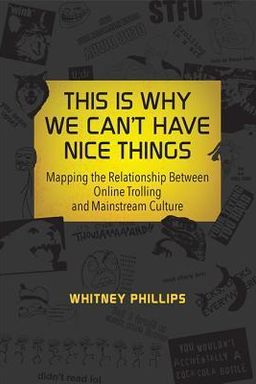
This is Why We Can’t Have Nice Things cover

This is Why We Can’t Have Nice Things

by Whitney Phillips

Whitney Phillips delves into the provocative world of online trolling, uncovering its complex relationship with mainstream culture. This insightful exploration reveals how trolling reflects societal contradictions and influences media and politics, challenging readers to rethink the role of digital provocateurs.

Trolling and the Mirror of Culture

What if the Internet’s most infamous provocateurs were not fringe monsters, but distorted mirrors of the systems the rest of us inhabit? In Whitney Phillips’s study of online trolling, you discover that trolls are not random chaos agents but participants in cycles of media, culture, and ideology that define the digital age. Their behavior reveals the hidden logics of mass communication, entitlement, and emotional detachment that pervade everyday life online.

Phillips argues that trolling is best read as cultural digestion: trolls consume cultural material, remix it, and excrete it back into circulation—vulgar, offensive, but diagnostic of what media systems feed us. This interpretive framework allows you to see trolling not as pathology but as a form of cultural commentary, albeit one often expressed through cruelty.

From Accusation to Subculture

Early Internet users used “troll” as an accusation—someone baiting others on Usenet or AOL. By the mid-2000s, platforms like 4chan’s /b/ board transformed trolling into an identity, united by anonymity, ephemeral posts, and the pursuit of lulz. Phillips shows how this transition—from accusation to self-definition—signals a new cultural form: subcultural trolling. Its members share style, language, and norms centered on ironic detachment.

The Logic of Lulz

Lulz, the pleasure derived from others’ humiliation, becomes trolling’s moral compass. It explains why empathy is inverted into performance and why harm turns into a spectacle. Phillips identifies three interlocking properties of lulz—fetishism (fixating on a single detail, ignoring suffering), generativity (constant remix and amplification), and magnetism (its power to attract attention and participants). Through these mechanisms, trolling sustains itself and merges with the logics of digital media, which also thrive on emotional extremes and visibility.

Trolls and Media Symbiosis

Perhaps Phillips’s most unsettling claim is that trolls and mainstream media operate symbiotically. News outlets amplify outrageous content for viewers and clicks; trolls supply that outrage for free. The infamous “Internet Hate Machine” label on Fox News in 2007 exemplifies this loop: media vilify trolls, trolls feed on the visibility, and both benefit from attention. Projects like Chanology—Anonymous’s anti-Scientology protests—emerged from this mutual exploitation of spectacle.

Emotion, Race, and Cultural Reflection

Phillips expands the analysis beyond pranks to show how trolling mirrors systemic racism, androcentrism, and entitlement. Trolls’ racial slurs and shock humor expose the same anxieties the media and punditry repackage in coded language. Likewise, trolling’s valorization of rational domination over emotional vulnerability repeats Western androcentric traditions—the “adversary method” of argument—where “winning” trumps understanding. These connections force you to see trolling not as an aberration but as an exaggerated echo of offline hierarchies.

Platforms and Affordances

Different platforms shape trolling differently. 4chan’s anonymity enables mobility and chaos; Facebook’s persistent identities facilitate RIP-trolling and networked harassment. Social media’s context collapse—where content circulates stripped of origin—allows trolls to weaponize personalized feeds and emotional detachment. As Eli Pariser warns in The Filter Bubble, algorithmic personalization fuels the same selective empathy that trolling exploits.

From Lulz to Activism

Anonymous illustrates how trolling’s aesthetic evolved into ideological movements. The boundary between “little-a” Anonymous (lulz-focused) and “Big-A” Anonymous (politically motivated) blurred as the group adapted to media attention. Operations against the Church of Scientology, WikiLeaks censorship, and corporate platforms reshaped troll energies into activism—but never shed the underlying spectacle logic.

Reading Trolls as Diagnosis

Phillips ends by reframing trolls as mirrors rather than monsters. If you study their artifacts—the jokes, raids, memes—you begin reading the culture’s digestive process. Trolls reveal our appetite for spectacle, our emotional flattening through mediation, and our dependence on outrage economies. Policy responses, she cautions, must be precise: vague “anti-trolling” laws can criminalize speech and obscure the structural conditions that make trolling thrive.

Core Argument

Trolls are not internet aberrations; they are scaled reflections of the media systems, power asymmetries, and ideological habits that shape modern culture. Studying them shows what we consume, what we reward, and what we choose to ignore.


From Accusation to Subculture

To trace trolling’s roots, you have to move from early accusations of “baiting” on Usenet to the self-declared troll collectives of 4chan. Phillips highlights how technological affordances—anonymity, ephemerality, and meme circulation—turned scattered pranks into a coherent subculture. Before 4chan, shock sites like Goatse and Tubgirl primed the Internet for aestheticized disgust; after 4chan, that disgust became a communal badge of honor. Trolls aligned themselves with digital folklore, adopting names, rituals, and linguistic quirks like “fap,” “newfag,” and “plox.”

The Birth of Shared Practice

4chan’s /b/ board, founded by Christopher “moot” Poole, codified trolling’s grammar: anonymity encouraged participation, threads vanished quickly, and content thrived through constant remix. Memes became social glue, creating inside jokes legible only to insiders. Phillips insists on calling this a subculture—not because it is ideologically unified, but because it possesses repeatable style and collective self-awareness. It is a culture of practice and performance rather than belief.

The Aesthetic of Anonymity

Trolling’s anonymity is more than secrecy; it is an aesthetic stance. Without names or permanent accounts, users can behave without consequence—each post is performance unattached to a stable identity. This structure, Phillips notes, allows empathy to dissolve. Laughter replaces responsibility; the “mask” of trolling shields participants psychologically and morally. Saying “I did it for the lulz” becomes both defense and declaration of belonging.

Why Subculture Matters

Calling trolling a subculture prevents confusion between trolls, griefers, flamers, and activists. It marks a threshold: trolls care less about winning arguments and more about performing transgression. This distinction becomes critical when Phillips later examines how troll language and technique migrate into mainstream political and journalistic discourse—the same tools of domination, anonymity, and spectacle, now legitimized.


The Economy of Lulz

You cannot grasp trolling until you understand lulz—a perverse pleasure derived from another’s confusion or pain. Phillips treats lulz as the organizing logic of subcultural trolling, explaining not just why trolls act but why the behavior spreads. Lulz is more than mockery: it’s emotional economy, social currency, and moral disengagement rolled into one.

Fetishism: Distilling and Ignoring Context

Trolls fetishize fragments of suffering. In the “an hero” meme, Mitchell Henderson’s suicide became comic shorthand for narcissistic failure—his despair reduced to a lost iPod. Stripping tragedy of complexity allows trolls to laugh without acknowledging trauma. This deliberate narrowing of empathy exposes how digital culture often processes emotion as consumable data.

Generativity and Magnetism

When a target reacts, trolls gain material to recycle. The Jessi Slaughter saga multiplied through each new outburst, spawning endless meme variations. Lulz is thus generative: emotional chaos produces infinite content loops. Magnetism compounds the cycle—each incident attracts new participants and spectators, replicating viral feedback that mirrors the media economy’s hunger for clicks and outrage.

Masking and Moral Distance

“I did it for the lulz” works as both alibi and performance. Trolls know their cruelty is indefensible, but the irony allows emotional insulation. Phillips wants you to see this as a structural feature, not moral failure unique to trolls. The same detached laughter—the voyeuristic thrill of Others’ suffering—pervades much mainstream entertainment and shock media.


Media Loops and Spectacle

Trolls and mass media feed each other. Phillips dismantles the idea that they are adversaries, demonstrating instead that both exploit spectacle for attention and profit. Her key concept, media fuckery, captures how trolls intentionally manipulate reporters’ hunger for sensational stories. The Jenkem hoax—a fabricated news panic about teens huffing sewage—thrived because local television stations aired it unverified, providing trolls maximum publicity and networks cheap content.

Mutual Amplification

The so-called “Internet Hate Machine” broadcast by Fox News in 2007 epitomizes the feedback loop: the network vilified trolls, the phrase itself became a meme, and site traffic surged. Trolls supply outrage, media amplify it, and both reap rewards. This cycle blurs the boundary between mockery and journalism. Phillips reads it as a moral mirror for the attention economy—trolls act out what institutions already do under corporate guise.

Project Chanology and Political Mutation

When Anonymous turned from prank raids to protesting Scientology in 2008, the spectacle reached the streets. Wearing Guy Fawkes masks, participants merged activist language with troll imagery. Media fascination reframed the group as political innovators, attracting “causefags” alongside “lulzfags.” That blend revealed trolling’s plasticity: the same meme culture could serve protest or prank, depending on framing.

The Mirror Effect

Trolls parody media excess by imitating it. Every shrill broadcast describing depravity supplies new fodder, ensuring the spectacle reproduces itself indefinitely.

Seeing trolls as co‑producers of the media spectacle teaches you to question all viral outrage cycles—because whatever the subject, the dynamic remains: attention rewards extremity.


Platforms, Mourning, and Exploitation

Facebook’s memorial pages transformed private grief into searchable public space, and trolls invaded those spaces relentlessly. Phillips names this phenomenon RIP trolling. It demonstrates how social media architectures—their algorithms, visibility, and emotional affordances—make vulnerability exploitable. When you post grief publicly, you create content that trolls can recode for lulz, and journalists can commodify for headlines.

Tragedy as Platform Event

Cases like Dawn Brancheau’s death at SeaWorld and the murder of Chelsea King show how mourning pages became battlegrounds. Mike McMullen’s joke page “I Bet a Pickle Can Get More Fans” attracted obscene replies and sensational local news coverage, which in turn spurred more trolling. The pattern—trauma, trolling, amplification—repeats wherever digital grief is public.

Global Echoes and Corporate Responses

Britain and Australia experienced similar scandals, prompting Facebook’s policy updates: memorialized accounts, CEOP buttons, and anti-harassment teams. Still, design changes can’t erase the economic logic that equates emotion with engagement. Phillips insists: if outrage drives clicks, platforms will always struggle to protect grief from spectacle.

A Troubling Mirror

RIP trolling mimics how mainstream news monetizes tragedy. Both feed on emotional display, and both convert personal pain into circulable content.

Understanding RIP trolling helps you grasp Phillips’s broader argument: the problem isn’t only deviant users; it’s the emotional infrastructure of social media itself.


Race, Gender, and Rhetorical Power

When you juxtapose troll extremism with pundit subtlety, the boundary between digital cruelty and institutional prejudice blurs. Phillips draws from Stuart Hall to differentiate overt racism (explicit slurs) from inferential racism (coded claims). Trolls deploy the former on 4chan; pundits circulate the latter on television. Both reinforce the same hierarchies while appealing to different audiences.

Racial Provocation and Legitimacy

The “Obama as Socialist Joker” meme exemplifies the migration of troll aesthetics into political discourse. Memetic remix met Tea Party rhetoric, and news outlets repeated the image as political commentary rather than racial satire. Phillips’s insight: mainstream coverage can sanitize troll-coded racism, granting bigotry institutional respectability.

Androcentrism and the Adversarial Tradition

Trolling’s use of humiliation and emotional policing also exposes gendered traditions in Western argument. Drawing on Janice Moulton’s critique of the “adversary method,” Phillips connects troll behavior to philosophical norms that prize dominance over empathy. The lexicon of “butthurt” and “raeping with logic” parodies Socratic debate while perpetuating masculine ideals of control. Once again, you realize: trolling doesn’t deviate from cultural scripts—it exaggerates them.

Key Observations

Trolls mock emotion as weakness; pundits reframe empathy as bias. Both enact androcentric hierarchies that silence vulnerability and reward cruelty.

By positioning trolling within these larger cultural frameworks, Phillips transforms an Internet pathology into a critique of systemic dominance.


Entitlement and the Digital Frontier

Behind trolling’s bravado lies a deep sense of entitlement rooted in cultural myths of expansion—the hacker ethic meets Manifest Destiny. Phillips maps these ideologies: the belief that cyberspace is an ungoverned frontier where those with knowledge have the right to conquer. The mantra becomes “I can, therefore I should.”

Frontier Ideology Online

John Perry Barlow’s 1996 “Declaration of the Independence of Cyberspace” typifies this mentality. Troll raids like “Pool’s closed” on Habbo Hotel reenact digital homesteading, with avatars claiming territory and excluding others (often with racist overtones). In this myth, the Internet belongs to those bold enough to seize it.

Privilege and the Hacker Ethic

Phillips invokes Steven Levy’s hacker ethos—hands-on access as moral good—and shows how it morphs into justification for exploitative acts. Most trolls are white, male, and socially privileged, using technological mastery to evade accountability. Their “Declaration” of rights revolves around Anonymity, Impunity, and the Pursuit of Lulz—a parody of constitutional liberty.

Illustrative Pattern

Corporate memes labs at Hot Topic or Old Spice attempted to monetize subcultural memes and were met with hostile troll campaigns—Operation Black Rage—a defensive assertion of ownership over the digital frontier.

By linking frontier myth to platform culture, Phillips explains why calls for Internet “freedom” often mask inequities: who gets to roam freely, and who is targeted when boundaries are erased?


Cultural Digestion and the Trickster Mirror

Phillips’s master metaphor for trolling is digestion: trolls ingest cultural waste and excrete it visibly, letting you analyze what the culture has been consuming. Studying a meme, she argues, is like examining scat for undigested meanings. Troll products—ugly, shocking, hilarious—are signs of what mainstream systems feed on: spectacle, celebrity, disaster, and fear.

Reading the Scat

To interpret troll artifacts, Phillips suggests parsing three layers: the tactic (what they did), the cultural object (the medium or image appropriated), and the underlying ideology (the worldview that made the object exploitable). For instance, 9/11 memes combining cartoon characters with collapse footage reveal our desensitization through mediated catastrophe.

Trickster Archetype

Drawing from Lewis Hyde and Gabriella Coleman, Phillips likens trolls to tricksters—boundary-crossing figures who unsettle order. They scavenge mainstream material to expose hypocrisy, even if their methods offend. The grotesque becomes revelatory: trolls parody the same exploitations practiced by media corporations and political campaigns but strip away decorum.

Core Insight

The behavior we condemn in trolls often mirrors the logic of attention economies that govern mainstream culture. Their extremity forces visibility on what polite society disavows.

By adopting this analytic stance, you learn to read trolls not as threats alone but as barometers of media pathology and cultural appetite.


Ethics, Method, and Counterresponses

Studying trolls presents unique ethical and policy challenges. Phillips’s research combines ethnography, participant observation, and reflexivity to navigate anonymous spaces. She demonstrates that you can’t rely on demographic surveys or moral simplifications; instead, you must read symbols, platform affordances, and behaviors across time.

Researching Moving Targets

Troll culture mutates constantly: what’s true on /b/ in 2008 looks different by 2012 as memes migrate to Facebook and mainstream markets. Phillips’s response is methodological humility—she observes rather than generalizes, revealing patterns through context, not statistics. The ethical tension lies in empathy versus endorsement: you listen without excusing harm.

Policy Precision

Phillips warns lawmakers against overbroad “anti-trolling” bills that conflate annoyance with harassment. Legal interventions should target persistent, identity-linked abuse while preserving anonymous speech crucial for activism and whistleblowing. Drawing on Danielle Citron and Jonathan Zittrain, she urges balance between freedom and protection, noting that draconian rules often silence vulnerable users first.

Counterstrategies

Effective responses require layered tactics: better platform moderation, cultural literacy to dampen amplification, and ethical countertrolling where defensible. Programs like the U.S. State Department’s “Viral Peace” used humor to undercut extremist propaganda, proving wit can defend as well as wound. The lesson: you fight trolls not by outlawing them but by altering the incentives that feed them.

Phillips ultimately positions trolling research as civic work: to study trolls responsibly is to hold a mirror to how digital culture rewards cruelty. When we change those rewards, trolling loses its stage.

Dig Deeper

Get personalized prompts to apply these lessons to your life and deepen your understanding.

Go Deeper

Get the Full Experience

Download Insight Books for AI-powered reflections, quizzes, and more.