
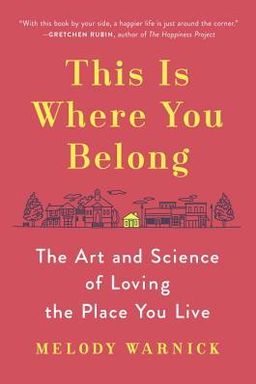
This Is Where You Belong cover

This Is Where You Belong

by Melody Warnick

In ''This Is Where You Belong,'' Melody Warnick explores how to transform your city into a beloved hometown. Learn to embrace your surroundings, connect with locals, and discover hidden opportunities for a fulfilling and happy life.

The Power of Loving Where You Live

The Power of Loving Where You Live

How do you turn a town into a home? In This Is Where You Belong, Melody Warnick argues that loving where you live is not a passive sentiment but a set of learnable behaviors. Through personal stories, social science, and local experiments, she explores how people cultivate a deep sense of connection to their communities—what psychologists call “place attachment.” It’s a practical form of happiness, one that blends emotion and action.

At the book’s core is the distinction between the fantasy of the “geographic cure”—the belief that moving will fix your problems—and the empowerment of staying put. Warnick herself was a serial mover, chasing better vibes from Austin to Blacksburg, Virginia. Eventually she realized that contentment doesn’t arrive automatically with a new address. Belonging is something you make, through slow, deliberate effort. The book is, in effect, a manual for making that happen.

Place Attachment as Feeling Plus Behavior

Scholars like Setha Low and Irwin Altman define place attachment as emotional connection plus actions that express and reinforce that connection. You don’t have to be born somewhere to belong there; your feelings grow from what you do—volunteering, talking to neighbors, walking the streets, and showing up. Warnick uses a 24-item diagnostic scale to illustrate measurable differences between people who merely live in a place and those who truly know it. Attachment predicts civic involvement, local spending, and even long-term health outcomes.

The Civic, Economic, and Social Ripple Effects

Place attachment is not sentimentality—it’s social infrastructure. Gallup and the Knight Foundation’s Soul of the Community project shows that places where residents report high emotional connection enjoy faster economic growth and stronger recovery after recessions. Studies from Japan and the U.S. link attachment to better health and longevity. Neighborhoods with trust and cohesion experience lower stress and crime. Warnick uses Gertie Moore’s story—a woman rooted in her small West Virginia town—as an emblem of durable, lived loyalty that becomes the backbone of community resilience.

A Toolkit for Everyday Belonging

The heart of the book is practical. You can learn belonging through what Warnick calls “Love Where You Live” experiments. These include walking more, buying local, meeting neighbors, doing fun things, engaging with nature, volunteering, supporting local food, becoming political, creating art, and staying loyal through hard times. Each practice turns passive residency into civic connection. You start small—attending a farmers’ market, posting a wayfinding sign, or chatting with your barista—and the habits compound. (In The Great Good Place, Ray Oldenburg offers a similar psychology of “third places” where consistency and recognition breed community.)

The Moral of the Experiment

Warnick’s experiments—joining cash mobs, starting a CSA membership, becoming a volunteer, and exploring local trails—prove that attachment starts in motion. You don’t wait to feel affection for a city; you generate it through participation. Her message is hopeful: community pride is a renewable resource, built from mundane acts of showing up. When you behave like someone who loves their town, you prime your emotions to follow.

Core lesson

Belonging is not found—it’s practiced. The simple, repeatable actions of everyday life can transform any location into a place that feels like home.

Taken together, Warnick’s insights form a civic philosophy: happiness grows from attachment, attachment grows from participation, and participation turns geography into community. The book invites you to test this idea in your own life—not by moving again, but by moving toward engagement where you already are.


Walking and Mapping Your World

Walking and Mapping Your World

Walking is the book’s first prescription for feeling at home, because nothing builds familiarity faster. Warnick draws on cognitive science and urban design to show that walking is how you learn geography—the practice of creating a mental map transforms foreign streets into lived space. Edward Tolman’s studies of rats navigating mazes, and Bruce Appleyard’s child map research, demonstrate that real movement generates cognitive structure. When you walk, you orient your body, not just your GPS.

From Orientation to Belonging

Walkability translates physical access into psychological comfort. A high Walk Score correlates with satisfaction, while long car commutes predict lower happiness (Bruno Frey and Alois Stutzer found commuting reduces joy almost as much as a pay cut). Warnick suggests the “one-mile solution”: draw a one-mile circle around your home and handle errands within that radius on foot. It’s small, practical, and it instantly shifts how you perceive local space. Suddenly you notice architecture, people, and patterns once blurred by car windshields.

Guerrilla Placemaking in Practice

Her experiment using Walk [Your City] signs demonstrates “tactical urbanism.” Inspired by Matt Tomasulo’s Walk Raleigh project, Warnick placed signs showing walk times to the duck pond and farmers’ market in Blacksburg. These simple cues turned long, car-oriented distances into approachable pathways. Guerrilla placemaking works because it reimagines public space through micro-interventions—cheap, cheerful nudges that make walking normal.

Walking changes what you see

Urban designer Jeff Speck notes that only walking offers “the slowest productive pace” for noticing buildings, landscapes, and human dynamics around you.

Simple Steps to Start

  • Replace one car trip a week with a walk to sense seasonal and social rhythms.
  • Take GPS-free wanders to rebuild curiosity about your surroundings.
  • If walking is difficult, support walkability campaigns or help install local wayfinding projects.

Walking is where awareness begins. It re-teaches you the world at human speed, creates relational space, and reinforces the sense that your community exists on foot, not just on a map. Every step you take builds roots.


Neighbors and Social Glue

Neighbors and Social Glue

For Warnick, neighbors are the first layer of place attachment. A familiar wave or conversation can ripple into trust, shared safety, and even improved health. She documents the decline of casual neighborliness and reasserts its power through evidence and practice: local ties reduce loneliness, buffer poverty, and raise life expectancy.

Evidence That People Matter

A University of Michigan study found people who interact with neighbors are dramatically less likely to suffer heart attack or stroke. Social scientists call this “collective efficacy”—the capacity of a neighborhood to watch out for itself. Detroit’s East English Village, for example, organized collectively to save a neighbor’s home from foreclosure; their cooperation turned abstract community into action.

How to Start Connecting

Warnick’s muffin-box experiment—leaving baked goods for a stranger who became “Jeff”—shows that kindness breaks through awkwardness faster than ideology. Municipal programs often help: Surprise, Arizona’s Block Party Trailer lets residents borrow tables and games for neighbor events. Tonya Beeler’s Sunday Dinners in Indianapolis became rituals of belonging. You can replicate these gestures with potlucks, front-yard Fridays, or even small favors that remind people they’re seen.

Practical Checklist

  • Say hello to your neighbors and learn their names.
  • Organize one event per year—a shared meal, game night, or community cleanup.
  • Offer small help—check mail while they’re away or shovel snow for the elderly.

Neighborliness creates civic armor

Relationships are the invisible walls that protect a street against isolation and decline.

Belonging starts next door. If you know who lives near you, your town stops feeling anonymous. The simplest gestures—a greeting, a muffin, a shared joke—can launch lifelong friendships and civic muscle.


Local Money and Local Culture

Local Money and Local Culture

Economic attachment reinforces emotional attachment. Warnick reveals how spending locally, eating locally, and supporting local producers multiply wealth, culture, and pride. Buying from independent businesses is not just ethical—it’s how towns flourish. Studies she cites (from Salt Lake City) show local stores recirculate more than three times the revenue compared to chains, fueling public services and local jobs.

From Groceries to Civic Revival

Community campaigns like Jay Leeson’s fight to save Fitch’s IGA in Wilmore, Kentucky, illustrate neighborly economics: people refurbish stores, shop consciously, and turn a local business into a civic symbol. Cinda Baxter’s 3/50 Project and Andrew Samtoy’s Cash Mobs give you concrete formats—spend $50 across three local shops each month or join group-buy events that make local patronage fun.

Food as Sensory Belonging

Food intensifies attachment because it ties memory to flavor. Eating regional dishes—like barbecue in Kansas City or lobster rolls from Portland’s Bite into Maine—turns geography into taste. The psychology of “terroir” (Rowan Jacobsen’s phrase) means you carry a map of flavor that connects you to place. Local eating experiments, such as community-supported agriculture shares or farmers’ markets, convert errands into relationships. You meet growers, learn seasons, and strengthen local identity.

Try These Shifts

  • Choose a local shop as your first choice for one category—books, gifts, or produce.
  • Visit your farmers’ market weekly; talk to vendors and share recipes.
  • Join a CSA for a season to learn local agricultural rhythms.

Taste is belonging

Eating from your region is the most immediate way to bond sense, memory, and economy in one act.

When you spend and eat locally, you weave yourself into your town’s story. Civic identity often starts at the cash register and the dinner table.


Volunteering and Civic Engagement

Volunteering and Civic Engagement

Helping others is among the fastest ways to feel invested in place. Warnick shows how volunteering transforms identity, health, and local resilience. Studies confirm that volunteers have lower stress and higher life satisfaction. Giving time or money is not charity—it’s ownership of your civic environment.

From Small Acts to Structural Change

Her own “Birthday Kindness Project” and stories like Robyn Bomar’s or the Doley sisters’ “Grow This Block” prove that micro-actions—cleaning a lot, planting flowers, hosting one-day events—cascade into visible community improvement. Programs like Cities of Service formalize these efforts through volunteer networks that support local governments. (Note: Daniel Aldrich’s disaster studies show that communities with more volunteers survive crises better.)

Giving as Civic Ownership

If you lack time, Warnick suggests civic crowdfunding: platforms like ioby or Spacehive let residents fund neighborhood improvements and see tangible results. Local giving circles also build emotional feedback—you see what your money built, which ties self to place.

  • Start modestly: one volunteer hour or $25 to a local cause monthly.
  • Join one short civic event or work shift to meet people.
  • If remote, support civic tech or local crowdfunding projects online.

The secret of service

Volunteering isn’t giving away time—it’s buying emotional stake in where you live.

Civic engagement roots you more deeply than property ever could. When you help others locally, your imagination of “home” expands to include everyone whose life you’ve touched.


Creativity, Politics, and Resilience

Creativity, Politics, and Resilience

The final sections connect place love to agency. To belong fully, you must not only consume or volunteer—you must help shape your community’s narrative and stay loyal when times get hard. Warnick examines creative placemaking, civic learning, and resilience as the advanced dimensions of local attachment.

Creative Placemaking and Micro-Initiatives

Nancy Barton’s Prattsville Art Center example shows how art can heal disaster zones: a flood-damaged store became a free creative hub after a simple grant and a “no-assholes policy.” Warnick mirrors that local spirit with her own chalk festival and Better Block experiments. These lighter, quicker, cheaper projects illustrate how culture can rebuild civic identity from scratch. (Comparable to Jane Jacobs’s claim that small-scale civic acts sustain urban vitality.)

Civic Learning and Local Politics

Through Blacksburg’s Citizens Institute, Warnick learns government from the inside—meeting bus drivers, park managers, and firefighters. Seeing the human face of bureaucracy transforms cynicism into empathy. She also explores civic tech (Code for America, MySidewalk, Nextdoor) as modern extensions of participation that keep citizens informed and responsive.

Resilience and Staying Loyal

Attachment is tested during crisis. Warnick cites Daniel Aldrich’s findings after the tsunami in Japan: social ties, not wealth, predict survival. After disasters like Katrina or the Virginia Tech shooting, community networks—not infrastructure—determine recovery. She contrasts the loyalty of Chernobyl’s returning babushkas with rational movers who leave for safety, arguing there’s no moral hierarchy between staying and going; both reflect how deeply people link identity to place.

  • Make resilience a neighborhood routine: keep contact lists, hold cleanups, and support preparedness plans.
  • Study local government to know how to influence resilience measures.
  • Stay loyal in downturns—economic or emotional loyalty sustains civic dignity.

Resilience stems from relationship

Disaster reveals not what breaks a town, but what binds it once the shock subsides.

Belonging, Warnick concludes, is activism as much as affection. You build it through art, participation, and endurance. Loyalty through hardship proves that love of place isn’t naïve—it’s civic strength.

Dig Deeper

Get personalized prompts to apply these lessons to your life and deepen your understanding.

Go Deeper

Get the Full Experience

Download Insight Books for AI-powered reflections, quizzes, and more.