
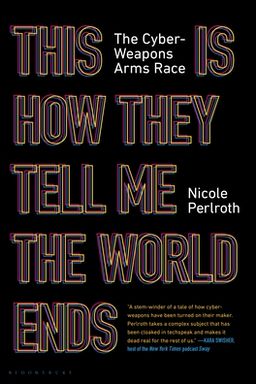
This Is How They Tell Me the World Ends cover

This Is How They Tell Me the World Ends

by Nicole Perlroth

Dive into the gripping world of cyberweapons with ''This Is How They Tell Me the World Ends'', where Nicole Perlroth unveils the hidden arms race threatening global security. Through riveting stories and expert insights, discover the dark world of zero-days, government espionage, and the urgent need for cybersecurity reforms.

The Hidden Arms Race of Code

Nicole Perlroth’s This Is How They Tell Me the World Ends exposes a new kind of global arms race — one fought not with missiles, but with lines of code. She argues that the most dangerous weapons today are not stored in silos but hidden in software: zero-days, undisclosed vulnerabilities that let attackers slip, unseen, into the systems running everything from smartphones to power plants. These flaws have become the currency of intelligence, espionage, and warfare, creating a marketplace where secrecy, cash, and ethics collide.

You learn that this economy didn’t arise overnight. It evolved through hackers selling bugs for beer money, brokers turning discoveries into six-figure sales, and governments competing for digital supremacy. The result is a world where every piece of consumer technology is a potential battlefield — and where a single leak can boomerang into global catastrophe.

Zero-days: invisible keys to the kingdom

A zero-day is a secret flaw unknown to the vendor, giving those who find it unfettered access. It’s like a spare key no one knew existed. Perlroth likens them to digital superweapons: stealthy, persistent, and immensely valuable. Intelligence agencies hoard them to infiltrate adversaries’ systems; criminals buy them to steal; autocrats use them to spy on dissidents. When Stuxnet used seven zero-days to sabotage Iran’s Natanz centrifuges, it marked the crossing of a cyber Rubicon—code causing physical destruction for the first time.

A market built on secrecy and cash

Perlroth traces the market’s evolution from early vulnerabilities posted on public mailing lists to professionalized brokerage networks like iDefense and later Zerodium. As governments and contractors began paying large sums for enduring, undetectable exploits, incentives shifted. Researchers who once reported bugs freely began selling them in hush-money deals. The price of secrecy skyrocketed, and a thriving gray economy emerged running parallel to official bounty programs.

Here you meet characters like Adriel Desautels, Jimmy Sabien, and The Grugq—brokers who shuttled exploits between researchers and defense agencies, sometimes by cash-filled duffel bags. Perlroth documents how these middlemen built global supply chains of digital weaponry, often ignorant or indifferent to how their code would be used.

From nation-states to mercenaries

Nation-states, led by the NSA’s Tailored Access Operations (TAO), industrialized hacking. TAO’s automation projects—Genie and Turbine—scaled espionage into tens of thousands of implants. But these tools soon escaped containment. When the Shadow Brokers leaked TAO’s arsenal, exploits like EternalBlue fueled worldwide ransomware outbreaks (WannaCry, NotPetya) that paralyzed hospitals and shipping lines. Perlroth calls this the “boomerang effect”: offensive code returning as chaos.

Private contractors amplified the trend. Firms like CyberPoint and DarkMatter exported NSA talent to the Gulf, where Western ex-hackers helped autocratic clients target journalists and activists. NSO Group’s Pegasus spyware expanded such reach to phones, showing how surveillance markets turned personal devices into eyes for the state. For hackers lured by money, ethics quickly blurred.

The human consequences and the reform debate

Behind this technical arms race are ordinary people caught in the crossfire. Stolen exploits disrupt hospitals, shipping companies, and even elections. Perlroth shows how ransomware and perception hacks — digital attacks and disinformation intertwined — threaten democracy itself. Yet she also highlights reform efforts: Google’s Project Zero forcing vendors to patch faster; bug bounty programs creating legal channels; Brad Smith’s call for a “Digital Geneva Convention.”

The book’s central warning is clear. As long as governments hoard zero-days, private markets thrive, and autocratic states buy offensive tools, civilians will bear the impact. You’re left with one truth: the world’s digital security now depends not just on technology, but on how humans handle the secrets buried inside it. Whether those secrets are patched, sold, or stockpiled determines whether code protects or destroys.


The Zero-Day Economy

Perlroth reveals how a hacker hobby morphed into a multi-billion-dollar trade. The zero-day market began with public disclosure culture—researchers posting on BugTraq—but quickly evolved once brokers offered money for silence. Adriel Desautels’s path from researcher to broker captures that pivot: discovering a minor flaw, realizing governments would pay huge sums, and building a business that commodified secrecy. The market’s DNA was simple: pay the highest price to keep flaws hidden.

From disclosure to discretion

Programs like iDefense pioneered paying modest bounties for reporting vulnerabilities. Yet beside these ethical markets grew lucrative shadow ones that paid up to hundreds of thousands for the same bugs. Perlroth calls this “the perverse incentive”: pennies for disclosure, six figures for silence. Researchers naturally gravitated to anonymity and cash, and companies like Vupen and Zerodium institutionalized the practice—advertising price lists for iPhone and Android exploits as if selling luxury goods.

The brokers and their buyers

Middlemen such as The Grugq and Jimmy Sabien managed trust networks between hackers and buyers (NSA, CIA, foreign ministries). Their trade ran on non-disclosure agreements, courier payments, and reputation. Reliability mattered as much as innovation—a 98.9% clean exploit commanded premium rates. Over time, boutique contractors became the bridge from research to cyber offense, supplying intelligence agencies with turnkey capabilities.

Ethics and fallout

The market’s moral line eroded fast. Desautels realized his sold exploits ended up inside spyware used by Sudan and Bahrain. Hackers rationalized neutrality; brokers claimed ignorance. By the time Hacking Team’s internal emails leaked in 2015, the trade’s ethical foundations were irreparable. Perlroth’s core insight is that when code becomes currency, morality is optional—and the buyers with the least restraint hold unlimited budgets.

You finish understanding that zero-days are not mere technical quirks but tradable power. Every dollar spent on keeping vulnerabilities secret is a dollar spent making the world a little less safe for everyone who depends on connected systems.


Cyber Offense and Its Fallout

Inside government, Perlroth shows how offense dominated defense. The NSA’s Tailored Access Operations (TAO) turned hacking into a bureaucratized craft. Projects like Turbine automated exploit deployment, creating an offensive ecosystem vast enough to reach millions of machines. Stuxnet, co-developed with Unit 8200 and the CIA, illustrated how digital weapons can produce physical damage—spinning centrifuges beyond tolerance to destroy hardware silently.

Stuxnet: crossing the Rubicon

You trace Stuxnet’s anatomy: seven zero-days chained through Windows and Siemens software, hiding behind stolen certificates, and sending fake telemetry. It escaped labs, spread globally, and became the seed of copycat attacks. Perlroth argues this moment shattered the line between espionage and war. Once malware could destroy machinery, cyber conflict ceased to be hypothetical—states would inevitably imitate.

When secrets leak

The NSA’s hoard eventually spilled into the open via the Shadow Brokers. Tools like EternalBlue fueled ransomware attacks (WannaCry, NotPetya) that crippled global institutions. Perlroth’s interviews with Microsoft’s Brad Smith highlight the irony: private companies became first responders to code built by their own government. EternalBlue proved hoarding vulnerabilities for offense converts them into public disasters once leaked.

The lesson for you

Cyber offense promises deterrence but often backfires. Perlroth insists that transparency, patching, and restraint must supplement technical prowess. Offensive code multiplies global insecurity unless coupled with strong disclosure ethics—the very thing intelligence agencies neglected for years.


Mercenary Hackers and Autocrats

Beyond formal agencies, Perlroth reveals a growing mercenary class: ex-intelligence hackers for hire. Contractors like CyberPoint in Abu Dhabi evolved into DarkMatter, employing Americans to run surveillance programs against dissidents and even U.S. citizens. David Evenden’s story captures the shift—choosing conscience over cash and exposing how corporate fronts enable repression.

Exporting skills as weapons

When Western professionals take classified expertise abroad, they bring offensive capacity to regimes without democratic safeguards. Project Raven used those skills to penetrate journalists’ devices. Similar dynamics appear in NSO Group’s Pegasus, which infected iPhones and WhatsApp accounts worldwide. Ahmed Mansoor and Carmen Aristegui became case studies in personal vulnerability: civil society crushed by code sold as “law-enforcement technology.”

Accountability and the human price

From Bezos’s hacked phone via Saudi-linked exploits to Twitter insiders leaking user data, Perlroth connects the dots between free-market exploit trading and authoritarian manipulation. Autocrats now purchase surveillance infrastructure the way nations once bought fighter jets. For you, that means privacy is hostage to regulation gaps and globalized talent pipelines.

Her prescription: demand transparency in sales, enforce export controls, and treat surveillance software as arms. Without guardrails, the mercenary economy will keep enriching autocrats at democracy’s expense.


Corporate Defense and Public Responsibility

Google’s Aurora attack in 2009 transformed how private firms view cyber defense. The intrusion via an Internet Explorer zero-day awakened tech giants to their national-security role. Perlroth shows how Google’s reaction—public disclosure, withdrawal from China, and investment in Project Zero—created a new corporate paradigm: companies as digital defenders.

Bug bounties and Project Zero

Post-Aurora, Google, Microsoft, and Facebook began paying hackers for vulnerabilities. This reframed ethics around disclosure: instead of criminal suspicion, researchers received institutional respect and payment. Project Zero pushed vendors to patch within 90 days, draining the hoarded-bug market and recruiting elite exploit developers into defense. It demonstrated that transparency and collaboration could outpace secrecy.

Limits and progress

Although bounties can’t rival Zerodium’s million-dollar payouts, they anchor an alternate narrative—one of responsibility. Perlroth notes how the Pentagon’s “Hack the Pentagon” campaign symbolized this cultural shift even within government. You realize that private-sector ethics now shape global cyber norms more effectively than opaque state processes.

The takeaway: public safety depends on better incentives. Paying for disclosure instead of silence channels hacker brilliance toward protection, not exploitation.


The Boomerang Effect and Systemic Risk

Across the narrative, Perlroth highlights the boomerang: once offensive code is unleashed, it returns unpredictably. EternalBlue birthed WannaCry and NotPetya; NotPetya paralyzed global business. Iran’s Shamoon and Russia’s Sandworm transformed political grievance into industrial sabotage. Each event proves interconnected vulnerability—digital warfare doesn’t stay confined.

Regulation and reform attempts

International efforts like Wassenaar tried to restrict intrusion tech exports but lacked teeth. Perlroth advocates concrete fixes: a transparent Vulnerabilities Equities Process (VEP), expiration dates for retained flaws, DHS oversight, and aggregate reporting. She argues these reforms would curb hoarding and align offensive calculations with public safety.

Offense as deterrence

Cyber Command’s “defend forward” operations (against Russia’s IRA and TrickBot) show that offense can deter but also provoke. The retaliation against hospitals after TrickBot takedowns illustrates this double edge. Perlroth warns you that escalation cycles make deterrence fragile—digital warfare leaks into civilian life faster than diplomacy can catch up.

Her closing message: our interconnected world magnifies every exploit kept secret. Regulatory transparency and resilient infrastructure aren’t luxuries—they’re the only viable defense against the next boomerang.


Information Warfare and Democratic Resilience

Finally, Perlroth situates cyber weaponry within political manipulation. The same connectivity that spreads ransomware also amplifies disinformation. Russia’s operations—the Internet Research Agency, Project Lakhta—shifted from fake accounts to renting real ones, blending propaganda with authentic voices. This “perception hack” undermines trust more effectively than code alone.

The convergence of crime and politics

Ransomware crews like TrickBot became tools for state influence, cataloging municipalities, striking near elections, and creating panic. The same EternalBlue exploit that hit hospitals could disrupt voting systems. Perlroth connects technical breaches to psychological ones, explaining how digital chaos fuels civic doubt.

Defending the public sphere

Defensive measures extend beyond code: education, media literacy, and transparent audits provide immunity against perception hacks. Initiatives like CISA’s rumor-control portal illustrate how factual infrastructure can counter both malware and misinformation. You learn that securing democracy means hardening minds as well as machines.

Perlroth’s ultimate insight: digital weapons aren’t only technical—they’re cultural. Whether cyberattacks or disinformation campaigns, the fight for security now hinges on truth, trust, and the human capacity to discern fact from fiction.

Dig Deeper

Get personalized prompts to apply these lessons to your life and deepen your understanding.

Go Deeper

Get the Full Experience

Download Insight Books for AI-powered reflections, quizzes, and more.