
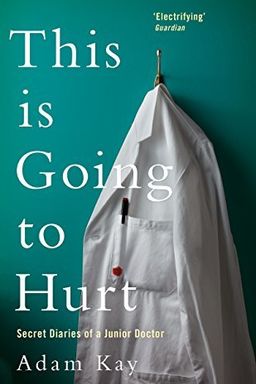
This is Going to Hurt cover

This is Going to Hurt

by Adam Kay

This is Going to Hurt offers a candid, humorous, and often shocking insight into the life of a junior doctor in the UK''s NHS. Through personal diaries, Adam Kay reveals the highs and lows of a system under strain, where dedicated doctors face relentless hours, absurd patient encounters, and systemic challenges.

The Hidden Cost of Healing: Life Inside the NHS

Have you ever wondered what really happens behind the closed doors of a hospital ward at 3 a.m.? In This Is Going to Hurt: Secret Diaries of a Junior Doctor, Adam Kay pulls back the curtain on the often-unseen world of hospital medicine. Through his darkly hilarious and heartbreakingly poignant diary entries, Kay reveals what it truly means to serve on the front lines of Britain's National Health Service (NHS). His central argument is simple but powerful: doctors are human beings working under inhuman conditions—and the cost of their heroism is often their own mental health, relationships, and sense of self.

Kay’s book isn’t a traditional memoir or manifesto. It’s a collection of raw, unfiltered diary entries from his years as a junior doctor working in obstetrics and gynaecology. But together, these snapshots form a damning indictment of how the healthcare system treats both its patients and its providers. He reminds readers that every life saved comes at a price—paid in exhaustion, bureaucracy, and emotional burnout.

A Life Defined by Duty

From the very first page, Kay paints the medical profession as one that demands total surrender. He enters medicine almost on autopilot, following in his father’s footsteps, and quickly discovers that the life of a doctor is defined more by sacrifice than by reward. Junior doctors work ninety-hour weeks, sleep in on-call rooms that smell of disinfectant and despair, and often have to deliver bad news before they’ve eaten or slept. Medicine, he suggests, is as much a test of endurance as of intellect. You don’t simply perform medicine; you survive it.

The Emotional Cost of Compassion

One of the book’s most striking insights is how compassion can be eroded by overwork. Kay’s diary charts his gradual desensitization—from feeling horror at a patient’s death early in his career to desperately seeking a cigarette after witnessing another tragedy years later. His humor becomes a mask, a way to manage the emotional noise of daily trauma. The same wit that delights the reader, he admits, was a defense mechanism to keep from collapsing under the weight of human suffering.

A Satire and a Love Letter

Despite the gallows humor, This Is Going to Hurt is more than a cynical rant. It is, paradoxically, both a satire of and a love letter to the NHS. Kay’s tone swings between manic comedy and moral outrage, but his affection for his colleagues never wavers. He celebrates their skill, resilience, and black humor as the glue that holds an overstretched system together. Underneath every sarcastic remark lies admiration and grief for a service collapsing under the weight of political negligence.

Why It Matters

Kay’s story couldn’t be more relevant in an era when healthcare systems worldwide are under immense strain. His account forces you to reconsider what “frontline work” really means—not just in moments of crisis like pandemics, but every single night when an exhausted doctor decides between food, sleep, or finishing a patient chart. He also asks an uncomfortable question: how much suffering are we willing to allow the people who save lives to endure?

In this summary, you’ll explore the contradictions of a life spent healing others at the expense of yourself. You’ll meet unforgettable patients and even more unforgettable bureaucratic absurdities; you’ll watch as humor becomes a survival tool; and finally, you’ll confront the moment that broke Kay—the tragedy that ended his medical career and changed his life. Together, these stories reveal medicine not as a noble calling or a horror show, but as both at once: a profession defined by grit, absurdity, and the fragile humanity of those who practice it.


Becoming a Doctor Too Young

Adam Kay was only sixteen when he unwittingly chose to become a doctor—a decision he humorously compares to selecting a chicken entrée months before the office Christmas party, not realizing he might later crave the halloumi skewers. He enters medicine because it’s expected of him, not because of passion. Raised in a Jewish family, educated at a top London school, and with a doctor father, he views medicine as his automatic destiny. But this choice, made before adulthood, traps him in a high-stakes career he barely understands.

Education as Indoctrination

Medical training, Kay explains, is less about nurturing curiosity and more about creating durable professionals who can endure endless pressure. Students spend six years memorizing anatomy, physiology, and pathology, believing mastery of science will prepare them for the wards. But as Kay discovers, the moment you step into a hospital, theory collapses under the messy, chaotic weight of real patients. His early shock—where textbook learning meets sepsis, blood, and panic—illustrates how medicine trains minds but rarely hearts.

The Jekyll and Hyde Years

As a house officer, Kay’s days are consumed by menial admin, and his nights by chaos. During the day, he parrots senior instructions—book scans, chase results, tick boxes—basically acting as a human clipboard. But come nightfall, he’s suddenly responsible for hundreds of patients, “a ship on fire” with nobody steering. He recounts the visceral terror of being paged to handle emergent cases in every corner of the hospital—twelve unending hours of crises ranging from heart failure to catastrophic bleeds. His initiation into medicine is baptism by fire, where competence is learned not from textbooks but from mistakes not yet fatal.

A Tragic Education

Kay’s first patient death—a man vomiting blood from ruptured esophageal varices—marks the end of innocence. The account is harrowing: the patient’s death throes, the arterial spray, the helplessness. Medicine, he learns, is where humor and horror coexist. There’s no slow acclimation—just a sudden understanding that those “clinical cases” from textbooks are real people dying in front of you. The cigarette he smokes afterward is his first ever, lit not from habit but shock.

By capturing how he stumbled through those formative years, Kay exposes a brutal paradox of medical training: it demands compassion yet systematically erodes it. The very system meant to create healers nearly destroys their emotional capacity to care. (This echoes Danielle Ofri’s What Doctors Feel, which documents how medical culture suppresses vulnerability.) By the time Kay finishes his first year, he has become what the NHS needed him to be—tough, efficient, and emotionally armoured—but at immense personal cost.


Surviving the NHS Machine

The National Health Service is portrayed in Kay’s diaries as both a miracle and a monster. It delivers millions of babies, treats the gravely ill, and saves countless lives—yet it devours those who serve within it. To work in the NHS, Kay suggests, is to live in a constant state of triage—not just for your patients but for yourself. Every decision weighs physical exhaustion against moral responsibility.

Endless Hours, Vanishing Life

Kay’s schedule violates the European Working Time Directive, legally intended to cap working weeks at forty-eight hours. In reality, he logs upwards of ninety-seven hours a week, seeing his partner for less than two. His wit sharpens into gallows humor: the Directive, he writes, “was dragged screaming from its bed and waterboarded.” Sleep disappears, meals are skipped, and personal life collapses into a distant abstraction. Friends celebrate milestones; Kay spends holidays in fluorescent-lit wards, delivering babies for strangers while missing his own Christmases.

Bureaucracy and Absurdity

Between emergencies, Kay endures absurd bureaucratic demands. He recounts endless form-filling, nonsensical IT systems, and managerial incompetence that borders on satire. When transcriptions get outsourced overseas, his dictated phrase “S for sugar” becomes “Esther Sugar”—a perfect symbol of how NHS efficiency drives doctors to madness. The disconnect between policymakers and practitioners widens as administrators chase productivity metrics while junior doctors chase blood tests and stop dying patients from crashing.

Resilience as Resistance

Despite it all, camaraderie sustains him. Kay describes moments of dark laughter with colleagues, the kind of humor only those knee-deep in catastrophe can appreciate. A nurse calling him a “good little doctor” becomes the first real validation he’s ever heard—so rare that he blurts out “Love you, bye” in response. That fleeting warmth encapsulates the emotional economy of the NHS: praise is scarce, exhaustion constant, and humor mandatory.

Kay’s portrayal of the NHS as a “glorious, collapsing cathedral of care” mirrors Atul Gawande’s exploration of systemic fragility in Being Mortal. Both reveal how compassion survives not because of the system but despite it. Doctors endure because patients need them—an ethical feedback loop that keeps them trapped in noble self-destruction.


Obstetrics: Joy, Horror, and the Absurd

Kay specializes in obstetrics and gynaecology—what med students jokingly call “brats and twats.” In this setting, joy and terror coexist on a minute-by-minute basis. Every delivery is a potential miracle or a catastrophe. Kay embraces the irony that this department, associated with beginnings, constantly exposes him to suffering, blood, and loss.

Miracles and Misfires

Through vignettes both comic and grotesque, Kay captures childbirth’s raw duality. He delivers babies who arrive “in a blizzard of blood and amniotic fluid,” battles hemorrhages that soak his clothes, and fields bizarre emergencies—a man stuck halfway up a curtain rail, a lamp-post-related injury he’ll never forget. Each story underscores nature’s indifference: life and death hinge on moments of improvisation. In one episode, a woman nearly dies from a retained placenta; in another, he saves a life mid-bleed, hitting heroism by sheer reflex.

Moral Grey Zones

His encounters reveal the ethical complexity of medicine. Treating Jehovah’s Witnesses who refuse blood transfusions, managing abortions, or easing stillbirths—all force him to confront the paradox of control and helplessness. Each decision balances law, faith, and life itself. He also faces the darker side of human nature—racism from patients, bribes, and misplaced aggression. Yet even amid these moral mazes, humor persists. When a patient offers him £15 to extend her sick note, he muses that maybe he just doesn’t dress well enough to attract bigger bribes.

Comedy as Coping

Kay’s wit reaches its sharpest during the unbearable. A patient gives birth while her confused neighbor mistakes her for his wife, leading to an unthinkable incident he must explain to the daughter with tact only gallows humor allows. These stories toe the line between tragedy and farce, revealing medicine’s constant dance between empathy and self-protection. Laughter, he insists, is the only anesthesia for trauma that never stops coming.

By balancing vulgar humor with deep humanity, Kay reminds us that obstetrics is a frontline between life and loss—and that even those delivering joy absorb a lifetime of sorrow. (As Mary Roach observes in Stiff, medical work often requires detachment to survive contact with mortality.) For Kay, every joke hides an unstitchable wound.


When Healing Hurts Too Much

After years of sleepless nights and emotional overload, Kay’s breaking point arrives with a devastating incident: the death of a baby and the near-death of a mother under his care. This tragedy, recounted in his final diary entry, forms the emotional core of the book and the reason he leaves medicine forever. It is the moment when professional resilience collapses under the unbearable truth that even doing everything right can end in ruin.

The Unbearable Weight of Responsibility

As the senior doctor on duty, Kay faces a catastrophic hemorrhage and loss during childbirth. Technically, he does nothing wrong—every step aligns with protocol. Yet the outcome is fatal. The guilt that follows is existential: “If I’d been better, faster, smarter,” he thinks, “she might have lived.” Officially absolved of negligence, he nonetheless feels condemned by conscience. Medicine, he realizes, offers no emotional safety net for its practitioners. When tragedy strikes, support systems are perfunctory; compassion is rationed, professionalism weaponized against grief.

The Impossible Standard

Kay’s story reflects a systemic cruelty: doctors are expected to be superhuman until they break, then quietly replaceable once they do. After the incident, he returns to work the next day as if nothing happened. The hospital machine continues to grind, indifferent to personal devastation. This silence, Kay argues, is what destroys countless doctors—not the deaths they witness but the lack of space to mourn them.

Learning to Let Go

Leaving medicine becomes an act of survival. But retreat brings its own pain. Kay struggles with guilt—at abandoning his patients, his colleagues, the NHS that shaped him. His humor falters; his identity dissolves. The book’s poignancy lies in how he channels that trauma into activism and art, transforming personal pain into public advocacy for healthcare workers. His later “Open Letter to the Secretary of State for Health” demands politicians spend a night on an actual ward before cutting NHS budgets—a fitting last call from a man who once bled for the system.

“This Is Going to Hurt” ends not with triumph, but with truth: heroes don’t burn out because they lack strength; they burn out because they’re never allowed to stop. Kay’s final pages remind you that every smiling doctor has weathered storms you’ll never see—and many never heal from them.


Why Adam Kay’s Story Matters

Kay’s memoir transcends medical autobiography; it’s a moral document about empathy, labor, and systemic neglect. Through humor and heartbreak, he personalizes what health statistics and policy papers never can—the emotional cost of saving lives. His narrative gives voice to thousands of doctors whose exhaustion is mistaken for indifference, whose breakdowns are labeled weakness, and whose humanity is the NHS’s most undervalued resource.

From Individual to Universal

While rooted in British culture, the book resonates globally. In America’s privatized health system or Europe’s strained public ones, the same pattern repeats: political leaders praise healthcare heroes, then underfund their institutions. Kay’s diaries become universal testimony to a paradox—medicine teaches compassion but rewards detachment. The laughter that fills his pages isn’t frivolity; it’s armor.

A Call to Witness

Ultimately, Kay’s book asks you to bear witness. He wants the public to understand that behind every “doctor shortage” statistic is a human being like him—someone who stayed late, skipped meals, and wept in a supply cupboard. His open letter to the Health Secretary crystallizes his mission: before politicians cut budgets, they should experience a single shift in A&E or on the labor ward. “You would never press the button,” he writes, echoing ethicist Roger Fisher’s nuclear analogy, “if you had to dig it out of someone’s chest yourself.”

By turning his pain into prose, Adam Kay has done what medicine often fails to do—treat the wound rather than ignore it. His story reminds us that empathy saves lives on both sides of the stethoscope. For readers, it’s an invitation: the next time you thank a doctor, mean it. Behind their steady hands are scars you’ll never see.

Dig Deeper

Get personalized prompts to apply these lessons to your life and deepen your understanding.

Go Deeper

Get the Full Experience

Download Insight Books for AI-powered reflections, quizzes, and more.