
Idea 1
Redefining Value: Moving Beyond Financial Maximization
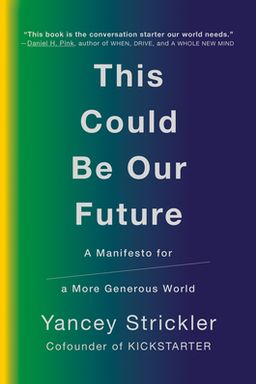
What if the richest measure of a successful life—or a successful society—was not how much money we made, but how much value we created for one another? In This Could Be Our Future, Yancey Strickler, the cofounder of Kickstarter, proposes nothing less than a moral revolution against what he calls the hidden default of our age: financial maximization. His central claim is both simple and transformative: the world’s most urgent problems—from inequality and burnout to the loss of community and creativity—stem from our decision to treat money as the only rational goal worth pursuing.
Strickler argues that this obsession with profit is not a law of nature. It’s an idea—one born in boardrooms and business schools in the last half century—that has quietly metastasized to dominate nearly every sphere of life. We’ve been trained to think that the rational choice in any situation is the one that makes the most money. But this belief, he says, has trapped us in what he calls the financial maximization mindset—a worldview too narrow to handle today’s challenges or to inspire a hopeful future.
From Kickstarter to a Global Vision
Strickler’s insight began during his years leading Kickstarter, the crowdfunding platform he co-founded to help creators bring their ideas to life. Unlike typical Silicon Valley startups seeking a billion-dollar exit, Kickstarter refused to sell or go public. In 2015, it became a Public Benefit Corporation (PBC)—legally committing itself to social and cultural goals alongside profit. This choice reflected Strickler’s growing belief that there are forms of value that can’t be counted in dollars. Kickstarter’s success demonstrated that ideas rooted in generosity and community could thrive—even in a marketplace shaped by greed.
Yet Strickler’s question went further: if a single company could resist the pull of financial maximization, could whole societies do the same? His answer takes shape in what he calls Bentoism—a new way to visualize our self-interest as something larger than individual gain, encompassing the needs of future generations, our communities, and our own moral growth.
The Trap of the Hidden Default
In the opening chapters, Strickler exposes the modern economy’s default settings—those invisible rules we mistake for common sense. He points to behavioral economics, game theory, and policy changes from the 1970s onward that trained us to equate rationality with selfishness. Adam Smith’s notion of the “invisible hand” became distorted by thinkers like Milton Friedman, who proclaimed that “the social responsibility of business is profit.” Once that ideology took hold, financial maximization seeped into government, education, healthcare, and even our personal ambitions. It became the water we swim in without noticing.
The result? A world of sameness and stagnation. Strickler chronicles how radio stations, movie studios, and neighborhood stores were swallowed by giant chains pursuing profit above all else. He calls this the “Mullet Economy”: business in front (cost-cutting, layoffs, efficiency), party in back (executives and shareholders reaping giant rewards). While productivity has soared, wages have flatlined since the 1970s, and community institutions—from local bookstores to small-town main streets—have withered.
A New Definition of Progress
To replace financial maximization, Strickler invites us to expand our idea of value itself. True progress, he insists, can’t be measured only by Gross Domestic Product (GDP)—a metric that counts spending but ignores meaning. (As Simon Kuznets, the economist who invented GDP, warned in 1934, “The welfare of a nation can scarcely be inferred from a measurement of national income.”) Strickler draws on economists Mariana Mazzucato and Elizabeth Anderson, and philosophers like Michael Walzer, to argue for a pluralistic theory of value. Each domain of life should be guided by its own values: fairness and justice in politics, sustainability in business, care in health, creativity in art—not by the blunt calculus of profit.
This expansion of value aligns with human psychology. Strickler weaves in Abraham Maslow’s hierarchy of needs and Daniel Pink’s research on intrinsic motivation to show that money motivates us only until basic security is met. Beyond that, people thrive through autonomy, mastery, and purpose. Our current system, by prioritizing wealth over these deeper needs, traps us in what he calls “the second rung” of human potential: safe but unfulfilled.
Bentoism: Seeing the Bigger Picture
To help us act beyond narrow self-interest, Strickler introduces Bentoism—a conceptual tool inspired by the Japanese lunch box. It divides our choices into four quadrants: Now Me (our immediate desires), Future Me (our long-term growth), Now Us (the people and communities we affect), and Future Us (the generations after us). Each quadrant represents a valid form of self-interest. In practice, Bentoism helps you check your decisions against a broader field of values—security, purpose, fairness, sustainability—to find what Strickler calls “rational self-coherence.”
Bentoism’s significance goes beyond personal growth. Strickler envisions entire organizations and societies guided by the same multi-dimensional awareness. Companies like Patagonia or Tesla, he notes, already use their resources to create long-term value rather than just short-term profit. Musicians like Adele and Taylor Swift exemplify it through fairness and community-minded decisions. If these ideas spread, Strickler believes a new class of leaders—the Values Maximizing Class—could emerge, devoted to inventing systems that grow nonfinancial forms of prosperity.
Why It Matters Now
Strickler’s manifesto combines philosophical depth with democratic optimism. He reminds us that capitalism itself was once a radical idea born of imagination, and that hidden defaults can always be reprogrammed. Change, however, is slow: social transformation takes roughly thirty years—a generation. But the author wants readers to see this not as discouraging but empowering. The next thirty years, he insists, are our window to build a world driven not by accumulation but by meaning.
Strickler’s invitation is clear: what if we stopped measuring life by how much we earn and started measuring it by what we enable? If financial maximization was yesterday’s default, today we can choose a new one—a system designed for fairness, sustainability, mastery, and shared purpose. Thirty years from now, that choice could define our collective future.