
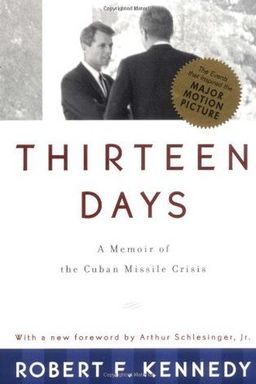
Thirteen Days cover

Thirteen Days

by Robert F Kennedy

Thirteen Days offers a riveting insider perspective on the Cuban Missile Crisis, detailing the tense deliberations and strategic decisions that narrowly averted nuclear war. Robert F. Kennedy''s memoir provides a unique window into the complexities of high-stakes diplomacy and the fragile nature of global peace.

Thirteen Days That Changed the World: Leadership in Crisis

Have you ever faced a decision that could change the course of everything you care about? In Thirteen Days: A Memoir of the Cuban Missile Crisis, Robert F. Kennedy invites you into a moment where such decisions were literally world-altering. Over thirteen tense days in October 1962, the fate of humanity balanced precariously between peace and nuclear annihilation. Kennedy’s account reveals not just how the world narrowly avoided nuclear war, but what true leadership, judgment, and moral courage look like under impossible pressure.

Robert Kennedy, then U.S. Attorney General and closest adviser to President John F. Kennedy, recounts the inside story of how the President and his small group of aides—the Executive Committee of the National Security Council (Ex Comm)—managed the Cuban Missile Crisis. His narrative is part history, part moral reflection, and part guidebook for decision-making during extreme uncertainty. Every paragraph reflects the exhaustion, fear, and determination that suffused those days. He writes with personal insight, humility, and a clear respect for the stakes involved: the survival of civilization itself.

A World on the Brink

In October 1962, U.S. reconnaissance discovered that the Soviet Union had secretly deployed nuclear missiles in Cuba, a mere 90 miles off American shores. The revelation shattered existing assumptions about Soviet behavior and forced an immediate question: What could the United States do without provoking total war? The Cold War had already scarred the global psyche—Berlin, the Bay of Pigs, and a relentless arms race underscored the volatility between two superpowers armed with enough weapons to obliterate humanity.

For 13 days, the President and his advisers debated options ranging from a full-scale invasion to limited air strikes to a naval ‘quarantine’ of Cuba. Voices in the room clashed sharply—the military demanded decisive attack, while others feared moral and geopolitical catastrophe. Robert Kennedy’s recounting captures these debates intimately—not as abstractions, but as gut-wrenching choices that could end millions of lives.

Moral Dilemmas and Strategic Patience

At its heart, Thirteen Days is not about power, but restraint. The Kennedys understood that military superiority meant little in the face of mutual destruction. Choosing not to attack first required discipline and faith in diplomacy. President Kennedy’s guiding philosophy, adapted from military strategist Basil Liddell Hart, became a moral compass: “Keep strong, if possible. In any case, keep cool. Have unlimited patience. Never corner an opponent and always assist him in saving his face.”

Through this lens, every meeting, memo, and message was a test of empathy and perspective-taking. Robert Kennedy stresses how vital it was to “put ourselves in the other country’s shoes.” Understanding Khrushchev’s fears and pressures helped prevent misjudgment and allowed room for a solution both sides could accept. This human factor—the capacity to integrate insight rather than merely impose will—became the lifeline to peace.

Leadership, Communication, and the Role of Dissent

Leadership during crisis, Kennedy insists, depends on openness to contradiction and humility before uncertainty. Within Ex Comm, the President deliberately allowed disagreement and debate without hierarchy. No one person’s view was sacrosanct; ideas evolved daily. The story demolishes the myth of the infallible leader: what saved humanity was less brilliance than deliberation, collaboration, and disciplined reason under fire.

This process was possible because discussions were secret. Kennedy emphasizes that had deliberations been publicized or forced through partisan politics, decisions would likely have tilted toward military escalation. Eleven men representing the best minds in government almost disagreed on every approach—but hidden from public scrutiny, they could take their time to think, change opinions, and consider long-term consequences. That privacy, Kennedy concludes, “saved the world.”

Why It Still Matters

The book’s lessons extend far beyond the Cold War. In an era where rapid judgments, public posturing, and digital outrage dominate decision-making, Thirteen Days reminds you of the value of introspection, patience, and perspective. Kennedy pushes readers to reflect: what does moral courage look like when compromise feels like weakness? What separates prudent restraint from fear-induced paralysis?

By intertwining global stakes with human frailty, Kennedy reconstructs an experience that tested the moral architecture of leadership. In these pages, you meet not perfect heroes but weary, thinking humans confronting the most terrifying responsibility imaginable. The result is a timeless study of how reason, empathy, and calm courage can prevail—if, as Kennedy cautions, we remember always to “avoid self-righteousness like the devil—nothing is so self-blinding.”


The Anatomy of a Crisis

Robert Kennedy opens the main body of Thirteen Days on a seemingly ordinary Tuesday morning, October 16, 1962, when President Kennedy summoned him to the White House. Within minutes, they learned that Soviet nuclear missiles were secretly being installed in Cuba. The photographs taken by U-2 reconnaissance flights left little doubt. The revelation ignited what Kennedy calls "the most dangerous moment in human history.”

At first, disbelief overshadowed fear. U.S. intelligence had repeatedly assured the President that the Soviets would never risk placing nuclear weapons in Cuba—it was deemed politically and militarily irrational. Yet, as Kennedy recalls, the evidence was irrefutable. Feeling both betrayed and stunned, he reflected bitterly that Soviet Premier Nikita Khrushchev had lied directly to him even weeks earlier through diplomatic exchanges.

The First Hours

The first Ex Comm meeting included twelve of the most powerful men in the U.S. government: Dean Rusk, Robert McNamara, John McCone, McGeorge Bundy, General Maxwell Taylor, and others. The President’s decision to let them deliberate without his constant presence was strategic—he wanted genuine disagreement rather than deference. Kennedy understood how the weight of the Oval Office might silence dissent. This lesson in management—create psychological distance to cultivate honesty—became one of the book’s enduring insights.

Initially, a majority supported a surprise military strike to destroy the missile sites. But Robert Kennedy recoiled at the thought. Writing later, he confessed that the plan made him feel “how Tojo must have felt when he was planning Pearl Harbor.” The irony of America, long self-defined as liberty’s protector, initiating a surprise bombing against a small nation deeply disturbed him. That moral discomfort shaped the entire course of decision-making to follow.

Emergence of the Blockade Plan

Amid ferocious debate, McNamara proposed an alternative: a naval “quarantine” that would intercept Soviet ships delivering additional missiles. He argued that it was a measured, reversible pressure—a way to demonstrate strength while maintaining control of escalation. The President saw its appeal: it asserted resolve without immediate violence.

By Thursday night, most advisers had come around, yet few felt entirely sure. As Kennedy emphasizes, "there was no obvious or simple solution.” The crisis demanded ambiguity tolerance and humility rare in bureaucracies. During sleepless nights in October 1962, reasoned uncertainty—holding multiple competing ideas without rushing to closure—proved more valuable than apparent decisiveness.

Strategic Patience and Deliberate Secrecy

Maintaining secrecy was essential. The circle of awareness remained extraordinarily tight, so much so that public life in Washington continued as usual while global catastrophe loomed in private. The President even left for campaign speeches to avoid suspicion. Each man in the Ex Comm labored under enormous psychological pressure—what Kennedy describes as “the strain that does strange things to strong men.”

From these meetings emerged one of Kennedy’s key conclusions: in crises, the luxury of time—both to deliberate and to reflect—is not incidental but vital. In virtually all subsequent remarks about leadership, he would argue that the secret to survival was not perfect knowledge but disciplined process, an insight echoed decades later by crisis scholars like Graham Allison in Essence of Decision.

By Sunday, October 21, the President had decided: the United States would impose a naval blockade and demand the removal of the missiles. The public would soon learn that the world was one hesitant command away from nuclear war. The anatomy of those first five days—fear, moral anguish, contested advice, and courageous calm—set the pattern for how statesmen might face impossible choices with measured humanity.


Moral Courage and the Question of War

For Robert Kennedy, moral courage is the quiet heart of Thirteen Days. The book repeatedly tests what it means to balance security with conscience. Should moral restraint prevail when others are pushing for strength at any cost? For the President and his brother, the question became unbearably real as military chiefs insisted on invading Cuba.

A Clash of Worldviews

General Curtis LeMay and the Joint Chiefs argued that striking Cuba was both inevitable and necessary. LeMay dismissed fears of Soviet retaliation, assuring Kennedy there would be “no reaction.” The President knew better. “They can’t let us kill Russians and do nothing,” he replied. The Chiefs pressed on—if the missiles stayed, America would appear weak; if destroyed, U.S. prestige would soar. Yet behind this reasoning was the monstrous arithmetic of mutual annihilation.

Robert Kennedy’s discomfort was deepened by the moral optics: a powerful nation bombing a small one without warning. “We could not, as Americans, start that,” he recalls. America’s identity—its moral standing in a world divided between systems—depended not just on military success but on ethical coherence. The decision to define strength through restraint became one of John F. Kennedy’s most courageous acts.

Humanizing the Enemy

Perhaps the most unique thread in the Kennedys’ approach was their willingness to think empathetically about the Soviets. John F. Kennedy urged his team constantly to “put themselves in Khrushchev’s shoes.” Why had the Soviets done this? What pressures did Khrushchev face at home? What psychological traps might he now be caught in?

Such perspective-taking was radical during the Cold War. Where others saw only an adversary, JFK saw another human leader fearing humiliation. By refusing to corner Khrushchev, he created space for retreat. Significantly, this empathy did not stem from naïveté—it was strategic realism. As Robert Kennedy later observed, “Misunderstanding and miscalculation start wars—not always reckless ambition.” (Compare this view with Barbara Tuchman’s argument in The Guns of August, which profoundly influenced JFK at the time.)

Choosing the Blockade and Its Costs

When the blockade began on October 24, Soviet ships steamed toward the U.S. line. For agonizing hours, no one knew whether war would begin in minutes. “We had come to the edge of the precipice with no way off,” Robert Kennedy writes. Then at 10:32 a.m., word arrived that twenty Russian ships had stopped or turned around. The President sighed with visible relief—but he knew the danger was far from over.

Through diplomacy, empathy, and restraint, the U.S. created an off-ramp for the Soviet Union, confirmed days later when Khrushchev agreed to withdraw the missiles in exchange for an American non-invasion pledge and the quiet removal of U.S. missiles from Turkey. For the Kennedys, victory was not dominance but survival without dishonor.

Robert Kennedy closes his account of these days with a simple but resonant conviction: that courage in the nuclear age must be moral before it is military. Leadership meant bearing the weight of terrifying options—and still asking, not what we could do, but what we should do.


Learning From the Edge of Disaster

In his final chapters, Robert Kennedy shifts from narrative to reflection. Having witnessed the potential end of civilization, he turns philosopher. “Some of the things we learned,” he writes, “should never be forgotten.” The lessons of Thirteen Days reach far beyond geopolitics—they offer a framework for how any leader or institution might navigate crisis.

The Power of Process and Diversity of Thought

Kennedy’s first lesson is procedural: deliberation saves lives. The ability to gather differing opinions behind closed doors allowed Ex Comm to test assumptions rather than rubber-stamp plans. “Opinion, even fact itself, can best be judged by conflict—by debate,” he insists. Unanimity should always raise suspicion. Genuine debate, though messy, guarantees rigor.

He draws a revealing contrast between the Bay of Pigs fiasco—marked by groupthink and deference—and the Missile Crisis, where dissent was encouraged. By fostering disagreement, the President avoided catastrophic consensus. This insight later informed modern management theory and decision science (Graham Allison’s Essence of Decision directly builds on this principle).

Civilian Control and the Limits of Expertise

Another profound lesson concerns military advice. Kennedy’s prose betrays quiet alarm at the faith some place in uniformed authority. The Joint Chiefs had advocated invasion even when evidence showed Soviet tactical nuclear weapons were already on the island. “These brass hats,” JFK joked bitterly, “have one great advantage: if we do as they want, none of us will be alive to tell them they were wrong.”

Respecting expertise, Kennedy teaches, does not mean surrendering judgment. Military logic can overlook moral and political dimensions essential to survival. Civilian leaders must listen but ultimately decide. That ideal—civilian control of the military—becomes, for Kennedy, not bureaucratic decorum but existential necessity.

The Essential Role of Allies and Trust

A quieter but crucial takeaway is the importance of relationships. During the crisis, French President Charles de Gaulle and British Prime Minister Harold Macmillan supported Kennedy unreservedly; even skeptical Latin American nations voted unanimously for the U.S. at the Organization of American States. Those alliances transformed isolation into legitimacy. “It changed our position from that of an outlaw into a nation acting with twenty allies under law,” Kennedy observes.

Trust, then, is not merely diplomatic courtesy—it’s a form of strategic capital. In times of confusion and fear, nations (and individuals) rely not on facts alone but on the accumulated credibility of those they believe. Kennedy reminds readers that maintaining that credibility—through honesty, moral consistency, and empathy—is the real groundwork of peace.


Putting Yourself in the Other Country’s Shoes

Kennedy ends with perhaps his most enduring insight: the moral imagination required to see adversaries not as demons but as human beings driven by fear, pride, and their own conceptions of security. “No action is taken against a powerful adversary in a vacuum,” he writes. “A government or people will fail to understand this only at their peril.”

Empathy as Strategy

This perspective reversed the prevailing Cold War mindset, which treated understanding an adversary as weakness. Kennedy saw it as survival. Every U.S. decision—from letting non-Soviet ships pass the blockade to avoiding triumphalist rhetoric afterward—was shaped by the need to let Khrushchev save face. Humiliating him might have provoked retaliatory madness. Diplomacy, when done well, is a form of moral imagination.

Even after the crisis ended, President Kennedy refused to claim victory. He forbade staff from gloating publicly and honored Khrushchev’s courage in backing down. To the Kennedys, this discretion was not politeness—it was insurance against future wars. The peace that followed, including the Test Ban Treaty and the establishment of the “hotline” between Washington and Moscow, stemmed directly from this ethos of respect.

The Ethical Question

Robert Kennedy’s closing words turn philosophical. He asks what moral right any government has “to bring its people—and possibly all people—under the shadow of nuclear destruction.” It’s a haunting reminder that technological power outpaced humanity’s ethical evolution. The question lingers unanswered but essential: what obligations accompany the possession of ultimate power?

In this reflection, Thirteen Days transcends memoir. It becomes a moral meditation on humility, empathy, and restraint as the true instruments of survival. Kennedy’s lesson for every citizen and leader alike is clear: when facing any conflict—personal, political, or global—begin by seeing through the other side’s eyes. That act of imagination may be the last barrier between reason and ruin.

Dig Deeper

Get personalized prompts to apply these lessons to your life and deepen your understanding.

Go Deeper

Get the Full Experience

Download Insight Books for AI-powered reflections, quizzes, and more.