
Idea 1
Building Your Dream Without Quitting Your Day Job
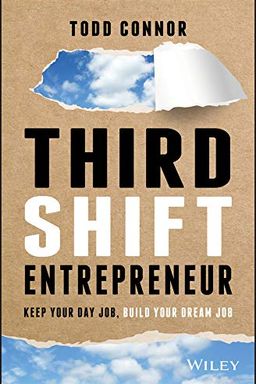
How can you pursue your entrepreneurial dream without risking your financial stability or family security? In Third Shift Entrepreneur, Todd Connor argues that you don’t need to gamble everything to build a business or follow your purpose. Instead, you can keep your day job while constructing your dream job bit by bit during your so-called “third shift”—the early mornings, late nights, and lunch breaks that most people spend passively. Connor contends that the myth of the overnight success story has held back millions from taking action, and that the way forward is through disciplined, incremental entrepreneurship that fits your real life.
Connor’s central premise challenges the traditional Silicon Valley narrative—the idea that success belongs only to young founders who drop out of elite schools or attract big investors. In reality, he says, sustainable, purpose-driven businesses are built by people who already have responsibilities, families, and careers. They aren’t “unicorns.” They’re everyday people who learn to claim their half hours and weekends to make something incredible. His book delivers a field manual for this overlooked population—what he calls “the rest of us.”
Redefining Entrepreneurship
Connor opens with an engaging story about Matt Carney, a mid-career professional who, like many readers, feels unfulfilled even after achieving conventional success. He loves his wife and makes good money, yet he dreads Monday mornings and questions whether he has ever truly honored his potential. Through Matt’s journey—and the unlikely friendship he develops with Cedric, a Lyft driver who also happens to be a CFO moonlighting to research his upcoming venture—Connor illustrates how entrepreneurial awakening rarely happens in a flash of inspiration. It starts with curiosity, a single conversation, and the willingness to listen when discomfort arises. The “third shift” mindset is more about discipline than risk.
Connor defines the “third shift” as the time after your regular obligations but before burnout—when you choose curiosity over complacency. It’s in this space, often squeezed between your job and your sleep, that transformation happens. He counters the all-or-nothing mindset perpetuated by startup culture: quitting everything to found a tech company is not the only valid entrepreneurial path. For Connor, every person can be a creator when they learn to align their purpose, skills, and energy toward solving real problems for real people.
A Playbook for the Rest of Us
The book presents itself as both a narrative and a manual. It reads like fiction through the life of Matt Carney but functions as a series of guided lessons, each chapter concluding with a Key Point, a Personal Inquiry, and Homework. These reflective exercises ensure that you aren’t just inspired but actually applying the concepts. Connor’s framework draws from his work with military veterans at Bunker Labs, where he witnessed countless men and women build successful enterprises while working full-time jobs and raising families. His message is radical in its accessibility: you don’t have to be rich or connected to start; you have to start with what you already have.
Connor introduces essential ideas that recur throughout the book, such as Breaking Patterns (disrupting unproductive habits), Getting Paid to Learn (finding ways to acquire knowledge through your day job or side gigs), Building an Audience (teaching rather than selling), and Calculating Your Return on Initiative (judging your progress by action, not investment). He insists that entrepreneurship is a skill set, not a personality type, and this skill can be honed by anyone.
Why This Approach Matters Now
Connor wrote Third Shift Entrepreneur as both a social commentary and a call to arms. He notes that only about one percent of venture-backed companies are founded by Black entrepreneurs and less than twenty percent by women. The institutional barriers that keep capital and mentorship locked in privileged circles have excluded massive populations from starting. His book provides a new playbook that replaces venture capital with community capital—mentorship, peer networks, and accountability groups that thrive outside Silicon Valley. (This mirrors the entrepreneurial inclusivity discussed in books like The Lean Startup by Eric Ries and Company of One by Paul Jarvis, which also celebrate sustainable growth over explosive scale.)
Connor’s message is ultimately one of agency: you don’t need permission to start. You need structure, courage, and a community that holds you accountable. Through the metaphor of “the third shift,” he reframes success as the daily choice to act on your creative impulses, however small. Whether you’re an overworked parent with a side hustle or a seasoned executive yearning for meaning, Connor insists there’s room for your dream within your existing life. The book’s stories—of veterans, coffee roasters, escape room designers, and nonprofit founders—prove that the extraordinary often begins with small, disciplined moves made during ordinary hours.