
Idea 1
Seeing the World Through Systems Thinking
When you face a stubborn problem that keeps coming back no matter what you do—whether it’s traffic congestion, workplace stress, or environmental degradation—how do you make sense of it? Donella Meadows’ Thinking in Systems invites you to step back from individual events and start seeing the hidden structures generating them. The book’s central claim is simple yet radical: to solve complex problems, you must shift from reacting to symptoms to understanding the systems that produce them.
Meadows argues that most of what we experience—economic booms and busts, organizational dysfunction, addiction, social inequality, and ecological crises—are not random or caused by single factors. They are the predictable behaviors of interconnected systems made up of stocks, flows, feedback loops, and delays. The power of systems thinking lies in recognizing that structure determines behavior. Once you understand how systems create their own behavior, you gain the ability to design them for better outcomes.
The Core Idea: Systems Cause Their Own Behavior
This insight challenges the way we traditionally assign blame. Politicians are accused of causing recessions, individuals are blamed for addiction, and corporations are faulted for pollution. But Meadows insists that these results arise not from isolated mistakes, but from system design—how feedback loops interact, how goals are defined, and how information flows throughout the network. Systems generate “messy” problems because their components are interconnected and constantly coevolve.
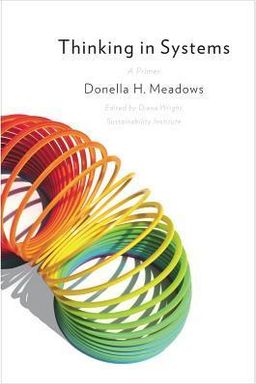
In her opening metaphor of a Slinky toy, the motion doesn’t come from your hand but from the spring’s structure itself. Likewise, social and ecological systems bounce between crises and recoveries because their internal feedbacks—positive loops driving growth, negative loops maintaining balance—create patterns. Understanding those loops gives you leverage to change the system’s behavior instead of fighting its surface events.
Why Systems Thinking Matters
Western society, shaped by reductionist science, emphasizes isolated causes and technical fixes. We’re taught to break problems into parts and look for linear causation. Meadows shows that this approach fails for complex issues like poverty or climate change because cause and effect loop back on each other. Systems thinking reclaims the holistic intuition we use unconsciously when managing living systems—families, gardens, bodies—where feedback and adaptation are natural.
“Serious problems—hunger, war, unemployment—persist because they are intrinsic to system structure.”
– Donella Meadows
By shifting focus from people and events to systemic design, Meadows encourages courageous rethinking: instead of attacking symptoms, ask what feedbacks, information flows, or goals perpetuate the issue. This change of lens is both empowering and unsettling—you realize problems are self-reinforcing, but their levers for change lie within reach if you learn to identify them.
How the Book Builds Systems Literacy
Across three parts, Meadows takes you on a full journey. First, she explores system structure and behavior—stocks, flows, and feedback loops—and why systems often surprise us. Next, she turns to systems and us, revealing why systems work so beautifully when functioning well, yet trap us when designed poorly. Finally, she offers guidance for creating change: identifying leverage points where small actions can yield major transformations, and cultivating attitudes for living wisely within complex systems.
Meadows’ examples move from simple devices like thermostats and bathtubs to large-scale ecosystems and economies. She bridges physics, biology, economics, and ethics, showing that similar feedback structures produce comparable dynamics everywhere—from population growth to market cycles. Her goal is not mathematical precision but intuition: to help anyone, regardless of technical training, “see systems” in action.
The Promise of Systems Thinking
Thinking in systems grants freedom—the freedom to look beyond blame and consider redesign. Systems, she writes, can be transformed through new information flows, revised goals, or changes in feedback strength. But Meadows also warns of humility: complex networks resist control. The aim isn’t prediction or domination, but “dancing with the system”—learning, adapting, and aligning with its natural rhythms. It’s a philosophy of cooperation rather than conquest, deeply resonant with ecological and spiritual wisdom (similar to Peter Senge’s The Fifth Discipline and Gregory Bateson’s systems ecology).
In the end, Meadows leaves you with both caution and hope: systems thinking is not a quick fix or formula, but a worldview shift—a way to perceive interconnections, anticipate unintended effects, and design gracefully for resilience. Whether dealing with personal challenges or planetary crises, she invites you to step onto the “systems dance floor” with curiosity, compassion, and courage.