
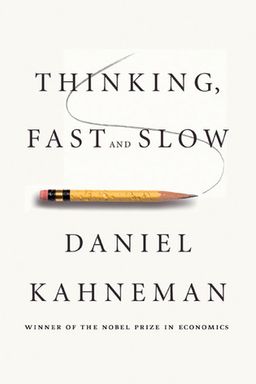
Thinking, Fast and Slow cover

Thinking, Fast and Slow

by Daniel Kahneman

Thinking, Fast and Slow by Daniel Kahneman delves into the dual processes of our minds, exploring the intuitive and deliberate systems that guide our decisions. Through decades of research, it uncovers cognitive biases and offers strategies for improved thinking and decision-making.

Thinking, Fast and Slow: The Story of Two Minds

Daniel Kahneman’s Thinking, Fast and Slow explores how your mind operates as two engines—the fast, intuitive System 1 and the slow, deliberate System 2. These systems explain why you often make confident but mistaken judgments, why effort feels costly, and how hidden forces shape choices from everyday life to major policy decisions. Kahneman, drawing on decades of research with Amos Tversky and others, replaces the myth of rational consistency with a portrait of the human mind as an intricate interplay between automatic reactions and effortful reasoning.

Two Systems Working as One

System 1 is fast, associative, and emotional—it detects threats, completes familiar patterns, and generates impressions without conscious control. When you see an angry face or answer 2 + 2, System 1 acts instantly. System 2, by contrast, is slow, analytical, and supervisory; it solves 17 × 24, resists temptation, or reasons about moral dilemmas. Most of the time System 1 dominates, with System 2 rubber-stamping its outputs unless surprised or challenged. This balance explains why you glide through routine life but struggle when faced with unfamiliar, high-effort problems.

Effort, Attention, and the Law of Least Effort

Effort is a limited resource—measurable through physiological signals like pupil dilation and increased heart rate. Kahneman’s pupillometry studies show that as System 2 engages, pupils widen, then contract as effort subsides. Your mind naturally favors least-effort paths: automatic reactions are tempting because sustained attention is costly. Skill acquisition reduces this cost—experienced chess players exert less cognitive effort for the same task because pattern recognition has been automated into System 1 (similar to Herbert Simon’s insights on expert intuition).

Intuition, Laziness, and Ego Depletion

System 2 avoids unnecessary strain—a “lazy controller.” Kahneman links this tendency to ego depletion: acts of self-control share a finite resource. After suppressing emotion or resisting temptation, your capacity for effort wanes. Studies by Roy Baumeister show that low glucose levels correlate with weakened control. Real-world data from parole judges illustrate the effect—decisions become harsher late in sessions as depletion sets in. Kahneman contrasts this fatigue with “flow,” a state where deep engagement feels effortless because motivation energizes System 2 without strain.

Priming, Association, and Hidden Influences

System 1 operates as an associative machine. Subtle cues—words, images, or environmental reminders—activate linked ideas and shape behavior unconsciously. Priming experiments (John Bargh’s “Florida effect,” Vohs’s money cues, eye-poster honesty box) reveal that incidental stimuli modify conduct and social attitudes without awareness. Kahneman warns you to design environments that minimize unwanted priming, acknowledging that autonomy is fragile under constant associative pressure.

Cognitive Ease and the Illusion of Truth

Fluent information feels true. Repetition, clear fonts, and simplicity produce cognitive ease, encouraging trust and acceptance. Strained processing—poor print, hard language—provokes skepticism and System 2 vigilance. Kahneman shows how illusions of truth emerge when fluent processing substitutes for real evidence. Repetition makes false claims more believable (Zajonc’s mere-exposure effect, Jacoby’s familiarity studies). The practical insight: design communication for clarity if the message is true, but induce deliberate strain when you want to guard against easy deception.

How You Jump to Conclusions

Your mind often answers difficult questions by substituting easier ones. This process, coupled with WYSIATI (“What You See Is All There Is”), explains intuitive errors: System 1 builds coherent stories from limited data, ignoring absent evidence. You judge risk by vividness instead of statistics, happiness by mood instead of long-term evaluation, and confidence by coherence rather than accuracy. The remedy is self-awareness—training System 2 to ask “What evidence am I missing?” and to resist overly fluent intuition.

From Statistics to Psychology

Many chapters translate these mental habits into statistical lessons: regression to the mean and base-rate neglect show why you mistake luck for cause. Kahneman’s flight-instructor anecdote reveals how people infer causal stories from inevitable reversions. Predictions improve when you combine the intuitive inside view with statistical base rates and regress toward the mean. These disciplined System 2 procedures counter the biases of System 1 storytelling.

Illusions of Understanding and Skill

After outcomes, hindsight bias convinces you that events were predictable, feeding overconfidence in narratives and “expert skill.” Kahneman’s research on Israeli Army evaluations and market forecasting exposes the illusion of validity—coherence masquerading as accuracy. He shows that simple algorithms often outperform professional intuition because rules are consistent and humans are noisy. Yet intuition can be trusted when environments are regular and feedback is immediate, as in chess or firefighting (Gary Klein’s recognition-primed decisions).

Risk, Emotion, and Framing

Tversky and Kahneman’s prospect theory redefines how you value outcomes. You measure gains and losses from a reference point and feel losses twice as strongly as equal gains. Framing—“keep” versus “lose”—thus changes choices and activates emotional brain regions like the amygdala. Loss aversion explains why people overpay for insurance, underinvest, and fear policy tradeoffs deemed taboo. Kahneman’s neuroscience collaborations show how emotion drives decisions even in trained experts.

Memory, Happiness, and the Two Selves

Late chapters shift from judgment to wellbeing. Kahneman distinguishes the experiencing self—which lives moments—from the remembering self—which narrates life stories. The remembering self dominates choices but misrepresents experiences, following the peak-end rule and neglecting duration. Experiments with colonoscopy pain or cold-water immersion prove that endings outweigh actual duration of suffering. You live by stories, not integrals of pleasure.

From Theory to Policy: Nudging Better Behavior

Finally, Kahneman connects cognitive findings to public policy and personal welfare. The Day Reconstruction Method measures real-time emotion to guide improvements in daily life. Thaler and Sunstein’s nudge framework applies these insights to design environments that steer people toward beneficial decisions—without coercion—using defaults, clear information, and small structural changes. The overarching lesson: by understanding when System 1 misleads and System 2 tires, you can design both personal habits and institutions that respect human limits while improving judgment.


Fast and Slow Thinking

Your mind understands and reacts through two systems. System 1 is automatic and intuitive, while System 2 is deliberate and analytical. Kahneman’s central insight is that you live by System 1 far more than you imagine. It forms first impressions, makes quick decisions, and shapes emotion. System 2 serves as a rational monitor but often defers out of laziness or fatigue.

How Intuition Works

System 1 reacts instantly by drawing on memory associations and learned patterns. A chess master spots a strong move in a blink because countless hours of practice have stored valid cues for System 1’s use. However, System 1 also produces confident illusions—seeing cause where none exists, misreading ambiguous pictures, or trusting first impressions. It values coherence, not correctness.

System 2 as Supervisor

System 2 does the hard work: calculating, reasoning, suppressing impulses. It feels effortful and is reflected physiologically in pupil dilation and heart rate increase. But System 2 is not always engaged; it defaults to accepting System 1’s conclusions unless obstacles arise. Attention is precious, and your mind follows the law of least effort—preferring shortcuts over diligence.

The Interaction that Defines You

Together, the two systems explain the illusion that you are a rational actor. Kahneman shows that thought is a partnership between an impatient storyteller and a reluctant fact-checker. Self-control depends on energy; when depleted, System 2 yields to impulse. The practical path forward is learning when to invite System 2 deliberately—during surprises, uncertainty, or high stakes—and how to design life so that costly effort is reserved for what really matters.


Biases and Mental Shortcuts

Human judgment relies on shortcuts called heuristics. Kahneman and Tversky catalogued dozens: representativeness (judging by similarity), availability (judging by ease of recall), and anchoring (starting from arbitrary numbers). These heuristics make life efficient but create systematic errors.

Jumping to Conclusions

You simplify hard questions through substitution—answering an easier question instead. Rather than estimating true risk, you react to vivid images. Rather than evaluating overall happiness, you describe your current mood. This pattern combines with WYSIATI (What You See Is All There Is): you form full judgments from what’s visible, ignoring missing data. The mental shotgun spreads activation to irrelevant areas, matching intensities between emotion and numbers.

Illusions of Truth and Ease

Fluency—how easily information is processed—guides belief. Clear fonts, repetition, and simple wording increase acceptance. Strained text or complex phrasing triggers caution. Cognitive ease seduces you into believing statements are true simply because they feel fluent, explaining why myths persist. Kahneman advises using deliberate complexity to activate skepticism when accuracy matters.

Association and Priming

Priming demonstrates how unconscious cues steer thought and behavior. Words related to age make people walk slower; money cues foster selfishness; pictures of eyes increase honesty. You are profoundly impressionable—System 1 builds coherence from cues without supervision. Awareness helps you counteract these effects or use them ethically in design and communication.


Statistics, Stories, and the Illusion of Understanding

System 1 loves stories, not statistics. Kahneman’s concept of norms and surprise shows how you construct coherence: you expect regularity and seek causes when anomalies arise. This storytelling impulse explains misinterpretations like confusing regression to the mean for real causal effects. Your mind connects dots faster than reality supplies them.

Regression and Prediction

Extreme results—good or bad—tend to revert toward average. Yet humans mistake this statistical inevitability for feedback: praising success seems to cause decline; punishment seems to help. Kahneman’s flight-instructor experiment captures this illusion vividly. The fix is learning to ask: “Was this change statistical or causal?” and applying regression-based corrections when forecasting (his four-step method combining base rate, intuition, and estimated correlation).

Hindsight and Overconfidence

After events, you construct stories of inevitability—the illusion of understanding. Hindsight bias and the halo effect lead you to overrate leaders after success and denounce them after failure. Kahneman shows that luck and randomness drive much of performance; yet coherent narratives feel satisfying. Distinguish process quality from outcome to judge decisions fairly.

The Expert Illusion

Professionals often convince themselves of skill because confidence feels like validity. Studies of traders and fund managers reveal near-zero consistency in success. Simple algorithms and equal-weighting rules outperform intuition because they eliminate noise. Yet true expert intuition exists—in regular, feedback-rich environments. Kahneman and Gary Klein agree: trust intuition when experience meets stability; otherwise, defer to data and rules.


Emotion, Framing, and Loss Aversion

Emotion dominates risk perception. Kahneman’s prospect theory replaces classical utility by modeling how you weigh gains and losses around a reference point. Losses hurt more than gains of equal size—typically by a factor of two. This asymmetry shapes choices from gambling to healthcare.

Frames That Flip Decisions

Identical outcomes trigger different reactions depending on phrasing. “Keep £20” versus “Lose £30” evokes opposite emotions, confirmed by fMRI data showing amygdala activation. The Asian Disease problem shows frame-dependent risk preferences: risk-averse for lives saved, risk-seeking for lives lost. Even doctors and judges succumb to framing effects—proof that emotional context outweighs professional training.

Moral Emotions and Taboo Tradeoffs

Loss aversion becomes strongest when moral stakes enter—a parent refusing tiny safety tradeoffs for money or society adopting the precautionary principle against innovation. These instinctive emotional shields prevent rational cost-benefit reasoning. Kahneman accepts their moral power but warns that taboo tradeoffs drain resources from larger dangers. Quantification helps reveal when raw emotion distorts proportionality.

Regret and Responsibility

You anticipate regret when deviating from defaults; action feels riskier than inaction. Studies show people blame themselves more for harmful actions than for omissions. Anticipated regret influences cautious decisions—in investing, medicine, and management. Kahneman suggests documenting reasoning or conducting “premortems” to expose potential failure stories before commitment, balancing emotional intuition with reflective planning.


From Happiness to Policy

Kahneman closes by shifting from judgment errors to the measurement of wellbeing. He distinguishes the experiencing self from the remembering self: the first lives in moments; the second constructs stories. What you later recall and use for decisions depends on peaks and endings, not on duration.

Peak-End and Duration Neglect

Experiments with painful colonoscopies and cold-water trials confirmed that memory tracks the intensity and end of experience, ignoring length. People even choose longer but better-ending episodes over shorter ones with sharper finales. This explains how the remembering self dominates—life as narrative outweighs life as lived.

Focusing Illusion

When you evaluate life, salient features—weather, income, or prestige—crowd attention. Kahneman’s California study shows that people overestimate climate’s impact because it is focal when imagining life there. The focusing illusion warns that “nothing in life is as important as you think it is while thinking about it.” Adaptation and shifting attention neutralize most enduring effects.

Measuring Happiness

To study real-time wellbeing, Kahneman devised the Day Reconstruction Method (DRM), capturing emotional episodes and computing the U-index—the proportion of time spent unhappy. These data reveal how daily routines, commutes, and social contact affect experienced happiness. Income correlates with reduced misery up to a threshold (~$75,000), beyond which satisfaction—not momentary emotion—rises. Policy should aim to reduce hours of suffering, not only raise income.

Designing Better Systems

Kahneman unites these insights with Thaler and Sunstein’s nudge philosophy: use behavioral science to create choice architectures that respect freedom but offset predictable flaws. Defaults, transparent rules, and feedback can steer individuals and institutions toward wiser, happier outcomes. The ultimate takeaway: your mind is brilliantly adaptive yet predictably flawed. Understanding its patterns lets you design both life and policy that honor human nature instead of denying it.

Dig Deeper

Get personalized prompts to apply these lessons to your life and deepen your understanding.

Go Deeper

Get the Full Experience

Download Insight Books for AI-powered reflections, quizzes, and more.