
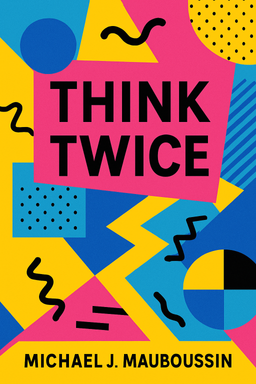
Think Twice cover

Think Twice

by Michael J Mauboussin

Think Twice exposes the cognitive biases and mental shortcuts that impair judgment and offers concrete strategies to counteract these pitfalls. By adopting an outside view and challenging assumptions, readers can make clearer, more effective decisions in complex situations.

Thinking Twice: Why Smart People Make Dumb Decisions

Why do incredibly intelligent people—Nobel laureates, CEOs, surgeons, and analysts—still make spectacularly bad decisions? This is the provocative question that Michael Mauboussin explores in Think Twice: Harnessing the Power of Counterintuition. He argues that intelligence alone doesn’t safeguard you from faulty reasoning. Instead, it's your ability to recognize and correct the biases and illusions built into your mental 'software' that determines decision quality.

Mauboussin draws from psychology, economics, and complexity science to show that our brains, designed for a simple, prehistoric world, struggle in modern contexts of probabilistic, interconnected systems. We crave coherence, even when reality is noisy. That mismatch leads to catastrophic misjudgments—from financial crashes to engineering disasters.

The Core Argument: Smart Is as Smart Does

Across fields like finance, medicine, and management, Mauboussin finds the same paradox: intelligent professionals making irrational decisions. Intelligence tests measure knowledge and logic but neglect rational thinking—the ability to calibrate evidence, anticipate error, and adjust beliefs. As the psychologist Keith Stanovich notes, rational thinking is more predictive of decision quality than IQ itself.

Our mental software has useful shortcuts (heuristics), but these can betray us. Cognitive illusions—much like optical ones—warp perception. Just as the eyes can’t help but misjudge a visual illusion, the brain defaults into errors like overconfidence, confirmation bias, and misjudged causality. The challenge is to learn when to trust intuition—and when to override it with structured thinking.

A Framework for Better Thinking: Prepare, Recognize, Apply

Mauboussin teaches counterintuition through a three-step process:

  • Prepare: Understand the systematic errors people make. Awareness of biases—like the planning fallacy or the illusion of control—is the first defense.
  • Recognize: Spot those biases in real-world context. Situational awareness helps you identify whether your decision environment is stable, changing, or complex.
  • Apply: Introduce deliberate practices to offset bias—decision journals, checklists, diverse feedback, and slow-thinking methods.

In Mauboussin’s own classroom experiments, students repeatedly fall into traps like the “winner’s curse” when bidding on a jar of coins—a simple but vivid example of how competition and overconfidence distort judgment. Yet, once made aware of these traps and trained to think “outside the mind,” their performance improves dramatically.

Why Thinking Twice Matters

The book’s subtitle—“Harnessing the Power of Counterintuition”—captures its heartbeat: smart decision-making often requires doing what feels wrong. Instead of seeking certainty, we must embrace probability. Instead of trusting experts blindly, we compare models, test assumptions, and consider the broader system.

From predicting racehorse victories (and misjudging Big Brown’s odds) to building airplanes or managing stock portfolios, Mauboussin shows how mental shortcuts—and misplaced confidence—lead professionals astray. You’ll learn to favor data over anecdotes, process over outcome, and context over impulse.

“Smart people make big, dumb, consequential mistakes.” – Michael Mauboussin

Ultimately, Think Twice is an optimistic book about human improvement. It offers a toolkit not to make you perfect, but to make you aware—to slow down before leaping to conclusions, to question certainty, and to see through your brain’s comforting illusions. The result is not just sharper decisions in business or investing, but better judgment about life itself.


The Outside View: Escaping the Bubble of Optimism

What do racehorse bettors, CEOs, and cancer patients have in common? They trust their inside stories too much. In the book’s first chapter, “The Outside View,” Mauboussin explores why Big Brown—a horse predicted to win the Triple Crown in 2008—turned out to be a “bad bet” despite extraordinary statistics. The answer lies in the human bias toward the inside view—relying on personal narratives and unique details—rather than consulting the broader base rates and history known as the outside view.

Inside vs. Outside Views

The inside view is the default human perspective: “This time is different.” We focus on details close to home—our company’s special culture, our project’s exceptional technology, or our horse’s unbeatable record. But the outside view asks: what typically happens in comparable cases? How have similar bets fared?

Statistically, fewer than 15% of horses who won the first two races of the Triple Crown went on to win the third since 1950. Yet bettors gave Big Brown odds suggesting a 75% chance—pure optimism. Psychologists Kahneman and Lovallo call this “the planning fallacy”: the tendency to underestimate risks, costs, and timelines because we ignore comparable outcomes.

The Three Illusions

  • Illusion of superiority: Most people think they’re above average at everything—driving, leadership, judgment. Statistically impossible, but emotionally irresistible.
  • Illusion of optimism: We expect our futures to turn out better than others’, even when facing identical odds.
  • Illusion of control: We act like random events bend to our will—rolling dice harder for “high” numbers or believing strategy guarantees success.

Together, these illusions make us overconfident gamblers of time, money, and credibility. Investors, for instance, believe they can outsmart markets despite clear evidence that active funds consistently underperform index averages—a prime case of misplaced control.

From Horse Tracks to Boardrooms

In corporate mergers, executives almost always believe their deal will be the one that bucks the trend. Research shows that two-thirds of mergers destroy shareholder value, yet boardrooms brim with confidence (“We can beat the odds”). The Dow Chemical acquisition of Rohm & Haas in 2008 was one such case: grand rhetoric met poor arithmetic.

How to Take the Outside View

  • Find a reference class: Look at similar past examples and calculate base rates before you estimate outcomes.
  • Assess the distribution: Know how wide results vary—what’s average, typical, and extreme.
  • Make predictions cautiously: Expect your estimate to be overly optimistic and adjust downward.
  • Fine-tune the forecast: Confront the uncertainty; rely on data, not desire.

“The best decisions often derive from sameness, not uniqueness.” – Michael Mauboussin

When facing complex choices—an investment, a job change, a marriage—don’t just ask: “What do I feel?” Ask: “What happened when others like me made this decision?” As Kahneman says, “the outside view is the single most powerful corrective to overconfidence bias.”


Open to Options: Escaping Tunnel Vision

Have you ever anchored your thinking on a number, even one you know is irrelevant? That’s the power of anchoring and adjustment, a cognitive trap Daniel Kahneman illustrated decades ago. In “Open to Options,” Mauboussin unpacks this and other mental models that narrow perspective and cause what he calls tunnel vision.

Anchors and False Certainty

When asked to estimate the number of doctors in Manhattan after writing down the last four digits of their phone numbers, students gave answers varying by 75%—proof that irrelevant numbers sway even trained minds. Anchors stick subconsciously, even when nonsense. Negotiators, for example, are influenced by the first offer—whoever anchors first sets the frame.

Anchoring is part of a general tendency to stop thinking once an answer seems plausible. As Nicholas Epley and Thomas Gilovich show, adjustments away from an anchor are insufficient because our brains “search for acceptable answers, not accurate ones.”

Mental Models and Illusions

We rely on internal representations—mental models—to navigate reality. But these models filter what we see, excluding what doesn’t fit. The result is a beam of reasoning that shines on what we believe while leaving alternatives in the dark. The representativeness heuristic (“he looks healthy, so it can’t be a heart attack”) and availability heuristic (“I saw a plane crash on TV, so flying must be unsafe”) distort professional decisions daily.

When Emotions Blind Us

Cognitive dissonance and confirmation bias further trap us in false consistency. We rationalize choices (“My intuition was right before”), forget contrary evidence, and surround ourselves with like-minded people. Drew Westen’s brain scans reveal that partisan political thinkers literally deactivate reasoning areas when reading evidence against their beliefs—their brains protect identity over truth.

Stress, Incentives, and Overload

Under stress, our minds regress to rule-of-thumb survival mode. As neurologist Robert Sapolsky shows, stress narrows focus to immediate threats, muting long-term reasoning—a physiological form of tunnel vision. Similarly, incentives distort thinking: surgeons choose high-paying procedures; lenders chase fees that worsen systemic risk. As Alan Greenspan later admitted, self-interest “failed to protect shareholders’ equity.”

How to Widen the View

  • List alternatives: Deliberately name multiple options before choosing one.
  • Seek dissent: Invite opposing views (Abraham Lincoln’s “team of rivals” remains a model).
  • Use decision journals to log reasoning, combating hindsight bias.
  • Avoid decisions in emotional extremes; clarity requires calm.

“When the stakes are high, you must force the light to swing across all possibilities.”

Tunnel vision feels comfortable because it simplifies the world. But as Mauboussin shows, the price of simplicity can be catastrophe. Complex problems demand more than instinct—they require space for options to breathe.


The Expert Squeeze: Why the Crowd or Computer Wins

For centuries, experts have ruled knowledge—priests, physicians, analysts. But in “The Expert Squeeze,” Mauboussin reveals how networks and algorithms are eroding that monopoly. Expertise remains valuable, but only where cause and effect are stable. Everywhere else, models and crowds outperform intuition.

When Best Buy’s Amateurs Beat the Pros

In 2005, Best Buy’s executive Jeff Severts tested a radical idea: he asked hundreds of employees, not analysts, to predict gift card sales. The average of the crowd’s guesses was 99.5% accurate—better than the company’s senior forecasters. This “wisdom of crowds” effect was later institutionalized as a prediction market, providing more reliable insights than hierarchies of experts ever did.

Diamonds, Doctors, and Data Crunchers

Ian Ayres’s “Super Crunchers” and Orley Ashenfelter’s wine regression formula show that equations often outperform intuition. By analyzing rainfall and temperature, Ashenfelter predicted Bordeaux vintages with astonishing precision, infuriating wine critics who relied on taste. Similarly, Netflix’s Cinematch algorithm routinely predicts your favorite film more accurately than any video clerk could. Data and diversity beat expertise in repetitive, rule-based domains.

Where Experts Still Matter

Experts excel when problems involve strategy, human interaction, or creativity—areas where emotion, nuance, and ethics matter. Doctors designing treatment plans, CEOs crafting culture, and coaches motivating teams rely on tacit knowledge that no model can mimic—yet.

Crowds, Diversity, and the “Jellybean Effect”

In Mauboussin’s classroom, students guess the number of jellybeans in a jar. Individually, most guesses are wrong, but averaged together, they’re astonishingly close. Diversity in guesses cancels out individual error—a principle Scott Page formalized as the Diversity Prediction Theorem: collective error = average individual error – prediction diversity. The more viewpoints, the smarter the group. However, if all members share the same biases, diversity collapses—and crowds become mobs.

“A diverse crowd will always predict more accurately than the average person in it.”

Still, blind faith in data is dangerous. Algorithms can mismatch metrics with meaning—the “mismatch problem” seen in sports combines that rate players on bench presses, not in-game performance. Similarly, markets fail when diversity breaks down, as during the 2008 crash when everyone made the same bets.

The expert squeeze isn’t the death of expertise—it’s the discipline of it. The best leaders now ask: Is this a problem of calculation, or one of judgment? If it’s the former, hand it to the machine or the crowd. If it’s the latter, bring in the human wisdom that can’t be coded.


Situational Awareness: The Power of Context

Ever bought more French wine because the grocery store played accordion music? In “Situational Awareness,” Mauboussin explores how invisible cues—music, framing, and social forces—shapeshift our judgments while we insist we’re objective. Context, not character, often drives behavior.

Seeing Is Believing What the Group Sees

Solomon Asch’s conformity experiments first showed that people knowingly give wrong answers just to align with the group. Decades later, neuroscientist Gregory Berns scanned their brains. Conformers didn’t just “fake” agreement; their visual processing actually changed. Their brains saw what the group said it saw. Independence, meanwhile, triggered fear responses in the amygdala—proof that dissent literally feels threatening.

The lesson? Nonconformity is biologically uncomfortable. Without awareness, even smart professionals adjust perception to fit group norms.

Primes, Defaults, and Subconscious Nudges

Retailers exploit what psychologists call priming: subtle sensory cues that shape behavior. Wine shoppers buy more French bottles with French music playing—while 86% deny influence. Likewise, organ donation rates hinge on default settings: opt-out nations have near-total consent; opt-in nations lag far behind. These aren’t ethical differences—they’re design effects, or what Richard Thaler calls “choice architecture.”

The Fundamental Attribution Error

We habitually explain others’ actions by disposition (“she’s careless”) instead of situation (“the system failed her”). But we excuse ourselves with context (“I was exhausted”). This bias blinds managers and jurors alike. Cultural psychologists like Richard Nisbett find Westerners especially vulnerable to it; Easterners, accustomed to interdependence, interpret behavior more situationally.

When Situations Turn Dark

Stanley Milgram’s obedience experiments and Philip Zimbardo’s Stanford prison study revealed that ordinary people can commit shocking acts when systems reward compliance and suppress empathy. Zimbardo later called this the “Lucifer Effect”: situational power can corrupt without malice. The antidote is awareness—seeing the frame before it traps you.

Fighting Contextual Blindness

  • Design good defaults—make the easiest choice the wisest one.
  • Ask “what’s the situation?” before judging character.
  • Watch for the “institutional imperative”: people imitate peers even when irrational (“you’ve got to dance while the music’s playing,” said Citigroup’s CEO before the crash).
  • Challenge inertia: question why “we’ve always done it this way.”

In short: you’re not just a product of your mind—you’re a product of your context. Design that context intentionally, and you’ll design better choices.


Complex Systems: Why Bees and Markets Outthink Us

Why can a swarm of bees find the best hive spot faster than a corporate task force with PowerPoint? Because collectives, when decentralized and diverse, often outperform hierarchies. In “More Is Different,” Mauboussin examines complex adaptive systems—markets, ecosystems, and organizations that evolve without central control—and why we misunderstand them.

From Ants to Investors

Biologist Deborah Gordon observed that while individual ants are dumb, colonies are brilliant. Similarly, bee swarms choose near-perfect homes through decentralized consensus. Each scout signals enthusiasm with longer dances; once about fifteen scouts converge, the swarm moves. The intelligence emerges from interaction, not leadership. The same applies to markets—price movements reflect collective decisions, not individual genius.

Why We Misread Systems

Humans crave simple cause and effect. We assume if individuals are irrational, the system must be too. But as economist Vernon Smith’s experiments show, markets can produce efficient outcomes even when participants have partial knowledge. The problem is that we study the 'ants'—individual traders or executives—when we should study the 'colony'—the market or organization. What emerges is synergy, not summation.

Unintended Consequences and Systemic Feedback

Tinkering with complex systems often backfires. In Yellowstone, well-meaning rangers fed elk to save them from starvation. The elk multiplied, destroying vegetation, which hurt beavers, which shrank trout habitats. Fixing one part broke the whole. Similar logic applies to financial systems: interventions (like bailouts or rate cuts) ripple through unpredictable feedback loops.

Hiring stars suffers the same trap. Harvard researchers found that when top analysts switch firms, their performance collapses—the system, not the individual, drove prior success. You can’t extract excellence from its ecosystem.

“If you want to understand an ant colony, don’t ask an ant.”

Thinking Like a Systems Designer

  • Analyze at the right level—system, not component.
  • Expect unintended consequences; complexity punishes hubris.
  • Simulate before acting—virtual experiments reveal hidden feedback.
  • Cultivate diversity and decentralization—the essence of resilience.

Complex systems thrive when autonomy and coordination coexist. Too much central planning—and innovation dies. Too little—and chaos reigns. The trick is designing systems that self-correct faster than they self-destruct.


Evidence of Circumstance: Context Over Correlation

In “Evidence of Circumstance,” Mauboussin issues a warning: beware flashy success formulas. Most fail because they confuse correlation with causality and mistake attributes for circumstances. The right answer to most business questions, he reminds us, is “it depends.”

The Birth-Order Debate

Psychologist Frank Sulloway’s bestseller Born to Rebel claimed that youngest children are natural innovators while firstborns defend tradition. The theory dazzled readers—until data scientists found it didn’t hold up. Birth-order effects appear only within families, not across society. Context (home vs. school) reshapes behavior. In other words, dispositions don’t travel well.

The lesson? Theories without situational boundaries—what Clayton Christensen calls “circumstance-based theories”—mislead.

When Boeing’s Dreamliner Became a Nightmare

Boeing outsourced much of its 787 Dreamliner design, expecting cost savings and faster assembly. Instead, delays snowballed as suppliers failed to coordinate. Outsourcing works for modular systems like computers, not for nonmodular, interdependent products like aircraft. Boeing trusted an attribute (“outsourcing improves efficiency”) without assessing circumstance (“degree of integration needed”).

Games of Competition and Chance

The Colonel Blotto game—a resource allocation exercise used in strategy and war—illustrates this balance. The more dimensions (battlefields), the more unpredictability and upsets. Likewise, industries with many moving parts favor agility over raw strength. Strategy must match environment, not ideology.

Correlation ≠ Causation

Mauboussin lampoons spurious statistics like “butter production in Bangladesh predicts the S&P 500.” Correlation dazzles but deceives. True causation demands three tests: X precedes Y, X varies with Y, and no unseen factor Z drives both. Few business “success patterns” pass these tests.

The Greenland Norse colonies that starved to death while ignoring Inuit survival techniques exemplify failed adaptation. They clung to ancestral farming out of pride—ignoring shifting context. In dynamic systems, rigidity kills faster than ignorance.

In short, good theories tell you when and why something works, not just that it works. Whether outsourcing, innovating, or investing, always ask: what are the boundaries of this idea? If you don’t know, your next triumph might already be turning into a Dreamliner debacle.


Grand Ah-Whooms: When Small Changes Trigger Chaos

Sometimes, everything seems fine—until it suddenly isn’t. In “Grand Ah-Whooms,” Mauboussin borrows physicist Philip Ball’s term for phase transitions to describe how small perturbations can create massive, unforeseen changes. The Millennium Bridge in London, which began swaying wildly on opening day in 2000, illustrates this beautifully—and dangerously.

Invisible Vulnerability

During stress tests, 156 pedestrians barely moved the bridge. Add just ten more—and it wobbled violently. The bridge’s lateral dampeners created positive feedback: as the bridge swayed, walkers adjusted their stride to match, amplifying motion. Systems can cross “tipping points” without warning. Before the crisis, they appear stable—right up until they aren’t.

This phenomenon, echoed in economics (bubbles, crashes) and culture (viral hits, revolutions), explains why forecasting feels futile. Causal forces remain hidden until the system flips.

Black Swans and Power Laws

Nassim Taleb’s “black swans” are extreme, unforeseeable events that break expectations. Most systems have fat-tailed or power-law distributions, meaning rare events dominate outcomes (in markets, wars, or books). These don’t follow simple averages. Yet models—like Wall Street’s Gaussian copulas—pretend they do, leading to catastrophic mispricing of risk.

Why Predictions Fail

From Bertrand Russell’s “thankful turkey” to Merrill Lynch’s 2008 losses, induction misleads: you can’t infer permanence from repetition. Reductive bias—oversimplifying complex dynamics—makes it worse. Economists favor tractable equations over true complexity, ignoring feedback and correlation spikes that precede collapses.

Music Labs and Virality

Duncan Watts’s “Music Lab” experiment proved social influence can amplify randomness. Identical songs ranked wildly differently across parallel worlds depending on early downloads. Popularity bred popularity—cumulative advantage in action. Like the Polya urn, where each draw reinforces itself, success snowballs into monopoly and mediocrity alike.

How to Think in “Ah-Whooms”

  • Study distributions—know whether you’re in bell curve or black swan territory.
  • Look for coordination and mimicry; less diversity means greater fragility.
  • Prepare for extremes—mitigate downside, capture upside (the “Kelly Criterion” principle).
  • Beware of forecasters who promise clarity in inherently unpredictable systems.

“Consequences are more important than probabilities.” – Peter Bernstein

Complex systems don’t break gradually—they leap. The moment before every collapse looks eerily ordinary. That’s why Mauboussin insists: if you want to survive the next “ah-whoom,” stop trying to predict it and start building antifragility instead.


Sorting Luck from Skill: How Success Misleads Us

Why do great companies stumble, hot streaks fade, and geniuses lose their edge? Because most outcomes in life mix skill and luck—and we’re terrible at telling them apart. In “Sorting Luck from Skill,” Mauboussin explores reversion to the mean, the halo effect, and how to evaluate performance without being fooled by randomness.

Galton’s Sweet Peas and the Law of Averages

Statistician Francis Galton discovered that tall parents have tall children—but shorter than themselves; short parents have taller children. Over time, luck regresses, creating stability. The same principle explains why star fund managers or .400 baseball hitters revert to average—the luck that lifted them dissipates.

The Three Mistakes of Misjudging Luck

  • Thinking you’re exempt: The “this doesn’t apply to us” fallacy blinds successful teams to regression.
  • Misreading data: Horace Secrist’s 1933 book The Triumph of Mediocrity misread mean reversion as a slide toward mediocrity, rather than variance reshuffling.
  • Attributing feedback to skill: Israeli flight instructors thought their scolding improved performance—it didn’t; their pilots simply regressed after unusually good flights.

Mauboussin’s advice: focus on process, not outcome. Praise good decisions that had bad luck; critique poor processes even when results look good.

The Halo Effect and Illusions of Greatness

Phil Rosenzweig’s The Halo Effect shows that we exaggerate favorable traits in success stories and reverse them when fortunes fall. ABB’s revered CEO Percy Barnevik went from “visionary” to “arrogant” as the company declined—same man, different halo. In truth, performance fluctuated around averages, not archetypes.

Separating Skill from Chance

Mauboussin offers a litmus test: can you lose on purpose? If yes, skill dominates (chess). If no, luck rules (roulette). Investing, sports, and business sit in between. When luck matters, sample sizes must be large—and feedback must focus on controllable actions, not random wins. Small samples and short-term metrics breed illusion.

“When outcomes are extreme, expect them to move closer to average next time.”

Mauboussin’s paradoxical conclusion: luck often determines short-term success, but skill in process design determines long-term survival. Train your feedback systems to reward good thinking, not just good outcomes—and you’ll outlast those still chasing halos.


How to Think Twice: Building Rational Habits

The book’s conclusion distills eight practical ways to “think twice”—converting insight into habit. Awareness without application, Mauboussin warns, is useless. Decision errors are preventable only when you train your mind and systems to catch them early.

1. Raise Your Awareness

Notice bad reasoning around you. Read news critically, ask how data was interpreted, and spot common fallacies like correlation = causation. Once you can identify errors in others, you’ll recognize them in yourself.

2. Adopt the Outside View

Use base rates before gut feelings. Every major life or business decision has precedents; find them and quantify outcomes.

3. Consider the Role of Situation

Judge others by context before character. Frame problems not as “who messed up?” but “what conditions made this result likely?”

4. Separate Skill from Luck

When evaluating yourself or others, default to process-based metrics. Don’t confuse streaks with skill or bad luck with incompetence.

5. Get Feedback (and Use It)

Create a decision journal to record reasoning, expectations, and outcomes. This combats hindsight bias and reveals patterns in judgment over time.

6. Build Checklists

Borrow from pilots and surgeons: reduce high-stakes errors to repeatable steps. Checklists don’t restrict thinking; they free cognitive bandwidth for creativity.

7. Perform a Premortem

Imagine your decision has failed—why? This exercise, devised by psychologist Gary Klein, reveals hidden risks before they strike.

8. Know What You Can’t Know

Accept uncertainty. Focus less on prediction and more on resilience—plan for outcomes, not probabilities.

“Virtually all surprises are unpleasant.” – Warren Buffett

Practiced together, these habits form a mental operating system for the modern world—one that balances logic with humility, intuition with reflection. Thinking twice isn’t about freezing up before choices; it’s about refining the way you see, so your first thought becomes better than your second guess.

Dig Deeper

Get personalized prompts to apply these lessons to your life and deepen your understanding.

Go Deeper

Get the Full Experience

Download Insight Books for AI-powered reflections, quizzes, and more.