
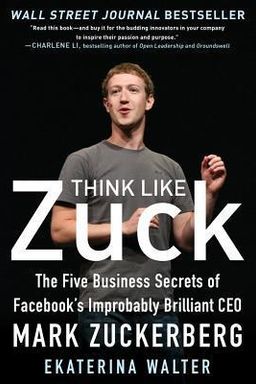
Think Like Zuck cover

Think Like Zuck

by Ekaterina Walter

Think Like Zuck unveils the five key principles behind Facebook''s phenomenal success. By exploring Mark Zuckerberg''s unique leadership style and strategies, this book provides a roadmap for entrepreneurs to innovate, inspire, and achieve sustainable success in their ventures.

The Zuckerberg Approach: Building with Passion, Purpose, and People

What separates the world’s most transformative innovators from the countless dreamers who never get beyond brainstorming? In Think Like Zuck: The Five Business Secrets of Facebook’s Improbably Brilliant CEO Mark Zuckerberg, social innovator Ekaterina Walter argues that real change happens when you combine a deep personal passion with a clear sense of purpose—and then surround yourself with people who share that vision. Her book isn’t just about Mark Zuckerberg or Facebook; it’s a blueprint for anyone who wants to build something enduring, whether you’re a start-up founder, a corporate leader, or an intrapreneur trying to shake up the system from within.

Walter lays out five interconnected principles—what she calls the “Five Ps”: Passion, Purpose, People, Product, and Partnerships. Together, they form the foundation of what she calls entrepreneurial vision. Through these, Zuckerberg turned a college dorm project into the world’s most influential social platform. But Walter goes far beyond Facebook, weaving lessons from other visionaries like Steve Jobs, Jeff Bezos, Tony Hsieh, and Blake Mycoskie (founder of TOMS) to show that these principles apply universally. If you’ve ever wondered how small ideas grow into movements that redefine industries, this book offers both inspiration and a practical guide.

Passion and Persistence as the Engine of Creation

Walter begins with Zuckerberg’s story—a young coder whose fascination with how people connect online fueled everything he built. From his earliest programs like Synapse to the infamous Facemash, his obsession with human relationships manifested in code. Passion, she argues, is what kept Zuck grounded during setbacks like the Facemash scandal or early rejections from investors. It’s a theme mirrored in stories of other entrepreneurs: from TOMS founder Blake Mycoskie’s “one for one” shoe idea born out of compassion, to Dyson’s 5,127 prototype failures before success.

Passion powers perseverance, and perseverance separates dreamers from doers. Zuckerberg didn’t wait for the university to create a social network for students—he built one. (In Start with Why, Simon Sinek similarly notes that purpose-driven leaders inspire action even without certainty or resources.) Passion isn’t about comfort; it’s about being restless enough to solve problems no one else sees.

Purpose: The “Why” That Makes Success Sustainable

Walter’s second principle, Purpose, builds on Sinek’s concept of starting with why. A company’s purpose isn’t just a slogan—it’s its DNA. Zuckerberg’s purpose was to make the world “more open and connected,” a mission embodied in Facebook’s evolution. Instead of selling early, even when Yahoo offered $1 billion, he held firm because his mission wasn’t profit—it was connectivity. Walter compares this with other purpose-led brands like Apple (“Think Different”) and Coca-Cola (“Inspire Happiness”). Purpose gives a company authenticity and longevity. Without it, initial successes crumble when trends shift.

This focus on purpose also informs leadership decisions. Zuckerberg’s IPO letter declared, “We don’t build services to make money; we make money to build better services.” Walter points out that this philosophy mirrors the long-term thinking of Amazon’s Jeff Bezos, who ignored Wall Street’s impatience and built enduring customer value instead of chasing quarterly gains.

People: Culture as a Strategic Advantage

No vision can be realized alone. The third principle, People, focuses on the quality of talent and culture. Zuckerberg’s hiring philosophy—“We look for people who are passionate about something”—led to Facebook’s hacker culture: fast, flat, and fearless. Walter parallels this with Zappos, where CEO Tony Hsieh institutionalized happiness and weirdness into company values. She observes that great companies recruit for attitude and values, not just skill. Facebook, for instance, empowers engineers to push code live—often terrifying but liberating. Walter also celebrates internal innovation rituals like hackathons and boot camps that nurture creativity. The right people don’t need micromanagement; they need permission to lead.

Product: Build Around People, Not Technology

Walter’s fourth principle turns to the product itself. Facebook’s success, she says, stems from putting human connection—not flashy technology—at its center. Zuckerberg’s dual studies in computer science and psychology defined his vision: to replicate real relationships online. From the introduction of the Wall to News Feed and Photos with tagging, every feature prioritized social behavior. When backlash hit, Zuckerberg trusted his data and intuition, teaching leaders to balance critique with conviction. Walter reminds readers how products like Dyson’s vacuum or 3M’s Post-it notes came from relentless iteration and empathy for how people actually live and work. In short: Build what people love, then refine endlessly.

Partnerships and the Power of Complementary Strengths

The fifth and final principle—Partnerships—explores the synergy between the visionary and the builder. At Facebook, that duo is Zuckerberg and COO Sheryl Sandberg. Where Zuck brings intuitive product focus, Sandberg delivers operational mastery. Walter calls this dynamic the “Visionary-Builder model,” reminiscent of pairs like Hewlett and Packard, or Walt and Roy Disney. True partnerships thrive when differences complement rather than compete. For entrepreneurs, she advises finding collaborators who share your core values but fill your skill gaps.

Why These Ideas Matter

Walter’s underlying claim is that innovation isn’t luck—it’s leadership anchored in values. Facebook’s story teaches us to think long-term, to grow deliberately rather than chase hype, and to value design simplicity and user empathy above all. And while the book centers on Zuckerberg, its message is universal: visionary success requires daring—what ancient wisdom calls qui audet adipiscitur, or “who dares, wins.” If you’re ready to build your own movement, these five Ps aren’t just business secrets—they’re a personal philosophy for making ideas matter.


The Fire That Sparks Action: Passion

Mark Zuckerberg’s journey began not with a business plan but with obsession. In high school and at Harvard, his fascination with communication led him to build small but socially tuned bits of software—like Zucknet for his family and CourseMatch and Facemash at college. Ekaterina Walter frames this early experimentation as proof that true entrepreneurs aren’t waiting for permission—they act because they can’t not act. Passion, she says, is both catalyst and compass: it keeps you going when logic tells you to quit.

Failure as Fuel for Learning

When Facemash landed Zuckerberg on Harvard’s disciplinary board, he didn’t sulk—he learned. Instead of abandoning the idea, he refined it into Facebook, where users joined voluntarily and managed privacy themselves. Walter highlights this response as the mark of passionate leadership: transforming mistakes into prototypes. (Thomas Edison’s remark, “I failed my way to success,” echoes this mindset.) Passionate creators, she insists, see false starts not as setbacks but as iterations.

Action Trumps Intellect

Walter contrasts Zuckerberg’s bias for action against the paralysis of planning. Many brilliant minds generate ideas but never execute them. Zuckerberg coded first and refined later, reflecting Facebook’s mantra “Done is better than perfect.” Walter connects this to Edison, Lauder, and Jobs—people who dared experimentation over talk. Studies she cites show that those who pursue what they love are exponentially more successful than those chasing financial security. Passion breeds energy, and energy breeds results.

Authentic Passion Creates Alignment

You can’t fake passion, Walter warns. Zuckerberg’s authenticity—living simply, driving a modest car, focusing on users before money—built trust with his team and investors. His leadership reflects what Jeff Bezos calls being “willing to be misunderstood for long periods of time.” Genuine enthusiasm creates resilience because it turns work into purpose. As Walter writes, people with passion don’t just see storms coming; they ride them.

The lesson for you: Find the thing you’d chase even if it never paid off, then act on it now, not when conditions are perfect. Passion is the seed of every empire because it transforms discipline into joy and failure into practice. Without it, business ambition remains motionless theory.


Live Your Why: The Power of Purpose

Walter’s second pillar is purpose—the reason your work deserves to exist. Drawing from Simon Sinek’s Start with Why, she argues that successful companies sell belief, not products. Zuckerberg built Facebook to make the world more open and connected, not to build a trendy website. This clarity guided every decision—from rejecting early buyout offers to designing features that mirrored authentic relationships. Purpose turns conviction into compass, helping leaders stay the course when pressure mounts.

The Mission as Decision Filter

When Yahoo offered $1 billion for Facebook, Zuckerberg declined because selling contradicted his vision. He knew Facebook had barely begun connecting the world. Walter compares this to Bezos ignoring critics while building Amazon for the “great expanse of time ahead.” Purpose acts as your strategic north star—it helps you prioritize meaning over short-term rewards.

Authenticity and the Long Game

Purpose also creates authenticity. “We make money to build better services,” Zuckerberg wrote in his IPO letter. Walter notes that this long-term mindset shields companies from the volatility of trends. Leaders focused on mission attract loyal employees and customers who share their values. She points to other purpose-driven models: TOMS’s social giving, Zappos’s delight-focused service, and Disney’s pursuit of joy. Purpose roots these brands in something timeless—the improvement of human life.

Practical Purpose: The Hacker Way

For Facebook, purpose translates into action through “The Hacker Way.” This culture champions continuous iteration, openness, and boldness, aligning perfectly with Zuckerberg’s belief in progress through connection. Every design choice and organizational value—moving fast, breaking things, staying open—is an operational echo of purpose. Purpose isn’t mystical; it’s managerial, shaping how teams think and innovate.

The challenge Walter sets for you is simple but profound: Define your why, communicate it clearly, and make every choice pass its test. As history shows—from Apple’s creative rebellion to Ford’s democratization of travel—companies that lead with purpose transform industries, while those chasing profit alone quickly fade.


Culture Is Destiny: People and Passionate Teams

If passion ignites and purpose guides, people sustain. Walter’s third principle examines how Zuckerberg and other leaders create cultures that multiply vision through teamwork. She opens with a simple truth: Success is a team sport. At Facebook, Harvard dorm mates became revolutionaries. As the company grew, Zuckerberg focused on hiring people who shared his enthusiasm for impact, not just those with perfect résumés.

Hiring for Attitude, Not Credentials

Zuckerberg looks for initiative—people who have “shown an ability to act.” Walter compares this to Tony Hsieh’s recruiting at Zappos, where cultural fit outweighs technical skill. The best people aren’t just competent—they’re emotionally invested. Facebook uses puzzles and boot camps to identify curiosity and courage. Engineer Andrew Bosworth created a six-week initiation to teach recruits how to “think like Zuck,” empowering them to fix bugs and push changes live. It’s baptism by creative fire.

Empowerment and Trust

Walter underlines empowerment as Facebook’s superpower. Hackathons, open-office debates, and “code wins arguments” policies give everyone a voice. This environment mirrors Zappos’s trust-first leadership and Intel’s intrapreneurial encouragement. True leaders breed leaders—they set direction but invite dissent. Zuckerberg’s weekly Q&As and open-door policy ensure transparency, making innovation safe yet bold.

Culture Maps and Shared Belief

Walter profiles XPLANE’s visual culture map to illustrate intention in design. While Facebook’s culture isn’t pictured on a wall, its slogans—“Move fast and break things,” “Stay focused and keep shipping,” “This journey is 1% finished”—function as living maps. They remind every employee that progress never stops. Like Facebook, great cultures operationalize belief so that every meeting, hire, and project reinforces purpose.

To lead like Zuckerberg, cultivate a culture that rewards initiative over caution and openness over hierarchy. People are indeed your brand—and if they’re empowered to own the mission, they become your loudest advocates. Walter’s conclusion echoes Tony Hsieh’s mantra: “For organizations, culture is destiny.”


Design for Humans: The Product Philosophy

Walter’s fourth P—Product—focuses on Facebook’s obsession with human-centered design. Zuckerberg’s double major in psychology and computer science shaped his conviction that technology should mimic real-life connection. “It’s as much psychology and sociology as technology,” he told students at Brigham Young University. This insight—starting from human needs, not technical possibilities—became Facebook’s product hallmark.

People Over Platforms

Walter shows how Facebook’s simple interface and features like the Wall, News Feed, and Photos evolved from behavioral observation. Engineers watched how users lingered on profiles and designed tools to make sharing effortless. Early critics mocked the site’s plainness, but for Zuckerberg, minimalism was intentional: let the product disappear so people can connect. This “social design” mirrors Apple’s philosophy of simplicity and human intuition.

Strategic Growth Without Collapse

Facebook’s expansion wasn’t reckless. Walter highlights how Zuckerberg controlled growth to avoid the fate of Friendster, whose servers couldn’t handle demand. He added schools only when infrastructure supported them, showing that pacing can be strategic leadership. Innovation isn’t always about speed—it’s about sustainability.

The Lessons from Iteration

Walter parallels Facebook’s iterative approach to 3M’s “15 Percent Time” and Dyson’s prototyping. The Wall became Timeline; Photos gained tagging; News Feed faced protests but ultimately transformed online interaction. These evolutions reveal a core product principle: Listen but lead. Data can guide, but vision must decide. Building great products means balancing empathy for users with courage to surprise them.

The takeaway: Design isn’t decoration—it’s empathy in motion. Build products that reflect how humans think, connect, and feel. Simplicity, iteration, and strategic pacing keep innovation alive long after the first release.


Partnerships That Multiply Vision

Walter’s final principle—Partnerships—reveals how great visionaries balance imagination with execution. Zuckerberg found his complement in Sheryl Sandberg, Facebook’s COO. While he focused on the platform and culture, she built business infrastructure and scaled revenue. Walter calls this union the “Visionary-Builder model”—a dual engine of creativity and discipline. Successful partnerships, she argues, aren’t about similarity but synergy.

The Visionary and the Builder

Zuck and Sandberg’s weekly feedback huddles exemplify mutual respect and clear communication. Walter compares their teamwork to historic duos: Hewlett and Packard, Walt and Roy Disney, and even the Beatles, whom Jobs admired for collective balance. Partnerships thrive when both parties share purpose but contribute different strengths. Zuckerberg’s product intuition meets Sandberg’s organizational mastery, creating stability without dulling innovation.

Rules for Lasting Collaboration

Walter distills seven philosophies for successful partnership: setting clear expectations, aligning vision, practicing trust, exchanging value fairly, leveraging complementary skills, maintaining commitment, and upholding mutual respect. Each rule comes alive in real examples—from the collaborative spirit at JESS3 to HP’s founder friendship forged in a garage. Strong partnerships reflect balance: yin meets yang, visionary meets operator.

Her advice applies broadly—to entrepreneurs, intrapreneurs, and teams within large organizations. When you find your own Sandberg, you unlock exponential impact. As Walter quotes a Latin motto: Qui audet adipiscitur—who dares, wins. Daring also means sharing that dream with someone who helps build it into reality.


Dare, Fail, and Build: The Long-Term Mindset

In her closing chapters, Walter widens the lens to examine how Zuckerberg’s philosophy of patience and iteration mirrors other long-term pioneers. Facebook didn’t rush into monetization or acquisitions; it built first, profited later. Walter compares Zuck’s “Book of Change” strategy to Steve Jobs’s ten-year patience with Pixar and Bezos’s enduring risk tolerance at Amazon. Great leaders, she declares, run marathons, not sprints.

Faith in Endurance

From refusing billion-dollar buyouts to weathering public protests, Zuckerberg demonstrated faith in his vision’s eventual resonance. Walter parallels this with innovators who defied critics once labeled foolish: the inventors of radio, telephone, and FedEx’s overnight delivery, all mocked before success. Sometimes, she writes, the best strategy is simply belief.

The Lesson of Failure and Reinvention

Drawing from James Dyson’s 5,126 failed prototypes, Walter reminds readers that error is evolution’s engine. Dyson’s persistence produced breakthroughs, as did Facebook’s willingness to test unpopular features like Beacon or News Feed until they matured. The commonality among disruptors—Bezos, Jobs, Zuckerberg—is courage to experiment publicly. They treat innovation as conversation, not perfection.

Make Innovation Personal

Walter concludes with a call to make innovation personal—give employees creative freedom and time, as 3M does with its “15 percent program.” Let them follow passions to invent the next Post-it—or the next Timeline. True innovation thrives on autonomy and tolerance for failure. Like Zuckerberg’s motto, “This journey is 1 percent finished,” the commitment to continuous learning transforms both people and organizations.

Walter’s final message is equal parts business insight and existential challenge: dare boldly, focus deeply, and build patiently. Every remarkable company—from Facebook to Dyson—proves that endurance, not genius, is the ultimate advantage.

Dig Deeper

Get personalized prompts to apply these lessons to your life and deepen your understanding.

Go Deeper

Get the Full Experience

Download Insight Books for AI-powered reflections, quizzes, and more.