
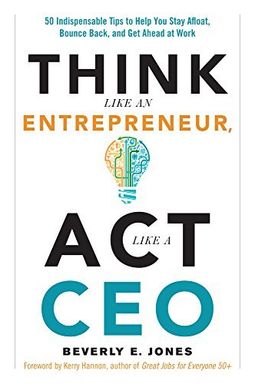
Think Like an Entrepreneur, Act Like a CEO cover

Think Like an Entrepreneur, Act Like a CEO

by Beverly E Jones

Think Like an Entrepreneur, Act Like a CEO by Beverly E. Jones provides 50 essential tips for navigating today’s unpredictable career paths. Learn to adapt, innovate, and lead with resilience, ensuring your professional journey is both fulfilling and successful.

Think Like an Entrepreneur, Act Like a CEO

What would happen if you treated your career like your own small business — if you were both its creative founder and strategic CEO? In Think Like an Entrepreneur, Act Like a CEO, Beverly E. Jones argues that the secret to modern career success lies in adopting this dual mindset. She believes that professionals at any age or level can no longer rely on traditional ladders, job titles, or corporate stability. Instead, you must become both adaptable and self-directed — capable of innovation, leadership, and sustained resilience in an ever-changing work environment.

Jones contends that thriving in your career today requires entrepreneurial thinking — a curiosity-driven approach that sees opportunity in uncertainty — paired with the steady discipline of a CEO’s managerial mindset. You have to own your career as a living enterprise, always scanning for growth, partnerships, and reinvention. This is not just survival advice; it’s an empowering call to design a rewarding, purposeful work life that evolves with you.

A New Landscape of Work

Jones begins by acknowledging that the rules of professional success have changed. Gone are the days when hard work, loyalty, and conformity guaranteed lifelong security. In the contemporary work world, change is constant, companies merge and dissolve, and technology disrupts old industries overnight. This transformation isn’t just affecting young workers; it impacts mid-career professionals and even those in their sixties who must keep retooling to stay relevant.

For much of the past century, careers were linear: pick a firm, climb the ladder, and collect your pension. But now, as Jones writes from her own experience — having moved from journalist to lawyer to Fortune 500 executive to career coach — professional life has become fluid. It involves multiple roles, cross-sector moves, learning bouts, and personal reinventions. You might be an employee, entrepreneur, volunteer, or student — sometimes all within the same year. Your career is no longer separate from your broader life; it encompasses how you grow intellectually, emotionally, and socially.

The Entrepreneurial Mindset

At the core of Jones’s philosophy is her definition of the entrepreneurial mindset. Entrepreneurs don’t wait for instructions — they observe needs, spot openings, and create value. They see obstacles as puzzles, not barriers. You might not be starting a company, but you can bring this spirit to your role inside any organization. Jones introduces the term “intrapreneur” to describe employees who act like innovators within their firms: identifying unmet needs, building cross-departmental alliances, and shaping projects that add new value. (This echoes Peter Drucker’s idea of the “knowledge worker,” who acts as an independent agent of innovation within a system.)

Entrepreneurial thinking, Jones suggests, rests on curiosity, optimism, and continuous learning. You need to cultivate flexibility: to pivot when the company restructures, to learn emerging technologies, or to network beyond your habitual circles. Above all, entrepreneurs focus on the customer — a metaphor for caring deeply about the needs of your colleagues, supervisors, and clients, and shaping your work to serve them better. This mindset values experimentation over perfection — progress through small, iterative improvements.

Acting Like a CEO

If entrepreneurial thinking drives innovation, acting like a CEO ensures sustainability and accountability. CEOs don’t wait for rescue from above; they make and own tough decisions. They manage their resources — time, relationships, and energy — strategically. They understand branding, meaning they’re aware of how others perceive them. And like effective CEOs, they’re skilled listeners and collaborators. Jones argues that to truly steer your career, you must combine creative initiative with practical rigor: crafting clear goals, measuring progress, managing stress, and keeping your personal “brand” consistent with your highest values.

She invites you to see yourself as “Me Inc.” — a one-person firm whose success depends on strategy, reputation, and continual professional development. Thinking like a CEO means balancing short-term pressures with a long-term mission. It also means leading without authority — learning how to influence, coach, or mentor others even if you’re not the one with the title.

Adaptability and Resilience

Entrepreneurial thinking and CEO-like leadership both rely on adaptability and resilience — qualities Jones sees as learnable, not innate. She tells her own story of career changes, from losing her corporate role after a merger to rediscovering her passion as an executive coach. Resilient people, she notes, don’t cling to security or dwell on setbacks. Instead, they anticipate risk, accept change, and rebound quickly. They maintain their energy and confidence even when circumstances fluctuate. You cultivate resilience by mastering small challenges — the way incremental progress builds your “confidence muscle.”

To build resilience, Jones recommends two key habits: continuous learning and self-management. Keep expanding your knowledge, not just through formal training but through conversations, reading, and trying new roles. Simultaneously, manage your health — physical, emotional, and spiritual. Your career depends on your ability to perform sustainably, which requires energy, focus, and emotional balance.

Why This Book Matters

The book’s 50 short chapters each address a workplace challenge, from how to impress your boss and accept feedback to conquering fear, building networks, fostering creativity, and managing career transitions. Yet behind each tactic lies a broader philosophy: success in modern work comes from agency, relationships, and optimism. Jones distills decades of experience as a lawyer, corporate executive, and coach into empowering lessons you can apply in any phase of your career.

“Your career is not what happens to you — it’s the enterprise you build, shape, and lead.”

Ultimately, Think Like an Entrepreneur, Act Like a CEO challenges you to redefine how you approach work. Instead of viewing your career as a series of jobs or promotions, see it as a creative enterprise in which you are the founder and chief executive. You must cultivate curiosity, self-leadership, emotional intelligence, and optimism — and use them to turn instability into opportunity. In doing so, you’ll not only survive but thrive in the new world of work.


Own Your Career Like an Entrepreneur

Jones’s central premise is simple but profound: no one else is in charge of your career. You are the CEO of your professional life. This shift in mindset transforms how you respond to challenges, setbacks, and opportunities. Instead of waiting for instruction, you begin to anticipate trends, spot openings, and act decisively — like an entrepreneur.

Think Like an Intrapreneur

Not everyone wants to start a business, but anyone can act like one. Jones shows how the best employees inside large institutions act as “intrapreneurs” — internal innovators who think beyond job descriptions. When she worked at Consolidated Natural Gas Company, a Fortune 500 energy firm, Jones learned this first-hand. Hired as a public affairs executive, she realized that success required marketing her department’s expensive new initiatives to top management every budget cycle. She discovered that even inside a huge organization, it’s only the entrepreneurial thinkers who thrive.

Her insight: every job exists in a marketplace. You have “customers” — your boss, team, and clients — who determine whether you succeed. By viewing colleagues as customers, your focus shifts from pleasing yourself to delivering value to them. Entrepreneurs survive because they know who they serve. So should you.

Core Principles of Entrepreneurial Thinking

  • Know the mission. Internalize your organization’s broader purpose and understand how your work contributes. Alignment creates leverage.
  • Focus on customers. Whether internal or external, customers are the reason your role exists. Listen to their needs and exceed expectations.
  • Understand the business. Learn how money, decisions, and influence flow in your company. Entrepreneurs don’t just do — they analyze systems.
  • Be comfortable with failure. Jones quotes the adage, “Entrepreneurs fail their way to the top.” Mistakes are experiments, not verdicts.
  • Choose positivity. Optimists create opportunity; pessimists preserve problems. Rosen’s rule: train yourself to expect possibilities, not pitfalls.

From Bureaucracy to Creativity

Jones contrasts her early SEC government job — predictable and structured — with the creative chaos of private law practice, where client-building demanded entrepreneurial drive. This shift was her awakening: careers aren’t preplanned scripts but evolving enterprises. Thinking like an entrepreneur frees you from institutional dependency. It pushes you to stay curious, innovate, and continually reinvent yourself.

(Note: Jones’s argument aligns with Tom Peters’s “brand of one” philosophy from The Brand You 50. Both stress self-reliance and identity as the path to career freedom.)


Build a Brand That Reflects Leadership

Your career brand — the impression you leave on others — shapes how opportunities find you. Jones insists that you already have a brand, whether or not you’ve crafted one. The key is to make it deliberate: clear, professional, and rooted in your true values.

Reframe Branding as Authenticity

Many professionals recoil at the word “branding,” imagining slick marketing or insincerity. But as Jones clarifies, your professional identity isn’t a facade — it’s the outward expression of your inner purpose. Personal branding isn’t manipulation; it’s self-awareness applied strategically.

Example: Sally’s Makeover

Sally, a tech project manager, was skilled and collaborative yet kept being passed over for promotions. Her boss described her as “a flake.” The culprit? Sally’s eccentric wardrobe and incessant talk about her fantasy conventions. Her hobbies had overwhelmed her brand narrative. With coaching, Sally took practical steps to align her public image with her professional ambitions: dressing more like her leaders, focusing conversations on her technical growth, and publishing a how-to guide to build credibility. Within months, she was seen as “mature and innovative.”

Sally didn’t sell out; she recalibrated. The new brand reflected her authentic professional strengths — not her weekend alter ego.

Components of a Leadership Brand

  • Image: Your visible expression — dress, energy, demeanor — communicates seriousness and confidence.
  • Expertise: Establish niche knowledge others depend on. Publish, teach, or present your skills.
  • Consistency: Align behavior, communication, and decisions with your stated values.
  • Visibility: Promote your work — not arrogantly, but factually. Leaders share credit but take accountability.

Building Credibility Online

In the digital era, your online footprint amplifies your brand. LinkedIn profiles, articles, and even casual social posts require awareness. Jones suggests starting small — posting thoughtful summaries, updating professional achievements, and connecting with mentors. Online presence now equals professional presence.

(Compared with Dorie Clark’s Reinventing You, Jones’s approach is less about massive transformation and more about refinement — subtle, strategic shifts rooted in daily behavior.)


Listen Deeply and Lead Through Connection

If there's one superpower Jones could gift every professional, it would be the ability to truly listen. She writes that deeper listening is not only the fastest route to understanding others but also the foundation of influence and leadership.

The Science of Listening

Neuroscience shows that people feel valued when their concerns are acknowledged. Mindful listening triggers empathy and trust. Too many of us focus on what we’ll say next or mentally defend our positions. Jones’s key insight: when you genuinely listen, you transform relationships — you turn critics into allies and subordinates into collaborators.

Six Moments to Listen Harder

  • When starting something new — ask questions before offering expertise.
  • As a leader — let the team talk first. Reflect back what you hear.
  • When making a case — frame your arguments around others’ priorities.
  • When caught in office conflict — take both sides seriously; neutrality earns trust.
  • With difficult colleagues — genuine attention diffuses tension.
  • When you want presence — confident people don’t need to talk constantly. Silence can project strength.

Jones combines empathy with practicality: practice with low-stakes conversations, consciously quiet your inner voice, note body language, and reflect compassion. These micro-habits, she argues, elevate your charisma more than any speaking workshop ever could.


Plan Change One Grain at a Time

When you face career shifts — or any major goal — the hardest part is getting started. Jones’s “Sugar Grain Principle” offers a deceptively simple method: change your life through small, continuous action. Big moves begin with grains of effort.

The Origin Story

As a teenager, Jones decided to cut sugar from her tea but found the task unbearable. So she removed just a few grains each day. A year later, she was drinking sugarless tea — effortlessly. She later applied the same logic to activism, committing to do one small “thing” each day to advance women’s equality at Ohio University. These micro-actions snowballed into a major reform: she became the school’s first MBA woman and later led Title IX implementation.

Her lesson: lasting change rarely comes from giant leaps. It comes from consistent tiny steps that build momentum and courage.

The Five-Step Sugar Grain Process

  • 1. Develop a vision. Create a wish list of everything you’d like in your future. Start broad — clarity comes from action.
  • 2. Define goals. Select two or three achievable priorities that move you toward the vision.
  • 3. Create your grains. Break each goal into tiny, painless actions. One email, one class, one conversation.
  • 4. Set a pace. Commit to a regular rhythm — one grain daily, or a few weekly — and never stop.
  • 5. Keep records. Note every grain. Patterns emerge, insights grow, motivation multiplies.

Jones stresses that small actions create feedback loops: one success seed produces another. You don’t have to see the full destination — only the next reachable step. The process works because action precedes clarity, not the other way around.

“You’ll start to trust the Sugar Grain Process — and that trust will generate its own energy.”

Whether you’re switching fields, recovering from burnout, or returning to work, one grain a day is how transformation becomes sustainable.


Use Feedback and Gratitude to Grow

Praise and feedback are your career’s hidden accelerators — when you learn how to accept and give them well. Jones teaches that the ability to handle appreciation gracefully and provide positive reinforcement to others separates strong leaders from insecure workers.

Receiving Praise Without Awkwardness

When her partners complimented Jones’s legal work early in her career, she would reflexively say “Oh, it was nothing.” Later she realized this humility backfired — it deflated the praise and made colleagues underestimate the value of her effort. A better response? Smile, say thank you, express pride in the result, and share credit sincerely. Simple, confident acknowledgment shows professionalism, not arrogance.

The 80/20 Rule of Positivity

Jones cites research showing that teams perform best when roughly 80% of feedback is positive. Humans naturally over-focus on criticism. So to sustain engagement, leaders must intentionally reinforce success. One of her clients, a federal agency attorney named Josh, transformed his office’s morale by practicing daily gratitude. He carried three coins in his pocket each morning and removed one each time he thanked or praised a team member. Within weeks, positivity became his default habit — and productivity soared.

Making Positivity Actionable

  • Be specific — name the action you’re praising.
  • Be quick — catch success while it’s still fresh.
  • Be sincere — false flattery erodes trust fast.
  • Be surprising — spontaneous thanks feels more genuine.
  • Be balanced — use written kudos and verbal appreciation.

Jones concludes that gratitude isn’t just kindness; it’s a leadership strategy. It increases motivation, deepens relationships, and rewires your brain for optimism — fueling the entrepreneurial and CEO mindset she champions throughout the book.


Resilience, Optimism, and Continuous Growth

Jones ends her book where she began: with the emotional core of long-term success — the choice to stay optimistic, curious, and resilient no matter how turbulent your path. She insists that optimism is not naivety; it’s strategy. You can learn it, just as you learn time management or negotiation.

Reframing Adversity

When her corporate job disappeared after a merger, Jones didn’t spiral into bitterness. Instead, she reframed it as opportunity: a chance to reinvent her career around her passion for mentoring. This mental flexibility — the habit of seeing losses as openings — became her resilient edge.

She quotes psychologist Martin Seligman, whose research on “learned optimism” shows that reframing pessimistic thoughts yields measurable performance and health gains. It’s not about denying problems; it’s about disputing self-defeating stories before they define you.

Everyday Habits for Resilience

  • Keep gratitude journals: recording what went right reduces anxiety.
  • Build stress stamina: exercise, sleep, and mindfulness keep you balanced.
  • Plan ahead for setbacks: contingency plans replace panic with control.
  • Surround yourself with positive relationships — optimism is contagious.

Optimism as Choice

Jones, once a self-admitted worrier, recounts how she learned optimism after fearing for her brother’s life. When the health crisis lifted, she noticed her entire worldview had shifted overnight — proof that mindset can change reality. She vowed to keep choosing optimism daily. Each morning, she advises, before reaching for your phone, pause and declare: “Today, I choose to be an optimist.”

Her conclusion encapsulates the book’s message: your attitude fuels your adaptability, your adaptability sustains your success, and your success shapes your happiness. “Choose optimism,” she writes, “and you’ll lead your own company — your career — with wisdom, creativity, and heart.”

Dig Deeper

Get personalized prompts to apply these lessons to your life and deepen your understanding.

Go Deeper

Get the Full Experience

Download Insight Books for AI-powered reflections, quizzes, and more.