
Idea 1
Think Like a Rocket Scientist
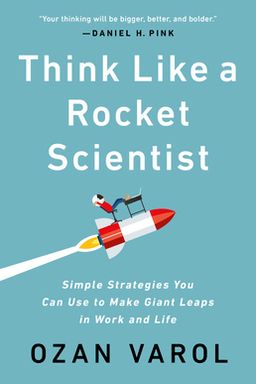
How can you think more creatively and make better decisions in uncertain, high-stakes environments? In Think Like a Rocket Scientist, Ozan Varol argues that every domain—from business to everyday life—benefits from applying the mental habits of rocket scientists: reasoning from first principles, embracing uncertainty, reframing problems, running real tests, and learning from intelligent failure. He contends that you do not need to be an engineer to think like one; you need to learn how to navigate unknowns with disciplined curiosity.
Varol’s core claim is simple: extraordinary breakthroughs come from ordinary people who learn to question assumptions and to tolerate doubt. When you stop copying the past and start reasoning from fundamentals, you open new frontiers of possibility. But to do so, you must evolve how you think—from clinging to answers toward exploring questions, and from defending beliefs toward disproving them.
Uncertainty as creative fuel
Rocket science thrives in the dark. Varol reminds you that 95% of the universe is composed of dark matter and dark energy—unknown forces that scientists explore without full comprehension. Breakthroughs like Fermat’s Last Theorem or Einstein’s relativity emerged only after prolonged wrestling with uncertainty. Uncertainty isn’t chaos; it’s the laboratory of progress. Genius, as Carlo Rovelli says, hesitates.
From imitation to invention
The book reveals how most people fall into the trap of default thinking—doing things “because that’s how they’ve always been done.” Path dependence, illustrated by the rocket diameter traced back to Roman roads, turns ingenuity into inertia. First-principles reasoning liberates you from this cage. Varol’s heroes—Einstein, Musk, Galileo—are not merely smart; they are relentless simplifiers who strip problems to their atomic truths before building anew.
Exploration through mental play
Varol champions thought experiments and combinatory play—Einstein’s daydreams of chasing light or Darwin’s fusion of geology and economics—as the mental engines of creativity. Rather than costly real-world prototypes, great thinkers first experiment in the imagination. Walks, boredom, solitude, and diverse interests provide the raw material for insights. You do not need to be a genius—you need the time and courage to think freely before building.
Moonshot and backcast thinking
Moonshots embody audacious clarity: they change not just the goal but the questions you ask. SpaceX’s aim to make humanity multiplanetary forced first-principles innovation. Varol contrasts this with “field-mouse” goals that waste effort on trivial gains. The key method, backcasting, reverses conventional planning—starting from a future vision and working backward to identify necessary steps. Tackling the hardest problem first—the “monkey before the pedestal”—ensures your bold idea survives real constraints.
A disciplined approach to truth
Rocket scientists succeed not because they avoid error, but because they design to find it early. Varol teaches you to seek disconfirming evidence, build a family of hypotheses, and look for missing facts. From the Mars Climate Orbiter’s metric mix-up to the Polar Lander’s phantom signal, the book shows how belief and hope can blind teams. You must test to disprove, use multiple instruments, and analyze absences—the dog that didn’t bark can save a mission.
Testing and learning cultures
Rocket engineers “test as they fly”: they simulate flight conditions precisely, seek breaking points, and align tests to real-world stress. They treat failure as data, not shame. SpaceX’s repeated launch setbacks and NASA’s airbags at Black Rock demonstrate intelligent failure—planned, reversible experiments that reveal boundaries. By mimicking this ethos, you transform uncertainty into learning and resilience.
Success as the next danger
Varol closes by warning that success itself can be fatal when it breeds complacency. Challenger and Columbia exploded not from ignorance but from normalization of deviance—small tolerated errors turned systemic. Treat each win as a warning. Practice premortems, analyze near misses, and stay curious even after triumphs. The lesson of rocket science—and of the book—is enduring humility before the unknown. Thinking like a rocket scientist means being perpetually willing to ask, “What are we missing?” and to learn fast before the next launch.