
Idea 1
The Power of Thought: Building Wealth from Within
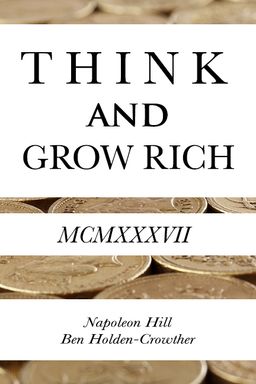
What if everything you’ve ever accomplished—or failed to accomplish—began not with your circumstances but with your thoughts? Think and Grow Rich by Napoleon Hill is built entirely on this audacious claim: your mind is the root source of every success, every fortune, and every failure. Hill contends that all achievement begins with an idea, and those ideas—when charged with faith, desire, persistence, and organized action—transform into tangible realities. He calls this the process of ‘transmuting thought into its physical equivalent.’
This book, which emerged from Hill’s two decades of research and his mentorship under industrialist Andrew Carnegie, distills the common philosophies of hundreds of the most successful men of the early 20th century. The result is not just a guide to making money but a philosophy for mastering the mind. Hill insists that wealth and success are intentional creations of disciplined thought, not accidents of talent or luck. Through the mastery of mental laws—autosuggestion, faith, imagination, and planning—you can turn invisible ideas into visible achievements.
The Central Premise: Thoughts Are Things
Hill begins with a revolutionary idea for his time—and still radical today: “Whatever the mind can conceive and believe, it can achieve.” This isn’t just motivational rhetoric. He means it literally. Thoughts are vibrations that carry the seeds of action and consequence. When a thought becomes emotionally charged—with feelings of desire, faith, and determination—it activates the subconscious mind to create corresponding circumstances in reality. The invisible becomes the visible.
For example, Hill tells the story of Edwin C. Barnes, a man who arrived at Thomas Edison’s lab announcing, with no money and no credentials, that he wanted to go into business with the inventor. Edison saw in him an unusual spark of determination and gave him a job sweeping floors. Years later, Barnes became Edison’s business partner. What started as a thought—invisible, intangible—became a thriving enterprise. Hill uses this story to demonstrate that success flows from definite purpose and burning desire rather than opportunity alone.
The 13 Principles of Achievement
Building on this foundation, Hill outlines thirteen principles for turning thought into success. These principles function as mental tools for transforming desire into concrete results. They include: Desire, Faith, Autosuggestion, Specialized Knowledge, Imagination, Organized Planning, Decision, Persistence, the Master Mind, the Mystery of Sex Transmutation, the Subconscious Mind, the Brain, and the Sixth Sense. Each principle represents a stage in the mental creation process—from clarifying what you want to attracting the circumstances that will deliver it.
In Hill’s system, Desire is the starting point of all achievement. It must be definite, not a vague wish. Faith then acts as the emotional engine that turns that desire into belief. Autosuggestion trains your subconscious through repeated affirmations. Specialized Knowledge provides the means to deliver value to others. Imagination converts knowledge and desire into actionable plans, while Organized Planning transforms those plans into reality through cooperation and coordination. Decision demands commitment, Persistence sustains momentum, and the Master Mind multiplies power through collective learning and encouragement. At the higher levels, the Subconscious Mind, Brain, and Sixth Sense act as channels of intuition and universal intelligence.
Aligning Thought, Emotion, and Action
The unifying theme linking all these principles is that success arises when thought, emotion, and action are aligned. Desire without action is fantasy; action without confidence is wasted effort. Hill’s philosophy insists that you cannot merely desire riches—you must emotionally believe you already possess them. He calls this process of inner conviction “faith.” When supported by daily autosuggestion and visualization, faith conditions the subconscious mind to work relentlessly toward the goal, attracting relevant circumstances, people, and opportunities along the way.
The subconscious mind, Hill argues, does not distinguish between success and failure—only between thoughts charged with emotion. Whether you dwell on fear or prosperity, your subconscious will obediently manifest the results. Hence, guarding your mental environment becomes as crucial as managing your finances.
Why These Ideas Matter
Hill’s philosophy is not just about accumulating money but about mastering one’s life direction. It’s a blueprint for psychological empowerment that has influenced nearly every motivational teacher since—from Earl Nightingale and Tony Robbins to modern cognitive and behavioral approaches. His core message is timeless: success begins in the mind long before it appears in the bank account. By choosing your dominant thoughts, you choose the quality of your life.
“You are the master of your fate, the captain of your soul, because you have the power to control your thoughts.”
Hill invites you to do more than read; he invites you to experiment with your own mind. He shows that poverty and riches, failure and success, begin with invisible choices about what you permit to occupy your thoughts. If you train your mind to generate faith, persist through defeat, and act on your plans, then—by his logic—you cannot help but prosper. In a world where distractions, doubts, and fears compete for your mental space, Hill’s century-old philosophy remains perhaps the most radical act of self-determination you can attempt today.