
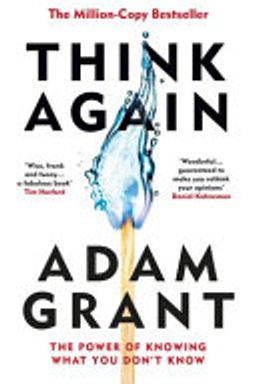
Think Again cover

Think Again

by Adam Grant

In "Think Again," #1 New York Times bestselling author Adam Grant challenges our reliance on entrenched beliefs and champions the transformative power of rethinking. Highlighting the importance of flexibility and humility in a rapidly changing world, Grant shares compelling stories and research that reveal how questioning our opinions can drive personal excellence and foster wisdom in our communities. Embrace the joy of being wrong and learn to cultivate critical thinking as a lifelong skill.

Think Again as Mental Fitness

How can you stay effective when facts shift under your feet? In Think Again, Adam Grant argues that success in a changing world depends less on raw intelligence and more on what he calls mental fitness: the capacity to rethink, unlearn, and update your beliefs quickly as reality evolves. Intelligence gives you horsepower; mental fitness gives you steering and brakes. The book’s core claim is that you can train rethinking as a skill and use it to make better decisions, collaborate without groupthink, persuade without polarizing, and lead through uncertainty.

Grant opens with the Mann Gulch wildfire. Smokejumper Wagner Dodge survives not because he is fastest or strongest but because he reimagines the situation: he lights an escape fire and lies in the charred patch. That improvisation is rethinking in action. In contrast, BlackBerry founder Mike Lazaridis’s brilliance as an engineer becomes a liability when he clings to the physical keyboard after the iPhone arrives. High IQ without intellectual humility can trap you in yesterday’s assumptions.

Why smart people get stuck

Grant names two traps that intensify with expertise: confirmation bias (you see what you expect) and desirability bias (you see what you want). The more knowledgeable you are, the more artful your rationalizations become. Studies show high-IQ individuals can be better at cherry-picking evidence that fits their priors. That is why Dodge’s quick reframe beats Lazaridis’s attachment. Intelligence without humility becomes a weapon against truth.

From preacher and prosecutor to scientist

Grant contrasts three mindsets you slip into: preacher (defend sacred beliefs), prosecutor (discredit opposing views), and politician (seek approval). All three bind your identity to your opinions. Scientist mode does the opposite: you treat your beliefs as hypotheses and run tests that could disconfirm them. European entrepreneurs trained to think like scientists doubled revenue because they pivoted faster when data refuted initial plans. Superforecasters, studied by Phil Tetlock, win not by knowing more facts but by updating forecasts early and often.

Confident humility: the performance advantage

The book’s ethic is confident humility: you trust your capacity to learn while doubting your current tools. Halla Tómasdóttir’s near-upset in Iceland’s presidential race shows how embracing uncertainty can energize learning and connection. You do not posture as all-knowing; you model curiosity, solicit critique, and adapt. That stance sits between armchair overconfidence (Dunning–Kruger’s steep early curve) and paralyzing impostorism. It fuels action without calcifying dogma.

The joy of being wrong

Rethinking is easier when you detach identity from ideas. Nobel laureate Daniel Kahneman famously says he keeps a cheerful readiness to be wrong because errors reveal where to learn. Superforecaster Jean-Pierre Beugoms documents what would change his mind and updates repeatedly; that discipline turns wrongness into progress. The opposite extreme is chilling: when convictions become identity, rethinking freezes (the Unabomber’s tragic trajectory is a cautionary tale).

Persuasion, conflict, and culture

Grant extends rethinking from the individual to relationships and systems. Interpersonally, persuasion works best as a collaborative dance: you lead with questions and common ground instead of flooding people with facts. Harish Natarajan’s win over IBM’s Project Debater illustrates how fewer, stronger arguments and steelmanning open minds. In teams, you want hot debates about ideas without getting mad at people. The Wright brothers’ fierce but respectful sparring and Pixar’s pirate crews show how structured dissent yields breakthroughs. At scale, organizations thrive when they pair psychological safety with process accountability—people feel safe to speak up and are also expected to reason carefully (Amy Edmondson’s learning zone; Amazon’s six-page memos).

What you will take away

Across chapters you learn to run mental experiments, use motivational interviewing to help others find their own reasons to change, complexify polarized issues to reduce tribal certainty, and design classrooms and cultures that normalize drafts, critique, and revision (Ron Berger’s studios; the Gates Foundation’s public feedback rituals). You also learn to rethink your career regularly so grit does not lock you into stale selves, and to lead with confident humility—FDR’s ethos of bold, persistent experimentation—so people can trust the process when answers are uncertain.

Key idea

In turbulent environments you need the ability to change your mind faster than others can change the situation. Mental fitness is that edge.

(Note: Grant’s argument complements Carol Dweck’s growth mindset—where Dweck emphasizes beliefs about ability, Grant emphasizes habits for changing beliefs themselves.)


Confident Humility And Joyful Wrongness

Grant locates the sweet spot between swagger and self-doubt: confident humility. You act decisively while staying open to being wrong. This is not a soft virtue; it is a performance multiplier that keeps you adaptable when conditions shift. It helps you avoid two costly syndromes: armchair quarterback overconfidence and crippling impostorism.

The two syndromes

Dunning–Kruger research shows a steep early peak: as you move from novice to amateur, a little knowledge inflates self-assessment. Leaders in that zone double down on bad bets (consider Davíð Oddsson’s role in Iceland’s financial collapse). At the other extreme, impostor feelings can sap initiative, but they also carry an upside: they orient you toward preparation, questions, and learning. Medical students with mild impostor thoughts often excel at empathy and bedside manner.

Confidence in capacity, humility about tools

Halla Tómasdóttir models the stance. She trusted her capability to learn and lead while admitting uncertainty and inviting critique. Sara Blakely’s Spanx story echoes the pattern: she believed she could figure things out—patents, textile mills—even without domain expertise. Both kept identity light and curiosity heavy. You can adopt the same split: high confidence in your ability to learn; low ego investment in your current answers.

Learn to love being wrong

Treat mistakes as data. Daniel Kahneman celebrates corrections because they bring him closer to truth. Superforecasters deliberately specify what would change their minds and update frequently. If you document your predictions and revise publicly, you start to feel a small hit of pride each time you discover a blind spot. That turns a threat response into a learning reflex. Unlike defensive rationalizing, this habit compounds accuracy over time.

Practical habits for the middle

First, detach your opinions from your identity. Frame beliefs as drafts, not tattoos. Second, build metacognitive checks: ask what you would need to see to change your mind, and schedule formal moments to test whether those conditions have emerged. Third, solicit disconfirming evidence—design a challenge network of colleagues who will poke holes in your logic. Finally, keep a wrongness journal: log predictions, outcomes, and what you learned. Each update earns a small reward to reinforce the behavior.

Guardrails against escalation

Overconfidence escalates commitment; humility reduces sunk-cost traps. When stakes rise, do not ask if you were right; ask if you are still right given new data. Separating your present self from your past self makes it easier to pivot without shame. The danger of identity fusion is stark: when beliefs harden into selfhood, as in extreme radicalization, rethinking shuts down. Keeping a loose grip on your views keeps you flexible and safer.

Practice

Once a month, list three beliefs you hold strongly. For each, write the strongest counterargument, the evidence that would change your mind, and a small experiment to test it. Share one with your challenge network.

(Note: This stance aligns with Tetlock’s work on forecast calibration and with Bayesian reasoning—confidence grows and shrinks with evidence, not with ego.)


Good Fights And Persuasion As Dance

Conflict is not the enemy; the wrong kind of conflict is. Grant distinguishes task conflict—vigorous debate about ideas—from relationship conflict—personal friction and status contests. High-performing teams get hot about the work without getting mad at each other. They match intellectual intensity with interpersonal safety and shared purpose.

Fight ideas, protect relationships

The Wright brothers called it thinking together. They argued fiercely over lift, control, and propellers, then went back to the shop with renewed clarity. Pixar director Brad Bird recruited pirates—disagreeable misfits like producer John Walker—to challenge comfortable assumptions and ship The Incredibles. The key was a culture that welcomed dissent but enforced respect. When norms make critique feel like collaboration, you avoid groupthink without breeding resentment.

Build your challenge network

A challenge network is a set of trusted critics who care enough to be candid. Identify people who reliably spot flaws and invite them early. Establish rules: be specific and kind; attack the idea, never the person; propose an alternative. Rotating devil’s advocates can help, but genuine disagreeables with shared goals are better. Pair dissent with psychological safety so people feel safe to probe uncertainty and expose weak assumptions.

Persuasion as a cooperative dance

When you need to change minds, stop prosecuting and start choreographing. Harish Natarajan’s debate against IBM’s Project Debater shows how to move an audience: begin with common ground, steelman the other side, and offer a few strong points rather than a laundry list. Research Grant cites reveals that piling on many reasons dilutes your best arguments and gives opponents more targets. Questions do more than declarations—especially how questions that shift people into implementation mode.

Conversation design under fire

If a discussion turns hostile, talk about the process before the content. Ask what a fair exchange would look like, where you agree already, and what evidence would change either of your minds. In negotiation studies (Neil Rackham’s work), experts prepare maps of shared interests and lead with curiosity, not counterpunches. That turns persuasion into joint problem solving and keeps egos from hijacking facts.

Team norms that raise the bar

Adopt routines that prioritize substance over showmanship. Silent memo reads (as at Amazon) cut performative slides and elevate reasoning quality. Use red teams to stress-test plans and premortems to surface hidden risks. Close debates with a decision log that records what was considered and why, so you can revisit assumptions without blame. These habits make it normal to reconsider without relitigating relationships.

Rule of thumb

Get hot on ideas and cool on people. If a comment targets identity rather than logic or evidence, reframe or pause.

(Note: This approach echoes Amy Edmondson’s psychological safety research and Karl Weick’s emphasis on small, continuous adjustments in complex systems.)


Listening That Changes Minds

Facts rarely move people when they feel cornered. Grant shows that motivational interviewing (MI) and complexity-based framing lower defenses and invite genuine reconsideration. If you want others to rethink, you help them hear their own doubts and expand how they see the issue.

Motivational interviewing in action

Arnaud Gagneur, dubbed the vaccine whisperer, met parents like Marie-Hélène Étienne-Rousseau with curiosity, not correction. He asked open questions about their concerns, reflected what he heard, affirmed their care for their children, and emphasized autonomy: you are free to choose. The result in PromoVac trials was higher short- and long-term vaccination uptake. MI resists the righting reflex—the urge to fix—and elicits change talk: people voice their own reasons to act, which stick better than yours.

Why facts backfire

When you attack a belief, minds often mount antibodies. Psychological inoculation means a direct blast of counterevidence can harden the very position you target. By asking what would change someone’s mind, or how they would implement their view, you shift them into problem-solving mode and expose practical constraints. That softens certainty and opens space for new information to land.

Complexify to depolarize

Peter T. Coleman’s Difficult Conversations Lab finds that binary frames fuel tribal certainty. When issues like gun policy or abortion are presented as a spectrum with caveats and contingencies, strangers are more likely to find common ground. Grant urges you to name uncertainties, distinguish skeptics from deniers, and highlight areas where positions overlap. Paradoxically, stating limits increases trust because it signals intellectual honesty.

Humanize rivals

Rivalries and stereotypes lock identities and shut down rethinking. Daryl Davis, a Black musician, befriended Ku Klux Klan members and helped dozens leave the Klan by engaging them as individuals. Betty Bigombe in Uganda sat with Lord’s Resistance Army commanders to build fragile bridges. Structured, respectful contact cracks caricatures. Counterfactual prompts—imagine you were born in their town—loosen overconfident judgments.

A choreography you can use

Start with agreements and shared values. Ask open questions: what led you here, what evidence would change your mind, how would you implement this? Reflect and summarize before offering a single, strong point. If tensions rise, talk process: how shall we have this conversation? End by inviting the smallest next step the other person proposes. Each move protects autonomy and dignity so new ideas can be considered on their merits.

Guiding principle

People change when they find their own reasons. Your listening helps them discover those reasons.

(Note: This aligns with self-determination theory—autonomy supports durable motivation—and with negotiation best practices on interest-based dialogue.)


Teach And Build Learning Cultures

If you teach, manage, or mentor, your real job is to normalize revision. Grant shows that active learning and learning cultures outperform polished performance cultures because they reward thinking again rather than performing certainty. The magic ingredients are effortful practice, psychological safety, and process accountability.

Active learning beats felt learning

Charismatic lectures feel great but can seduce you into the dumbstruck effect—you remember the delivery but not the logic. Meta-analyses led by Scott Freeman across tens of thousands of students show that interactive problem solving produces deeper learning and lower failure rates than traditional lectures. Grant redesigns classes to include group problem-solving, student-designed sessions, and assignments that reward intellectual risk, such as podcast projects that challenge conventional wisdom.

Model iterative craft

Ron Berger’s classrooms make drafts and critique a way of life. First-graders redraw a butterfly multiple times, guided by peers who follow the be specific and kind rule. The same rhythm helps adults. Public drafts, gallery walks, and outside critiques lower the stigma of being wrong and raise the standard of reasoning. When you teach revision, you teach resilience.

Psychological safety plus process accountability

In organizations, safety without accountability breeds comfort; accountability without safety breeds silence. You need both to reach the learning zone. Amy Edmondson’s research shows that psychologically safe teams admit more errors early and prevent more errors later. Grant highlights the Gates Foundation, where leaders recorded themselves reading tough staff feedback—Mean Reviews—and set public development goals, which increased employees’ willingness to speak up over time.

Judge decisions by process

Outcome-only metrics reward lucky wins and mask flawed reasoning. Amazon’s six-page narrative memos and silent reading periods slow the room down and surface logic. Process accountability asks: what alternatives did you consider, what uncertainties did you flag, what evidence did you weigh? Separating decision makers from later evaluators reduces justification bias—fresh eyes are more willing to reverse course.

Learn from near misses before they become disasters

NASA’s Challenger and Columbia tragedies reveal the cost of normalized anomalies—small warnings dismissed as noise. In astronaut Luca Parmitano’s near-drowning, earlier leaks were misattributed to a drink bag. Ellen Ochoa carried a card of probing questions like how do you know to interrupt premature closure. The lesson: institutionalize skepticism before hindsight forces it upon you.

How to act this week

In your next meeting, use a silent memo and require one counterargument and one caveat per proposal. In your next class or workshop, schedule a public draft and a critique round that follows the be specific and kind rule.

(Note: Pairing safety and accountability mirrors Deming’s quality principles and modern devops blameless postmortems, where learning is the goal and process is the unit of analysis.)


Rethink Careers And Identity

Your career is not a verdict; it is a series of experiments. Grant warns against identity foreclosure—locking into a single professional self too early—and escalation of commitment, where sunk costs and social rewards keep you on an ill-fitting path. The antidote is to treat work like a scientist treats hypotheses: test, learn, and revise.

Why grit can mislead

Grit helps you persist through friction, but it can also cement you in the wrong race. Grant’s cousin Ryan pursued neurosurgery for years because he had invested deeply and carried the identity of doctor. He finished residency despite burnout, then later pivoted into health-tech entrepreneurship, cofounding Nomad Health. The pivot eventually restored meaning and energy, but it came later and costlier than it needed to.

Schedule career checkups

Twice a year, ask: when did I form this goal, how have I changed since, what signs of plateau or misfit do I see? Distinguish short-term discomfort from chronic misalignment. If a path no longer fits, the bravest move may be a small experiment rather than a dramatic exit. You are not betraying your past self; you are updating with new data.

Test possible selves

Follow Herminia Ibarra’s advice to act and then think. Identify two or three possible selves and run cheap tests: informational interviews, shadowing, freelancing on weekends, a night class, a three-month project. Keep a hypothesis log: what would success look like, what risks am I willing to take, what evidence would tell me to double down or pivot? Small bets compound insight and reduce the emotional cost of change.

Craft your current job

If you cannot switch roles yet, retool the one you have. Job crafting means tilting tasks toward learning, mastery, and contribution. Candice Walker, a hospital custodian, made herself emotionally indispensable by shaping her work around patient care and connection. You can add a teaching component, a data analysis project, or customer interviews—whatever builds skills and meaning while staying within your mandate.

Keep identity light

Define yourself by values and capacities—curiosity, contribution, craftsmanship—rather than a title. That way, new opportunities feel like expressions of who you are, not betrayals of who you were. Detaching identity from a single role also makes public rethinking easier: you can say I have learned new information and I am changing course without triggering a shame spiral.

Playbook

Run one low-stakes career experiment each quarter. Log hypotheses, results, and next actions. Share your reflections with a peer to create gentle accountability and fresh perspective.

(Note: This experimental lens echoes design thinking and aligns with Cal Newport’s idea that passion is cultivated through mastery and impact, not discovered whole.)


Lead With Confident Humility

In crises and complexity, people want clarity, but reality demands learning. Grant argues that great leaders square that circle with confident humility: they commit to action while showing how they will adapt as evidence arrives. The tone is not I know; it is we will find out, and here is how.

The credibility of uncertainty

Admitting uncertainty can increase trust when paired with a plan. Franklin D. Roosevelt embodied bold, persistent experimentation: try something, measure, iterate. In organizational settings, leaders who publicly solicit and respond to critique model learning at the top. At the Gates Foundation, senior figures read harsh staff feedback on camera and described what they would change. Employees became more willing to speak up, and rethinking spread.

Make hypotheses public

Frame strategies as testable hypotheses with review dates, metrics, and kill criteria. Use premortems to imagine failure in advance and identify risks. Keep a decision journal to separate outcome noise from process signal. When you change course, explain the evidence and the process. That turns a U-turn into leadership rather than flip-flopping.

Ask better questions

Carry Ellen Ochoa’s simple probes: how do you know, what alternatives did we reject, what would change your mind? These questions signal that updating is expected. They also reduce the power distance that silences dissent. Pair them with rituals—silent memo reads, red-team reviews, challenge network briefings—to ensure voices are heard before momentum forms.

Communicate like a scientist

Explain caveats, confidence intervals, and contingencies. Complexify where the public conversation has flattened nuance. Name what is known, unknown, and in progress. In polarized contexts, lead with shared values and practical how questions to move people from moral certainty to problem solving. A few strong reasons beat a barrage; a clear process beats a charismatic plea.

Culture follows your thermostat

Your behavior sets the rethinking temperature. When you reward dissent, celebrate updates, and scrutinize process, others follow. When you punish error and prize bravado, people hide problems and double down on bad bets. The difference shows up in safety records, innovation rates, and trust. In complex systems, humility is not a concession; it is a control mechanism.

Leadership promise

I do not know everything, but I will show my work, test our path, and change when the evidence demands it.

(Note: This stance resonates with Ray Dalio’s idea meritocracy and with modern public health communication that pairs guidance with uncertainty ranges.)

Dig Deeper

Get personalized prompts to apply these lessons to your life and deepen your understanding.

Go Deeper

Get the Full Experience

Download Insight Books for AI-powered reflections, quizzes, and more.