
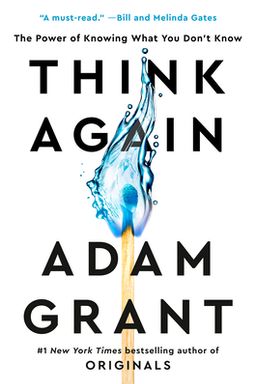
Think Again cover

Think Again

by Adam Grant

Think Again by Adam Grant explores the transformative power of rethinking and curiosity. It delves into the biases affecting decision-making and offers strategies to foster a culture of adaptability and learning, essential for personal and organizational success.

The Power of Rethinking

How can you stay smart when the world keeps changing? In Think Again, Adam Grant argues that the crucial skill of modern intelligence isn't knowing more — it's learning to rethink faster. Grant contends that genuine wisdom comes from questioning your own assumptions, revising outdated mental models, and treating knowledge as provisional. The book is a manifesto for intellectual humility: the courage to say, 'I might be wrong,' and the curiosity to ask, 'What else could be true?'

Rethinking Under Pressure

Grant begins with stories like the Mann Gulch fire in 1949, where smokejumpers’ adherence to routine cost twelve lives. Foreman Wagner Dodge survived because he rethought in real time: he lit an escape fire, a tactic never taught before. His improvisation reveals that mental agility sometimes outweighs intelligence itself. Rethinking under pressure means overriding automatic, habitual responses — dropping identity-bound tools and reimagining survival.

You see this pattern everywhere — from crisis leadership to personal change. People cling to old assumptions because identity gets attached to method. Firefighters won't drop tools, investors defend sunk costs, and learners freeze first answers into self-concepts. The lesson: updating fast is a form of intelligence in motion.

Thinking Like a Scientist

Grant, drawing on Phil Tetlock’s work on forecasting, explains the scientist mindset — a mental mode distinct from preacher, prosecutor, or politician. The scientist leads with questions, frames ideas as hypotheses, and runs mental experiments. You update beliefs when evidence contradicts them. This isn’t about skepticism for sport but about disciplined curiosity.

Mike Lazaridis of BlackBerry illustrates the cost of losing that mindset. Innovator turned CEO, he stopped testing hypotheses when smartphones changed the game. Steve Jobs, in contrast, used curiosity to reframe Apple’s identity and pivot to the iPhone. (Note: Grant connects this to Tetlock’s forecasts showing that ‘actively open-minded thinking’ predicts accuracy better than IQ.)

Confident Humility and the Joy of Being Wrong

The emotional foundation of rethinking is confident humility — faith in your capacity to learn paired with doubt about your current knowledge. Grant contrasts the armchair quarterback’s overconfidence (Mount Stupid) with the impostor’s self-doubt. Paradoxically, impostor feelings can fuel growth. Halla Tómasdóttir’s presidential run in Iceland began with insecurity, yet her curiosity and preparation — born of doubt — became advantages.

Learning to enjoy being wrong completes this mindset. Superforecasters like Jean-Pierre Beugoms treat errors as progress markers, logging mistakes to refine their judgment. Detachment from identity allows them to delight in correction. Define yourself by values such as curiosity or fairness, not fixed beliefs — then every correction feels like learning, not losing.

Rethinking Together

Grant shifts from individual to collective rethinking. In teams, task conflict sparks innovation, while relationship conflict stalls it. The Wright brothers and Pixar’s Brad Bird illustrate productive friction. They fought fiercely over ideas, not egos. These ‘good fights’ fuel creativity when critics are disagreeable but generous — givers, not takers.

In persuasion, rethinking also means changing how you make others rethink. Harish Natarajan defeated IBM’s AI Project Debater not with more facts but with empathy and elegant simplicity. He danced, not fought — establishing common ground, offering few strong reasons, and asking questions that invited reflection. The same principle drives motivational interviewing and vaccine whispering: listening triggers change better than lecturing.

Rethinking Society

The later chapters explore social rethinking — destabilizing stereotypes and complexifying charged debates. Daryl Davis changed minds in the KKK not by confrontation but through human connection and counterfactual questioning (“How would you think if you were born elsewhere?”). Peter Coleman’s research shows that presenting many perspectives — not binary camps — encourages compromise. Complexity liberates us from tribal polarization.

Building Habits and Cultures of Rethinking

Grant ends by zooming out to institutions and learning structures. NASA’s disasters revealed how performance cultures silence dissent; learning cultures thrive through psychological safety plus process accountability. Amazon’s six-page memos and Gates Foundation’s open criticism are designed to embed rethinking in organizational routines. In classrooms, active learning and critique networks — Ron Berger’s drafts, Erin McCarthy’s revision projects — teach students to think like scientists: challenge, revise, and test ideas publicly.

Across careers, relationships, and education, the meta-skill remains constant: rethink early, rethink often. Whether you’re dropping a shovel on a burning ridge or dropping a belief in a heated argument, Grant urges you to make rethinking a way of living — a reflex of curiosity instead of a reaction of fear.


Think Quickly, Adapt Wisely

Mental agility is the art of updating faster than your environment changes. Using the Mann Gulch fire as metaphor, Grant shows how habits and tools can become dangerous when conditions shift. Wagner Dodge survived by abandoning training rules and inventing an escape fire — rethinking under extreme pressure.

Seizing and Freezing

Humans “seize” an early belief, then “freeze” it into identity. Firefighters clinging to packs illustrate how skills become symbols of self-worth. In everyday life you do the same — sticking to career labels, first guesses, or investment narratives long after they stop serving reality.

How to Train Mental Agility

  • Practice abandoning habits purposefully — rehearse quitting outdated methods to build adaptability.
  • Use mental prompts like “What would make me change my mind?” before major decisions.
  • Detach tools from identity: your role is evolving, not anchored in yesterday’s tactics.

Grant’s message: intelligence is brittle when bound to pride. The smartest people survive not because they know more, but because they update faster when reality doesn’t match their map.


Confidence Without Arrogance

Between overconfidence and self-doubt lies confident humility. Grant argues this is the emotional engine of learning — trusting your ability to improve while accepting that your current understanding is incomplete. The Dunning-Kruger curve warns that Mount Stupid is where intuition outruns expertise; error begins when you stop questioning.

Impostor Advantage

Feeling like an impostor can be useful. Icelandic leader Halla Tómasdóttir transformed impostor thoughts into preparation and curiosity — adopting new tools and outpacing expectations. Across studies, professionals who admit ignorance perform better because openness drives improvement. (Grant contrasts this with chronic self-doubt that paralyzes; the key is channeling insecurity toward learning.)

Practical Habits

  • Ask for help and normalize not knowing — this makes you teachable.
  • Write down what evidence would change your mind on big decisions.
  • Turn impostor energy into curiosity and preparation instead of anxiety.

Confident humility transforms failure into feedback. It’s not weakness to question; it’s wisdom in motion.


Rethinking Through Relationships

Rethinking spreads most effectively through conversation, not confrontation. Grant contrasts fighting and dancing in persuasion — winning minds through empathy, curiosity, and questioning. Harish Natarajan’s debate with IBM’s Project Debater shows that facts alone don’t shift opinions; shared values and reflective questions do.

Listening That Changes Minds

Motivational interviewing by Bill Miller and Arnaud Gagneur reframes persuasion as listening. Asking open-ended questions, reflecting back emotions, and affirming autonomy make people generate their own ‘change talk.’ Vaccine whisperers in Quebec boosted immunization rates through empathy, not argument. Similarly, peace negotiator Betty Bigombe de-escalated conflict in Uganda by listening before advising.

Make Debates Collaborative

  • Start by finding common ground and shared goals.
  • Use few, strong arguments and ask questions that prompt reflection.
  • Listen to clarify, not to correct — curiosity disarms defensiveness.

Persuasion is partnership. When you lead with humility and curiosity, you dance others toward discovery instead of dragging them toward defeat.


Complex Conversations and Curiosity

Polarization thrives on simplicity; progress thrives on complexity. Grant highlights Peter Coleman’s findings that binary framing – two sides in opposition – triggers rigidity. When issues like abortion or climate are shown with multiple perspectives, participants collaborate faster.

How to Invite Complexity

  • Include caveats and contingencies — admit where ideas work and where they fail.
  • Avoid false balance: show nuance without equating poor data with strong evidence.
  • Ask “how” questions instead of “who’s right?” to open dialogue.

Erin McCarthy’s classroom demonstrates this principle: by rewriting textbook chapters that excluded voices, students learn history as evolving theory. Complexity teaches intellectual humility and curiosity simultaneously.

In public debates — from climate change to family arguments — moving beyond either/or thinking creates space for collective rethinking.


Learning Cultures and Critique Networks

Organizations and schools thrive when they reward rethinking as process, not perfection. Grant contrasts NASA’s tragic normalization of errors with Amy Edmondson’s research on psychological safety. The solution isn’t just courage to speak up — it’s structures that make questioning routine.

From Performance to Learning

Performance cultures prize flawless outcomes. Learning cultures combine safety with process accountability — judging the quality of thinking before the outcome. Amazon’s six-page memos and Jeff Bezos’s ‘disagree and commit’ track decision reasoning so that failures yield data, not shame. Ellen Ochoa’s mantra at NASA — “It’s our responsibility to speak up” — captures this.

Teaching Rethinking

Active learning and critique networks make rethinking habitual. Ron Berger’s students iterate through drafts, embracing revision. Robert Nozick modeled intellectual evolution by teaching new courses each year. When teachers introduce not only ideas but new ways of thinking, students internalize adaptability.

Learning cultures and critique networks operationalize curiosity: they make mistakes visible, safe, and productive. The goal isn’t flawless first attempts — it’s lifelong flexibility.


Careers and Lifelong Rethinking

Rethinking applies directly to how you design your life. Grant describes career identity as both compass and cage. Identity foreclosure — locking into one path too early — and escalation of commitment — doubling down because of sunk costs — trap ambition. Periodic ‘career checkups’ prevent drift.

Experiment with Possible Selves

Herminia Ibarra’s method mirrors the scientific mindset: treat career moves as experiments. Test small roles, seek mentors, observe fits before pivoting. Passion often follows mastery, not vice versa. Candice Walker, a hospital custodian, achieved meaning not by changing jobs but by job crafting — aligning daily tasks with purpose.

Sustaining Meaning Over Time

Instead of asking, “What do you want to be?” Grant suggests, “What do you want to learn this year?” Provisional identities encourage exploration. Schedule biannual reflection sessions to review learning and satisfaction. Small pivots compound into career flexibility and purpose.

A life well-lived, in Grant’s view, isn’t static happiness but dynamic meaning — built by continuous rethinking of who you are and what you’re learning.

Dig Deeper

Get personalized prompts to apply these lessons to your life and deepen your understanding.

Go Deeper

Get the Full Experience

Download Insight Books for AI-powered reflections, quizzes, and more.