
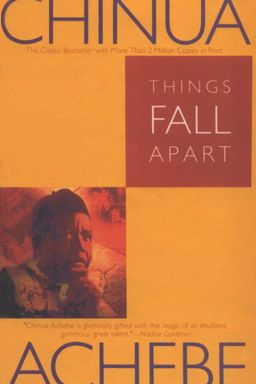
Things Fall Apart cover

Things Fall Apart

by Chinua Achebe

Things Fall Apart by Chinua Achebe is a compelling narrative about the Igbo society''s encounter with British colonial forces in Nigeria. Through the tragic story of Okonkwo, a respected leader, the novel explores themes of cultural conflict, identity, and the impact of change. Achebe''s masterful storytelling provides a deep, thought-provoking insight into the complexities of African life and tradition.

Tradition, Change, and the Fragile Center of Human Life

What happens when the foundation of your world—your values, your identity, your traditions—begins to crumble, not because it was weak, but because something entirely new invades and replaces it? Chinua Achebe's Things Fall Apart confronts this universal question through the intimate story of Okonkwo, a proud Igbo warrior, and through him, the story of a culture at the brink of collapse.

Achebe argues that both individuals and societies fall apart when the balance between tradition and change—between pride and humility, order and adaptability—breaks down. The novel is not just about a Nigerian village disrupted by colonialism; it’s about what happens when any human community loses its “center,” as poet W. B. Yeats described in the line that inspired the book’s title: “Things fall apart; the center cannot hold.” Achebe suggests that the collapse is rarely caused by a single event—it’s the slow erosion of shared meaning.

The World of Umuofia

The novel begins in Umuofia, a collection of Igbo villages living by ancestral codes, complex rituals, and rich oral traditions. This society values strength, community cooperation, and respect for spiritual forces governing the world. Custom binds every aspect of life—from weddings to funerals, from war decisions to peace offerings. Achebe paints this culture as vibrant and functioning, contradicting colonial portrayals of precolonial Africa as primitive or chaotic. The reader enters a world where proverbs are the "palm oil with which words are eaten," showing that truth and beauty are transmitted not through laws but through shared wisdom.

This world’s strength lies in balance: masculine and feminine principles coexist, as do human and spiritual realms. But balance can be fragile. We see its cracks early—in how Okonkwo interprets masculinity as control and violence, rejecting affection and emotion as signs of weakness. What Achebe builds beautifully in the beginning, he deliberately unravels by the end, showing how individuals and societies can destroy themselves from within.

Okonkwo: The Man Who Fears Weakness

At the heart of the story stands Okonkwo, whose very identity depends on being the opposite of his father, Unoka—an idle, gentle musician despised for his debts and nonviolence. Okonkwo rises through sheer willpower. He defeats the great wrestler Amalinze the Cat, becomes a wealthy farmer, and earns titles and wives. Yet, beneath this façade of control, he is ruled by fear—the fear of failure and weakness. His internal war between pride and vulnerability mirrors the external clash between tradition and change later faced by his village.

Achebe uses Okonkwo’s story to dramatize how personal insecurity can become collective tragedy. When Okonkwo kills Ikemefuna, the boy who called him father, he’s not just committing an act of cruelty; he’s enacting the rigidity that will destroy both him and his culture. He equates emotion with weakness, even when his own heart breaks. This inability to compromise or change becomes symbolic of Umuofia’s fate when confronted by colonialism: both uphold strength but lack flexibility.

When the Center Cannot Hold

The novel’s second and third parts trace an unstoppable collision between the Igbo world and European colonialism. Christian missionaries arrive, dismissing local gods as false and evil. They gain converts among those marginalized by traditional society—"efulefu," the powerless, and even outcasts "osu" who find dignity in a new faith. Achebe masterfully depicts how what begins as a small disturbance becomes an existential threat as Western religion intertwines with British governance. Where once elders settled disputes by consensus and priests mediated with gods, now court messengers and European laws dictate justice.

The tragedy is not simply that colonialism destroys Igbo culture, but that the people themselves are divided over how to respond. Some, like Okonkwo, resist violently; others, like Obierika, reflect on loss with sorrow but see the futility of war. The center—both moral and cultural—cannot hold when its people no longer act as one. This fragmentation echoes Yeats’s vision of apocalyptic disorder, but Achebe grounds it in human choices and pain. The village that once thrived on shared rituals ends with confusion and silence.

A Universal Collapse

Although deeply rooted in Igbo life, Things Fall Apart transcends geography. Achebe invites you to see your own world in Okonkwo’s: our social systems, like Umuofia, depend on equilibrium—between strength and empathy, faith and reason, past and progress. When that equilibrium is disturbed, collapse follows. The final image of Okonkwo’s suicide—an act forbidden by the very culture he once upheld—captures not only his personal defeat but the disintegration of meaning itself. The District Commissioner’s cold note to write about him in a single paragraph underscores how history often erases indigenous voices.

“He has put a knife on the things that held us together and we have fallen apart.”

This statement by Okonkwo’s friend Obierika is the novel’s moral heart. The knife is colonialism, but also fear, pride, and willful blindness—the knives we still carry in our own societies when we refuse to see others’ humanity. Achebe doesn’t merely narrate Africa’s encounter with Europe; he restores complexity to the story, turning caricatures of “savages” into compelling human beings with art, faith, and contradiction.

By the end, we’re left with two overlapping tragedies: one personal, one civilizational. Okonkwo cannot evolve, and his world cannot withstand interference. But in witnessing their fall, readers discover resilience in Achebe’s storytelling itself—it’s his act of reclaiming voice, proving that while things fall apart, language and memory can still hold.


Okonkwo and the Burden of Masculinity

What happens when our idea of manhood becomes our cage? In Things Fall Apart, Okonkwo’s destiny is shaped, and ultimately destroyed, by his need to embody ideals of strength and masculinity. Achebe uses him to explore how societies define gender—and how men, fearing weakness, sometimes forget compassion, flexibility, and balance.

Shame as Motivation

Okonkwo’s father, Unoka, represents everything the clan mocks: gentle, charming, but poor and indebted. From childhood, Okonkwo vows never to resemble him. “He had no patience with unsuccessful men,” Achebe writes. His entire life becomes a reaction to shame. Each wrestling match he wins, each wife he acquires, and each title he earns serves as armor against the ghost of weakness. To him, every sign of tenderness—toward his wives, his son Nwoye, or even Ikemefuna—feels dangerously close to becoming Unoka again.

This obsession imprisons him. When Nwoye enjoys listening to folktales rather than war stories, Okonkwo beats him. When Ikemefuna begins calling him “father,” Okonkwo kills him rather than risk showing mercy. Achebe shows us a man undone not by external enemies, but by his own terror of softness.

The Masculine and the Feminine

In Igbo culture, gender roles extend beyond biology into metaphors for balance: Earth and Ani (the fertility goddess) embody the feminine principles of nurture and morality; the yam—the “king of crops”—symbolizes masculine labor and achievement. Healthy society depends on harmony between these energies. But Okonkwo distorts this relationship. His refusal to heed feminine wisdom isolates him from the equilibrium his people prize. His daughter Ezinma, whom he loves most, should “have been a boy,” he thinks—a confession revealing that he equates worth with masculinity.

Achebe implies that true strength requires accepting both sides of humanity. Obierika, Okonkwo’s foil, exemplifies this: thoughtful yet brave, he adapts and questions injustice within tradition. Okonkwo’s downfall illustrates that rigid aggression can destroy even valor when disconnected from empathy. (Psychologists like Brené Brown might call this the “armor of invulnerability.” Achebe dramatized it decades earlier, through cultural narrative.)

The Cost of Control

Throughout the novel, Okonkwo equates control with survival. He rules his household “with a heavy hand,” shouting at his wives and children, fearful that compassion will breed weakness. Yet his behavior breeds the very fragility he fears. When he breaks the sacred Week of Peace by beating his wife, he offends Ani, the earth goddess—the feminine principle of harmony—and symbolically declares war on balance itself. His exile from Umuofia later mirrors this spiritual imbalance: cast out, he must live among his mother’s family, the nurturing principle he once disdained.

“It’s true that a child belongs to its father. But when a father beats his child, it seeks sympathy in its mother’s hut.”

This wisdom, spoken by Uchendu, reframes Okonkwo’s tragedy as a failure to understand both the practical and spiritual necessity of the feminine. Without mercy, strength curdles into tyranny. By taking his own life—a forbidden act—Okonkwo finally commits the ultimate “womanly” crime within his worldview, but in doing so, proves that the culture’s imbalance destroyed him. Achebe exposes how gender expectations don’t just oppress women—they trap men too.

For readers today, Okonkwo’s story resonates far beyond 19th-century Nigeria. It challenges you to ask: What beliefs about manhood, success, or pride might be limiting your capacity for joy, empathy, or growth? Achebe reminds us that true heroism lies not in conquering others, but in reconciling strength with tenderness before both fall apart.


Collision of Cultures and the Silent Revolution

The entry of Europeans into Umuofia isn’t a thunderous invasion—it’s a whisper that grows into a hurricane. Achebe crafts the arrival of colonialism not as violent assault at first, but as a slow seduction. Missionaries promise peace and salvation, offering belonging where tradition has excluded. The genius of Things Fall Apart lies in showing how destruction often comes disguised as harmony.

The Missionaries’ Appeal

When the white missionary Mr. Brown arrives, he preaches kindness and restraint. He respects Igbo leaders, learns their customs, and preaches unity under one God. Yet his very tolerance is the Trojan horse that dismantles Igbo spiritual authority. The people first find him curious; soon, powerless men—the outcasts, debtors, and men without titles—find in Christianity a chance to matter. This is Achebe’s quiet revolution: religion becomes the great leveler. In a society ranked by age, gender, and achievement, the church promises equality before a universal God. The powerless finally have a voice.

Among the earliest converts is Nwoye, Okonkwo’s son, who rejects his father’s violence and finds solace in a faith that condemns the killing of twins and embraces tenderness. His conversion isn’t just a spiritual decision—it’s a rebellion against his father’s harsh world. Achebe humanizes this choice, forcing readers to see both the loss and liberation in such cultural shifts.

From Faith to Domination

After Mr. Brown leaves, Reverend James Smith replaces him—a zealous absolutist who sees compromise as sin. Where Mr. Brown built bridges, Smith builds walls. Under his rule, Christian converts like Enoch provoke the clan by unmasking an egwugwu, a sacred ancestral spirit. The ensuing chaos—burning of the church, imprisonment of elders, and Okonkwo’s rage—reveals the extent to which the old order has collapsed. Now, foreign religion has merged with imperial administration, and spiritual conversion becomes political control. The “white man’s government” follows his Bible.

Achebe refuses to depict this as a one-sided oppression. He shows how colonial systems exploit existing fractures in Igbo society. When the court messengers—often local converts—arrest their own elders, it’s not merely Europeans conquering Africans; it’s Africans turned against themselves. The empire doesn’t only subjugate bodies—it reshapes loyalties, beliefs, and the meaning of justice. What looked like spiritual salvation becomes social engineering.

The Death of a Worldview

The last chapters offer colonialism’s final victory: the erasure of story. The District Commissioner’s plan to write The Pacification of the Primitive Tribes of the Lower Niger will reduce an entire civilization—and Okonkwo himself—to a line in European history. Achebe ends where silence begins: when others control your narrative, you no longer exist except as their curiosity.

“The white man has put a knife on the things that held us together and we have fallen apart.”

In this one line, Obierika speaks for every community that has seen its spiritual and cultural coherence undone by modernity, colonization, or globalization. The brilliance of Achebe’s portrayal lies in its moral complexity—no one wins fully, and no one escapes wounded. The missionaries’ faith brings comfort yet fractures families; the villagers’ pride inspires resistance but hastens destruction. Achebe’s balanced treatment makes the novel feel alive even today, reminding you that progress and loss often come hand in hand.

Through the symbolic death of Okonkwo and the survival of storytelling itself, Achebe turns tragedy into legacy. He reclaims the power to narrate Africa’s encounter with Europe—not as a tale of helplessness, but of endurance. In the end, while things fall apart, the act of telling ensures that memory doesn’t.

Dig Deeper

Get personalized prompts to apply these lessons to your life and deepen your understanding.

Go Deeper

Get the Full Experience

Download Insight Books for AI-powered reflections, quizzes, and more.