
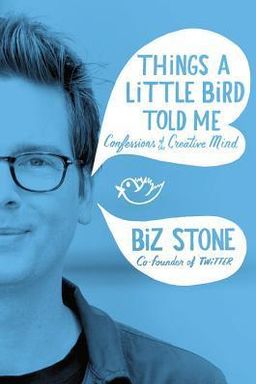
Things a Little Bird Told Me cover

Things a Little Bird Told Me

by Biz Stone

In ''Things a Little Bird Told Me,'' Twitter co-founder Biz Stone shares his entrepreneurial journey and the creative insights that led to Twitter''s success. This book encourages audacious self-belief, innovation through limitations, and learning from failures to thrive in the digital age.

The Triumph of Humanity through Creativity and Connection

How can you turn imagination, empathy, and risk into real-world impact? In Things a Little Bird Told Me, Biz Stone—cofounder of Twitter—argues that success isn't about intellect, luck, or money, but about believing in possibility, embracing vulnerability, and reimagining how creativity and compassion drive innovation. The book is both a memoir and a manifesto: Stone recounts his unlikely journey from a basement in Massachusetts to shaping global communication, while revealing lessons about entrepreneurship, humanity, and purpose in the digital age.

Stone contends that the technologies transforming our world aren't miracles of engineering; they are triumphs of humanity. Every failure, constraint, and absurd detour can spark creativity if you approach it with openness and empathy. His central claim? When you give people possibility, they will do great things—and when business serves humanity, it becomes a force for good. Twitter wasn’t designed to topple governments or save lives, yet it became a tool for revolution and connection. That’s the heart of Stone’s philosophy: humanity is inherently cooperative and good, and technology should amplify those traits, not exploit them.

From Basement to Global Influence

Stone begins with his humble roots in Wellesley, Massachusetts, where poverty and curiosity shaped his scrappy determination. His boyhood inventions—like homemade contraptions built from spare telephone parts—reflect his belief that opportunity is manufactured, not given. This mindset led him to found a lacrosse team when none existed and later quit college to pursue design, launching him into publishing and, eventually, the web. (Comparable to Phil Knight’s “just start” ethos in Shoe Dog, Stone’s story is about acting on possibility even when you have nothing.)

At Little, Brown, he learned the power of creative constraint: limited colors, bad art, tight deadlines—these limits didn’t stifle him, they liberated him. That idea became one of his lifelong mottos: Constraint inspires creativity. It later defined Twitter itself: 140 characters forced clarity, humor, and poetry in human expression.

The Power of Risk and Emotional Investment

Stone’s journey through startups like Xanga, Blogger, and Odeo underscores the value of risk. Leaving Google before it went public was bold; starting Odeo only to abandon it when he realized he wasn’t passionate about podcasting was courageous. His revelation was simple yet profound: You can’t succeed in what you don’t love. Emotional investment fuels perseverance, not profit.

When Apple crushed Odeo’s market, Stone and his partners—Evan Williams and Jack Dorsey—decided to start fresh. During a two-week “hackathon,” they built a simple status-sharing app. That prototype became Twitter. Out of failure emerged inspiration, born from passion and collaboration. As Stone notes, “Success isn’t guaranteed, but failure is certain if you aren’t emotionally invested.”

Creativity, Humanity, and Business as Moral Acts

Stone pushes against Silicon Valley’s myth of lone-genius heroes. He champions humility, empathy, and teamwork. His six core assumptions—like “We will win if we do the right thing for our users” and “We can build a business, change the world, and have fun”—form a manifesto for conscious capitalism. Business, he argues, should measure success by impact, joy, and sustainability, not profit alone. Twitter’s decision to eliminate bottled water, launch charity campaigns, and support causes like (RED) and Charity: Water embodies his belief that company culture can be an engine for change.

He redefines capitalism as “profitable altruism”—where helping others and building meaningful work coexist. His mantra: “Value before profit.” (This echoes Adam Grant’s concept of ‘giver cultures’ in Give and Take.)

The Larger Message: Global Empathy and Connection

Ultimately, Stone looks beyond business toward humanity’s next evolutionary leap: our ability to empathize through technology. From earthquake Tweets to the Arab Spring, Twitter revealed how a connected world could act as one. That insight inspired his next venture, Jelly—a platform for people helping people through questions and answers. He envisions a future where connection fosters empathy and where we act as a collective superorganism, like a flock of birds moving as one or a nerve net of jellyfish sharing intelligence.

Stone’s Core Belief

“People are fundamentally good. If you give them the right tools, they’ll use them for the right thing.”

Stone’s story reminds you to choose purpose over comfort, empathy over ego, and imagination over fear. His message isn’t only for tech entrepreneurs—it’s for anyone looking to live creatively and contribute meaningfully. The triumph of humanity isn’t measured in wealth or fame but in our willingness to care, to create, and to connect.


Manufacturing Opportunity

Biz Stone insists that opportunity rarely arrives—it's built. As a poor kid in Wellesley, he witnessed his mother’s struggle and decided to control his destiny. When he couldn’t make a sports team, he built one. When college restricted his creativity, he dropped out to work directly under an art director. His life became a masterclass in manufacturing luck—a concept echoing Richard Wiseman’s work on how ‘lucky people’ create more chances for success through openness and action.

Creating Your Own Conditions

At Little, Brown, Stone didn’t wait for permission to design. He snuck into the art department, designed a book jacket, and got hired. The cover wasn’t even spectacular, but his initiative was. From then on, he saw that conditions for success could be invented by bold action rather than inherited privilege. He calls this principle manufactured opportunity: you make the set of circumstances that make achievement possible. It’s the entrepreneurial DNA of proactive creativity.

Belief Before Proof

Stone’s creation of his alter ego, “Biz Stone, Genius,” when unemployed and buried in debt, was more than a joke—it was a vision exercise. By blogging as his confident future self, he summoned real opportunities, including a job at Google. This mirrors visualization techniques endorsed by performance psychologists and creative leaders like Shonda Rhimes: acting as if success is inevitable primes your brain to pursue it. Stone’s audacious self-marketing turned imagination into reality.

Embrace Improvisation

Stone suggests that improvisation is essential to creation—whether making art or business decisions. His path from designing book jackets to joining Blogger was a testament to “Just Start.” The lesson for you: define your vision loosely enough to allow surprises. As he writes, “Real opportunities aren’t listed on job boards. They arise when you invent your dream.” True progress often starts with rebellion against what’s expected of you.

Action Insight

If you’re waiting for the stars to align, stop. Build your own constellation.

Stone’s “manufacture first, believe later” principle is a blueprint for self-starters: don’t chase certainty, chase momentum. Every risk, whether designing an unsolicited book cover or applying to Google without credentials, was an act of future faith. In Stone’s world, confidence precedes results—and invention precedes opportunity.


Constraint Fuels Creativity

Stone’s most famous lesson, “Constraint inspires creativity,” stems from both art and technology. Whether limited colors for a book cover or Twitter’s 140-character rule, boundaries spark invention. Minimalism forces focus. (This idea parallels the design philosophy of John Maeda’s The Laws of Simplicity.) Constraints don’t restrict expression; they refine it.

When Less Becomes More

As a designer at Little, Brown, Stone learned that fewer resources meant greater creative freedom. Told to use bad art or two colors, he crafted striking designs by zooming in, exaggerating flaws, or finding beauty in limitation. Years later, this same mindset led him to embrace Twitter’s character cap. Instead of seeing a limit, he saw poetry in brevity—the “twoosh” of perfectly hitting 140 characters became a badge of honor for users worldwide.

Simple Systems, Deep Impact

Stone applies the constraint principle to life and business. He recounts Hermann Hauser’s invention of ARM chips with “no money, no time, and no resources.” Those limitations yielded a lightweight technology that revolutionized mobile computing. Similarly, Twitter’s simplicity allowed global access across devices—a design born not of excess but necessity. Limitations can reduce noise and inspire clarity of purpose.

Practical Minimalism

Beyond business, constraint is the art of editing your life. Stone urges readers to apply this ethic to possessions, habits, and decisions: fewer distractions equal more creativity. “Give away your Xbox,” he says, “and gain back all the hours it used to suck from your life.” Scarcity can be a creative state of mind that fosters innovation and presence.

Creative Takeaway

If you can’t do everything, do the essential thing. Constraint isn’t suppression—it’s focus.

Constraints made Twitter iconic, and they can make your work or life sharper too. Creativity rarely blooms in limitless space—it thrives within boundaries that challenge imagination. As Stone says, “Blank spaces are hard to fill, but a small prompt can send us in fantastic new directions.”


Emotional Investment and Passion

Stone’s career crystallizes one core truth: passion is non-negotiable. He learned firsthand at Odeo that talent and money can’t compensate for indifference. Creating a company around podcasting sounded smart—but since he and Evan Williams didn’t love podcasts, the project was doomed. The antidote was emotional engagement—the kind of joy that kept him obsessing about Twitter’s potential even when others mocked it as “Seinfeld for the internet.”

Feeling Is Working

In Stone’s worldview, work you love becomes play. He describes ripping up carpet during a heatwave only to laugh out loud when Evan tweeted “Sipping pinot noir after a massage.” That moment of delight proved Twitter’s emotional resonance. It wasn’t just a product—it made him feel joy. That was the metric he’d chase forever.

Rejecting False Success

Stone challenges the conventional pursuit of titles and salaries, invoking examples like Demetri Martin—who abandoned law to become a comedian. External rewards fade; real meaning comes from creative engagement. He likens misguided career paths to GPS routes set by someone else: “Who put ‘law degree’ in my phone?” True direction, he says, requires zooming out and checking where you really want to go.

Back Into Passion

Stone advises “backing into” life purpose: imagine what surrounding people, work rhythm, and energy you crave, and reverse-engineer your career from that image. This practical visualization technique helps you navigate toward emotionally rich work. Essentially, excitement is the best compass.

Core Principle

“If you don’t love what you’re building, even doing everything else right won’t save you.”

Like in Cal Newport’s So Good They Can’t Ignore You, Stone treats passion not as luxury but as necessity. Emotional engagement fuels creative endurance—without it, even genius ideas collapse. We follow through only on the things that make us feel alive.


The Art of Win-Win Thinking

Stone’s ethics extend to how we deal—whether in business partnerships or relationships. “The only deal worth doing is a win-win deal,” he writes. Exploiting others may yield short-term gains, but it erodes trust and longevity. Deals are like relationships: imbalance causes implosion. (This idea parallels Stephen Covey’s emphasis on mutual benefit in The 7 Habits of Highly Effective People.)

Balance Creates Strength

Stone likens unfair deals to scuba diving—unequal pressure inside and outside leads to disaster. Symmetry sustains partnerships. His story about advising Twitter’s CEO, Dick Costolo, after accidentally poaching talent captures this perfectly: “If you have a list of people you don’t want to lose, don’t wait until they quit to value them.” Relationships thrive on proactive care, not damage control.

Reputation Is Currency

Win-win isn’t just moral—it’s practical. Stone recounts colleagues returning favors years later because of his fairness. Integrity compounds into opportunity. When Twitter’s former mobile head got a message from a UK carrier saying, “I don’t know what Jelly is, but if you want it pre-installed, call me,” it wasn’t product—it was reputation at work.

Sustainable Success

Win-win thinking transcends deals into culture. Doing right by people transforms your network into a renewable resource of goodwill. As Stone puts it, “Deals are like marriages; if they’re lopsided, they won’t last.” The takeaway: mutual benefit isn’t idealism—it’s infrastructure.

Ethical Reminder

If you wouldn’t want to be on the other side of the deal, don’t make it.

In a world obsessed with competition, Stone reframes success as collaboration. Profit from people’s trust, not their weakness. That’s how you build companies—and relationships—that last beyond the contract.


Failure as a Path to Growth

Stone’s most liberating idea may be his embrace of failure. “In order to succeed spectacularly, you must be ready to fail spectacularly.” This lesson appears everywhere—from botched sports lessons to collapsing servers. Failure, he argues, is not an obstacle; it’s an ingredient of achievement. Each crash made Twitter stronger.

Save Nothing for the Return Trip

He uses the film Gattaca as metaphor: in a sea race, Vincent wins because he saves nothing for the swim back. Similarly, entrepreneurs must risk comfort for greatness. Stone’s own leap from Google illustrates that truth—he traded security for uncertainty, and it birthed Twitter. Courage is the cost of innovation.

Failing Forward

From the “Fail Whale” era to broken platforms, Twitter’s openness about mistakes cultivated user goodwill. Vulnerability built trust. Stone often personally replied to angry emails with empathy—transforming critics into fans. His philosophy: honesty humanizes companies. “Failure shared with users,” he says, “shows ultimate confidence.”

The Effortless Leap

His gymnastics teacher once told him, “Fall past the control point.” When fear grips us, effort multiplies. Releasing control, paradoxically, makes movement natural. The same applies to creative risk: let go, and invention happens. The secret to the back handspring—and to startups—is willingness to fall.

Failure Mantra

“Fall past the point of recovery; then you fly.”

Stone redefines failure as evidence of experimentation. Each mistake reveals what doesn’t work and earns empathy from those watching. As Brené Brown might agree in Daring Greatly, vulnerability is not weakness—it’s a creative advantage.


Empathy as Innovation

Stone sees empathy not as emotion but as strategy. It’s the ultimate technology. His wife, Livia, a wildlife rescuer, embodies this ethic; watching her save animals taught him that caring can be creative. He applied it to Twitter’s design, communication, and culture. When users complained, he listened—and his replies converted frustration into faith. “The loudest complainers were our biggest fans,” he discovered.

Empathy at Scale

Twitter’s global phenomena—earthquake warnings, Egypt protests, and humanitarian campaigns—proved empathy meets efficiency. Technology can be “the connective tissue of humanity.” Each 140-character message became a micro-act of connection. Empathy turned Twitter from novelty into necessity.

Compound Altruism

Stone defines “the compound interest of altruism” through DonorsChoose.org and Stephen Colbert’s $25 gift card. The ripple effect was massive: one small donation triggered hundreds more, each expanding empathy’s reach. Giving doesn’t subtract—it multiplies. “Start small,” Stone says. “Your kindness compounds over time.” This mirrors the ripple theory of kindness from Adam Grant and Simon Sinek’s advocacy for service-based leadership.

The True Promise

In his later company Jelly, Stone pursued empathy as innovation itself—a Q&A app leveraging global networks so people could help one another. “Wouldn’t it be great,” he asks, “if everyone were always able to hold in their minds the notion that there are people who need help—and others ready to offer it?” That’s social technology’s moral frontier.

Moral of Connection

Empathy isn’t soft skill—it’s the world’s next operating system.

Stone’s vision turns compassion into capability. In connected societies, empathy becomes efficiency. His ultimate ideal—global empathy as humanity’s triumph—shows how imagination and care may drive our collective future far beyond commerce or code.

Dig Deeper

Get personalized prompts to apply these lessons to your life and deepen your understanding.

Go Deeper

Get the Full Experience

Download Insight Books for AI-powered reflections, quizzes, and more.