
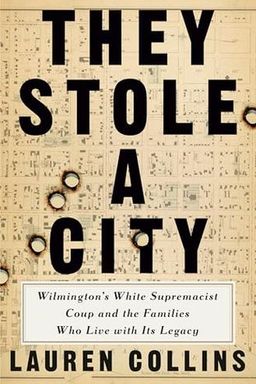
They Stole A City cover

They Stole A City

by Lauren Collins

A staff writer at The New Yorker depicts the 1898 massacre and coup in Wilmington, N.C., and its impact on four families.

When the past hunts the mother

What happens when the life you’re building—your home, your friendships, your child—collides head‑on with a past you’ve buried so deeply you can barely remember it? In The Night They Stole My Baby, Darren O’Sullivan argues that the fiercest force we possess is the kind of love that refuses to be erased by trauma. He contends that memory—especially memory forged in abuse—can both imprison and save you, and that reclaiming the truth about your past may be the only way to bring your child safely home.

You follow Emily Claywater, eight and a half months pregnant, as she’s attacked near her London home, knocked unconscious, and injected with insulin. She wakes from a coma to discover her daughter has been delivered by emergency C‑section—and is gone. Her ex, Lucas Nowak, is missing with the baby. A nationwide hunt ignites: detectives, journalists, and a grassroots campaign (#FindFreya) mobilize. But the case won’t yield to the obvious. The more Emily reaches out, the more the story reaches back—into a childhood in the Scottish wildlands, a brick shed, a dead sister named Freya, and a mother whose love curdled into something monstrous.

What this story really explores

Beneath the breathless, high‑stakes plot, O’Sullivan maps a far more intimate topography: how shame rewrites memory; how abusers gaslight survivors into carrying blame they don’t own; and how the longing to be a different kind of mother can become a lifeline. You see Emily’s inner court of appeals at work—her dead sister’s accusatory apparition, her fixation on the knife she once held, the scar on her thigh—each artifact insisting on a story where Emily is the killer. O’Sullivan’s bold claim is that healing hinges on wresting back authorship of your own past, even while you battle in the present to save your child.

How the book is built—and why that matters

The novel alternates between “Then” (a stark, wintry Dumfries childhood) and “Now” (a sweltering London summer of media storms, police briefings, and public pleas). This dual‑track creates a pressure cooker: as public panic escalates, Emily’s private reckoning sharpens. The “Then” chapters aren’t flashbacks for mood; they are keys. Every shed door, every bite of stolen chocolate, every night her mother locks her outside in the cold moves the modern plot forward. By the time we arrive at the final chase—back in those same wildlands—you don’t just know where the villain is hiding; you understand why she chose that ground, and why Emily must go there too.

The emotional argument

For you as a reader—and as a person who loves someone—O’Sullivan is putting a counterweight in your hands: Yes, trauma distorts, but the body remembers truth with startling clarity. Emily’s body keeps score (the scar at her thigh, the ache of the old staircase, the C‑section wound torn open in the final run); and it also points home (the way she instinctively shields her newborn from rain under a tree as she once shielded her sister from noise and cold). That embodied knowing becomes her compass. As in Paula Hawkins’s The Girl on the Train, unreliable memory is the hook; here, the deeper game is reliability reclaimed—not as perfect recall but as moral centre.

What you’ll learn in this summary

You’ll see how the two timelines lock together like cogs, how misleading certainty (“those closest are always involved”) both helps and harms a desperate mother, and how love re‑wires inherited cycles of violence. We’ll unpack: the story engine that keeps tension high; the psychology of gaslighting and self‑blame; the portrayal of motherhood as identity, instinct, and power; the role of friends, media, and messy human motives; and the ethics of hope when hope can be cruel, as Emily often says. Finally, we’ll walk the wildlands with her—literally—and watch how she uses recovered truth to dismantle an abuser, rescue her child, and choose a future that doesn’t deny the past but is no longer ruled by it.

Core claim

“Survival isn’t forgetting. It’s remembering accurately enough to love differently.” O’Sullivan’s thriller is propulsive, but its centre is contemplative: it invites you to re‑see your own hard stories and recognise how fiercely you’d fight to keep what love gave you.

If you’ve ever feared the past would catch up with you—or if you’ve ever wondered how you would hold on to yourself in the worst week of your life—this story gives you both a map and a mirror. It’s a chase novel, yes; but it’s also a manual for refusing inherited scripts, choosing a truer story, and doing the most ordinary, extraordinary thing a parent can do: pick up the child and keep going.


How the timelines lock tight

O’Sullivan structures the novel on two rails that speed toward the same junction: the present-day abduction and the childhood that made it possible. You don’t just toggle between “Now” and “Then”—you feel them tightening around each other until the past dictates where the present must end: the Dumfries wildlands, the brick shed, the tree whose roots once sheltered a shivering child and will soon shield a newborn. This isn’t a stylistic flourish. It’s the plot’s engine.

Then: Surviving the wildlands

In the “Then,” Emily Jones (her original surname) is eleven, living with her mother Carol and six‑year‑old sister Freya at the ragged edge of the Scottish wildlands. Hunger is a daily storyline. Carol drinks and morphs—Sad Mother, Fun Mother, Monster Mother—locking the girls in a shed for hours in freezing weather as punishment. Emily’s love becomes duty: she steals food so Freya can eat, drags her from the shed in secret, learns to stay invisible. One night, when Freya hides near Monster Mother’s bed, Emily cuts her foot on glass and quietly bleeds; another, she shoves a knife into her pocket “just in case.”

The pivotal “Then” sequence lands like a time bomb. Freya falls ill—feverish, shivering, her wound likely infected. Emily plans to run away with her to London. But when she returns to the room, Freya is already dead. Carol howls, “What did you do?” That refrain fuses with Emily’s guilt: she wished for the old life back; she held the knife; she must be the killer. Emily flees into the wildlands, buries herself in a ditch near “their tree,” and is found hypothermic by police on Christmas Day. Carol is charged and later sectioned in psych hospitals. Emily moves south to grandparents, changes her name to Claywater, and grows up with a secret she thinks is murder. (Compare the past/present tension to Gillian Flynn’s Sharp Objects, where returning to a hometown crime scene untangles personal history.)

Now: The baby is gone

Fast‑forward sixteen years. The book opens with Emily, heavily pregnant in London, joking with her best friend Michelle about a baby shower. Walking home, she’s ambushed: a white flash, her face slamming tarmac, a sharp pinch. She wakes from a ten‑day coma to a fresh C‑section scar and empty arms. Her ex, Lucas Nowak—the baby’s father—had taken custody while she was unconscious. Now he, and baby Freya, have vanished. Detective Steve Myers (steady, empathetic) thinks it’s a parental snatch. ANPR cameras catch Lucas’s car heading north up the A19. Port alerts go out. Media swarm. Michelle builds a war-room in Emily’s kitchen (#FindFreya) and recruits neighbours to plaster socials. The story becomes national news.

Clues spool out methodically, each with a hook to “Then.” Lucas leaves Emily a brooch of an angel with a sword—the crest of Dumfries, Emily’s buried birthplace. He’s type‑1 diabetic; Emily was injected with insulin. His car is traced to near Middlesbrough. A farmhouse raid yields a baby bib crusted with milk—but no child. Emily, aching for anything of her daughter, pockets the bib. Then a body: Lucas, in a garage, a hose feeding exhaust into his car. Suicide? No. A fresh insulin injection suggests murder staged as self‑harm, echoing exactly how Emily was attacked.

The hinge: return to origin

The dual timelines meet when a news clip from Dumfries flashes a familiar arm—scarred by a knife Emily once wielded. Carol is alive. Her motive clicks into place: “You took my Freya, I’ll take yours.” Emily shucks the press, the police, and even her friends’ offers to help, and drives north. It’s not bravado; it’s the geometry of trauma. The only way to end this is where it began. She squeezes through the back door of the derelict house; the baby monitor crackles. Her daughter is upstairs. A fight with Carol detonates on the landing. With her stitches tearing, Emily scoops the baby, barricades the door, then flees into the rain-soaked wildlands—back to the same tree, the same ditch—where she nurses her newborn for the first time and waits for darkness to move.

Why the structure matters

By making place the story’s memory, O’Sullivan ensures the climax can’t happen anywhere else. The past isn’t backstory; it’s trajectory.

When you read thrillers that juggle two eras, you often feel the author toggling. Here, you feel inevitability. Each “Then” chapter hands a coded message to the “Now,” until the mother with the knife and the mother with the baby are revealed to be the same person—and not, crucially, in the way Emily feared.


Unreliable memory, reliable love

If you’ve carried blame you can’t quite source, Emily’s arc will feel uncomfortably precise. She is, for half the book, convinced she killed her sister. The blade, the wish, the body—memory stitches these into a damning tapestry. O’Sullivan shows you how shame works: it edits, it overlays, it invents motives retroactively. And because an abuser’s voice is so often the first narrator we hear, it becomes authoritative. Carol’s question (“What did you do?”) becomes Emily’s litany (“I killed her”).

How gaslighting hardens into identity

Carol doesn’t simply punish; she scripts. She calls Emily her jailer, then her saviour, then her curse. She alternates neglect (no food, no heat) with love-bombs (a remembered sledge ride), which teaches Emily to doubt her own read of reality. In that climate, it’s easy for a child to “confess” to crimes she didn’t commit—first to survive, later because it’s who she believes she is. (This dynamic echoes Emma Cline’s The Girls and Tana French’s The Likeness, where belonging and suggestion warp perception.)

In the present, this warped identity keeps Emily quiet. She hides her past from Lucas, from her best friends (Michelle, Jack, Adam), and even from herself—stashing the old knife and a child’s cardigan in a box at the back of a wardrobe. When pressed by Detective Myers, she offers the smallest true thing (name, place) but withholds the central self‑accusation. Better to be a victim of Lucas than risk being known as a child who once lifted a knife over her sleeping sister.

Re-seeing the hardest scene

Memory doesn’t simply “come back.” It’s rebuilt—sometimes painfully, sometimes with relief—when you can finally stand in the place it happened and survive the retelling. The novel’s tremendous pivot is Emily’s return to the shed and the bed. In those exact rooms, her mind reruns the night and makes a new cut of the film: she raised the knife—and put it down. She planned to run. Freya had already died (almost certainly of sepsis from an untreated wound). What she remembers next is crucial: Carol’s accusation, then a lifetime of self-sentencing. The past is revised not by facts alone but by re‑inhabiting the body’s felt truth.

The counterweight: a love that doesn’t lie

Against unreliable memory, O’Sullivan places reliable love. It looks like reflex—Emily stepping between Monster Mother and Freya; adult Emily scooping her baby while her own stitches rip; nursing under a tree in the rain; turning herself into a shield as kicks land. Even Emily’s spectral visions of little Freya function as a kind of moral metronome. The “ghost” stops haunting when Emily’s memory aligns with her actions. When she holds the newborn and whispers “Mummy’s here,” the apparition smiles and disappears.

Key insight

Your harshest story about yourself often isn’t yours. It was given to you by someone who needed it to be true. Reclaiming the story doesn’t excuse the past; it frees your future.

Read alongside thrillers that weaponize the unreliable narrator, this book gives you something rarer: an unreliable self‑story corrected by love in action. You can’t “think” your way out of shame’s maze; you act your way out, and the new story forms around the truth your body insists upon: you protected the child. You didn’t fail. You can try again—now as a mother.


Motherhood: instinct, identity, power

Motherhood in this book isn’t a Hallmark card; it’s kinetic. It breaks doors, builds war rooms, runs red lights, and sits for hours in a ditch to keep a newborn dry. O’Sullivan frames three distinct mothering models: Carol’s curdled love (possessive, punitive); Emily’s emergent love (protective, redemptive); and Michelle’s yearning love (childless but catalytic). Watching Emily move from fear (“Will I be like my mother?”) to embodiment (“Mummy’s here”) is the novel’s deepest pleasure—and its thesis about where power lives.

Carol: possession mistaken for love

Carol’s motherhood is a set of roles: Sad, Fun, Monster. The core is possession—“my Freya”—not care. She locks children in a shed “to make them think,” then forgets they’re there. In the present, she lures Lucas north under the pretense of reconciliation, murders him with insulin (the same method used on Emily), and seizes the baby. Even then, standing in the ruined house, she tells Emily she might keep the child as a do‑over, as if a living person were an apology made flesh. Abuse reframed as mothering is chilling—and strikingly rendered. (For a nonfiction parallel, see Stephanie Land’s Maid on how instability masks itself as love.)

Emily: fear yielding to instinct

At first, Emily wants a blueprint. She worries she’ll fail like Carol. She tries to outsource hope to police procedure, to the court of public sympathy, even to Michelle’s social media campaign. But the moment Freya cries upstairs in Dumfries, the blueprint burns. She doesn’t debate morality or legality; she moves. She barricades, lifts, runs, feeds, hides, soothes. The book insists that mothering is not merely a role you step into but an identity you uncover—often by acting before you can explain.

That tree‑side nursing scene is the novel’s heart. In the exact landscape of childhood terror, Emily discovers a new animal knowledge. Milk lets down; the newborn latches; the rain keeps coming; the mother learns she can shelter and sustain a life in a place built for ending them. There’s theology in it, even if the book stays secular: a reversal of curses on the original ground.

Michelle: love as practical solidarity

Michelle can’t conceive. Her longing is an ache under many of her scenes. When suspicion falls on “those closest” and Emily discovers Michelle had been sleeping with Lucas, you brace for betrayal. O’Sullivan tilts you there on purpose. But Michelle’s arc is about friendship as a kind of mothering: she builds the ops centre, gets herself arrested tailing police cars, shoulders Emily’s anger, and ends as the first person to place the newborn back on Emily’s chest in the hospital. Desire thwarted doesn’t sour into envy here; it matures into service.

What the book asks you

Who taught you what mothering looks like? Which parts of that script are inheritance—and which are yours to rewrite by how you show up today?

In conversations about parenthood, we often over-index on intention and underplay instinct. This story rebalances that scale. You become the kind of parent you are by what you do at the door, on the stairs, in the rain. It’s not that intention is irrelevant; it’s that action makes identity—especially when the past whispers you can’t.


Trust, friends, and red herrings

When your child is missing, “trust your gut” is terrible advice; your gut is mostly adrenaline. O’Sullivan throws Emily into that bind and lets you watch her flail, learn, and recalibrate. The novel’s middle third is a study in relational epistemology: How do you know whom to trust when your fear paints targets on everyone you love?

The maxim that misleads—and helps

A whiteboard in Emily’s conservatory reads: “IN MOST CASES OF A CHILD GOING MISSING, THOSE INVOLVED ARE THOSE CLOSEST.” It’s true—statistically useful, operationally necessary. But in real time, it’s corrosive. It prods Emily to cross off her friends’ names in her head, then write them back again, then cross them off twice. She accuses Michelle; she runs after a stranger she thinks is Lucas; she throws a glass at the vision of her dead sister. Yet some version of the maxim also powers progress: it sends police to Lucas’s old circle in Middlesbrough; it primes Emily to notice when Detective Myers keeps asking about Michelle’s whereabouts; it makes the farmhouse raid plausible.

The affair that reframes but doesn’t define

The twist lands exactly where you expect it and still hits: Emily finds archived messages on Michelle’s phone—she’d been sleeping with Lucas, before and after he and Emily split. It’s a gut‑punch because Michelle has been the most vocal, visible ally. But O’Sullivan refuses the cheap turn. Michelle’s infidelity is a grievous personal wound, not a plot to steal the baby. The discovery forces Emily to recalibrate trust, not abandon it. In the end, it’s Michelle who stands beside her hospital bed, who brings Freya to Emily’s chest, who absorbs the apology without self‑pity.

Crowdsourced hope and media glare

The book deftly skewers the performative chaos of modern missing-child cases. Hashtags (#FindFreya). Volunteers with whiteboards and maps. A BBC journalist on the doorstep. A rider on a motorcycle filming Emily through her car window. All of it may help—and harm. Publicity gets eyes on the road to Stokesley; it also turns Emily’s childhood trauma into tabloids (“MOTHER OF MISSING CHILD’S TRAGIC PAST”). Emily learns to use the frenzy without handing herself to it. (Think Celeste Ng’s Little Fires Everywhere in its take on suburban mobs, or the docuseries The Disappearance of Madeleine McCann for the media echo chamber.)

Detective Myers as a ballast

Trust isn’t binary in thrillers; it’s earned. Myers models that. He doesn’t leap to saint or suspect. He’s both: a cop who sets port alerts and an exhausted dad of a seven‑year‑old named Molly. When he asks Emily hard questions about her past, he tempers them with, “Do you want the truth?” He misfires (he leaves with nothing at Stokesley) and calibrates (he later spots the insulin pattern). He is the only official who treats Emily’s history as context, not character indictment. His steadying presence lets the book keep faith with procedural readers while staying loyal to Emily’s interiority.

Takeaway for your life

When fear is loud, widen your circle slowly, not cynically. Let facts prune suspicion. Keep one ally who can ask you better questions than the ones panic offers.

The red herrings here aren’t cheap tricks; they’re moral tests. They ask whether you’ll cling to a maxim when it cuts your friends, or whether you’ll do the harder thing: hold the pain of betrayal and still see the good someone is doing for you right now.


Breaking violent inheritance

Family violence is often an economy: pain in, pain out, passed along like currency. The Night They Stole My Baby stares that economy down and refuses its math. Emily’s decisive act isn’t the final stab that drops Carol in the wildlands; it’s everything she does not do that her mother did—what she refuses to pass on.

What cycles look like up close

You see three generations in rough relief. Carol likely suffered, then curated chaos (booze, men called “uncles,” punishment as pedagogy). Emily grew inside that weather, learned invisibility, flirted with becoming the monster (“One sharp moment, and everyone would win”)—and then didn’t. The distinction matters. Plenty of thrillers make breaking the cycle a line; this one makes it a scene: a child holds a knife over her feverish sister and puts it down. Years later, the woman with a newborn faces the same antagonist and chooses defense, flight, and care. Violence still happens—Carol dies from a defensive knife wound—but the motive is pure: not revenge, not repetition, but removal of an immediate threat.

The ethics of force

O’Sullivan refuses moral squeamishness. Self‑defense isn’t bloodless. Emily slams Carol’s head into a doorframe; she stamps on a broken hand; she drives a blade into a thigh. Each act is anchored: baby in arm, attacker advancing, no exit. The book’s moral imagination is muscular and clear-eyed. It honors pacifists while admitting that sometimes the ethical move is to neutralize the danger. (If you’ve read Kristin Hannah’s The Nightingale or watched Big Little Lies, you’ll recognize this refusal to shame the survivor for force used in extremis.)

Choosing a different inheritance

The hospital epilogue is more than a coda; it’s an answer. Emily has lost her uterus (an emergency hysterectomy after her C‑section scar tore apart). The line of biological inheritance ends with this birth—yet the line of care begins anew. She cradles Freya; Michelle stands at her shoulder; Detective Myers names what happened: “What you did, it was self‑defense.” When the “ghost” of little Freya appears and then smiles away, you understand: the past is no longer owed violence to keep it quiet. It’s been told the truth and released.

Practical reflection

List one harmful reflex you inherited from your family. Name one concrete way you will interrupt it the next time stress spikes. Cycles break at points of repetition resisted.

In a genre that often glamorizes vengeance, this novel stakes out a wiser space: survival as creative non‑repetition. Emily is not “better than” Carol; she is different in the moments that count, and that difference saves a life.


Policing, media, and modern search

The book is intensely intimate, yet it never loses sight of the wider “machine” that spins up when a child disappears. You see how twenty‑first‑century policing, social media, and journalism collide—sometimes collaborating, sometimes cannibalizing one another—and how a parent might use all three without being used up by them.

The procedural spine

Detective Steve Myers keeps the case coherent. He triggers ANPR sweeps on Lucas’s car, notifies ports (Newcastle), liaises with Middlesbrough officers, and reads a staged suicide as homicide when he notices the insulin injection. He’s not omniscient—he misses the farmhouse window, and he doesn’t grasp Carol’s presence until late—but his steady, dad‑next‑door presence grounds you in how cases like this move. He also models trauma‑informed interviewing: he reveals Emily’s mother’s psychiatric history without weaponizing it and asks consent to talk when he could compel.

Citizen power—and peril

Michelle is a one‑woman logistics hub: a whiteboard forest in the conservatory; maps with string; volunteers running Facebook, Instagram, TikTok handles; the hashtag #FindFreya that pushes the BBC to Emily’s doorstep. This democratizes search—and spreads error. A bystander’s offhand report morphs into “freight company ties” and a false ferry panic. A helpful neighbor becomes paparazzi. Emily begins to learn the paradox of public help: widen the net, and you catch both fish and boots. (True‑crime fans will hear echoes of crowdsourced sleuthing in cases like Gabby Petito’s.)

The press as amplifier and predator

O’Sullivan doesn’t caricature journalists; he calibrates them. The BBC gives Emily a platform; a tabloid drags her childhood (“MOTHER OF MISSING CHILD’S TRAGIC PAST”). A motorcycle cameraman endangers her to get a shot; a print reporter helps her chase a man she thinks is Lucas. Emily learns the game: use the spotlight to keep police pressure on; don’t let it script your story. When she disappears from hospital after the River Skerne misreport (another baby, not hers), the media’s narrative spasm is background noise to her truer task: drive north.

The 999 that still matters

For all the tech and noise, the most old‑school intervention saves them: a landline 999 call from the Dumfries house. Emily collapses after barricading and running; responders triangulate and get there in time for both baby and mother. The lesson isn’t Luddite nostalgia; it’s proportionality. Use every tool—cams, crowds, cops—but remember that a human who answers the phone and a team who knocks a door down are often the hinge between tragedy and rescue.

Applied takeaway

If you’re ever thrust into a crisis: assign roles (one person handles media, one liaises with police, one manages socials), document facts in one place, and refuse to let speculation harden into strategy.

The modern search state is a chorus. This novel teaches you how to keep your own voice audible in the din—and how to retreat from it when the only way to win is to go where the microphones can’t.

Dig Deeper

Get personalized prompts to apply these lessons to your life and deepen your understanding.

Go Deeper

Get the Full Experience

Download Insight Books for AI-powered reflections, quizzes, and more.