
Idea 1
Love’s Codes in a City of Witness
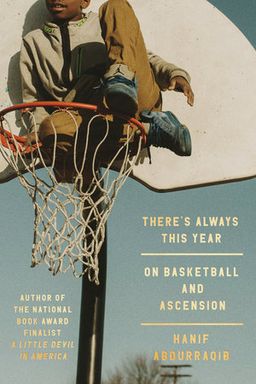
How do you protect love in a world that misreads your joy as threat? In There’s Always This Year, Hanif Abdurraqib argues that Black love and belonging have their own codes—rituals, styles, and small choreographies—that build shelter against misinterpretation and harm. He contends that to see this love accurately, you must learn its grammar in both intimate rooms and loud arenas, where basketball becomes liturgy and public grief becomes a chorus. Across barbershops, city gyms, jail cells, parade routes, and YouTube highlights, the book shows how affection, survival, longing, and spectacle braid into a single urban theology.
Abdurraqib invites you to trace how handshakes, beards, black socks, baggy shorts, and bald heads all say we to each other, even as outsiders insist they say danger. He moves from the Fab Five’s finger-twists and swagger to his father’s mealtime blessing in Arabic, from Scottwood’s cracked rims to Cleveland’s smoke-choked streets where men burned jerseys after The Decision. Every place bears a ritual; every ritual bears a claim on home. The book’s wager is simple: pay attention to the codes, and you’ll finally see how a people insist on life.
From Private Signals to Public Panic
You begin where affection is built in miniature—custom handshakes with your boys, a beard comb tucked in a pocket, a father’s sweat shining like proof of pleasure. These gestures are joyful and defensive. They draw a soft border: those who know are inside, those who don’t can only guess. When the guessing turns into fear—as with the Fab Five’s black socks, shoes, and shaved heads—the same signs of kinship are cast as threat. (Note: This reads like a sociolinguistics lesson—misread the dialect, and you misread the people.)
The Fab Five arrive as a cultural referendum. Their look and talk become an argument about who gets to look good and take up space. Jalen Rose’s studied trash talk is read as arrogance, when it’s also craft and care: he learns opponents’ tells to protect his team. Media panic follows, proving a larger point—Black self-styling meets a surveillance that confuses confidence with menace.
Arenas as Cathedrals, Fans as Choirs
From neighborhood courts, you move into arenas where sport becomes a secular sacrament. “We Are All Witnesses” turns a city into a congregation and LeBron James into the sermon you stand for. Miracle enters the civic record: Game 5 in Detroit (2007), LeBron scoring the Cavs’ final 25; Game 7 in 2016, the chasedown block that freezes time. These spectacles don’t replace prayer; they rhyme with it. Chalk dust ascends like incense; a city rehearses hope in unison.
But witness cuts both ways. The same public that sings your name will beg clumsily when you leave and burn offerings when you don’t return. Abdurraqib listens to “begging songs”—Otis Redding’s hesitant timing, Marvin Gaye’s swelling pleas—and hears Cleveland’s awkward “We Are LeBron” echoing the lover’s last-ditch performance. Sometimes the plea seeks repair; sometimes it seeks ego’s reassurance. (Compare to bell hooks on love’s ethics versus performance.)
Longing, Hustle, and the Politics of Place
Longing animates and distorts. It sends you to an ex’s Instagram at 2 a.m., or to a city you said you’d left, or to the edge of a parade, arm outstretched for a hero’s touch. Abdurraqib treats longing as an engine that turns heartbreak into motion. It powers hustles, too: the close read of someone’s wants, the speed with which you sell comfort—whether at a mall kiosk or in a Nike “Together” ad stitched from black-and-white nostalgia. The national hustle rebrands history as absolution. It can be tender; it can also be a trap.
Fire, Fathers, and Mercy
Where institutions fail, a city speaks in extremes. Fire becomes song and baptism—jerseys in gasoline, car bombs in 1976’s mob wars, vigil flames after police killings (Henry Green, Tamir Rice). Not every blaze is righteous; not every blaze is senseless. The book asks you to understand what scarcity of accountability pushes people to ignite. On smaller scales, mercy carries lives: a storage clerk who looks away, a library chair that holds sleep, a gym shower that returns you to a body you can bear. Prayer returns when the bottom drops out; ritual becomes structure when schedules collapse.
A guiding insistence
“With enough repetition, anything can become a religion”—even the ways a neighborhood teaches you to live on cracked concrete, to build a home from a rim, a scream-buzzer, and a promise to show up tomorrow.
By the end, you leave with a reader’s toolkit: decode affection’s codes; hear the subtext of begging; watch how nostalgia hustles you; and measure a city by its rituals of care. If you can read a handshake, a chalk cloud, a barbershop’s scent trail, or a parade’s roar, you can finally see how love endures in the open and underground—stubborn, athletic, and holy.